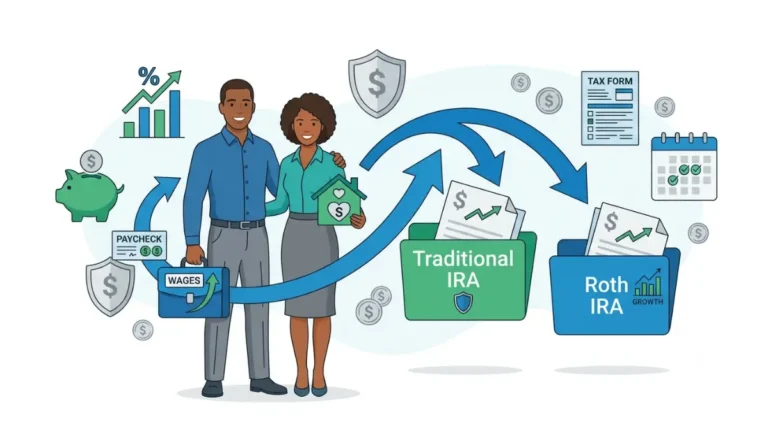
IRA Investments Worth Holding and the Ones That Aren’t
IRA investments don’t start themselves: 28% of 2022 rollovers were still in cash a year later. The money arrived. Nobody placed the trade.
In This Article
Your IRA is a container, not an investment
Your IRA is a container, not an investment. Funding it and choosing what the money buys are two separate acts, and the second is the one people skip.
Where you are now decides where to start:
- Just opened an account, cash sitting there — Sections 2 and 3
- Rolled over a 401(k) and never checked — Section 7
- Wondering whether gold, crypto, or real estate is allowed — Section 2
- Holding funds already, unsure they sit in the right account — Section 5
Why money sits in an IRA doing nothing
Rollover money lands as cash and stays there until you place a trade. Nobody sends a reminder, and the balance looks healthy on screen.
📊 Data Point: 28% of 2022 rollovers into Vanguard IRAs were still held in cash or cash equivalents twelve months later, and 55% of direct contributions were — Source: Vanguard investor-behaviour research, 2024.
What this guide answers
You can contribute $7,500 for 2026, or $8,600 at age 50 or older, under IRS Notice 2025-67. What follows: what the law permits, how to narrow the list, what holdings cost, where each asset belongs, and the errors that survive a good decision. If the account type is unsettled, start with which IRA account fits your income.
ℹ️ Financial Disclaimer: This is educational, not personalized investment, tax, lending, credit, insurance, or debt-relief advice. Consult a fiduciary financial advisor, a CPA or enrolled agent, or a qualified attorney before acting. FinanceAuthorityHub maintains no panel of credentialed financial reviewers.
What an IRA can hold — and the two things it can’t
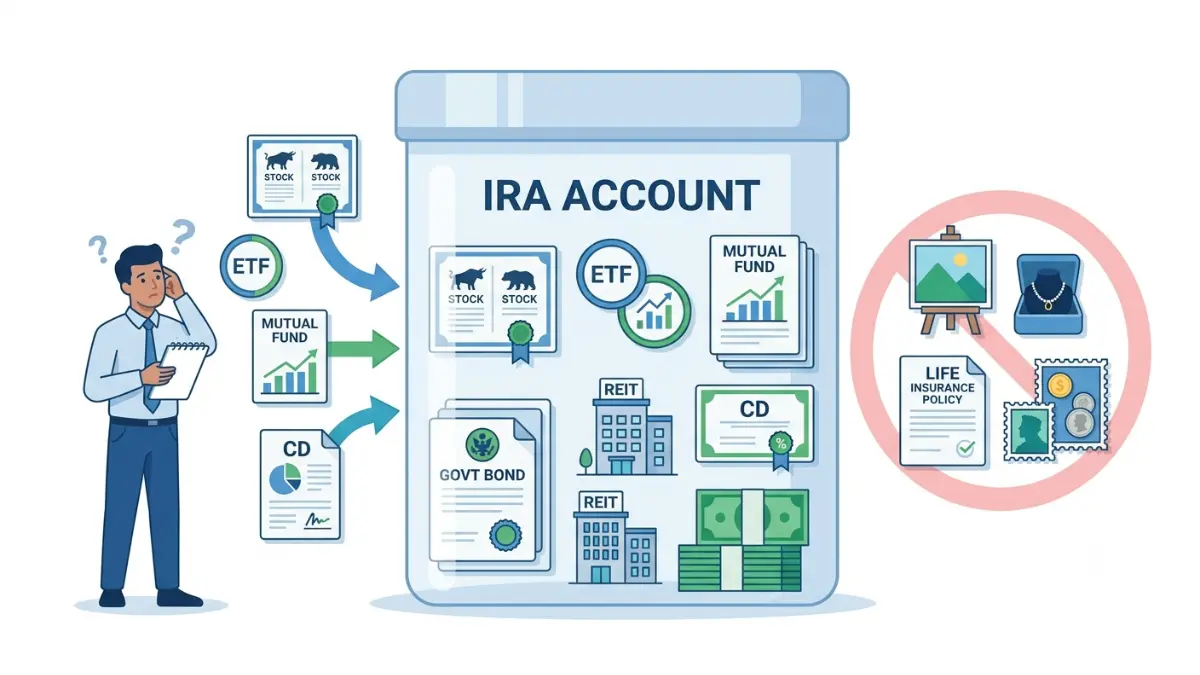
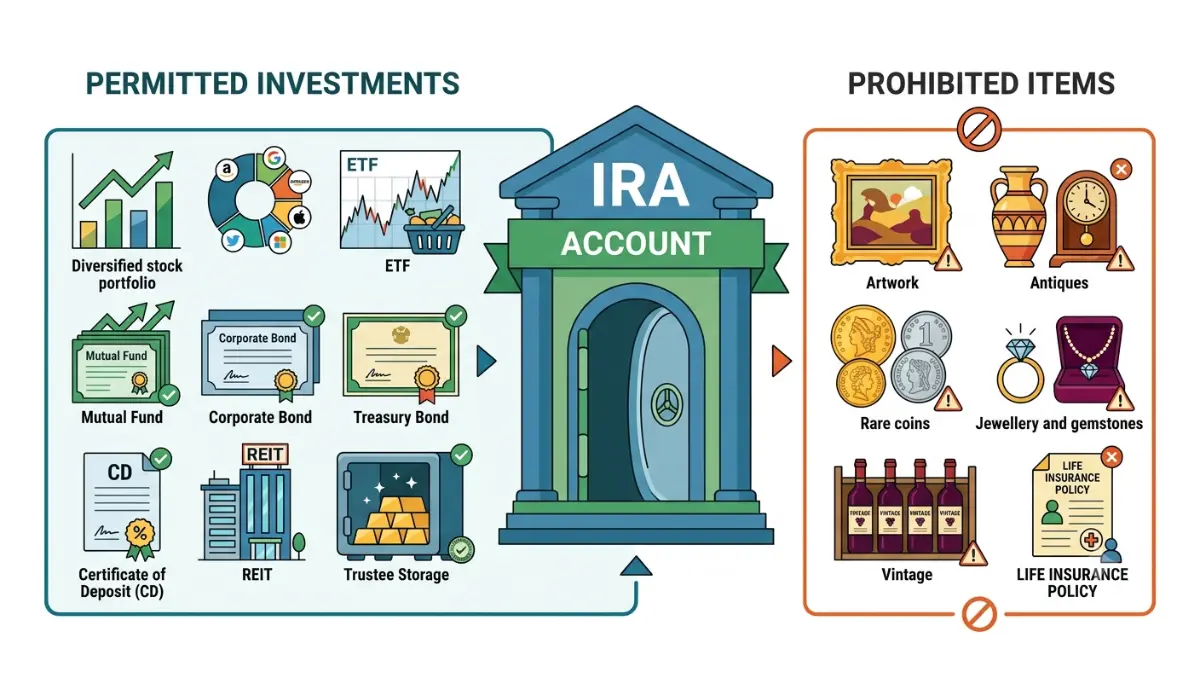
An IRA can hold almost any ordinary investment security. The tax code names only two categories it cannot hold: collectibles and life insurance.
The permitted list most people never use fully
Stocks, bonds, mutual funds, exchange-traded funds, certificates of deposit, and real estate investment trusts all sit comfortably inside an IRA — usually the same menu as a taxable account at the same firm.
Collectibles: barred, with a narrow metals exception
Internal Revenue Code §408(m) bars art, antiques, gems, coins, and alcoholic beverages, per the IRS list of investments a retirement account cannot hold.
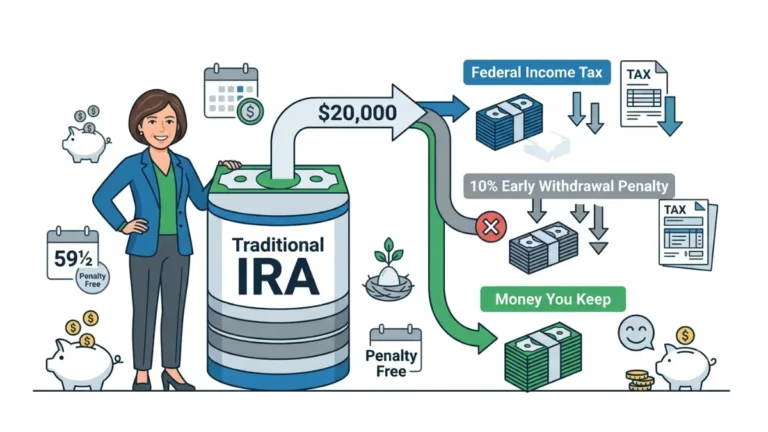
🔍 How It Works: §408(m)(1) treats the purchase as a distribution equal to what the account paid, reported on Form 1099-R and taxed as ordinary income, with the 10% additional tax under §72(t) below age 59½. The account is not disqualified — only the amount spent counts as withdrawn.
§408(m)(3) excepts bullion of specified fineness and certain minted coins, but only where a bank or approved non-bank trustee keeps physical possession. Before going further, read what a gold IRA actually costs.
Life insurance: barred outright
IRC §408(a)(3) bars life insurance contracts. No exception exists.
| Asset | Status | Rule | Key detail |
|---|---|---|---|
| Stocks, bonds, funds, ETFs, CDs | Permitted | — | Default IRA menu |
| Art, gems, most coins, alcohol | Banned | §408(m) | Purchase is a distribution |
| Life insurance contracts | Banned | §408(a)(3) | No exception |
| Qualifying bullion | Conditional | §408(m)(3) | Trustee holds it |
| Municipal bonds | Legal, wasteful | §103 | Already exempt |
| Deferred annuities | Legal, wasteful | FINRA 2330 | No added deferral |
| MLPs | Legal, costly | §511–514 | Can trigger an IRA tax return |
Sources: Internal Revenue Code as cited; IRS retirement plan investments guidance; FINRA Rule 2330.
Four questions that narrow the whole list
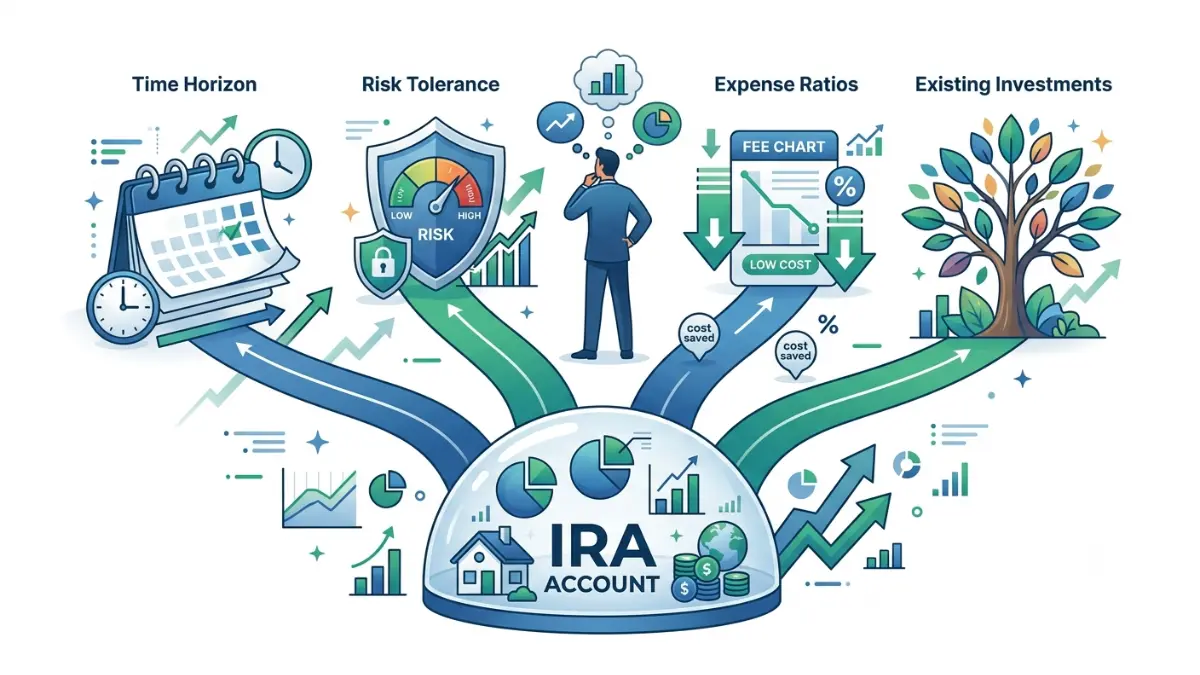
A permitted list this wide is a paralysis risk, not a menu. Four questions remove most of it.
How long until you touch this money?
Time horizon is the first input the SEC names, with risk tolerance, in its beginner guide to asset allocation. Decades tolerate volatility that a few years do not — run the projection on your own numbers.
How much complexity will you actually maintain?
A portfolio you rebalance beats one you admire. Savers often over-engineer because simplicity feels like negligence, and it isn’t.
The SEC describes lifecycle funds — sold as target-date funds — as diversified funds that shift toward a more conservative mix as a stated year approaches, with allocation and rebalancing handled by the manager. One can reasonably be a whole IRA.
What does it cost to own?
Every fund publishes an expense ratio — the one figure comparable across every candidate. Section 4 shows what small differences compound to.
Does it duplicate what you already hold?
Diversification does not guarantee a profit or protect against loss, as the SEC states plainly. The same exposure across three accounts is concentration wearing a costume.
✅ Action Step: Ask a fiduciary financial advisor: “Given my time horizon and what I hold outside this IRA, what allocation are you recommending, and are you a fiduciary here?”
What fund fees actually cost inside an IRA
An expense ratio is deducted from fund assets daily rather than billed, so it never appears on a statement. That is why it goes unexamined.
What the average investor actually pays
The Investment Company Institute’s Trends in the Expenses and Fees of Funds, 2025, published March 2026, reports asset-weighted averages of 0.40% for equity mutual funds, 0.36% for bond funds, 0.14% for index equity ETFs, and 0.09% for index bond ETFs.
Account charges sit on top — what IRA account fees and exit costs run is a separate question from what your holdings charge.
The gap between the average fund and the average investor
The same research puts the simple average across all equity mutual funds offered for sale at 1.10% — nearly three times what investors actually paid.
🔍 How It Works: $7,500 a year for 30 years — $225,000 contributed — at an assumed 6% gross return less 0.14% in fund costs produces about $578,500. The same contributions less 1.10% produce about $489,800, a gap of roughly $88,700. The 6% is our assumption, not a forecast; only the expense ratios are sourced.
Run the same comparison on your own balance.
Which investments belong in the IRA and which don’t
The rule that changes everything
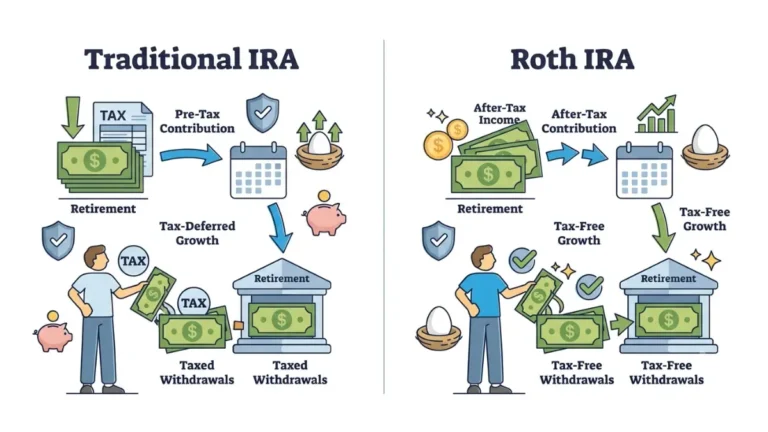
IRS Publication 590-B states that traditional IRA distributions you include in income are taxed as ordinary income, and that capital gain treatment is unavailable. Whatever produced the growth leaves as ordinary income.
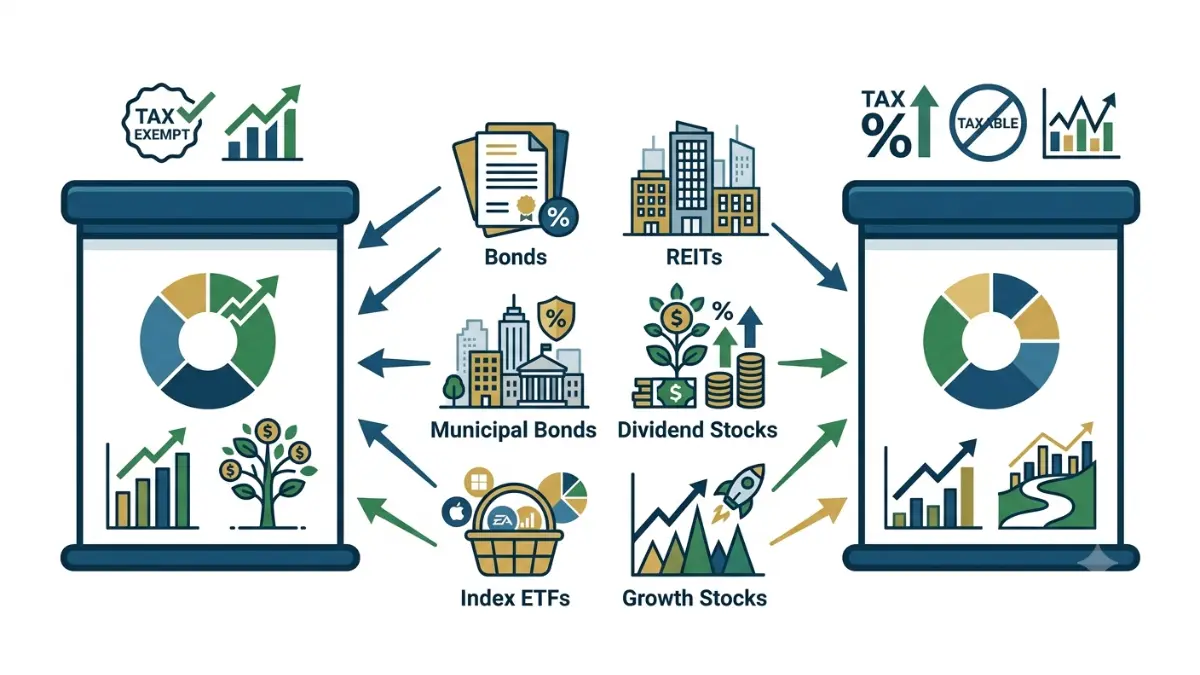
🔍 How It Works: A traditional IRA defers tax, then applies your ordinary rate on the way out; it does not preserve a preferential one. For 2026, ordinary rates run 10% to 37% while long-term gains and qualified dividends are taxed at 0%, 15%, or 20% — the 0% band reaching $49,450 of taxable income single and $98,900 joint, per IRS Rev. Proc. 2025-32. A 3.8% net investment income tax applies above $200,000 single or $250,000 joint under §1411.
What earns its place inside a traditional IRA
| Asset type | Taxed outside an IRA | Best for |
|---|---|---|
| Bond interest | Ordinary rates | Inside — nothing preferential lost |
| REIT dividends | Largely ordinary rates | Inside — same reasoning |
| High-turnover strategies | Ordinary rates | Inside |
| Low-turnover index equity | 0/15/20% | Either; least to gain |
| Municipal interest | Already exempt | Outside — Section 6 |
Sources: IRS Publication 590-B; IRS Rev. Proc. 2025-32; IRC §1411, §103.
Shelter the income the code punishes hardest; stop paying for shelter you already have. Compare the outside case with a capital gains tax calculator.
What the Roth should hold instead
Qualified Roth distributions are not taxed at all under Publication 590-B, so the conversion problem disappears — which is why the highest-growth holdings usually work best there. If that choice is unsettled, see choosing between a Roth and a traditional IRA.
✅ Action Step: Ask a CPA or enrolled agent: “Given my bracket now and at withdrawal, does moving my bond allocation into the IRA lower my lifetime tax bill or raise it?”
Legal to hold, but a poor use of the account
Four holdings clear every test in Section 2 and still make the account worse.
Municipal bonds: paying for a tax break twice
Municipal bond interest is already exempt from federal income tax under IRC §103, so an IRA adds nothing. In a traditional IRA it is worse — the exemption converts to ordinary income on withdrawal.
Annuities: buying deferral you already have
FINRA holds that a deferred variable annuity used to fund an IRA adds no tax deferral beyond what the IRA already provides, a position carried in Rule 2330. The full comparison sits in how an annuity and an IRA are taxed differently.
MLPs and the tax return your IRA has to file
⚠️ Costly Mistake: A master limited partnership passes operating business income through to the account. Under the IRS rules on unrelated business income, $1,000 or more of gross unrelated business income requires a Form 990-T, and the tax is the IRA’s own liability, paid from IRA assets. The $1,000 specific deduction under §512(b)(12) is measured across the whole account, not per holding.
If income is the goal, model the income stream first. Alternative assets need a self-directed structure, which brings the risks the SEC warns about in self-directed IRAs.
Cash: fine as a destination, costly as a default
Short-term cash yields track the policy rate, held at a 3.50%–3.75% target range at the FOMC’s June 2026 meeting. Choosing cash is an allocation; arriving in cash is Section 1 still running.
Three ways people get the holdings right and the account wrong
Assuming the contribution invested itself
Money reaches the account; the trade is a second step. This is the most common retirement savings error here, and the fix takes ninety seconds.
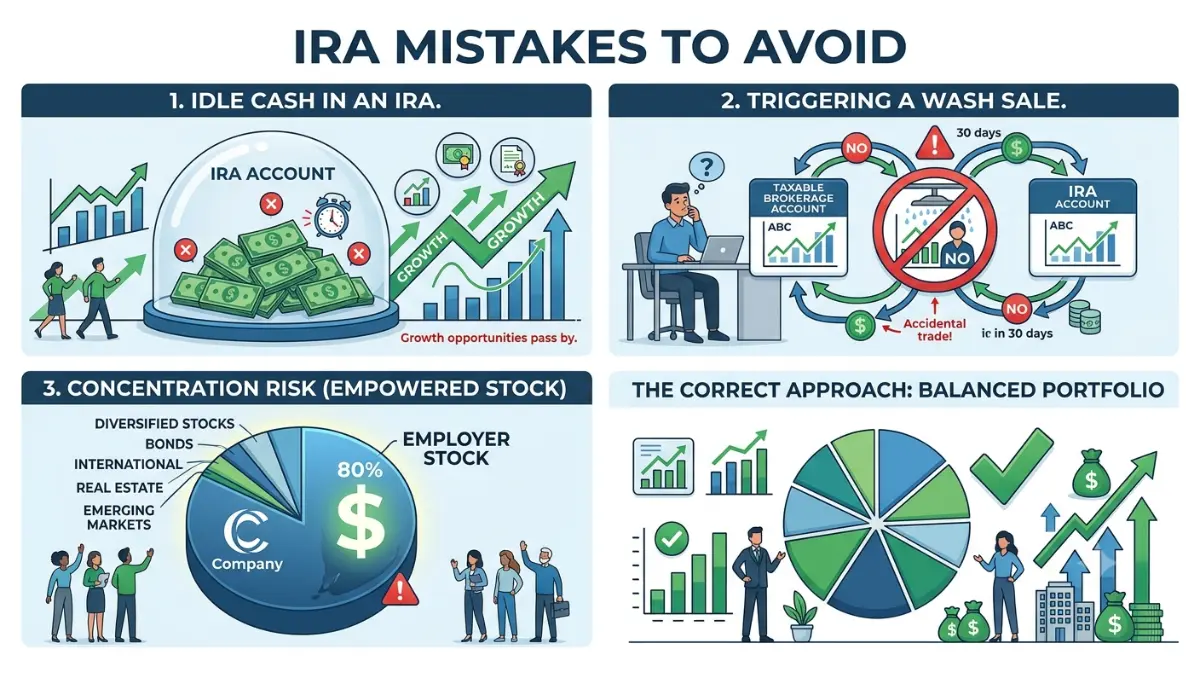
Selling at a loss in your brokerage and rebuying here
⚠️ Costly Mistake: Revenue Ruling 2008-5 holds that if you sell a security at a loss and cause your IRA or Roth IRA to buy a substantially identical one within 30 days either side, §1091 disallows the loss and §1091(d) does not increase your IRA basis. Sell $10,000 of a fund for $7,000, rebuy it in your IRA that week, and the $3,000 loss is gone for good. Rebought in a taxable account, it would have shifted into your cost basis.
There is no fix afterward. Rollover cash is where this often starts — read rolling a 401(k) into an IRA before moving money.
Concentrating in one employer’s stock
Company stock arriving from a workplace plan is a position, not a plan. Diversification guarantees nothing, but concentration guarantees one company’s bad year is your bad year.
IRA investments: common questions
1. What investments can I hold in an IRA?
An IRA can hold almost any ordinary security: stocks, bonds, mutual funds, ETFs, certificates of deposit, and REITs — usually the same menu as a taxable account at the same firm. The code names only two outright exclusions. Beyond those, your custodian’s policy is the real limit.
2. What can’t I hold in an IRA?
Two categories. IRC §408(m) bars collectibles — art, gems, most coins, alcohol — and §408(a)(3) bars life insurance. Buying a collectible isn’t a penalty: §408(m)(1) treats it as a distribution of its cost, taxed as ordinary income, plus the 10% additional tax below 59½. Confirm with a CPA.
3. Can I hold physical gold or silver in an IRA?
Conditionally. §408(m)(3) excepts bullion of specified fineness and certain government-minted coins, but only where a bank or approved non-bank trustee holds physical possession. Personal delivery defeats the exception. Costs differ sharply from a brokerage IRA, so confirm any such structure with a CPA.
4. Is my IRA automatically invested when I contribute?
Usually not. Contributions and rollovers land in a cash or money market position and stay there until you trade. Vanguard found 28% of 2022 rollovers into its IRAs still in cash twelve months later, and 55% of direct contributions. Check what your balance actually holds.
5. Should bonds go in my IRA or my taxable account?
Bond interest is taxed at ordinary rates outside an IRA, so sheltering it usually captures more than sheltering an asset already taxed at 0%, 15%, or 20%. That is asset location in one line. Your brackets now and at withdrawal change the answer — ask a CPA.
6. Can I hold municipal bonds in an IRA?
You can, and it usually wastes the account. Municipal interest is already federally exempt under §103, so the IRA adds no shelter. In a traditional IRA it is worse: that interest emerges as ordinary income, converting an exemption into a taxable distribution. Confirm with a CPA.
7. Do I pay capital gains tax on trades inside my IRA?
No. Trades inside an IRA create no current tax, which is the account’s advantage. But IRS Publication 590-B states traditional IRA distributions you include in income are taxed as ordinary income, with capital gain treatment unavailable. The gain is taxed on withdrawal instead. Confirm with a CPA.
8. Can I day trade inside an IRA?
Nothing in the code prevents frequent trading inside an IRA, and no capital gains tax applies. But losses inside the account are not deductible and cannot offset taxable gains elsewhere. The treatment that makes trading tax-free also removes every tax-loss tool you would have outside it.
9. Is one target-date fund enough for a whole IRA?
It can be. The SEC describes lifecycle funds as diversified funds that shift toward a more conservative mix as their target year approaches, with allocation and rebalancing handled by the manager. That covers the decisions savers most often stall on. A fiduciary advisor can confirm the fit.
10. Can I hold real estate or crypto in an IRA?
Neither is a collectible or a life insurance contract, so neither is barred outright. Both require a self-directed IRA with a specialist custodian, bringing prohibited transaction rules, valuation duties, and fraud exposure the SEC has warned about. Take the structure to a CPA first.
11. What happens if I sell at a loss and rebuy inside my IRA?
The loss is gone permanently. Revenue Ruling 2008-5 holds that selling at a loss while causing your IRA or Roth IRA to buy a substantially identical security within 30 days either side disallows it under §1091, with no basis increase under §1091(d). Ask a CPA.
One thing to do before you close this tab
✅ Action Step: Log in to your IRA and find what the balance is actually held in. Not the balance — the holdings. If the line reads money market, settlement fund, or core position, the money arrived and stopped.
That check costs ninety seconds and settles the question this article exists to answer. Everything above only matters once the account holds something.

Informational disclaimer
The content on Finance Authority Hub is provided for general informational and educational purposes only and should not be considered personalized financial, investment, tax, legal, or professional advice. Financial decisions depend on your individual goals, income, risk tolerance, location, and regulatory situation. Before acting on any information, strategy, estimate, or calculator result, consult a qualified licensed professional who can evaluate your specific circumstances.