What creates basis in a Trump account and what gets taxed later
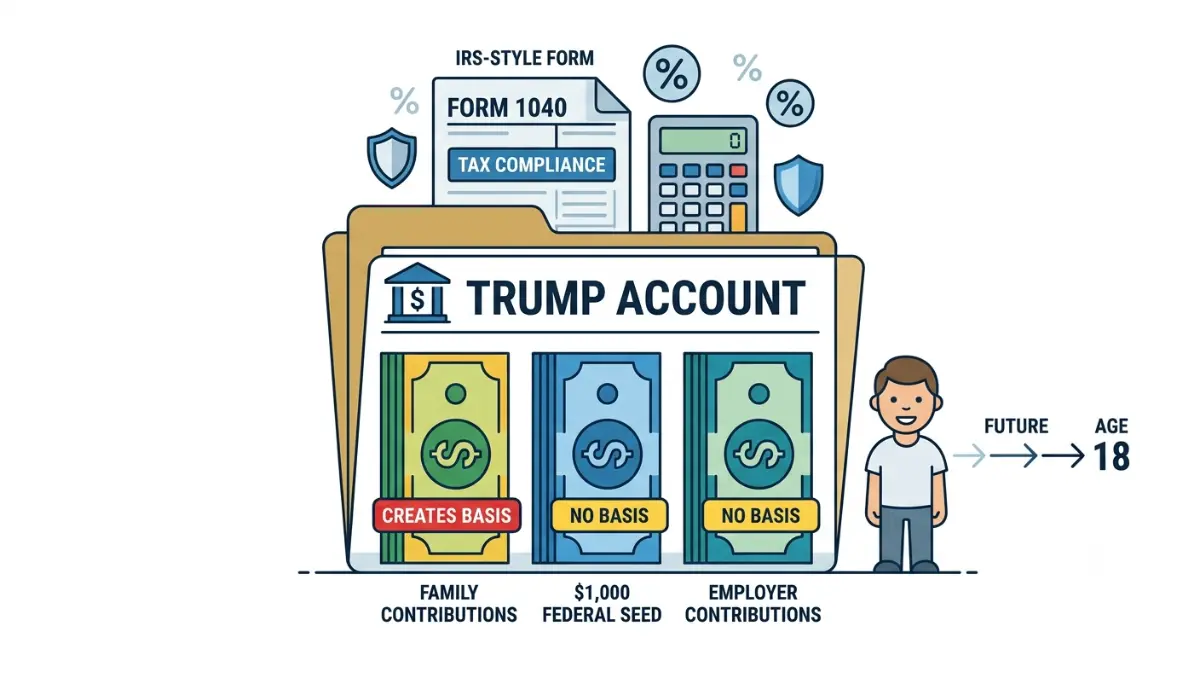
Trump account basis comes from one source only: contributions by individuals. The $1,000 federal seed and employer dollars are taxed in full.
In This Article
Trump accounts opened for contributions on July 4, 2026, and the phrase “tax-free” attached itself to them somewhere in the rush. It isn’t accurate, and the gap costs most on money you add yourself.
- No account yet: start with how to open one and claim the $1,000.
- Seed money only: the next two sections explain what your child owns.
- Already contributing: sections three to six decide what they keep.
- Still deciding: skip to the comparison near the end.
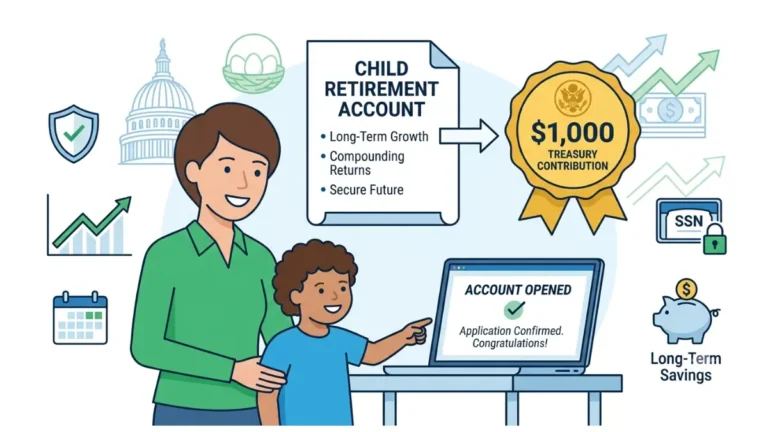
The pilot contribution of $1,000 is free money, and nothing below makes claiming it a bad idea. The narrower question is what the code does with the dollars you add.
📊 Data Point: Nearly 6,000,000 elections to open a Trump account had been received as of June 4, 2026 — Source: IRS Revenue Procedure 2026-25 (June 2026).
ℹ️ Financial Disclaimer: This is educational information about a tax rule, not personalized advice on investing, taxes, credit or lending, insurance, or debt relief. What it means for your family turns on your income and your child’s. Speak with a CPA, a tax attorney, or a fiduciary advisor before acting.
Not every dollar in the account is the same kind of dollar
Basis is the part of an account you have already paid tax on, and it comes back out untaxed. Only one kind of money creates it here.
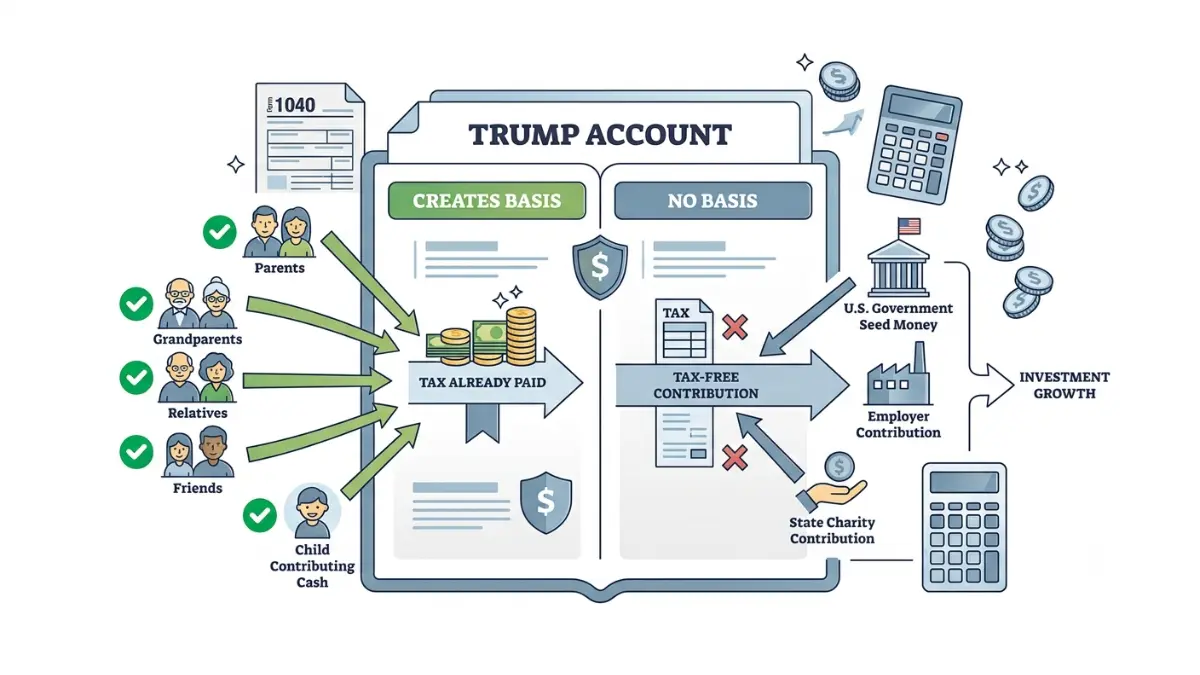
Which contributions create basis, and which don’t
- Creates basis: money from parents, grandparents, other relatives, friends, or the child.
- Creates no basis: the $1,000 federal seed, employer contributions under Code Section 128, and qualified general contributions from states or charities.
- Carries basis over: a qualified rollover from one Trump account to another.
That split comes directly from the IRS guidance on which contributions create basis.
Why the seed and your employer’s money differ
Basis stops a dollar being taxed twice, so a dollar never taxed going in has nothing to protect coming out. Nobody paid tax on the seed, and employer money was excluded from your pay rather than added to it.
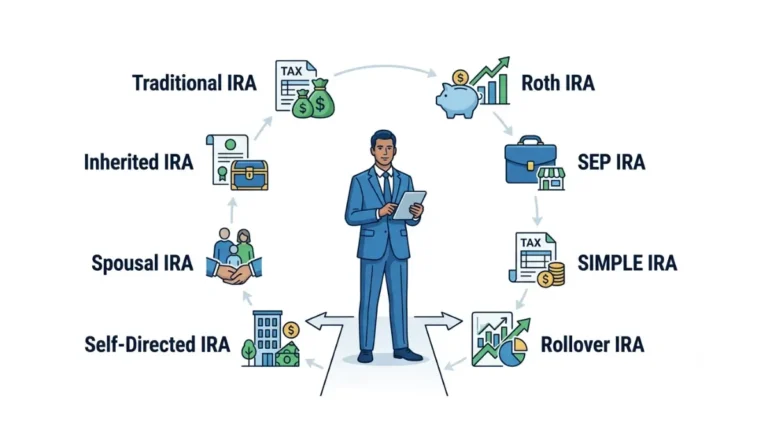
Your own contribution came from taxed income and still earns no deduction, which surprises people — the account sits among the traditional IRA types the tax code recognizes, and those usually mean one.
💡 Expert Note: The fastest way to know whether a deposit created basis is to ask who wrote the check. An individual, basis. A government, an employer, or a charity, none.
You can’t take your own money out first
Every withdrawal is part basis and part taxable, split in proportion. The tax-free share equals the withdrawal multiplied by total basis divided by total account value.
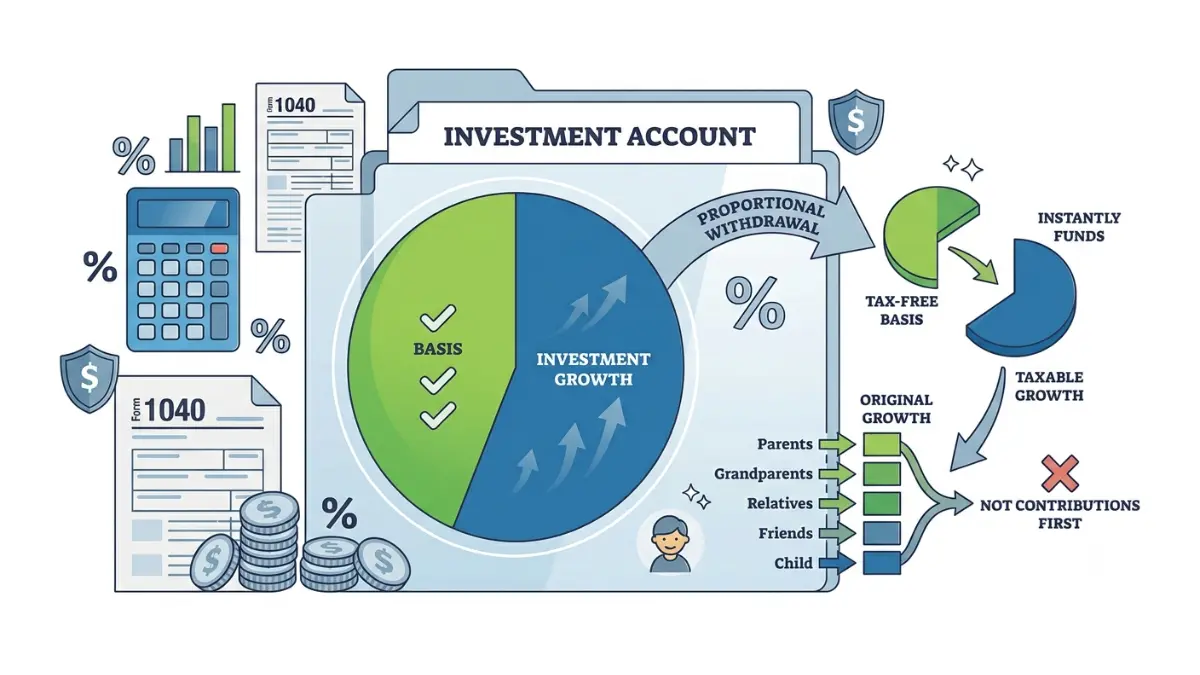
How the IRS splits every withdrawal
🔍 How It Works: An account holds $76,138 at 18, of which $36,000 came from family. Basis is 47.3% of the account, so a $10,000 withdrawal is $4,728 tax-free and $5,272 taxable. (Balance modeled at 7% on $2,000 a year plus the seed; allocation method set by the IRS rule for Trump account distributions.)
You cannot withdraw contributions first and leave the growth behind. That option belongs to Roth accounts, and a Trump account cannot be one.
Why the rate matters more than the ratio
The taxable portion is ordinary income, taxed at rates reaching 37% in 2026, not at the capital gains rates a taxable account would get, which are 0% for a single filer with taxable income at or under $49,450.
Here is the same $5,000 of family money after 18 years, net of tax:
| Where the $5,000 sat | Net at 18 | Key detail |
|---|---|---|
| Trump account, 12% bracket, no exception | $14,282 | Ordinary income, plus the 10% penalty |
| Trump account, qualified education | $15,472 | Penalty waived, growth still ordinary income |
| Taxable brokerage, 15% capital gains | $14,927 | Dividends taxed yearly, lower rate at sale |
| Taxable brokerage, 0% capital gains | $16,354 | Applies while the child’s income stays low |
| 529 plan, qualified education | $16,900 | Qualified withdrawals not taxed at all |
Modeled by FinanceAuthorityHub: 7% annual return over 18 years; brokerage assumes a 1.3% dividend yield taxed each year. Rates and thresholds from IRS Revenue Procedure 2025-32 (2026). Illustration only.
Deferral is not worthless — over long horizons a child in the 12% bracket edges out a taxed brokerage. The break-even is your child’s future ordinary rate against the capital gains rate they would otherwise pay, so run the projection yourself and price the gain at capital gains rates first.
Two rules that raise the bill at 18
Withdrawals become possible on January 1 of the year your child turns 18, and two rules can push the cost above their own bracket.
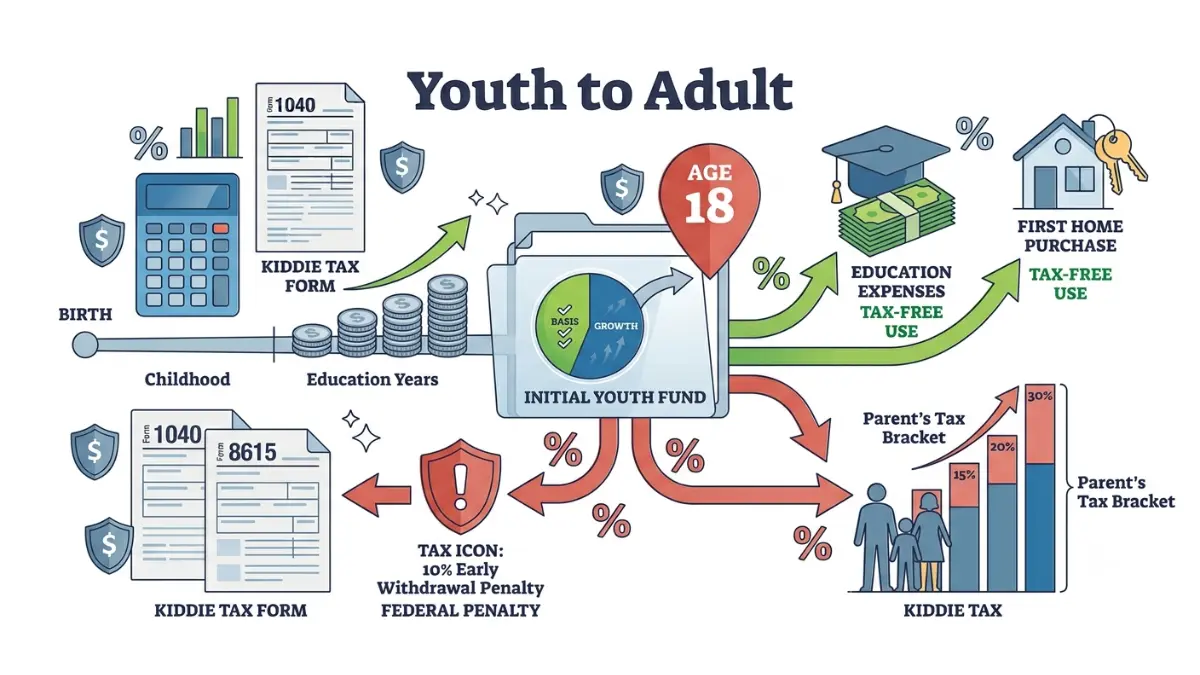
The 10% penalty and the exceptions that matter at 18
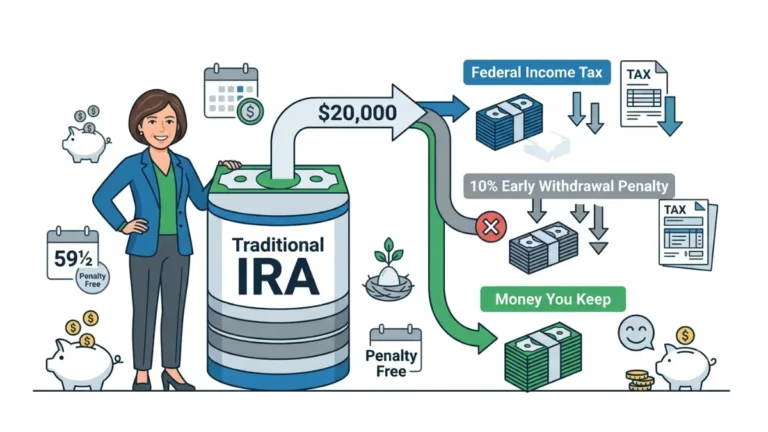
Traditional IRA distribution rules then apply, including the 10% early withdrawal penalty on the taxable portion before age 59½. Three exceptions realistically apply at 18: qualified higher education expenses, a first home purchase, and reaching 59½ itself.
The penalty hits only the taxable share, never the basis, and several other exceptions can remove it.
When the kiddie tax pulls the rate up to yours
A taxable distribution counts as unearned income. Under the IRS conditions for the kiddie tax, unearned income above $2,700 in 2026 is taxed at a parent’s rate when the child is 18 with earned income not exceeding half their support, or a full-time student aged 19 to 23 on the same test.
⚠️ Costly Mistake: Assuming an 18-year-old’s withdrawal is taxed at an 18-year-old’s rate. A student living at home can face the 10% penalty and a parent’s marginal rate on the same dollars. Estimate the bracket first — and note that neither rule bites if the money stays put.
The gift tax rule that catches generous grandparents
Money you put into a child’s account is a gift for federal tax purposes, and until recently that created a reporting problem.
Why a contribution counts as a gift at all
Because the child cannot reach the money until 18, a contribution looked like a gift of a future interest. Future-interest gifts get no annual exclusion and must be reported on Form 709, however small.
The IRS safe harbor for Trump account contributions, issued June 29, 2026, fixed that for most families. Qualifying contributions count as present-interest gifts covered by the $19,000 annual exclusion for 2026, with no return required.
The five conditions, and the one that breaks first
All five must hold for the year: you are an individual; your only taxable gifts are cash contributions to Trump accounts made before the child turns 18; total gifts to each child stay within the exclusion; no gift or generation-skipping tax results; and no gift tax return is otherwise required or filed.
⚠️ Costly Mistake: The third condition counts every gift, not just the account. A grandparent who puts $5,000 into each of two grandchildren’s accounts and hands one of them $16,000 for graduation has given that child $21,000. The safe harbor fails, and contributions to both accounts become reportable as future interests. Ask a CPA before December: counting everything I gave this child this year, am I inside the exclusion?
Who is actually tracking your basis right now
Basis only helps your child if someone can prove it 18 years from now, and the machinery for that is still being built.
What the law requires the trustee to report
During the growth period the trustee must report contributions, distributions, account value, and basis. That is written into the statute, so this is not a gap in the law.
It is a gap in the paperwork. The IRS says forms for that reporting will come later, the March 2026 proposed regulations left the reporting and distribution sections reserved, and the 2026 draft of the form used to track after-tax IRA money states that “traditional IRA” excludes Trump accounts.
What to keep in the meantime
One piece of good news: these accounts stay separate from your other IRAs when basis is allocated, so this one will not disturb the pro-rata rule that applies to your other IRAs.
✅ Action Step: Start a contribution log with four columns — date, who contributed, amount, source type — and store it where your child will find it. Custodians change over 18 years; a spreadsheet does not.
So where should the next $1,000 go?
The account has real strengths, worth naming before any comparison.
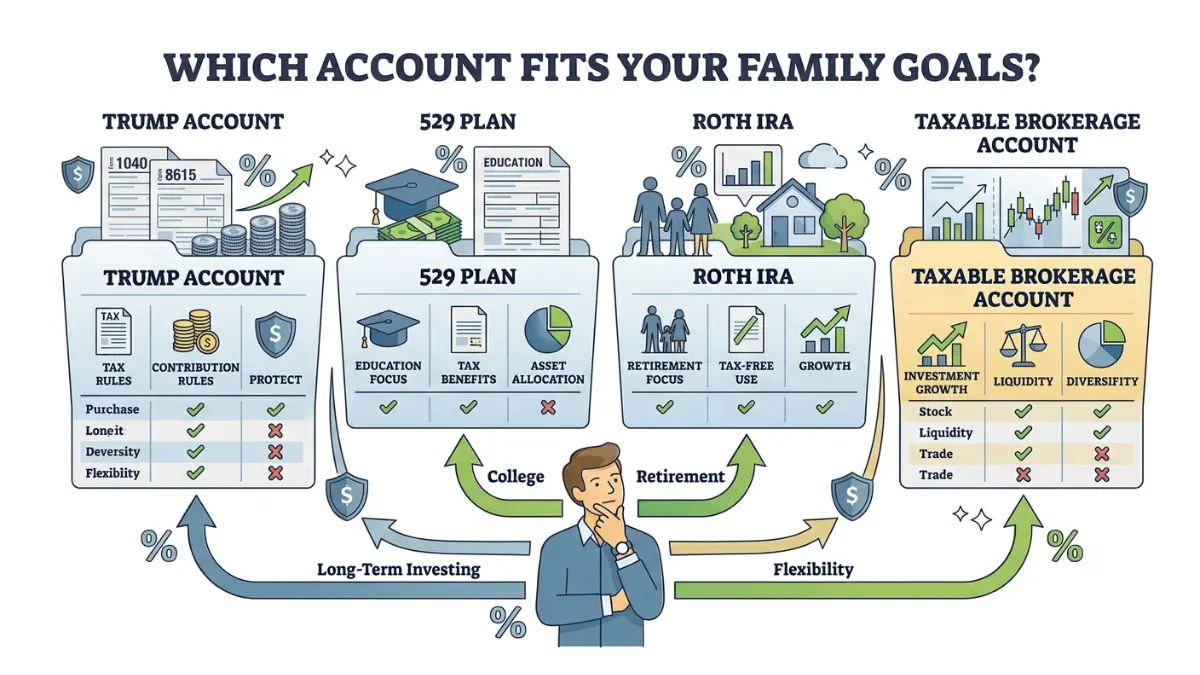
What the account is genuinely good at
The seed costs nothing. There is no earned-income requirement, so a newborn can hold one where a Roth IRA is impossible. Money compounds untaxed in a fee-capped index fund, and the $5,000 annual limit sits on top of your child’s own IRA room.
The three questions that decide the rest
- Is this money earmarked for education? A 529 keeps qualified withdrawals untaxed; this account does not.
- What ordinary rate will your child face in the year they withdraw? Near 12%, deferral competes well; at 22% or higher, capital gains treatment usually wins.
- Do you need the money reachable before 59½ without a penalty exception?
Question two is unknowable today, which is itself an argument for spreading money across account types rather than avoiding one.
✅ Action Step: Before funding anything, model what a 529 would need to cover, then ask a fiduciary advisor or CPA: given our tax picture and what this money is for, does it belong in a Trump account, a 529, or a taxable account in our name?
Trump account taxes: quick answers
1. Can I withdraw my own contributions tax-free first?
No. Every withdrawal splits proportionally between basis and taxable growth, so if basis is 47% of the account, then 47% of any withdrawal comes out tax-free and the rest is ordinary income. Contributions-first ordering belongs to Roth accounts, and a Trump account cannot be a Roth. Ask a CPA before withdrawing anything.
2. Are Trump account earnings taxed as capital gains?
No. Growth is taxed as ordinary income when withdrawn, at rates reaching 37% in 2026, rather than at capital gains rates that reach 0% for a single filer with taxable income at or under $49,450. That gap is the main cost of using this account for family money. Discuss with a CPA.
3. Will my child owe the 10% penalty if they withdraw at 18?
Usually yes, on the taxable portion, unless an exception applies. Qualified higher education expenses and a first home purchase are the two most likely exceptions at that age, and the basis share is never subject to the penalty at all. A CPA can confirm which exception fits your child’s situation.
4. Do I have to file a gift tax return for a contribution?
Usually not, if all five safe harbor conditions hold for the year. The one that fails most often is the limit on total gifts to a single child, which counts birthday money and graduation checks alongside the contribution. Exceeding it for one child affects every account you funded. Ask a CPA.
5. Who is required to track the basis?
The trustee must report basis during the growth period under the statute, but the IRS has said the forms and instructions for that reporting are still to come. Until it is settled, keep your own record of every contribution — its date, its amount, and who made it. Confirm the position with a CPA.
6. What happens to the basis if my child dies before 18?
The account stops being a Trump account and an IRA on the date of death, and its value less basis is included in the income of whoever acquires it. Basis still shelters that portion from tax, but there is no step-up in basis here, which surprises most families. Consult a tax attorney.
7. Can a Trump account be converted to a Roth IRA?
Not during the growth period, because a Trump account cannot itself be a Roth IRA. After the growth period, ordinary traditional IRA rules apply, and those include Roth conversions. A conversion is taxable in the year it happens, so time it with a CPA rather than assuming a low-tax year.
8. Does a Trump account interfere with a backdoor Roth?
No, and this is the genuinely useful news buried in the mechanics. Trump accounts stay separate from your other IRAs when basis is allocated to a distribution, so the account neither dilutes nor is diluted by your traditional IRA balances. Your backdoor Roth math is unaffected. Confirm with a CPA.
What to do before you fund it
Claim the $1,000. It costs your family nothing, and no rule above changes that.
Then treat your own money as a separate decision, because it is one. Family contributions create basis, that basis comes back proportionally rather than first, and everything above it is taxed as ordinary income at a rate nobody can predict today.
Start the contribution log this week, and take the funding question to a CPA before the next deposit. Three pieces of IRS guidance are still pending, so recheck how it compares with the other IRA types once the regulations land.

Informational disclaimer
The content on Finance Authority Hub is provided for general informational and educational purposes only and should not be considered personalized financial, investment, tax, legal, or professional advice. Financial decisions depend on your individual goals, income, risk tolerance, location, and regulatory situation. Before acting on any information, strategy, estimate, or calculator result, consult a qualified licensed professional who can evaluate your specific circumstances.