
Assets Not Covered by a Will and the Hidden Rules on Who Inherits
Assets not covered by a will include POD accounts, which FDIC insures up to $250,000 per beneficiary. Here is who really inherits yours.
In This Article
Assets your will doesn’t control: start with your situation
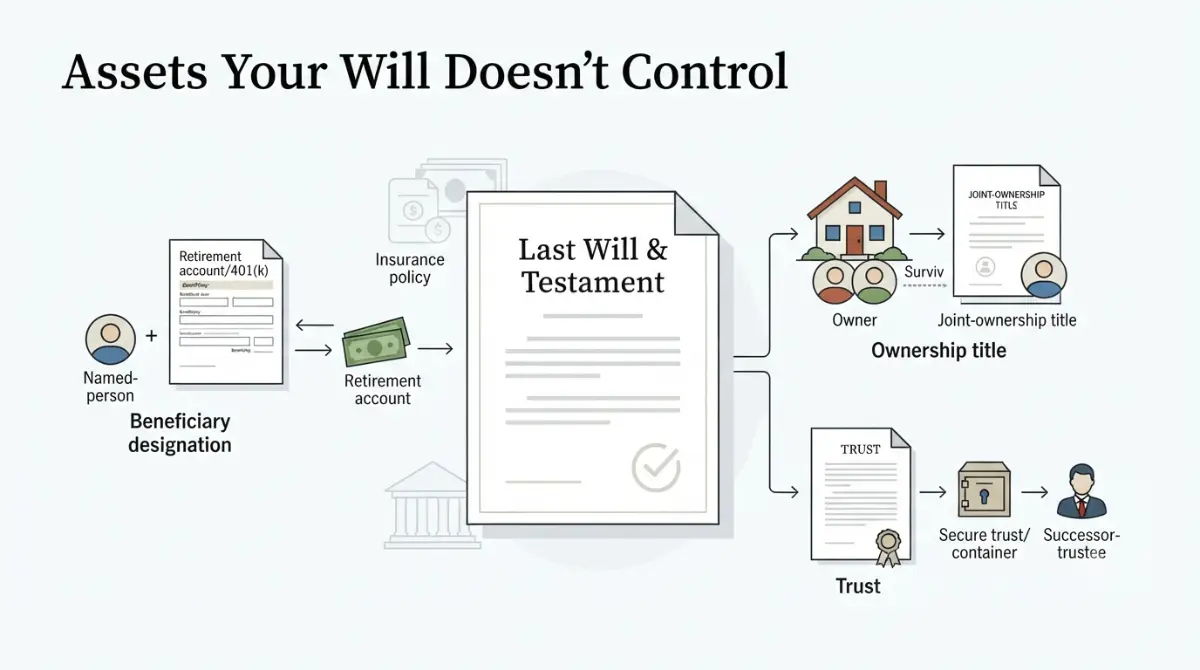
Your will is only one of the documents that decide who inherits what you own. Retirement accounts, life insurance, and many bank and brokerage accounts pass to whoever is named on their own paperwork, and the IRS notes that a retirement plan generally pays benefits only to its named beneficiaries.
Why your will covers less than you think
A will governs your probate estate: assets in your name alone with no beneficiary or co-owner. Anything with a beneficiary form, a survivorship title, or a trust follows those instructions instead, even when your will disagrees. That gap is how a 401(k) ends up with an ex-spouse or the house goes to one child.
Find your situation before you read further
- Online or older will: Start with the eight assets, then the audit.
- Divorced, remarried, or blended family: Read the conflicts section and worked example first.
- Large retirement accounts: Focus on the tax section.
- Minor children: See the warning about naming minors.
- Settling someone’s estate: Use the asset table to sort what the executor handles.
ℹ️ Financial Disclaimer: This article is general education about estate planning, wills, trusts, property titles, and deeds; federal estate tax and income tax on inherited accounts; retirement-plan distribution rules; life insurance and annuity beneficiary decisions; brokerage account registration; and FDIC deposit insurance. It is not legal, tax, insurance, or investment advice, and property and probate rules vary by state. Before changing a beneficiary, a title, or your estate plan, consult an estate planning attorney licensed in your state, a CPA, or a fiduciary financial advisor.
What your will controls and the 3 things that override it
A non-probate asset is property that passes at death under a beneficiary designation, a survivorship form of ownership, or a trust, rather than under a will. Because it transfers outside probate court, your will’s instructions generally don’t reach it.
Probate assets vs. non-probate assets
Probate assets are things you own alone with no beneficiary attached, such as a car or a brokerage account without transfer-on-death registration. Your executor gathers them, pays valid debts, and distributes the rest under your will, or under state law if there’s no will.
Contract, title, and trust: how assets bypass a will
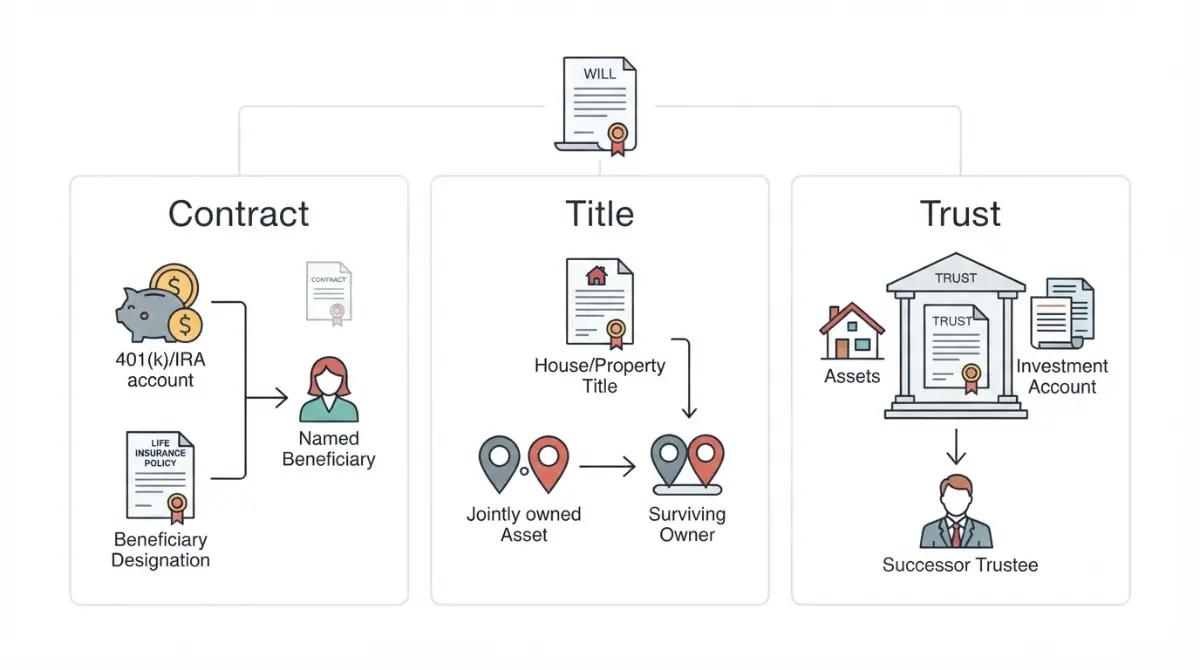
🔍 How It Works: Contract: a beneficiary designation on a 401(k), IRA, insurance policy, annuity, or payable-on-death account tells the institution whom to pay. Title: property owned as joint tenants with right of survivorship passes automatically to the surviving owner. Trust: assets retitled into a revocable living trust are distributed by the successor trustee.
When a non-probate asset ends up in probate anyway
A non-probate asset can fall back into probate when “my estate” is the named beneficiary, or when every named beneficiary has died and no backup exists. The result depends on the contract and your state’s law.
⚠️ Costly Mistake: Naming “my estate” on a life insurance policy or retirement account turns a fast, private transfer into a court process. The money waits for probate and can become reachable by the estate’s creditors first.
The 8 assets that pass outside your will
Eight common types of assets pass outside a will:
- Employer retirement plans, such as 401(k)s
- Individual retirement accounts (IRAs)
- Life insurance
- Annuities
- Payable-on-death (POD) bank accounts
- Transfer-on-death (TOD) brokerage accounts
- Property owned with survivorship rights, including TOD deeds
- Assets held in a living trust
| Asset | What controls it | If the designation fails | Who to contact | Key Detail |
|---|---|---|---|---|
| 401(k) / 403(b) | Beneficiary form and plan documents | Plan’s default order | Plan administrator | Many plans require spousal consent to name someone else |
| IRA | Custodian’s beneficiary form | Custodian’s default provision | IRA custodian | Most non-spouse heirs face a 10-year rule |
| Life insurance | Policy designation | May be paid to your estate | Insurer | Naming a minor can require court supervision |
| Annuity | Contract death-benefit terms | Contract terms decide | Insurer | Payouts and taxes vary by contract |
| POD bank account | Bank’s POD designation | Typically your estate | Bank | FDIC: $250,000 per eligible beneficiary, $1.25M cap |
| TOD brokerage | TOD registration under state law | May need probate | Brokerage firm | Firms choose whether to offer TOD |
| Survivorship property / TOD deed | Deed or title | Tenants-in-common shares go to probate | County recorder or bank | TOD deeds: roughly 30 states plus DC |
| Living trust assets | Trust document | Unretitled assets stay in probate | Successor trustee | A trust controls only what it owns |
Sources: IRS; FDIC, Trust Accounts (effective April 1, 2024); Investor.gov; FINRA. Rules vary by state and contract.
Retirement accounts, life insurance, and annuities
The institution pays the named beneficiary, not whoever your will names. Workplace accounts carry the separate rules for an inherited 401(k), and annuities depend on the contract, so check what happens to an annuity when the owner dies.
Payable-on-death bank accounts (and how FDIC insures them)
📊 Data Point: Since April 1, 2024, the FDIC insures trust deposits, including POD accounts, up to $250,000 per eligible beneficiary, with a maximum of $1,250,000 per owner at the same bank. Source: FDIC, Trust Accounts (verified September 2026).
🔍 How It Works: $600,000 in POD accounts at one bank naming two children is insured up to $250,000 × 2 = $500,000, leaving $100,000 uninsured. Naming a third eligible beneficiary raises the cap to $750,000.
Under the FDIC’s deposit insurance rules for trust and POD accounts, coverage limits don’t change who receives the money at death.
Transfer-on-death brokerage accounts
Investor.gov explains that state law governs securities registration and each firm decides whether to offer TOD registration. FINRA’s guide to planning the transfer of brokerage assets at death covers what to set up now.
Jointly owned property and transfer-on-death deeds
Property held as joint tenants with right of survivorship or tenants by the entirety passes to the surviving owner. Tenants-in-common shares go through probate. Roughly 30 states plus DC allow TOD deeds; counts differ by source, and the property’s state law decides.
Assets held in a living trust
A successor trustee distributes trust assets without probate, but only property actually retitled into the trust.
✅ Action Step: Before recording a TOD deed, ask an estate planning attorney in the property’s state: “Does this state recognize TOD deeds, and how would one interact with my mortgage and creditors?”
When your will and beneficiary forms disagree
Generally, a beneficiary designation overrides a will. The designation is a contract with the plan, insurer, or bank, which pays the person named on its form. Exceptions come mainly from court orders and some state laws.
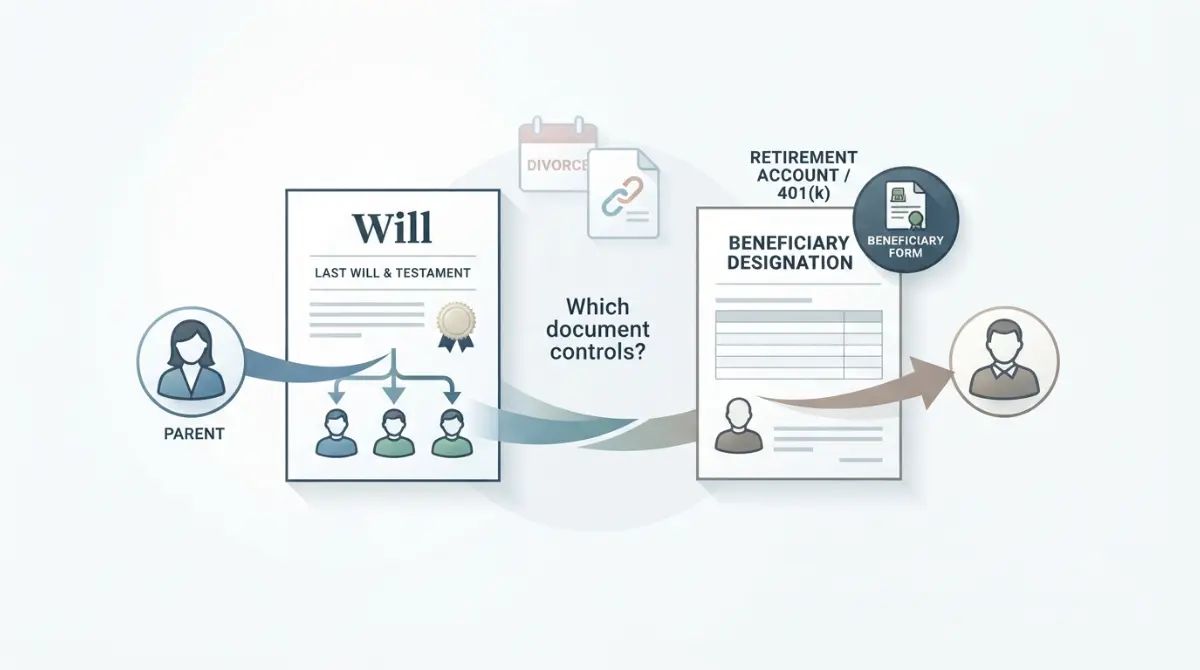
Divorce: why an ex-spouse can still inherit a 401(k)
In Egelhoff v. Egelhoff (2001), the U.S. Supreme Court held that federal ERISA law overrode a state law revoking an ex-spouse’s designation at divorce. In Kennedy v. Plan Administrator for DuPont (2009), the Court unanimously upheld paying a former spouse who was still the named beneficiary, even though she had waived her interest in the divorce decree.
For accounts not governed by ERISA, such as IRAs or individually owned life insurance, many states have revocation-on-divorce laws, but details vary. If a divorce split a workplace plan, see how a QDRO divides a 401(k) in divorce.
💡 Expert Note: A divorce decree doesn’t update a beneficiary form. As Kennedy shows, an ERISA plan pays according to its documents, so file a new form or a qualified domestic relations order.
A beneficiary who dies first, with no contingent named
Without a contingent beneficiary, the contract’s default rules decide, and they often send the money to your estate.
Naming a minor child or “my estate”
A minor generally can’t control a large inheritance directly, so a court may need to appoint a manager, adding cost and delay. Ask an attorney whether a custodial arrangement or trust fits.
Adding a child to a title or account “for convenience”
A child added as a joint owner with survivorship rights owns the asset at your death, regardless of your will’s equal shares. It can also expose the asset to that child’s creditors and change later taxes.
✅ Action Step: If you’re divorced, ask an estate planning attorney: “Does my divorce decree or QDRO change who my plan administrator and insurer will actually pay?”
One estate, worked through: who really inherits
This illustrative example uses a hypothetical family and ignores debts, probate costs, and taxes.
The will’s plan vs. the paperwork
A divorced parent’s will leaves “everything equally to my three children,” A, B, and C. The assets total $1,200,000, but most carry their own instructions.
| Asset | Value | Paperwork says | Who receives it | Key Detail |
|---|---|---|---|---|
| 401(k) | $420,000 | Names ex-spouse | Ex-spouse | Plan documents govern |
| House | $360,000 | Joint tenancy with child A | Child A | Title overrides the will |
| Life insurance | $250,000 | “My estate” | Probate estate | Falls under the will |
| POD savings | $60,000 | Names child B | Child B | Bank pays directly |
| Brokerage (no TOD) | $90,000 | No beneficiary | Probate estate | Falls under the will |
| Car and belongings | $20,000 | No beneficiary | Probate estate | Falls under the will |
Hypothetical figures. The 401(k) outcome assumes no QDRO or contrary plan provision.
The actual result, asset by asset
🔍 How It Works: Only $250,000 + $90,000 + $20,000 = $360,000 reaches the will, split into $120,000 shares. Child A gets $480,000, child B gets $180,000, child C gets $120,000, and the ex-spouse gets $420,000.
| Person | Will intended | Actually received |
|---|---|---|
| Child A | $400,000 | $480,000 |
| Child B | $400,000 | $180,000 |
| Child C | $400,000 | $120,000 |
| Ex-spouse | $0 | $420,000 |
Here the will controlled $360,000 of $1,200,000, or 30% of the estate.
The three fixes that would have matched the will
- Update beneficiary forms: name all three children, with contingents, on the 401(k), insurance, and POD account.
- Fix the house title: ask an attorney whether a TOD deed, a trust, or different ownership fits.
- Add TOD registration: register the brokerage account to all three children, if the firm offers it.
Skipping probate isn’t skipping taxes: what heirs owe
Avoiding probate doesn’t avoid tax.
Non-probate assets still count toward estate tax
The IRS says your gross estate covers everything you own or have certain interests in at death, and likely includes non-probate property. Its frequently asked questions on estate taxes explain what’s included.
📊 Data Point: The federal basic exclusion amount is $15,000,000 per person for 2026, under Public Law 119-21, signed July 4, 2025. Source: IRS, What’s New — Estate and Gift Tax (verified September 2026).
Most estates fall far below it, though some states levy their own estate or inheritance taxes.
Inherited IRAs and 401(k)s: the 10-year rule
For most heirs, the real bill is income tax. Withdrawals from inherited traditional accounts are generally taxable income, and most non-spouse beneficiaries must empty the account by the end of the 10th year after death.
A spouse or minor child is an eligible designated beneficiary with more options, as IRS guidance on retirement account rules for beneficiaries shows. See how the inherited IRA 10-year rule works and the options a surviving spouse has with an inherited IRA.
🔍 How It Works: Had the owner started required minimum distributions? Yes: Treasury’s 2024 final regulations require annual withdrawals in years 1–9 and an empty account by year 10, enforced from 2025 after penalty waivers for 2021–2024. No: withdraw on any schedule, but empty it by the end of year 10.
Inherited property and stepped-up basis
The IRS generally sets your tax basis in inherited property at its fair market value on the date of death. Shares bought for $50,000 and worth $200,000 at death get a $200,000 basis, so selling at $205,000 means a $5,000 gain, and you can estimate the gain a stepped-up basis can erase with our capital gains tax calculator.
Exceptions exist, and retirement accounts work differently, as does how inherited annuity payouts are taxed.
✅ Action Step: If you’ve inherited a retirement account, ask a CPA: “Had the owner reached their required beginning date, and what must I withdraw this year?”
How to audit every beneficiary form in five steps
You can check whether your paperwork matches your will in five steps:
- List every account, policy, and property title you own.
- Request the current beneficiary on file from each institution.
- Compare each designation with your will.
- Update forms, naming primary and contingent beneficiaries.
- Save written confirmations with your will.
The five-step beneficiary audit
Step 1: Include workplace plans, IRAs, policies, annuities, bank and brokerage accounts, and deeds. For your house, estimate your home’s current equity to see what’s at stake.
Step 2: Ask each institution what it currently holds; don’t trust memory.
Step 3: Flag any form naming an ex-spouse, a deceased person, a minor, or “my estate,” and any account missing a contingent.
Step 4: For employer plans, the IRS says to complete the plan’s change forms, including a spouse’s signature if required, and submit them to the administrator.
Step 5: File each confirmation with your will and tell your executor where it is.
Life events that should trigger a re-check
The IRS advises reviewing beneficiaries after marriage, having children, or a spouse’s death. Divorce and moving states matter too, since these rules follow state law.
⚠️ Costly Mistake: Signing a new will doesn’t change a single beneficiary form or title.
Will, beneficiary form, or trust: which tool fits
The right tool depends on your family and assets.
When updated forms and a simple will are enough
If your beneficiaries are adults and your property sits in one state, correct beneficiary forms plus a current will often cover most of what you own.
Signs you should talk to an estate planning attorney
Consider a professional plan, possibly including a revocable living trust, if:
- You have a blended family
- You’re leaving money to minor children
- You own real estate in more than one state
- A beneficiary has special needs or receives means-tested benefits
- You own a business interest
- Your estate may approach the $15 million federal exclusion or a lower state threshold
✅ Action Step: Ask an estate planning attorney: “What gaps would a trust close for my family that updated beneficiary forms and a will would not?”
Common questions about assets outside a will
1. Does a beneficiary designation override a will?
Generally yes: a beneficiary designation is a contract, so the plan, insurer, or bank pays whoever its form names, whatever your will says. An estate planning attorney can confirm how your state treats conflicts.
2. What happens if my beneficiary dies before me with no contingent?
If your beneficiary dies first and no contingent is named, the contract’s default rules apply, which often send the money to your estate. An estate planning attorney can review your forms’ default terms.
3. Is a joint bank account part of my estate?
A joint bank account with survivorship rights passes straight to the surviving owner, skipping probate, but your share still counts toward your gross estate. A CPA can explain the estate tax effect.
4. Can my ex-spouse still get my 401(k)?
Yes, if still named. In Kennedy v. Plan Administrator (2009), the Supreme Court upheld paying an ex-spouse named on the 401(k) plan’s form. An estate planning attorney can check your forms and divorce documents.
5. Do non-probate assets count toward estate tax?
Yes. The IRS says the gross estate generally includes non-probate property; for 2026, the federal estate tax exclusion is $15 million per person. A CPA can estimate whether your estate is affected.
6. How long does a non-spouse have to empty an inherited IRA?
Most non-spouse heirs must empty an inherited IRA by the end of the 10th year after death; annual withdrawals apply if RMDs had started. A CPA can calculate your required withdrawals.
7. Do all states allow transfer on death deeds?
No. Roughly 30 states plus DC allow transfer on death deeds, and the law where the property sits decides whether one works. A local estate planning attorney can confirm your state’s rules.
8. How much FDIC coverage do POD accounts get?
FDIC insures POD accounts up to $250,000 per eligible beneficiary, capped at $1.25 million per owner at the same bank.
Your next step before anything else changes
Most of what happens to your money at death is decided by forms you can check this week.
If you’re planning your own estate
Run the audit and bring your worksheet to an estate planning attorney if any warning sign applies.
If you’re settling someone else’s
Use the asset table to separate what beneficiaries claim directly from what goes through probate. If you inherited retirement money, see fixing an inherited IRA withdrawal that was already missed, and check whether you qualify for Social Security survivor benefits.
Related Articles
 Estate Planning
How a step-up in basis can cut tax on inherited stock
September 26, 2026 Estate Planning
Smart Digital Assets Estate Planning Steps So Family Can Get In
October 5, 2026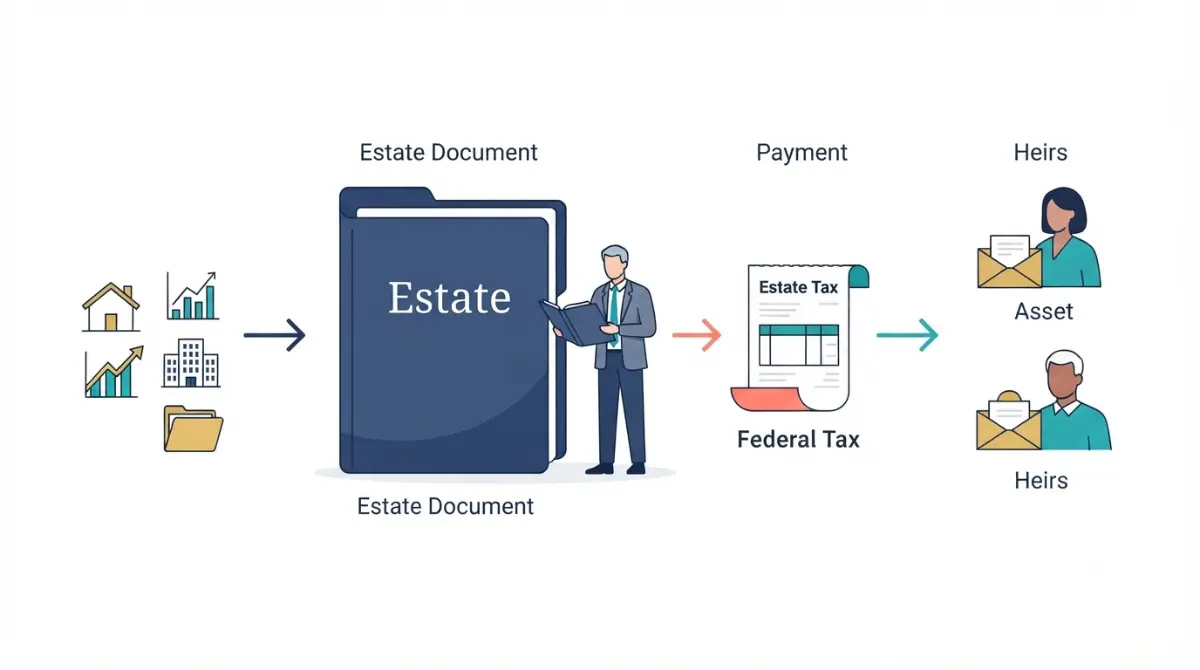 Estate Planning
Who Pays Estate Tax, and How Rarely Estates Actually Owe It
September 23, 2026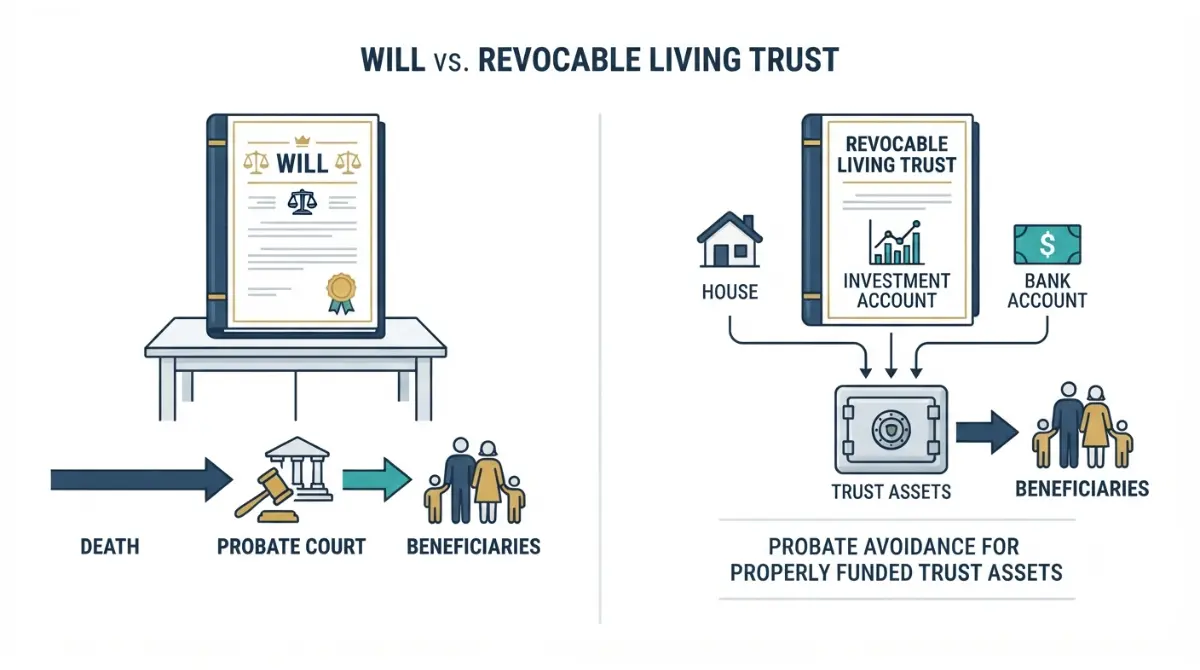 Estate Planning
Will vs Trust and How to Find the Right Fit for Your Family
September 17, 2026 Estate Planning
What Your Agent Can Legally Do Under a Durable Power of Attorney
September 29, 2026 Estate Planning
The Right Way to Read the Percentage of Americans With a Will
October 5, 2026 Estate Planning
States With Inheritance Tax, Estate Tax Limits and Who Pays
September 24, 2026 Estate Planning
A Clear Look at What Happens If You Die Without a Will
September 30, 2026 Estate Planning
The Portability Election and Your Spouse’s Overlooked Exemption
September 24, 2026
Informational disclaimer
The content on Finance Authority Hub is provided for general informational and educational purposes only and should not be considered personalized financial, investment, tax, legal, or professional advice. Financial decisions depend on your individual goals, income, risk tolerance, location, and regulatory situation. Before acting on any information, strategy, estimate, or calculator result, consult a qualified licensed professional who can evaluate your specific circumstances.