
States With Inheritance Tax, Estate Tax Limits and Who Pays
Inheritance tax states in 2026: Kentucky, Maryland, Nebraska, New Jersey and Pennsylvania. Your relationship to the person who died sets the rate.

In This Article
Most people who inherit money owe no tax on it. There is no federal inheritance tax, and only five states with inheritance tax remain for 2026 deaths: Kentucky, Maryland, Nebraska, New Jersey and Pennsylvania.
Start with your situation:
- You just inherited: use the heir table by relationship below.
- You’re the executor and a bill is due: jump to deadlines and discounts.
- You’re planning your own estate: see the estate tax limits, which are far below the federal $15 million in 12 states and DC.
Figures were last checked in September 2026 against the IRS and state tax-agency sources.
ℹ️ Financial Disclaimer: This article covers estate tax, inheritance tax and estate planning for educational purposes only. It is not personalized tax, legal or financial advice. Tax rules depend on the date of death, the state and each heir’s relationship to the person who died. Consult a CPA or an estate attorney licensed in the relevant state before acting.
Estate tax vs inheritance tax: which states charge heirs
The difference comes down to who pays the bill.
Who pays each tax
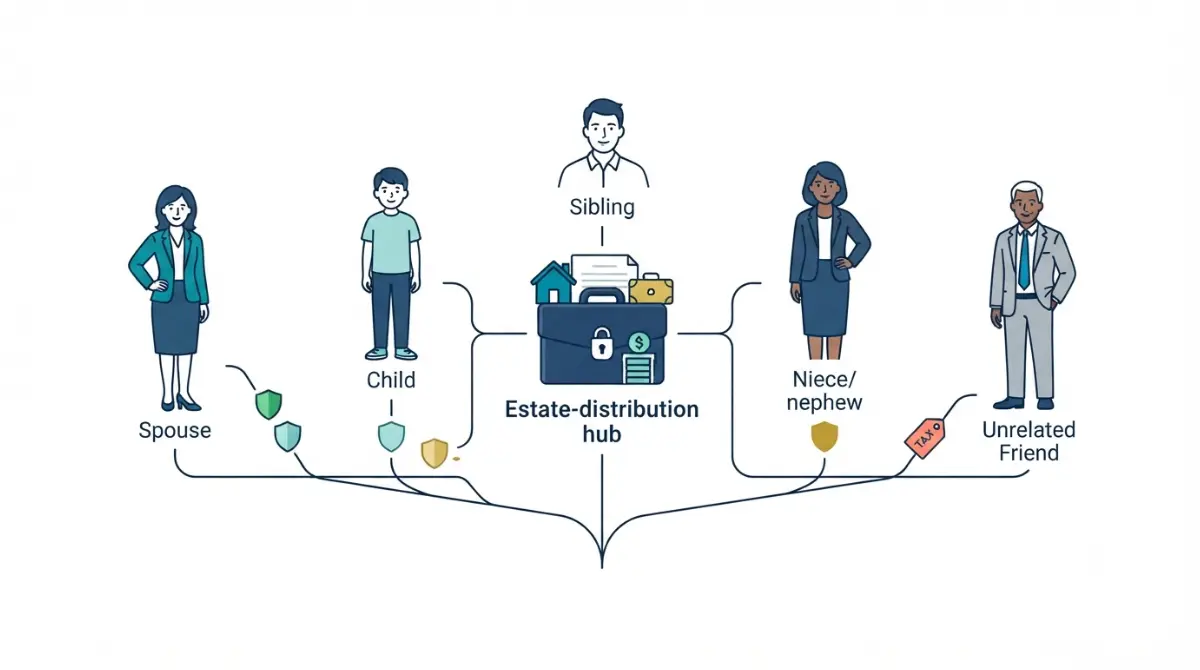
An estate tax is charged on the whole estate and paid before anything is distributed. An inheritance tax is charged separately on each heir’s share, and the rate depends on how closely that heir was related to the person who died.
🔍 How It Works: If one bill is calculated on everything the person left, it’s an estate tax. If each person who inherits gets their own calculation, it’s an inheritance tax. Maryland is the only state that charges both.
The five states that tax heirs in 2026
Kentucky, Maryland, Nebraska, New Jersey and Pennsylvania. Iowa’s inheritance tax ended for deaths on or after January 1, 2025, though some online tables still list it.
Whose state rules apply
The rules follow the person who died, not the heir. Kentucky, for example, taxes a resident’s property (except out-of-state real estate) and Kentucky property owned by nonresidents. That means an heir living in Florida can still owe.
Inheritance tax rates in the five states
Each state sorts heirs into classes, and the class sets the inheritance tax rate.
Pennsylvania
Spouses pay 0%, as do transfers between a parent and a child 21 or younger. Children, grandchildren and parents pay 4.5%, siblings pay 12%, and everyone else pays 15%.
New Jersey
Class A heirs (spouses, children, grandchildren, parents, stepchildren) are exempt. Siblings and children-in-law get $25,000 tax-free, then pay 11% rising to 16%. Everyone else pays 15% up to $700,000 and 16% above that.
Kentucky
Spouses, parents, children, grandchildren and siblings are exempt. Nieces, nephews, aunts, uncles and in-laws pay 4% to 16% after $1,000. Everyone else pays 6% to 16% after $500.
Nebraska
Spouses and heirs under 22 are exempt. Close relatives, including siblings, pay 1% above $100,000. Nieces, nephews, aunts and uncles pay 11% above $40,000, and everyone else pays 15% above $25,000.
Maryland
Close family, including siblings, is exempt. Other heirs pay a flat 10%, and the first $1,000 to each person is exempt.
⚠️ Costly Mistake: Some widely shared tables still quote Nebraska’s pre-2023 rates of 13% and 18%. The rules in effect on the date of death decide the bill, so match the rate to that date.
Do children, siblings or friends pay inheritance tax?
Your relationship to the decedent matters more than the size of the estate. Spouses are exempt in all five states.
| State | Child | Sibling | Niece or nephew | Unrelated heir |
|---|---|---|---|---|
| Kentucky | Exempt | Exempt | 4–16% after $1,000 | 6–16% after $500 |
| Maryland | Exempt | Exempt | 10% after $1,000 | 10% after $1,000 |
| Nebraska | 1% over $100,000 (exempt under 22) | 1% over $100,000 | 11% over $40,000 | 15% over $25,000 |
| New Jersey | Exempt | 11–16% after $25,000 | 15–16% | 15–16% |
| Pennsylvania | 4.5% (0% if 21 or younger) | 12% | 15% | 15% |
Sources: Kentucky, Nebraska, New Jersey, Pennsylvania and Maryland tax agencies and statutes, checked September 2026.
Spouses and children
Children owe nothing in three states. Pennsylvania charges them 4.5% from the first dollar.
Siblings
Siblings range from fully exempt in Kentucky and Maryland to 12% in Pennsylvania.
Nieces, nephews and friends
These heirs pay the highest rates everywhere, often 10% to 16%.
Worked example: $150,000 to a sibling
🔍 How It Works: Here is one $150,000 inheritance, before deductions such as debts and funeral costs.
- Kentucky: $0
- Maryland: $0
- Nebraska: 1% × $50,000 = $500
- New Jersey: 11% × $125,000 = $13,750
- Pennsylvania: 12% × $150,000 = $18,000, or $17,100 if paid within three months
Which states have an estate tax and their 2026 limits
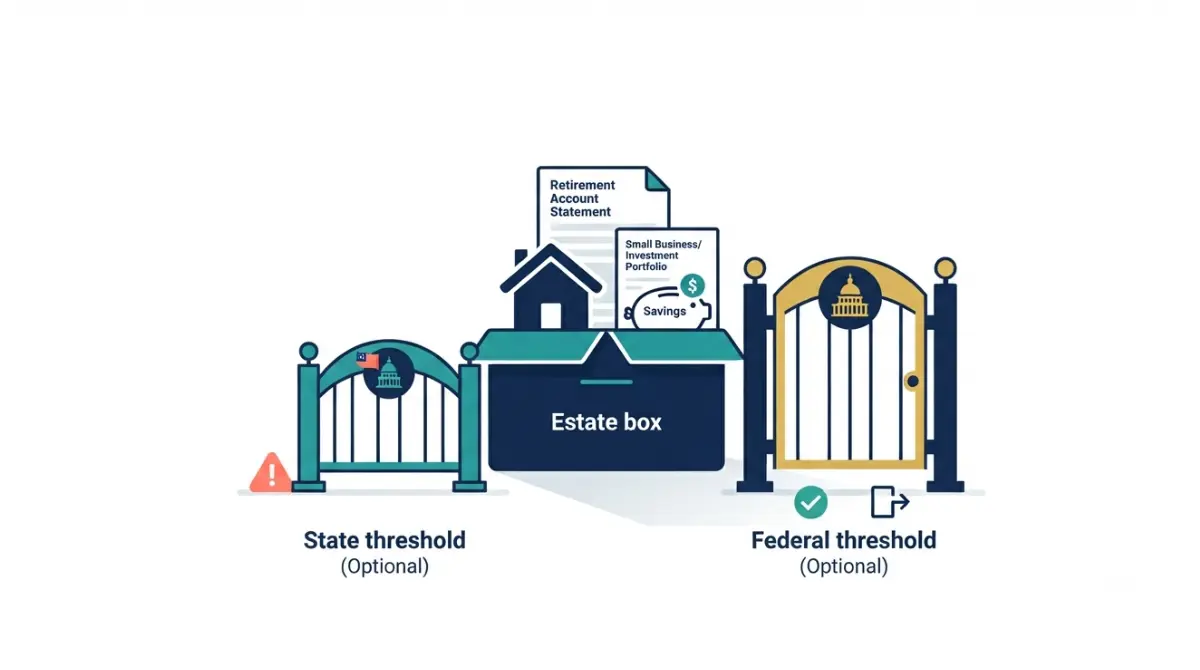
Twelve states and DC tax estates, many far below the federal line.
Federal exemption for 2026
📊 Data Point: Estates of people who die in 2026 can pass $15,000,000 free of federal estate tax, up from $13,990,000 for 2025 deaths. Source: the IRS’s 2026 inflation adjustments (IRS, October 2025).
See who actually pays estate tax for how the federal tax works.
Lowest state thresholds
Oregon starts at $1,000,000, followed by Rhode Island and Massachusetts at about $2 million or less.
| State | 2026 exemption | Top rate | Key detail |
|---|---|---|---|
| Oregon | $1,000,000 | 16% | Not indexed |
| Rhode Island | $1,838,056 | 16% | Indexed yearly |
| Massachusetts | $2,000,000 | 16% | Not indexed |
| Minnesota | $3,000,000 | 16% | 3-year gift add-back |
| Washington | $3,076,000 (Jan–Jun) / $3,000,000 (Jul–Dec) | 35% / 20% | Date of death decides |
| Illinois | $4,000,000 | 16% | Not indexed |
| District of Columbia | $4,988,400 | 16% | — |
| Maryland | $5,000,000 | 16% | Also has inheritance tax |
| Vermont | $5,000,000 | 16% | 2-year gift add-back |
| Hawaii | $5,490,000 | 20% | Portability by election |
| Maine | $7,160,000 | 12% | 1-year gift add-back |
| New York | $7,350,000 | 16% | 105% cliff |
| Connecticut | $15,000,000 | 12% | Matches federal |
Sources: each state’s tax agency or statute, checked September 2026.
Washington’s mid-year change
For deaths through June 30, 2026, Washington’s exclusion is $3,076,000 with a 35% top rate. For deaths on or after July 1, 2026, it’s $3,000,000 with a 20% top rate.
New York’s cliff
🔍 How It Works: If a New York estate exceeds 105% of $7,350,000 ($7,717,500), the exemption disappears and the entire estate is taxed.
Compare the federal numbers in our 2026 estate tax exemption guide.
✅ Action Step: Ask an estate attorney licensed in your state: “Will my estate, including my home and retirement accounts, cross this state’s threshold, and does the state allow portability between spouses?”
What to do if an inheritance tax bill is due
The executor usually files the return and pays the inheritance tax from the estate before distributing shares.
Filing deadlines by state
In Pennsylvania, the return is due nine months after death. Nebraska’s tax is due within one year. New Jersey’s is due within eight months.
Early-payment discounts
Pennsylvania takes 5% off tax paid within three months of death. Kentucky allows 5% off tax paid within nine months.
Who files the return
In Pennsylvania, if no executor is named, the person receiving the property files.
✅ Action Step: Ask a CPA or a qualified estate planning attorney: “Does the estate have enough cash to pay early and take the discount?”
Common inheritance and estate tax traps
Assets outside the will can still be taxed
Skipping probate doesn’t mean skipping tax. In Pennsylvania, jointly held assets with someone other than a spouse are generally taxable. See the assets that pass outside a will.
No state portability
New York, Washington, Connecticut, Massachusetts and most other estate-tax states don’t let a surviving spouse use the unused state exemption. Maryland and Hawaii allow it by timely election. Our estate planning checklist lists what to review with an attorney.
Frequently asked questions
1. Which states have inheritance tax in 2026?
Kentucky, Maryland, Nebraska, New Jersey and Pennsylvania are the states with inheritance tax. Iowa’s inheritance tax ended for deaths from January 2025. A CPA can confirm what applies to you.
2. Is there a federal inheritance tax?
No. There’s no federal inheritance tax; the federal estate tax applies only to estates above $15,000,000 for 2026 deaths. Confirm your situation with a CPA.
3. Does the heir’s state or the decedent’s state decide inheritance tax?
The decedent’s state decides inheritance tax, along with where their real estate sits. An out-of-state heir can still owe. An estate attorney can confirm which state applies.
4. Do children pay inheritance tax?
Children pay no inheritance tax in Kentucky, Maryland or New Jersey. They pay 1% above $100,000 in Nebraska and 4.5% in Pennsylvania. Ask a CPA about your share.
5. Do siblings pay inheritance tax?
Siblings are exempt from inheritance tax in Kentucky and Maryland. They pay 1% above $100,000 in Nebraska, 11% after $25,000 in New Jersey, and 12% in Pennsylvania. Confirm with a CPA.
6. How much is Pennsylvania inheritance tax?
Pennsylvania inheritance tax is 0% for spouses, 4.5% for children and parents, 12% for siblings and 15% for other heirs. A CPA can check your class.
7. Which state has the lowest estate tax exemption?
Oregon has the lowest estate tax exemption at $1,000,000, followed by Rhode Island and Massachusetts. An estate attorney can review your exposure.
8. What is the federal estate tax exemption for 2026?
The federal estate tax exemption is $15,000,000 per person for 2026 deaths, up from $13,990,000 in 2025. Confirm planning details with an estate attorney.
9. What is New York’s estate tax cliff?
Under New York’s estate tax cliff, an estate above $7,717,500 (105% of $7,350,000) loses its exemption and is taxed in full. An estate attorney can model this.
10. Can inheritance tax be paid early for a discount?
Yes. Pennsylvania cuts inheritance tax 5% if it’s paid within three months, and Kentucky cuts it 5% if paid within nine months. Ask the estate’s CPA about timing.
11. Is jointly owned property subject to inheritance tax in Pennsylvania?
Property jointly owned by spouses is exempt from Pennsylvania inheritance tax, but assets held jointly with anyone else are generally taxable. Confirm with a Pennsylvania estate attorney.
The three facts that decide what you owe
Three things decide whether any tax is due: where the person who died lived or owned property, your relationship to them, and the date of death. Check all three against the tables above. If a bill looks likely, bring these questions to a CPA or estate attorney before any money is distributed.
Related Articles
 Estate Planning
Online Will vs Lawyer Decisions Made Clear for Your Family
September 21, 2026 Estate Planning
When an Irrevocable Trust Is the Right Trade for Your Family
September 29, 2026 Estate Planning
Key Rules for the $19,000 Annual Gift Tax Exclusion and Form 709
September 24, 2026 Estate Planning
Your Executor Duties After Someone Dies, in Plain English
October 1, 2026 Estate Planning
Where a Transfer on Death Deed Works and Where It Goes Wrong
September 28, 2026 Estate Planning
How a step-up in basis can cut tax on inherited stock
September 26, 2026 Estate Planning
How to make a will and avoid the errors that void it
September 18, 2026 Estate Planning
Will vs Trust and How to Find the Right Fit for Your Family
September 17, 2026 Estate Planning
Naming a Guardian for Minor Children in Your Will, Step by Step
October 2, 2026
Informational disclaimer
The content on Finance Authority Hub is provided for general informational and educational purposes only and should not be considered personalized financial, investment, tax, legal, or professional advice. Financial decisions depend on your individual goals, income, risk tolerance, location, and regulatory situation. Before acting on any information, strategy, estimate, or calculator result, consult a qualified licensed professional who can evaluate your specific circumstances.