
Who Pays Estate Tax, and How Rarely Estates Actually Owe It
Estate tax is paid by the executor from estate funds, not by heirs. Just 7,195 returns were filed in 2024, and filing isn’t the same as owing.

In This Article
Who actually pays federal estate tax
Federal estate tax is paid by the estate itself, through its executor, before heirs receive anything. It applies only when the estate exceeds the $15 million basic exclusion for 2026 deaths.
It’s rare. Just 7,195 estate tax returns were filed in 2024, and filing a return doesn’t mean tax was owed.
If you’re an heir
You won’t receive a federal estate tax bill. Section 2 explains how state inheritance taxes differ.
If you’re the executor
Sections 3, 6 and 7 cover the threshold, the math, and one filing that matters even when no tax is due.
ℹ️ Financial Disclaimer: This article is for educational purposes only. It is not personalized tax, legal, investment, insurance, lending/credit or debt-relief advice. Estate tax outcomes depend on asset valuations, deductions, lifetime gifts and state law. Before filing Form 706 or making estate-planning decisions, consult a CPA, an estate-planning attorney or a fiduciary financial advisor.
Does the estate or the heirs pay estate tax?
The executor pays any federal estate tax from estate assets before distributing what remains.
What the executor pays and when
The estate tax return, Form 706, is generally due nine months after death. Most are filed in the following calendar year. Heirs receive their share after the tax is settled.
Estate tax vs. inheritance tax
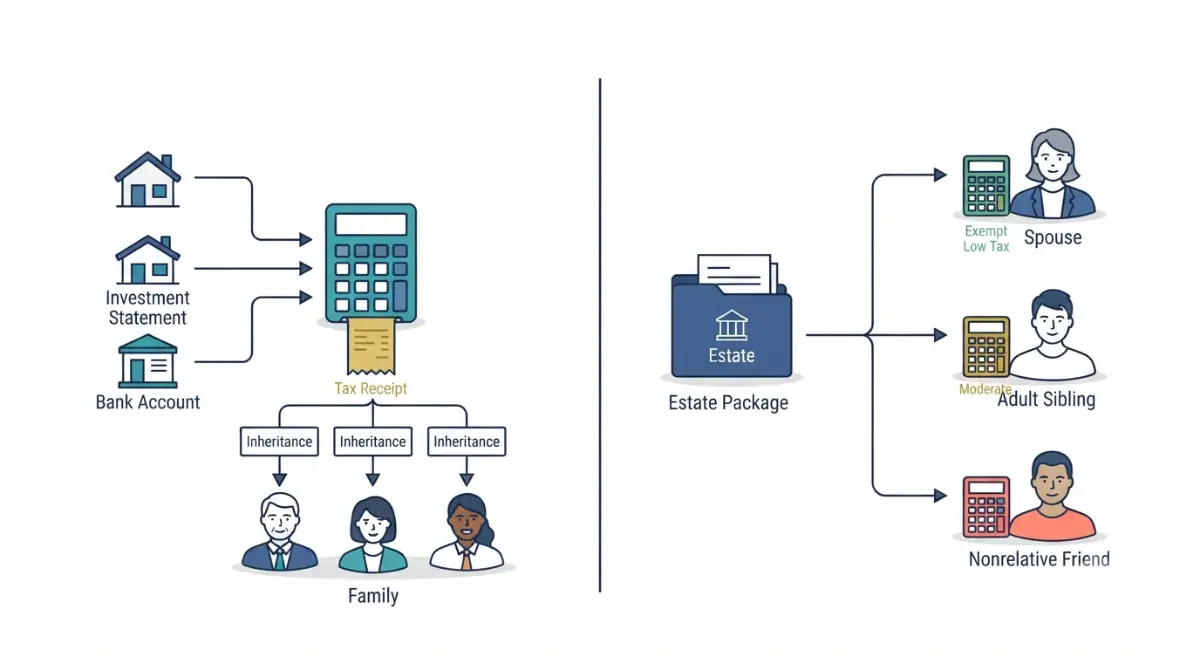
An inheritance tax is a state-level tax that a beneficiary may owe. There is no federal inheritance tax. Whether a state tax applies depends on where the deceased lived and your relationship to them.
What counts in the gross estate
The IRS counts real estate, cash, stocks, bonds, business interests and life insurance the decedent owned. Deductions include debts, administrative expenses, and transfers to a spouse or charity. How assets pass, whether by a will compared with a living trust, doesn’t remove them from this count.
🔍 How It Works: Gross estate minus allowable deductions equals the taxable estate. Tax is figured only on the amount that, combined with lifetime taxable gifts, exceeds the exclusion.
The 2026 estate tax threshold and rate, explained
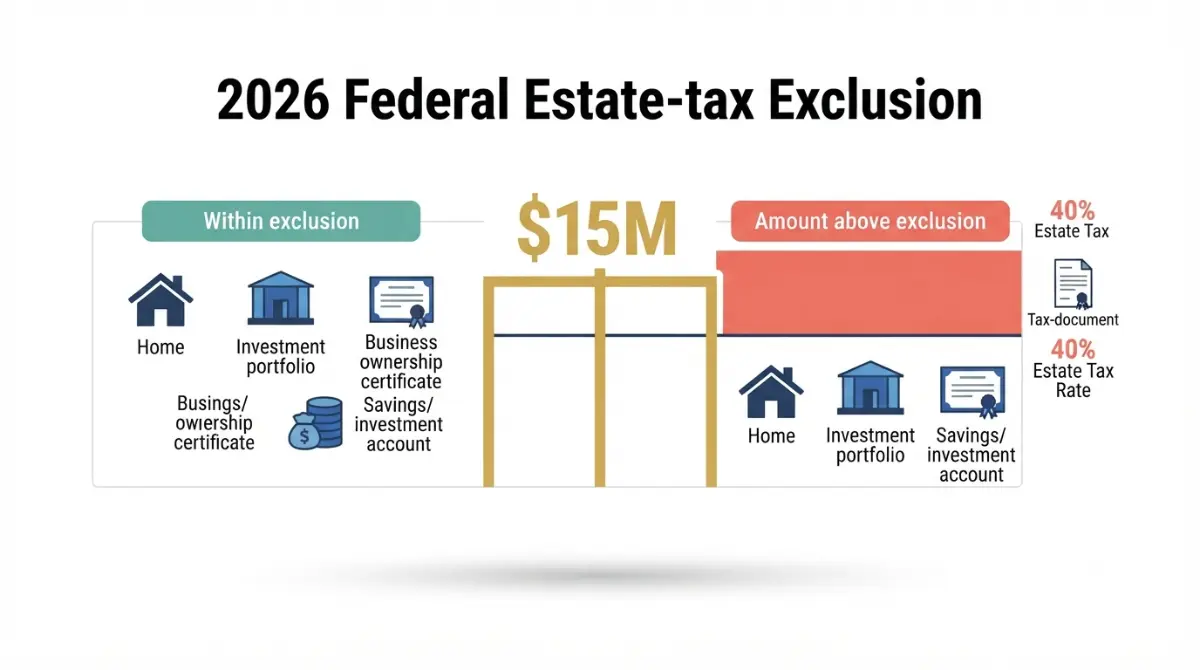
For deaths in 2026, the federal basic exclusion amount is $15,000,000, set by Public Law 119-21.
The $15 million basic exclusion for 2026
| Year of death | Filing threshold | Increase to reach 2026 | Key detail |
|---|---|---|---|
| 2018 | $11,180,000 | +34.2% | First year after the 2017 tax law increase |
| 2024 | $13,610,000 | +10.2% | Applies to most returns filed in 2025 |
| 2025 | $13,990,000 | +7.2% | Last year before the new law |
| 2026 | $15,000,000 | — | Set by Public Law 119-21 |
Source: IRS filing threshold table in the IRS estate tax FAQs. Percentage changes calculated by FinanceAuthorityHub.
How the threshold changed since 2018
The 2017 tax law raised the threshold’s base from $5 million to $10 million. The 2025 law raised it to $15 million, with inflation adjustments going forward. You can see how inflation indexing moves a dollar figure over time with our inflation calculator.
What the 40% top rate applies to
The IRS rate schedule tops out at 40% on amounts over $1 million. The 2026 credit of $5,945,800 cancels the tax on the first $15 million. So every dollar above the exclusion is effectively taxed at 40%. Our complete guide to the estate tax exemption covers lifetime gifts and planning details.
What IRS filing data shows about who pays
Estate tax returns are rare, and getting rarer. Filings fell 20%, from 9,024 in 2023 to 7,195 in 2024.
📊 Data Point: Net estate tax reported on returns filed in 2024 was just over $23.3 billion — Source: IRS Publication 5332 (Rev. July 2026).
Threshold vs. filings
| Filing year | Returns filed | Net estate tax reported | Threshold for most deaths in that filing year | Key detail |
|---|---|---|---|---|
| 2023 | 9,024 | Roughly $44 billion or more (calculated) | $12,060,000 (2022 deaths) | Inflated by a few $50M+ estates |
| 2024 | 7,195 | Just over $23.3 billion | $12,920,000 (2023 deaths) | Latest IRS data |
| 2027 (projected) | Not yet reported | Not yet reported | $15,000,000 (2026 deaths) | First filings under the new law |
Source: IRS Publication 5332 (Rev. July 2026) and the IRS filing threshold table. The 2023 tax figure is calculated from the IRS’s reported decline of more than 47.5%.
Filing a return isn’t the same as owing tax
Filing is triggered by the gross estate plus lifetime gifts. Deductions for a spouse or charity can then reduce the tax to zero. Of the 7,195 returns filed in 2024, were taxable.
For scale, the Tax Policy Center estimated that only about 0.14% of 2022 decedents would pay any estate tax.
Why 2023’s numbers were an outlier
The IRS attributes the drop in 2024 largely to unusually large tax payments by estates over $50 million in 2023.
Why filing years mix several death years
Returns filed in one year can belong to decedents who died in different years, so each year blends thresholds. The full IRS estate tax filing-year statistics break this down.
Where estate tax filers live and what they own
California filed the most estate tax returns in 2024, followed by Florida, New York, Texas and Illinois.
States with the most estate tax returns
Relative to adult population, the leaders were Wyoming, Florida, Connecticut, California and the District of Columbia. Wyoming tops the per-capita list despite missing the top five by raw count.
Stocks and real estate dominate
Stocks and real estate made up nearly 57% of estate tax decedents’ assets. If your home is your largest asset, our home equity calculator shows how much of its value you own outright.
How the $50M+ estates differ
The largest estates held 45% in stocks and just 1.8% in pensions and 401(k)s, according to the IRS’s 2015–2024 estate tax data summary.
Retirement accounts pass to named beneficiaries, who may owe income tax on withdrawals. That is a separate issue from estate tax, covered in our guide to the inherited IRA 10-year rule.
How much estate tax would an estate over $15M owe?
Only the amount above the exclusion is taxed, and in 2026 it’s taxed at 40%.
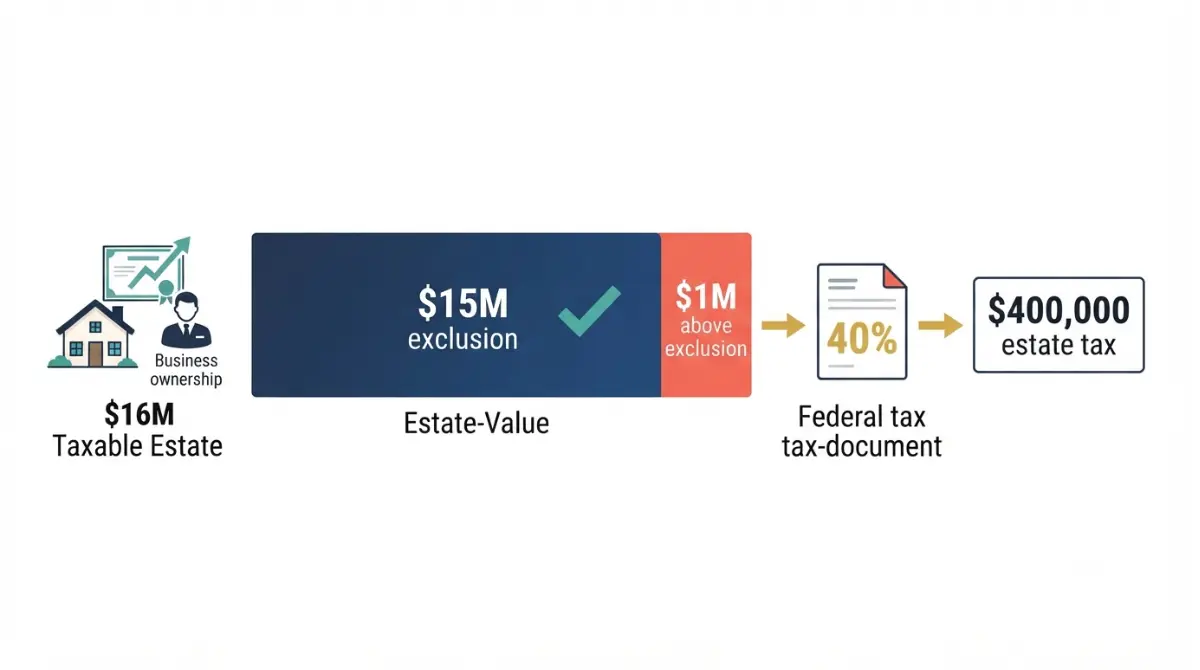
A single decedent with a $16M taxable estate
🔍 How It Works: This example assumes a 2026 death, no lifetime taxable gifts, and no further deductions. It is illustrative only.
- Tentative tax on $16,000,000: $345,800 + (40% × $15,000,000) = $6,345,800
- Subtract the 2026 basic credit amount: $5,945,800
- Federal estate tax: $400,000, which is 40% of the $1 million above the exclusion
Figures from the IRS Form 706 instructions and rate schedule.
A married couple using the marital deduction and portability
Transfers to a surviving spouse are deductible, which can reduce the first spouse’s estate tax to zero. The executor can also pass the unused exclusion to the survivor. This is called a portability election, and it happens only by filing Form 706.
✅ Action Step: Before the nine-month deadline, ask a CPA or an estate-planning attorney you’ve vetted: “Should we file Form 706 to elect portability even though no tax is due?”
Estate tax mistakes families below $15M still make
Most estates owe nothing federally, but three mistakes still cost families.
Skipping Form 706 and losing the spouse’s unused exemption
⚠️ Costly Mistake: The IRS requires Form 706 to transfer a spouse’s unused exclusion, regardless of estate size. Skip it, and the survivor may lose that exclusion. A six-month extension requires a timely request and payment of estimated tax, per the IRS due-date and extension rules.
Forgetting state estate taxes
Some states tax estates far smaller than the federal threshold. Check your state revenue department’s estate tax page before assuming nothing is owed.
Undercounting life insurance and accounts outside the will
Life insurance the decedent owned counts toward the gross estate, even though it skips probate. Learn how these assets that pass outside a will work, and review how life insurance policies are structured.
Frequently asked questions about who pays estate tax
1. Who pays federal estate tax, the estate or heirs?
The estate pays federal estate tax through its executor before assets are distributed, so heirs don’t receive a federal estate tax bill. An estate attorney can confirm whether your state adds its own tax.
2. What is the estate tax exemption for 2026?
The federal estate tax exemption for 2026 deaths is $15,000,000 per person, set by Public Law 119-21. A CPA can confirm how lifetime gifts reduce it.
3. How many estates file estate tax returns?
The IRS reports that 7,195 estate tax returns were filed in 2024, down 20% from 9,024 filed in 2023.
4. How much estate tax is reported to the IRS?
Estate tax returns filed in 2024 reported just over $23.3 billion in net estate tax, according to IRS Publication 5332.
5. What is the federal estate tax rate?
The top federal estate tax rate is 40%, and in 2026 it effectively applies to every dollar above the $15 million exclusion. A CPA can run your estate’s numbers.
6. Do married couples get double the exemption?
Married couples can combine exemptions through portability, but the first spouse’s executor must file Form 706 to transfer the unused estate tax exclusion. Ask a CPA whether filing makes sense.
7. When is the estate tax return due?
The estate tax return, Form 706, is generally due nine months after death. A six-month extension requires a timely request and payment of estimated tax. A CPA can track the deadline.
8. Does life insurance count toward the estate?
Life insurance the decedent owned counts in the gross estate for estate tax purposes, even when it passes directly to a named beneficiary. An estate attorney can review policy ownership.
9. Which states file the most estate tax returns?
California filed the most estate tax returns in 2024, followed by Florida, New York, Texas and Illinois, per IRS data.
10. Is estate tax the same as inheritance tax?
No. Estate tax is paid by the estate before distribution, while inheritance tax is a state-level tax a beneficiary may owe. An estate attorney can confirm your state’s rules.
11. Will the $15 million exemption change?
The $15 million estate tax threshold is subject to inflation adjustment under the 2025 law, so future years’ amounts may rise. A CPA can confirm each year’s figure.
What to do next
Federal estate tax is paid by the estate, only above $15 million, and IRS data shows how rarely that happens. If a spouse survives, weigh the portability filing within nine months.
Our estate planning checklist covers the remaining steps. You can also project how your savings may grow over time with our investment growth calculator.
Related Articles
 Estate Planning
States With Inheritance Tax, Estate Tax Limits and Who Pays
September 24, 2026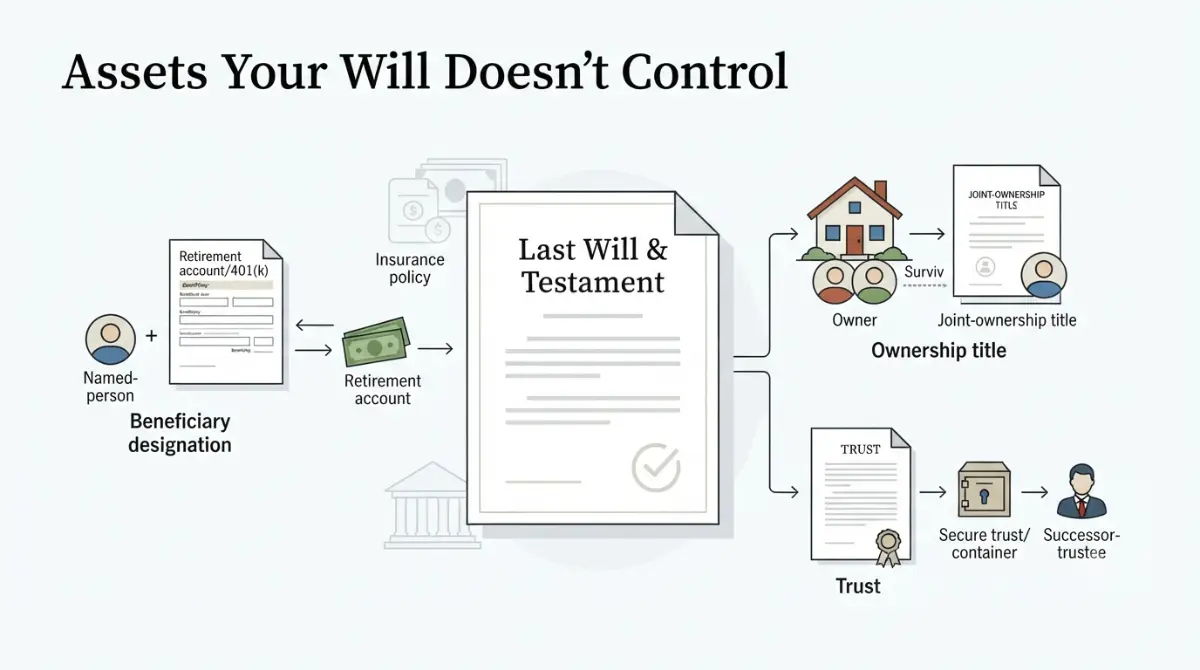 Estate Planning
Assets Not Covered by a Will and the Hidden Rules on Who Inherits
September 16, 2026 Estate Planning
What Is Probate? A Clear Guide to Steps, Timing, and Cost
September 26, 2026 Estate Planning
How a Special Needs Trust Can Protect SSI and Medicaid
September 30, 2026 Estate Planning
A Clear Blended Family Estate Planning Guide for Stepkids
October 5, 2026 Estate Planning
A Clear Look at What Happens If You Die Without a Will
September 30, 2026 Estate Planning
What Your Agent Can Legally Do Under a Durable Power of Attorney
September 29, 2026 Estate Planning
A Clear Signing Order for Estate Planning After Diagnosis
October 2, 2026 Estate Planning
How to make a will and avoid the errors that void it
September 18, 2026
Informational disclaimer
The content on Finance Authority Hub is provided for general informational and educational purposes only and should not be considered personalized financial, investment, tax, legal, or professional advice. Financial decisions depend on your individual goals, income, risk tolerance, location, and regulatory situation. Before acting on any information, strategy, estimate, or calculator result, consult a qualified licensed professional who can evaluate your specific circumstances.