
What Is Probate? A Clear Guide to Steps, Timing, and Cost
Probate can’t close before its creditor window ends: 3 to 4 months after notice in states like Idaho and Utah. Here’s what sets the real timeline.
In This Article
What is probate, in plain terms?
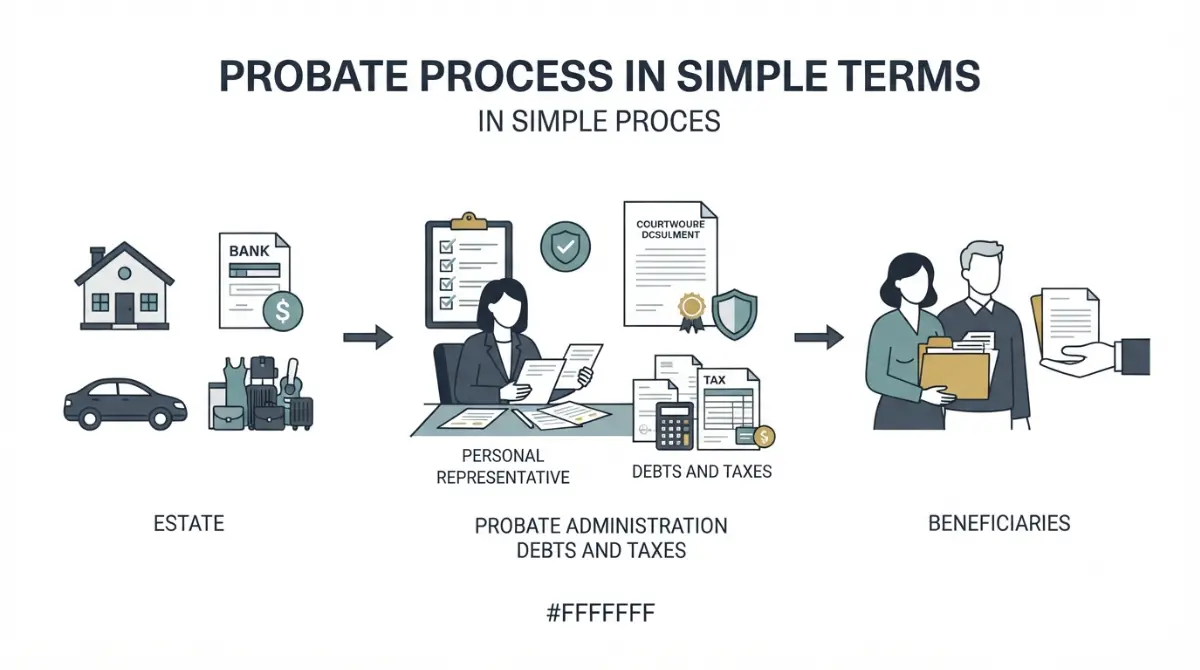
Probate is the court-supervised process that confirms a will, pays a deceased person’s debts, and transfers what’s left to heirs. If there’s no will, state law decides who inherits, and the court still oversees the process.
Who handles probate: executor vs. administrator
The person named in a will to run the estate is the executor. Without a will, the court appoints an administrator, usually a spouse, adult child, or other close relative. The law calls both roles a personal representative.
Where to jump in this guide
- You’re the executor: start with the step-by-step process.
- The estate includes a house: read the timeline and cost sections.
- Most assets had named beneficiaries: check what skips probate, then the small-estate shortcuts.
ℹ️ Financial Disclaimer: This article explains probate, estate debts, and estate taxes for general education only. It is not legal, tax, investment, insurance, lending, or debt-relief advice, and probate rules differ by state. Before acting, consult a licensed probate attorney in the state where the person lived and a CPA for any estate or income tax filing.
What goes through probate, and what skips it
Probate only covers assets the person owned in their own name with no built-in instructions for who gets them.
Assets that usually go through probate
- A house or car titled only in the deceased person’s name
- Bank or brokerage accounts with no named beneficiary or joint owner
- Personal belongings such as furniture, jewelry, and collectibles
Assets that pass directly to someone
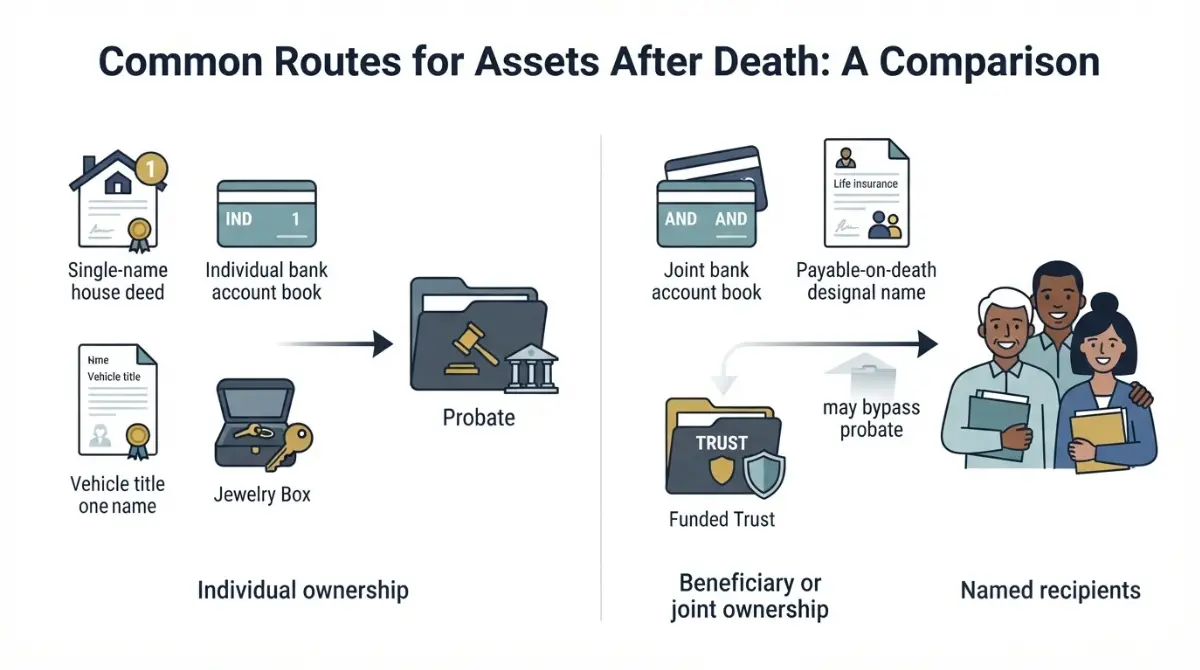
Joint tenancy with right of survivorship and payable-on-death accounts are the most common ways property passes outside probate. Life insurance with a named beneficiary and assets held in a properly set-up living trust usually skip probate too. Our pillar guide covers every type of asset that passes outside a will, and retirement accounts have their own inherited IRA 10-year rule.
Does having a will avoid probate?
No. A will tells the probate court what to do; it doesn’t bypass the court. See how a will compares with a living trust on this point.
The probate process, step by step
Most US probate cases follow the same basic sequence, even though forms and deadlines vary by state.
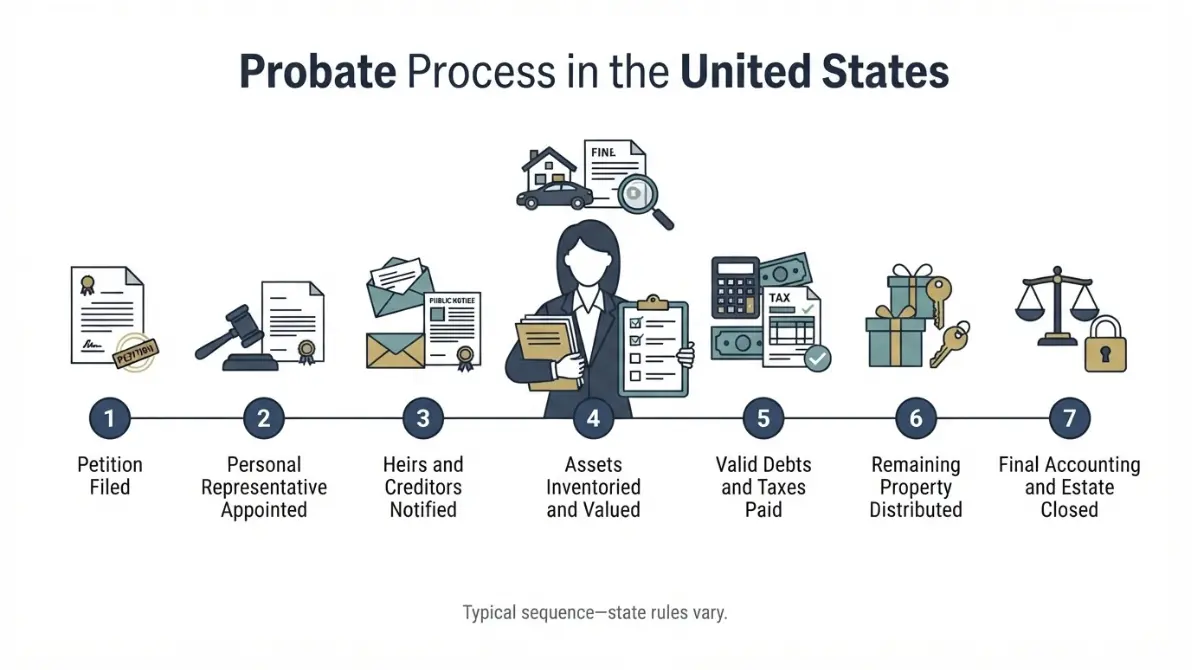
- File a petition with the probate court in the county where the person lived.
- Get appointed and receive legal authority to act for the estate.
- Notify heirs and creditors. This starts the creditor clock.
- Inventory and value assets as of the date of death.
- Pay valid debts, expenses, and taxes from estate funds.
- Distribute what remains under the will or state law.
- File a final accounting and close the estate.
Getting appointed: letters testamentary
The court issues letters testamentary when there’s a will, or letters of administration when there isn’t. These letters are your proof of authority to act for the estate.
Notifying creditors and heirs
A notice to creditors is published, known creditors get written notice, and heirs and named beneficiaries are told about the case.
Paying debts, then distributing
Bills and taxes are paid before beneficiaries receive anything. IRS Publication 559 for executors explains the federal tax returns involved.
✅ Action Step: Before you file, ask a probate attorney: “Does our state allow informal probate, or must this estate be court-supervised?” Our guide on choosing an estate planning attorney covers what to check first.
How long does probate take?
Probate usually can’t close before the creditor claim window ends, so that window sets the minimum length.
| State | Creditor or closing rule | Key Detail |
|---|---|---|
| Idaho | Claims due 4 months after first published notice | Uniform Probate Code state |
| New Mexico | Claims due 4 months after first published notice | Uniform Probate Code state |
| Utah | Claims due 3 months after first published notice | Shorter version of the same rule |
| Florida | Estate generally closes within 12 months of opening | Longer if the court allows |
Sources: Idaho Code §15-3-801; N.M. Stat. §45-3-801; Utah Code §75-3-801; American College of Trust and Estate Counsel (ACTEC). Examples only, not a full state list.
Why the creditor window sets the minimum
🔍 How It Works: The creditor clock usually starts when the notice is first published, which happens after the court appoints the personal representative. Appointment takes time, then the full window must run, then claims are paid and the accounting is filed. Timelines start at the length of that window and go up from there.
What stretches probate past a year
Disputes between heirs are what most often make probate slow and difficult. Real estate that must be sold, a business that must be valued, or an estate tax return can add months.
How much does probate cost?
Probate costs are paid from the estate and usually include attorney fees, the personal representative’s pay, and court costs such as filing, newspaper notice, and appraisal fees. Most states allow “reasonable” fees, but California sets them by law, which makes the math easy to show.
Worked example: a $500,000 California estate
| Fee tier | Rate | Fee on a $500,000 estate |
|---|---|---|
| First $100,000 | 4% | $4,000 |
| Next $100,000 | 3% | $3,000 |
| Remaining $300,000 | 2% | $6,000 |
| Attorney fee (Probate Code §10810) | — | $13,000 |
| Executor fee (§10800, same schedule) | — | $13,000 |
| Combined | 5.2% of gross | $26,000 |
Source: California Probate Code §§10800, 10810. Calculation by FinanceAuthorityHub.
🔍 How It Works: California figures these fees on the estate’s gross value, without subtracting any mortgage. If that $500,000 home carries a $300,000 mortgage, the family’s equity is $200,000, yet the fees are still based on $500,000. The $26,000 equals 13% of the family’s actual equity. You can check a home’s equity with our home equity calculator.
Attorneys can also bill for extra work, such as litigation or selling real estate, on top of these fees.
Who pays probate fees
The estate pays them before heirs receive their share, so the fees reduce every inheritance rather than coming out of heirs’ own pockets.
💡 Expert Note: The American Bar Association notes that most probate cases are neither expensive nor drawn out, and that claims to the contrary often come from companies selling living trusts. Compare the full picture in our estate planning cost guide.
When probate is skipped: small estates and shortcuts
Many estates never need full probate because states offer simpler procedures below a set dollar limit.
What a small estate affidavit is
A small estate affidavit is a sworn statement an heir gives to a bank or other institution to collect property without opening a court case.
Example state thresholds
| State | Limit | Waiting period | Key Detail |
|---|---|---|---|
| California | $208,850 in qualifying personal property | 40 days after death | Deaths on or after April 1, 2025 |
| South Dakota | $100,000 in probate assets | 30 days after death | No court filing required |
📊 Data Point: California’s limit is $208,850 for deaths on or after April 1, 2025. Source: Judicial Council of California, form DE-300 (rev. April 2025). The limit in effect on the date of death applies, not the limit on the filing date.
A 3-question check before you file
- Did the major assets have a named beneficiary, a joint owner, or trust ownership?
- Are the remaining probate assets under your state’s limit?
- Is there real estate titled only in the deceased person’s name? If yes, some court process is likely.
A living trust only avoids probate if assets were actually moved into it. See how to fund a living trust.
✅ Action Step: Ask a probate attorney: “Does this estate qualify for our state’s simplified procedure, and which assets count toward the limit?”
Debts, taxes, and mistakes executors should avoid
In most cases, the estate handles the deceased person’s debts and taxes, not family members’ own bank accounts.
Do family members inherit the debt?
Usually not. Debts are paid from the estate, and if the estate can’t cover them and no one else shared responsibility, the debt may go unpaid, according to CFPB guidance on a deceased person’s debts. The FTC names the exceptions: co-signers, spouses in community property states, and personal representatives who didn’t follow state probate rules.
⚠️ Costly Mistake: Don’t pay a relative’s debt from your own money just because a collector calls. Debt collectors aren’t allowed to suggest you’re responsible when you aren’t. Point them to the personal representative instead.
Estate tax returns: who files
Most families owe no federal estate tax: the 2026 estate tax exclusion is $15 million per person. Separately, an estate earning more than $600 in annual gross income must file Form 1041 under the IRS rules on estate income tax returns. Related guides: the estate tax exemption and how inherited stock is taxed.
✅ Action Step: Ask a CPA: “Does this estate need Form 1041, Form 706, or both, and when is each due?”
Frequently asked questions about probate
1. What is probate in simple terms?
Probate is the court process that confirms a will, pays the deceased person’s debts, and transfers remaining property to heirs.
2. What assets don’t go through probate?
Joint accounts with survivorship rights, payable-on-death accounts, life insurance with a named beneficiary, and assets in a funded living trust usually skip probate.
3. Do you need probate if there’s a will?
Usually yes. A will directs the probate court on who inherits; it doesn’t avoid probate for assets titled only in the deceased’s name.
4. What are the steps of probate?
Probate steps are: file a petition, get appointed, notify heirs and creditors, inventory assets, pay debts and taxes, distribute property, and close.
5. How long does probate take?
Probate can’t close before the creditor window ends, which is 3 to 4 months after published notice in the example states above.
6. How much does probate cost?
Probate costs vary by state. In California, combined statutory fees on a $500,000 estate are $26,000, calculated on gross value.
7. Who pays probate fees?
The estate pays probate fees before distributions, so heirs don’t pay out of pocket, but each inheritance shrinks by the fee amount.
8. What is a small estate affidavit?
A small estate affidavit is a sworn statement letting heirs collect property directly from institutions without opening a probate case in court.
9. How small must an estate be to skip probate?
It depends on the state and date of death. California allows $208,850 in qualifying personal property for deaths on or after April 1, 2025.
10. Do family members inherit the deceased’s debt?
Usually not. The estate pays debts, and unpaid debts often go unpaid unless you co-signed or another exception applies. Confirm your situation with a probate attorney.
11. Does an estate file its own tax return?
Yes, if the estate earns more than $600 in annual gross income, it files Form 1041 with the IRS. Ask a CPA which returns this estate needs.
Your next steps
Gather the will and several certified death certificates. List every asset by how it’s titled, check your state’s small-estate limit, then call a probate attorney with your questions ready. Our estate planning checklist helps you organize the paperwork.
Related Articles
 Estate Planning
The Right Way to Read the Percentage of Americans With a Will
October 5, 2026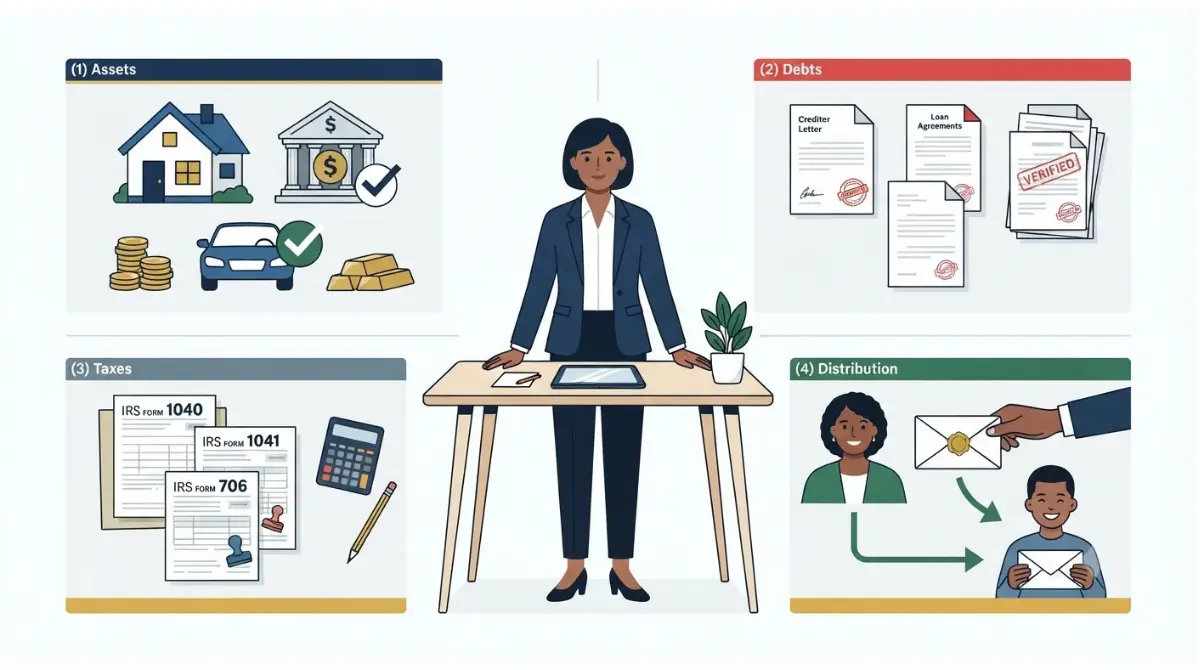 Estate Planning
Your Executor Duties After Someone Dies, in Plain English
October 1, 2026 Estate Planning
How to Choose an Estate Planning Attorney You Can Verify
September 22, 2026 Estate Planning
States With Inheritance Tax, Estate Tax Limits and Who Pays
September 24, 2026 Estate Planning
What Your Agent Can Legally Do Under a Durable Power of Attorney
September 29, 2026 Estate Planning
How a step-up in basis can cut tax on inherited stock
September 26, 2026 Estate Planning
Living Will vs Health Care Proxy and Who Speaks for You
September 29, 2026 Estate Planning
A Clear Price Guide to the Best Online Will Service
September 22, 2026 Estate Planning
Gifting a House vs Inheritance and What Your Child Will Owe
September 26, 2026
Informational disclaimer
The content on Finance Authority Hub is provided for general informational and educational purposes only and should not be considered personalized financial, investment, tax, legal, or professional advice. Financial decisions depend on your individual goals, income, risk tolerance, location, and regulatory situation. Before acting on any information, strategy, estimate, or calculator result, consult a qualified licensed professional who can evaluate your specific circumstances.