
Living Will vs Health Care Proxy and Who Speaks for You
Living will or health care proxy? A Health Affairs review found just 36.7% of US adults had any advance directive. Here’s who decides for everyone else.
In This Article
Living will vs. health care proxy: the short answer
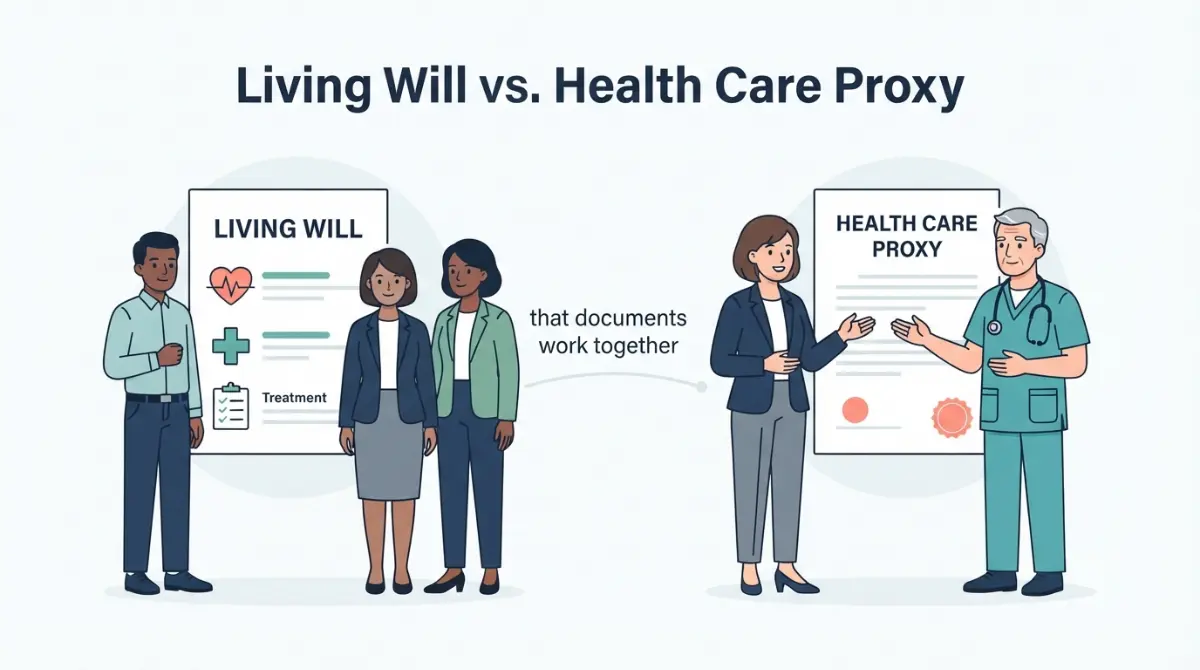
A living will records what medical care you want if you can’t speak for yourself. A health care proxy names who makes medical decisions for you. Both are advance directives, and the National Institute on Aging lists them as the two most common kinds.
Start where your situation fits:
- Planning for yourself: go to the comparison table, then the setup steps.
- Caring for a parent: read what a proxy does and the mistakes that undo it.
- No documents yet: see who decides for you if you have neither.
ℹ️ Financial & Legal Disclaimer: This article is general education only. It is not legal, medical, tax, insurance, or financial advice. Advance directive laws differ by state, so confirm your state’s requirements with an elder law or estate planning attorney before signing anything.
What a living will covers (and where it falls short)
A living will speaks for you in writing when you can no longer speak for yourself.
What goes in a living will
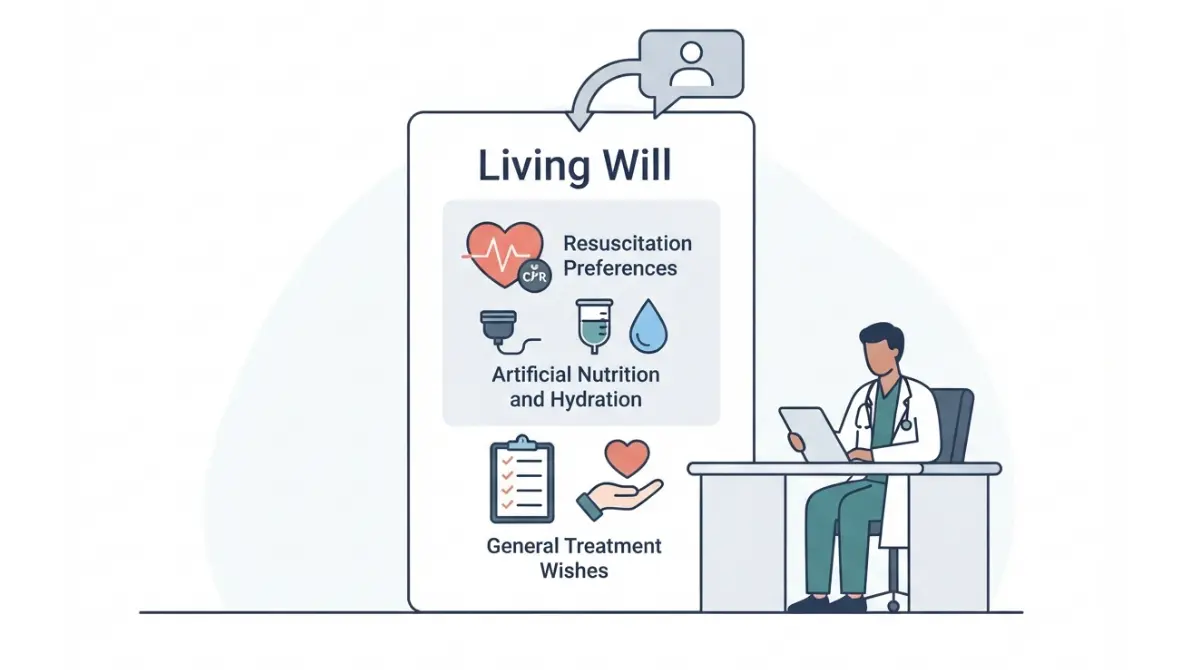
It tells doctors how you want to be treated if you can’t make your own decisions, for example about resuscitation or artificial nutrition and hydration. It applies only while you’re unable to communicate. As long as you can express your wishes, you decide.
Why the wording can be too narrow
Palliative care specialists warn that the standard wording in living wills often doesn’t match the medical situations people actually face. A document written years earlier can’t anticipate every diagnosis or treatment choice.
🔍 How It Works: A living will is a set of instructions, not a decision-maker. If your situation isn’t covered by its wording, doctors and family still have to interpret what you would have wanted.
What a health care proxy does and when it kicks in
A health care proxy is a person, not just a document.
Other names for the same role
Your proxy may be called an agent, surrogate, or representative. You name one using a form called a durable power of attorney for health care.
When the proxy takes effect
The proxy’s authority typically begins when a doctor determines you can’t make or communicate your own decisions. The exact trigger depends on your state’s law.
Choosing the right person

A proxy can handle what no document predicts, such as a serious car accident or a stroke. Choose someone who knows your values and can stay calm under pressure.
💡 Expert Note: The National Institute on Aging points out that giving your doctor permission to talk with a family member is not the same as naming a proxy. Only a named proxy can make decisions for you.
Which one decides in real situations
Here is who actually decides in five common situations.
Side-by-side comparison
| Situation | Living will only | Proxy only | Neither | Key Detail |
|---|---|---|---|---|
| Sudden stroke, outlook unclear | May not address it | Agent decides with current facts | State default decision-maker, if your state has one | A proxy covers the unforeseen |
| Terminal illness, wishes in writing | Guides doctors directly | Agent applies your known wishes | Family must guess | Both together work best |
| Slow decline, such as dementia | Covers only the situations it names | Agent adapts over time | Default rules or court | Review documents yearly |
| Family members disagree | Your written words carry weight | Agent holds legal authority | Relatives with equal priority can deadlock | Name one agent |
| State doesn’t formally recognize living wills | May count only as guidance | Recognized | Default rules apply | Massachusetts is one such state |
Sources: National Institute on Aging; Massachusetts Medical Society; Merck Manual (Professional); FinanceAuthorityHub analysis.
Do you need both?
The NIA says you can name a proxy in addition to, or instead of, writing a living will. Having both is stronger, because your proxy can use your living will as a guide when deciding for you.
Who decides if you have no advance directive
If you have no advance directive, most states name a default surrogate by law, typically in this order:
- Spouse or domestic partner
- Adult child
- Parent
- Sibling
- Other relatives, or a close friend in some states
📊 Data Point: A Health Affairs review of studies covering nearly 796,000 people found that 36.7% of US adults had completed any advance directive and 29.3% had a living will. Source: Health Affairs, 2017 (studies from 2011–16). Completion was higher among adults 65 and older, at 45.6%.
How state default surrogate laws rank family
When several people share the same priority, such as three adult children, consensus is preferred. Some states let doctors rely on a majority decision.
States without a default law
As of December 2022, 46 states had default surrogate laws, according to the ABA Commission on Law and Aging. Massachusetts, Minnesota, Missouri, and Rhode Island did not. Naming a proxy means you don’t have to rely on any of these rules.
⚠️ Costly Mistake: Assuming your spouse can automatically decide for you everywhere. In states without a default law, there may be no clear legal answer, and families can be forced into delays at the worst possible moment.
How to set up both documents
Setting up both documents usually takes a state form, a signature, and a few copies.
Do you need a lawyer?
No. The NIA says a lawyer isn’t required to create advance directives. If your family situation is complex or you split time between states, see our guide on choosing an estate planning attorney.
Signing, witnesses, and copies
Use your state’s own form, because signing rules vary. New York, for example, requires two witnesses for a health care proxy but no notary. Give copies to your proxy and your doctor, and review the documents at least once a year.
Getting it done at a $0 Medicare visit
Medicare Part B covers advance care planning at no cost when it’s part of your Welcome to Medicare or yearly Wellness visit and your provider accepts assignment. If it’s done during other treatment, you pay the Part B deductible ($283 in 2026) and coinsurance. See how Medicare’s costs add up.
✅ Action Step: When you book your yearly Wellness visit, ask the office to include advance care planning so it’s billed with that visit. If you use an elder law attorney, ask: “Does my form meet this state’s signing rules, and will it be honored if I move?”
Mistakes that leave your wishes unenforced
Even properly signed documents can fail in predictable ways.
Conflicting documents
If your living will and your proxy form say different things, that inconsistency can cast doubt on what you really wanted. Draft or review them together.
State recognition gaps
New York has no living will statute, although its courts accept a living will that gives clear and convincing evidence of your wishes. Massachusetts recognizes proxies but not living wills.
A health proxy doesn’t cover money
Your proxy makes medical decisions only; paying your bills requires a separate financial power of attorney. The CFPB’s guides for people managing someone else’s money explain that role. A will can’t fill either gap, because it only governs property after death. See what your will doesn’t cover.
Emergencies outside the hospital
In some states, paramedics generally can’t follow a living will or proxy outside a hospital. A seriously ill person may need a separate medical order form, such as a POLST or MOLST.
FAQ: living will vs. health care proxy
1. Do I need both a living will and a health care proxy?
You don’t have to, but a living will and health care proxy together work best, because your proxy can follow your written wishes.
2. Which is more important, a living will or a health care proxy?
A health care proxy is usually more flexible, since your agent can respond to situations a living will never anticipated.
3. Who decides if I have no living will or health care proxy?
Most states name a default surrogate, typically your spouse or partner first, then adult children, parents, and siblings.
4. Do I need a lawyer for a living will or health care proxy?
No. The National Institute on Aging says a lawyer isn’t required, though state signing rules still apply. An elder law attorney can confirm your form is valid.
5. Does a health care proxy need to be notarized?
It depends on your state. New York requires two witnesses for a health care proxy but no notary. Check your state’s rules with an attorney.
6. Can my health care proxy override my living will?
Your proxy should use your living will as a guide, and conflicting documents can cast doubt on your wishes. An attorney can help align them.
7. Is a health care proxy the same as a power of attorney?
No. A health care proxy covers medical decisions; managing money needs a separate financial power of attorney. Ask an estate attorney which documents you need.
8. When does a health care proxy take effect?
A health care proxy typically takes effect when a doctor determines you can’t make or communicate your own medical decisions.
9. Does Medicare pay for advance care planning?
Yes. Part B covers it at no cost during a Wellness visit when your provider accepts assignment.
10. Is a living will valid in every state?
Not uniformly. Massachusetts doesn’t formally recognize living wills, while New York courts accept clear and convincing ones. Confirm your state’s rules with an attorney.
11. How often should I update my living will and health care proxy?
Review your living will and health care proxy at least yearly, and after major events like moving states or a health change.
Put both in place this year
Name a proxy, write down your wishes, and hand out the copies. That combination settles who decides and what they’re deciding. Then work through our full estate planning checklist for the rest of what your will doesn’t cover.
Related Articles
 Estate Planning
Your Executor Duties After Someone Dies, in Plain English
October 1, 2026 Estate Planning
A Clear Blended Family Estate Planning Guide for Stepkids
October 5, 2026 Estate Planning
A Clear Look at Estate Planning Costs for a Will, Trust, and POA
September 21, 2026 Estate Planning
Beneficiary Designation vs Will and Who Really Gets Paid
September 28, 2026 Estate Planning
A Clear Guide to the $15 Million Estate Tax Exemption
September 23, 2026 Estate Planning
What Your Agent Can Legally Do Under a Durable Power of Attorney
September 29, 2026 Estate Planning
First Steps When a Parent Has Dementia and No Power of Attorney
October 1, 2026 Estate Planning
A Clear Signing Order for Estate Planning After Diagnosis
October 2, 2026 Estate Planning
How a step-up in basis can cut tax on inherited stock
September 26, 2026
Informational disclaimer
The content on Finance Authority Hub is provided for general informational and educational purposes only and should not be considered personalized financial, investment, tax, legal, or professional advice. Financial decisions depend on your individual goals, income, risk tolerance, location, and regulatory situation. Before acting on any information, strategy, estimate, or calculator result, consult a qualified licensed professional who can evaluate your specific circumstances.