
The key steps to fund a living trust, asset by asset
Funding a living trust takes three mechanisms, not one. FDIC trust coverage caps at $1,250,000 per owner per bank at five or more beneficiaries.
In This Article
What “funding” actually means
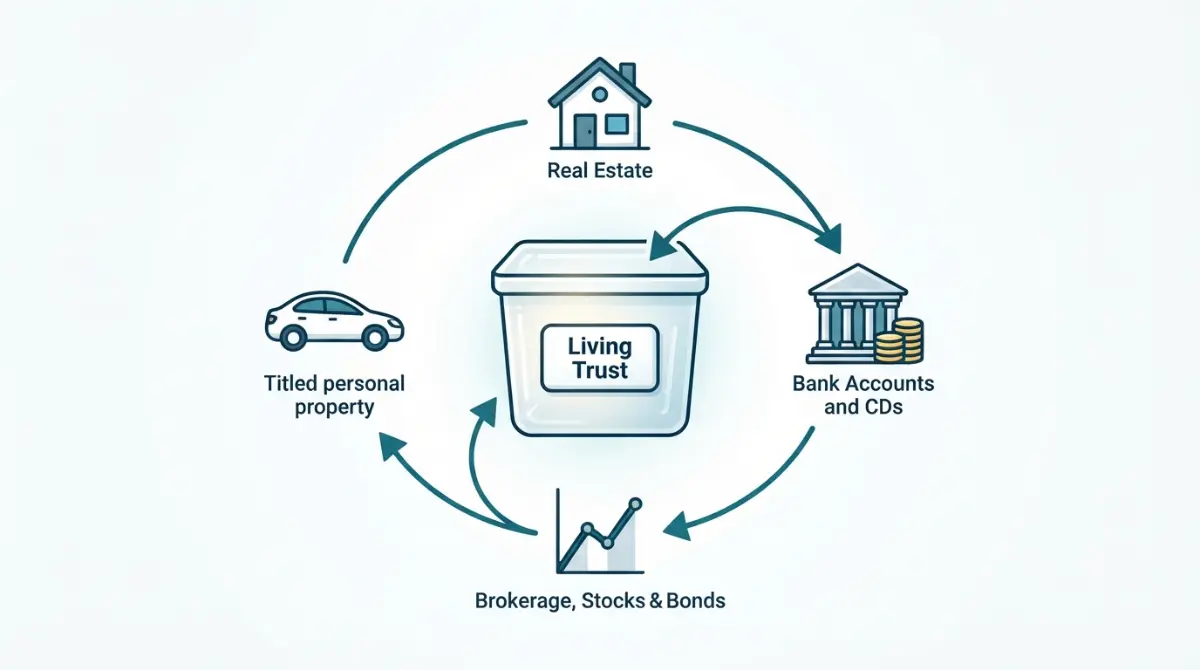
Your signed trust document creates an empty container. Funding a living trust means changing the ownership of each asset so the trust holds it instead of you. Until that happens, those assets still go through probate.
Who has to do this work
Most attorneys draft the trust and hand the funding back to you. That is standard practice, not neglect.
Work through this guide by what you own. Mortgaged home, start at Section 4. Most of your savings in a 401(k) or IRA, read Section 6 first, because that is where the expensive mistake lives. Vehicles or a business interest, Section 7.
Federal estate tax is rarely the reason for any of this. The Internal Revenue Service sets the basic exclusion amount at $15,000,000 per person for 2026, so for most families this is about probate, privacy and control — the same forces that govern assets that pass outside your will.
ℹ️ Financial Disclaimer: This article is financial education, not personalized advice on investment, tax, lending or credit, insurance, or debt relief. Trust funding is governed substantially by state law. Consult a licensed estate planning attorney, a CPA, or a fiduciary advisor about your own assets before acting.
The three ways to move an asset into your trust
Funding a living trust means moving ownership of each asset using one of three methods:
- Retitling — changing the legal owner on the account, deed or title to the trust.
- Beneficiary designation — leaving ownership alone and naming the trust to receive the asset at death.
- Written assignment — a signed schedule transferring property that carries no title document.
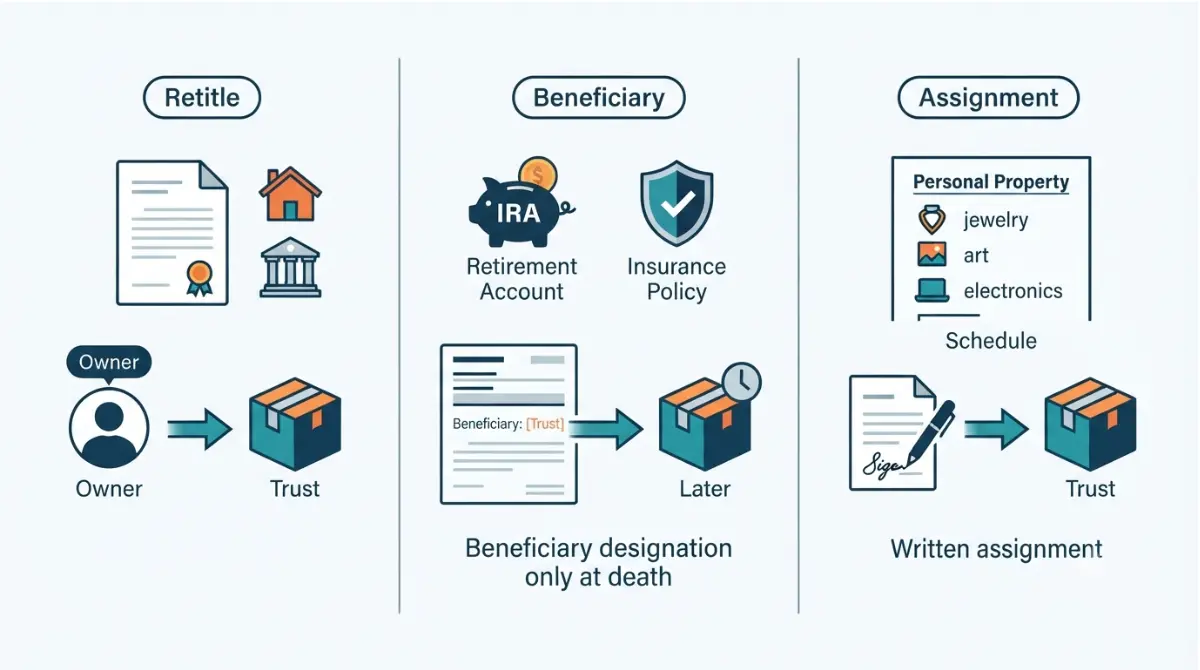
Each asset you own takes exactly one of these. Mixing them up is the single most common funding mistake. If the document itself is not signed yet, start with setting up the living trust.
The trust funding map
| Asset | Method | Document needed | Key detail |
|---|---|---|---|
| Home, other real estate | Retitle | New deed | Must be recorded with the county |
| Bank accounts, CDs | Retitle or POD | Change-of-ownership form | Bring your certification of trust |
| Taxable brokerage | Retitle or TOD | Re-registration form | TOD is optional for the firm |
| Retirement accounts, HSAs | Beneficiary only | Beneficiary form | Never retitle — see Section 6 |
| Life insurance, annuities | Beneficiary only | Carrier’s form | Check the contingent line too |
| Vehicles | Retitle, if your state allows | State title transfer | Confirm insurance continues |
| Business interests | Retitle if permitted | Assignment + entity consent | Operating agreement may block it |
| Untitled personal property | Assignment | Schedule of assets | No title exists to change |
Source: editorial framework built from the IRS, FDIC, SEC and FINRA guidance cited throughout this article.
Bank accounts, CDs and cash
A trust account is insured for $250,000 per eligible beneficiary, up to $1,250,000 per owner at each bank.
What the bank will ask for
Ask for the change-of-ownership form and bring your certification of trust — a short summary page, not the full document.
Retitle or name a beneficiary?
These are alternatives, not a pair. Retitling gives the trust control; a payable-on-death designation simply hands the balance to a person at death.
What happens to FDIC coverage
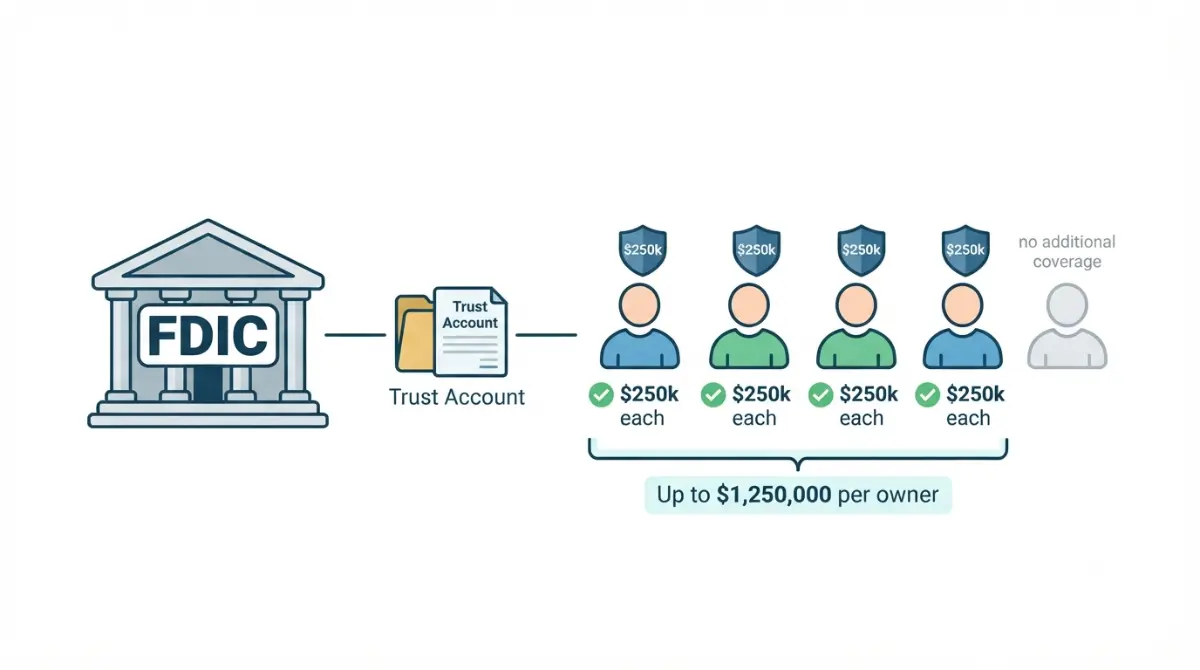
📊 Data Point: Trust deposits are insured at $250,000 per eligible beneficiary, capped at $1,250,000 per owner per bank at five or more beneficiaries — Source: FDIC deposit insurance guidance, rules effective April 1, 2024.
🔍 How It Works: Multiply owners × eligible beneficiaries × $250,000. A $900,000 trust account naming three beneficiaries is insured for $750,000, leaving $150,000 uncovered. (Calculation by the FinanceAuthorityHub editorial team using the FDIC formula above.)
Your home and other real estate
A new deed transfers the property; the county recorder’s office makes it official.
The new deed and where it gets recorded
🔍 How It Works: A deed names you as grantor and your trust as grantee. Unrecorded, it may not bind third parties — recording is the step that completes the transfer.
Will this trigger your mortgage’s due-on-sale clause?
Generally no. The Garn-St Germain Depository Institutions Act, at 12 U.S.C. §1701j-3(d)(8), bars a lender from enforcing a due-on-sale clause on a transfer into an inter vivos trust where you remain a beneficiary and occupancy does not change.
The exemption covers residential property of fewer than five dwelling units.
⚠️ Costly Mistake: That protection does not extend to transfers into an LLC. Investors who move a rental into an entity instead of a trust lose the statutory shield entirely.
What to check before you record
Deed form, recording procedure, property-tax reassessment and homestead continuity are all state-specific.
✅ Action Step: Ask a licensed estate planning attorney: “Does my state reassess property tax on a transfer to a revocable trust in which I remain the beneficiary?” Then ask your title insurer whether coverage continues.
Brokerage accounts, stocks and bonds
A taxable brokerage account is retitled through your firm’s re-registration paperwork, using the same certification of trust.
Retitling a taxable brokerage account
The holdings do not move or sell; only the registered owner changes.
Transfer-on-death registration as the alternative
💡 Expert Note: SEC guidance on transferring securities confirms that transfer-on-death registration is created by state law and that firms may choose whether to offer it. It is an option your brokerage extends, not a right.
Securities held outside a brokerage
Certificates and direct-registered shares go through the transfer agent, following FINRA’s guidance on brokerage transfers at death.
Choose retitling if you want the trust to control distribution after your death; choose TOD if a clean handoff to named people is all you need.
The accounts you should never retitle
Four asset types should never be retitled into a revocable living trust:
- 401(k) and other employer plans
- Traditional and Roth IRAs
- Health savings accounts
- Life insurance policies and annuities
Why retitling a retirement account is a distribution
These accounts are owned by one individual by law. An HSA, on IRS Form 5305-B, is established for the exclusive benefit of the account owner. Changing the owner is a withdrawal, not a transfer.
⚠️ Costly Mistake: Retitling an IRA to your trust can be treated as a full distribution — the entire balance taxable in one year, with no way to undo it.
Naming the trust as beneficiary instead
IRS Publication 590-B addresses a trust as beneficiary directly. The trust must qualify as a see-through trust for its beneficiaries to be treated as designated beneficiaries.
📊 Data Point: For deaths on or after January 1, 2020, most non-spouse designated beneficiaries must fully distribute an inherited account within ten years — Source: IRS Retirement topics – Beneficiary, reflecting the SECURE Act and the 2024 final regulations.
Before naming your trust, understand the ten-year distribution rules your heirs will face.
Life insurance, annuities and HSAs
All three pass by beneficiary form. Naming a trust is permitted; whether it helps depends on your beneficiaries’ circumstances.
✅ Action Step: Ask a CPA: “Does my trust as drafted qualify as a see-through trust, and what distribution timeline would my beneficiaries actually face?”
The assets people forget, and the gaps they leave
Three categories quietly stay outside the trust unless you act.
Vehicles and titled property
State titling rules vary, and some states make this more trouble than it is worth for one car. Confirm your insurer will cover a trust-owned vehicle first.
Business interests and LLC membership
💡 Expert Note: Under IRC §1361(c)(2)(A)(i), a revocable grantor trust is an eligible S corporation shareholder while you are alive. The eligibility question arises after your death, when a limited continuation period applies and an election may be required.
Assets acquired after you fund
Anything bought later sits outside the trust. A properly witnessed pour-over will catches the strays, but they pass through probate.
Common questions about funding a living trust
1. Does a living trust avoid probate if it isn’t funded?
No. An unfunded living trust controls nothing, and every asset left outside it passes through probate as usual.
2. How do you fund a living trust?
By retitling ownership, naming the trust as beneficiary, or signing a written assignment — one method per asset, depending on the type.
3. Do I retitle my bank account or just add the trust as beneficiary?
Retitling gives the trust control during your lifetime; a payable-on-death designation only transfers the balance at death.
4. Is trust money still FDIC insured?
Yes — $250,000 per eligible beneficiary, capped at $1,250,000 per owner at each bank.
5. Will transferring my house to a trust trigger the due-on-sale clause?
Generally no, under 12 U.S.C. §1701j-3(d)(8), provided you remain a beneficiary and occupancy is unchanged. Confirm with a real estate attorney and your servicer.
6. Do I need a new deed to put my house in a trust?
Yes. A new deed naming your trust as grantee must be prepared and recorded with your county recorder’s office.
7. Should I put my brokerage account in a trust or use TOD?
Retitle if you want post-death control over distribution; use transfer-on-death if a direct handoff is sufficient. A fiduciary advisor can review your holdings.
8. Can I put my 401(k) or IRA in a living trust?
No. Retitling a retirement account can be treated as a taxable distribution; name the trust as beneficiary instead. Confirm with a CPA first.
9. Should a trust be the beneficiary of a life insurance policy?
Sometimes — useful when beneficiaries are minors or need managed distributions. Ask an estate planning attorney about your beneficiaries’ circumstances.
10. How do I transfer my car into a living trust?
Through your state’s title transfer process, where permitted. Confirm your insurer covers a trust-owned vehicle before changing the title.
11. Can a living trust own an LLC or S-corp shares?
A revocable grantor trust is an eligible S corporation shareholder during your lifetime. Your operating agreement may still restrict transfers; consult a CPA.
Where to start this week
Take the easiest one first. Call your bank, ask for the change-of-ownership form, and bring your certification of trust.
✅ Action Step: Work down the trust funding map above, then bring the unresolved rows — real estate, business interests, retirement beneficiary forms — to a licensed estate planning attorney in your state.
Related Articles
 Estate Planning
Key Rules for the $19,000 Annual Gift Tax Exclusion and Form 709
September 24, 2026 Estate Planning
What Your Agent Can Legally Do Under a Durable Power of Attorney
September 29, 2026 Estate Planning
Naming a Guardian for Minor Children in Your Will, Step by Step
October 2, 2026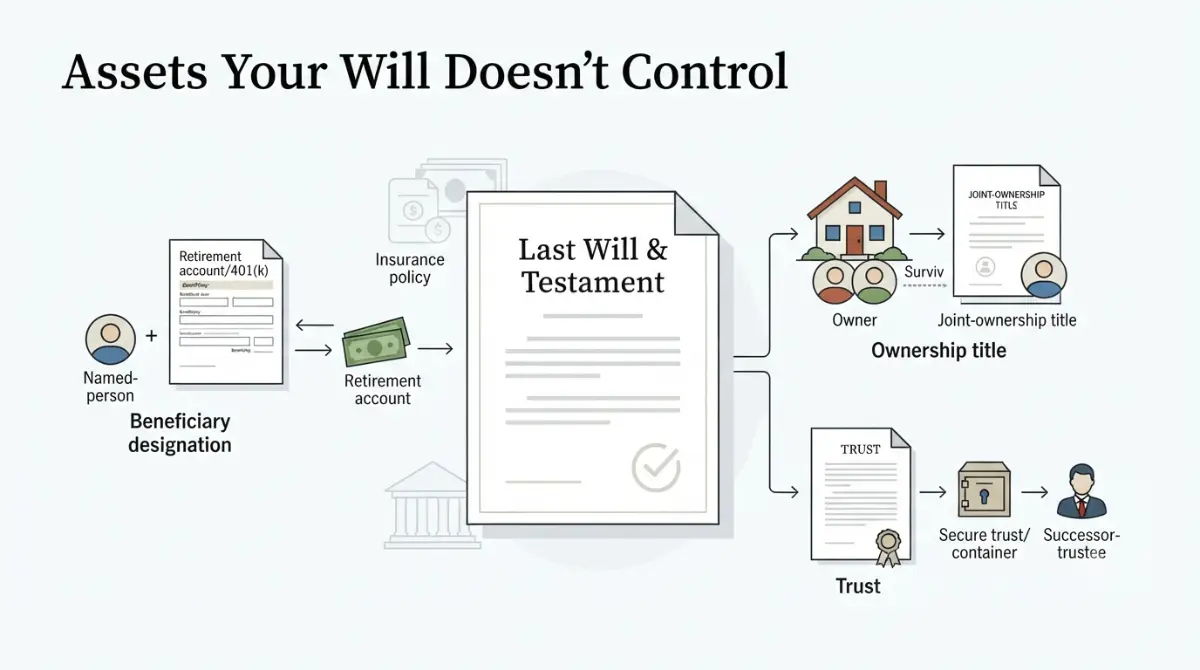 Estate Planning
Assets Not Covered by a Will and the Hidden Rules on Who Inherits
September 16, 2026 Estate Planning
A Clear Price Guide to the Best Online Will Service
September 22, 2026 Estate Planning
How to Avoid Probate With the Right Tool for Each Asset
September 28, 2026 Estate Planning
A Clear Blended Family Estate Planning Guide for Stepkids
October 5, 2026 Estate Planning
First Steps When a Parent Has Dementia and No Power of Attorney
October 1, 2026 Estate Planning
Will vs Trust and How to Find the Right Fit for Your Family
September 17, 2026
Informational disclaimer
The content on Finance Authority Hub is provided for general informational and educational purposes only and should not be considered personalized financial, investment, tax, legal, or professional advice. Financial decisions depend on your individual goals, income, risk tolerance, location, and regulatory situation. Before acting on any information, strategy, estimate, or calculator result, consult a qualified licensed professional who can evaluate your specific circumstances.