
Gifting a House vs Inheritance and What Your Child Will Owe
Gifting a house to your child in 2026 usually means filing Form 709, not paying gift tax. The bigger cost shows up later, when your child sells.
In This Article
Gifting a house vs. inheritance: the short answer
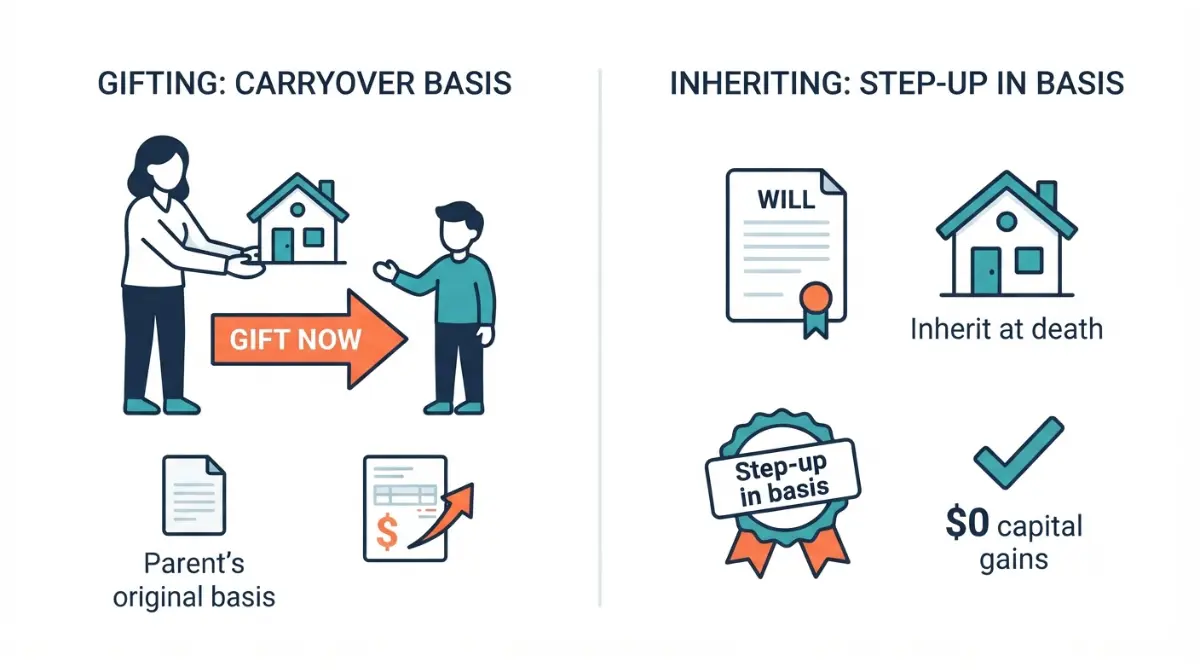
For most families, inheriting a house is cheaper for the child than receiving it as a gift, because an inherited home’s tax basis resets to its value at death. A gifted home keeps the parent’s original basis, so the child can owe capital gains tax on decades of growth when they sell. In the worked example below, that gap is $45,000.
The main exception is a child who moves in and lives there for at least two years. And before choosing either route, it helps to understand what a will does and doesn’t control when someone dies.
If you’re the parent deciding
Start with the five-question checklist further down, then take it to a CPA.
If you’re the child receiving
Jump to the worked example to see what a sale could cost you.
ℹ️ Financial Disclaimer: This article explains federal tax, gift, and estate rules for educational purposes only. It is not personalized tax, legal, estate-planning, Medicaid-planning, investment, lending, insurance, or debt-relief advice. Outcomes depend on your income, state, filing status, and family situation. Consult a CPA, an estate planning attorney, or an elder law attorney before transferring a home.
Why the tax bill depends on the home’s basis
Your cost basis is roughly what the IRS treats you as having paid for a home. When the house sells, the taxable gain is the sale price minus that basis.
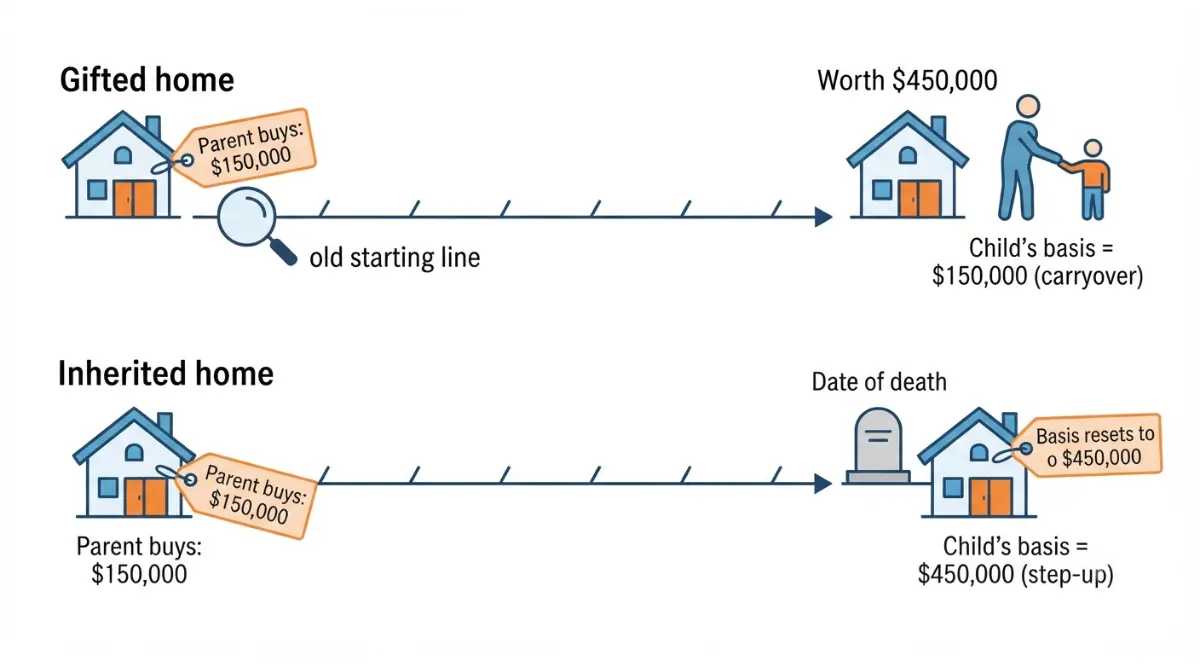
Gifted home: the giver’s basis carries over
With a gift, the child generally takes over the parent’s adjusted basis. This is called carryover basis.
If the parent paid gift tax, part of it can be added to the basis, as shown in IRS Publication 551 on the basis of gifted and inherited property.
Inherited home: basis resets to date-of-death value
With an inheritance, the heir’s basis is the home’s fair market value on the date of death. It is the value on the alternate valuation date instead if the executor elects that on an estate tax return. This reset is the step-up in basis heirs receive.
🔍 How It Works: Think of basis as a starting line. A gift keeps the parent’s old starting line. An inheritance moves it up to the home’s value at death, so the growth during the parent’s lifetime is never taxed as the child’s gain.
Same house, two tax bills: a worked example
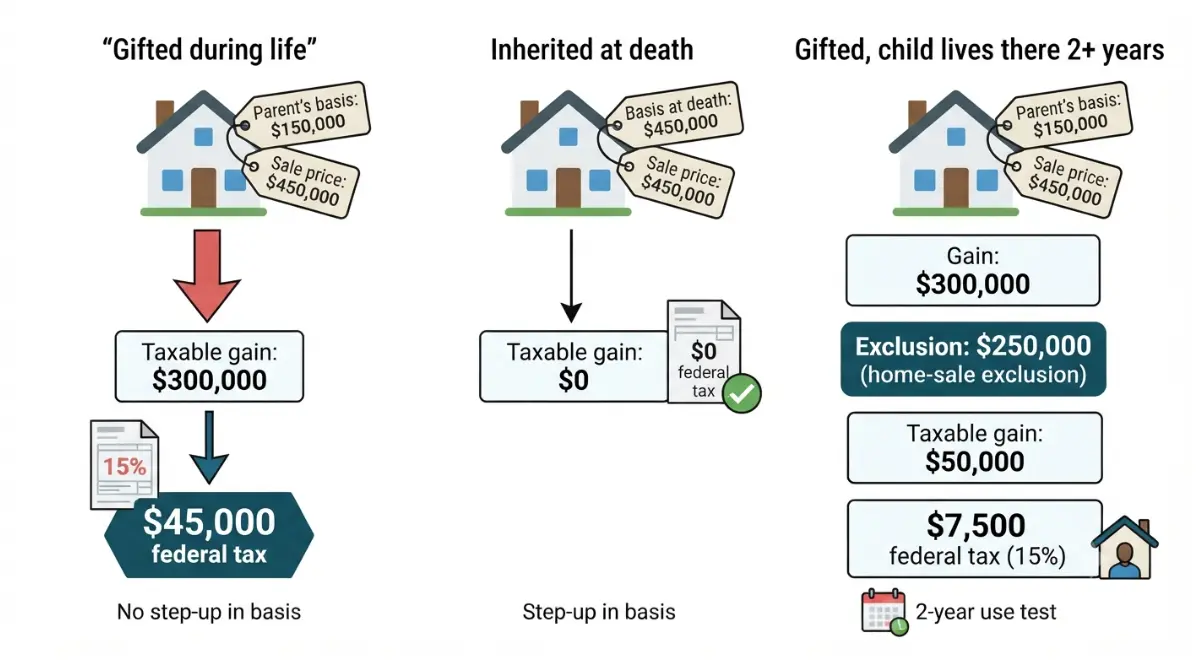
Here is the difference on one hypothetical home under 2026 federal rules.
The setup
The parent’s adjusted basis is $150,000, and the home is worth $450,000 when it passes to an adult child. The child sells for $450,000 without living there.
We assume the gain is taxed at the 15% long-term capital gains rate. For 2026, that rate covers single filers with taxable income above $49,450 and up to $545,500, according to IRS Revenue Procedure 2025-32.
The two tax bills side by side
| Scenario | Child’s basis | Taxable gain | Federal tax at 15% | Key Detail |
|---|---|---|---|---|
| Gifted during life | $150,000 | $300,000 | $45,000 | Parent’s basis carries over |
| Inherited at death | $450,000 | $0 | $0 | Basis resets to date-of-death value |
| Gifted, child lives there 2+ years | $150,000 | $50,000 | $7,500 | Up to $250,000 excluded (next section) |
Illustrative example calculated by FinanceAuthorityHub from IRS rules (Publication 551, Rev. Proc. 2025-32, Topic 701). This is not your tax bill.
⚠️ Costly Mistake: The gifted bill can run higher than $45,000. A 3.8% net investment income tax can apply to single filers with modified AGI above $200,000, and state income tax may add more. The inherited scenario avoids both, which is why the transfer method matters more than the gift tax itself.
To test your own numbers, use our capital gains tax calculator. Our guide to 2026 capital gains tax rates explains how the brackets stack.
Do you owe gift tax when you give a house?
For almost every family, giving a house means filing a return, not paying gift tax. For 2026, the annual gift tax exclusion is $19,000 per recipient, and the lifetime basic exclusion amount is $15,000,000, according to the IRS’s 2026 inflation adjustments.
The $19,000 annual exclusion and Form 709
A $450,000 home exceeds $19,000, so the parent reports it on Form 709. The $431,000 above the exclusion reduces the parent’s lifetime amount, and gift tax is due only if lifetime taxable gifts exceed it. For more, see our guide to the annual gift tax exclusion.
Jointly owned homes: each spouse files
Spouses cannot file a joint gift tax return. When a home is held as joint tenants or tenants by the entirety, each spouse files their own Form 709.
✅ Action Step: Before signing a deed, ask a CPA: “Should we elect gift splitting, and does each of us file Form 709 for our jointly titled home?”
When gifting the house can still make sense
Gifting can still work when the child will live in the home, or when the estate is very large.
Your child moves in and meets the 2-of-5-year test
The home-sale exclusion lets a seller exclude up to $250,000 of gain ($500,000 on a joint return). To qualify, the seller must have owned the home and lived in it as a main home for at least 24 months of the 5 years before the sale, per the IRS ownership and use tests.
In our example, a child who owns and lives in the gifted home for two years excludes $250,000 of the $300,000 gain. Excluded gain is also not subject to the net investment income tax.
Your estate may exceed the exemption
Lifetime gifts and your estate draw on the same $15 million basic exclusion. So families near that level face a different calculation; see how the federal estate tax exemption works. Married couples should also understand portability of a late spouse’s exemption.
Gift now or leave it in your will: a decision checklist
Five questions usually decide which route costs your family less.
Five questions to answer first
- Will your child likely sell soon? If yes, the step-up at inheritance usually saves more.
- Will your child live there 2+ years first? If yes, the home-sale exclusion can shrink a gift’s tax cost.
- Could your estate approach $15 million? If yes, lifetime gifting deserves professional review.
- Might you need Medicaid for long-term care? If yes, a gift can create eligibility problems (see below).
- Do you want to keep control of the home? A gift hands over legal ownership.
Other ways to pass a home
A will, a living trust, or a state-specific deed can pass a home at death instead. Compare a will vs. a living trust, and learn how to choose an estate planning attorney.
✅ Action Step: Ask an estate planning attorney: “Which transfer method in our state lets the home pass at death with a stepped-up basis?”
Mistakes that make gifting a house expensive
These mistakes can undo the benefit a family expects from gifting a home.
Selling to your child for $1 is still a gift
When a home is sold for less than its market value, the difference is generally treated as a gift that may need reporting on Form 709.
Medicaid look-back and losing control
Medicaid reviews asset transfers made during a look-back period before an application, so a gifted home can delay long-term care coverage. Once gifted, the home also becomes your child’s asset, which exposes it to their creditors or a divorce.
The one-year boomerang rule
If you gave property to someone who dies within one year and it returns to you or your spouse, special IRS basis rules for property returned within a year can deny the step-up. Some states also tax heirs, so check the states with an inheritance tax.
✅ Action Step: Ask an elder law attorney: “Would gifting our home affect Medicaid eligibility in our state, and over what look-back period?”
Frequently asked questions
1. Is it better to inherit or be gifted a house?
Inheriting a house is usually cheaper, because the heir’s basis resets to date-of-death value, while a gifted house keeps the giver’s original basis. A CPA can run your family’s numbers.
2. What is the basis of a gifted house?
A gifted house generally keeps the giver’s adjusted basis, called carryover basis, possibly increased by part of any gift tax paid. Confirm your figures with a CPA.
3. What is the basis of an inherited house?
An inherited house’s basis is generally its fair market value on the date of death, or the alternate valuation date if the executor elects it. Ask the estate’s executor or a CPA for the value used.
4. How much can I gift in 2026 without filing a return?
In 2026, you can gift up to $19,000 per recipient without filing; gifting a house worth more requires Form 709. A CPA can prepare the return.
5. Will I owe gift tax on gifting a house?
Usually not. Gifting a house above $19,000 uses part of your $15,000,000 lifetime exclusion, and tax is due only beyond it. Confirm with a CPA.
6. Can my child avoid capital gains on a gifted house?
Partly. A child who owns and lives in the gifted house for 24 months of the 5 years before selling can exclude up to $250,000 of gain. A CPA can confirm eligibility.
7. Do both parents file Form 709 for a jointly owned house?
Yes. Spouses can’t file a joint gift tax return, so each spouse files Form 709 when gifting a jointly held house. A CPA can coordinate both returns.
8. What if I sell the house to my child for $1?
Selling a house to your child for $1 generally makes the gap between market value and price a gift, reportable on Form 709. Ask a CPA before closing.
9. Does gifting a house affect Medicaid?
It can. Medicaid reviews asset transfers during a look-back period, so gifting a house may delay long-term care coverage. An elder law attorney can assess your state’s rules.
10. What if a gifted house comes back to me within a year?
If you gave the house to someone who dies within a year and it returns to you, special IRS basis rules can deny the step-up. Ask a CPA.
11. Should I talk to a CPA before gifting a house?
Yes. A CPA can compare gifting a house with inheritance using your basis, income, state, and estate size before any deed is signed.
Your next step
For most families, leaving the home at death preserves the step-up and spares the child a large capital gains bill. Gifting mainly makes sense when the child will live there for two or more years, or when the estate is very large. Work through our estate planning checklist, then bring the five questions above to a CPA or estate planning attorney.
Related Articles
 Estate Planning
The Right Way to Read the Percentage of Americans With a Will
October 5, 2026 Estate Planning
A Clear Guide to the $15 Million Estate Tax Exemption
September 23, 2026 Estate Planning
How a Special Needs Trust Can Protect SSI and Medicaid
September 30, 2026 Estate Planning
What Your Agent Can Legally Do Under a Durable Power of Attorney
September 29, 2026 Estate Planning
The estate planning checklist, ordered so nothing gets overlooked
September 19, 2026 Estate Planning
Who Pays Estate Tax, and How Rarely Estates Actually Owe It
September 23, 2026 Estate Planning
A Clear Blended Family Estate Planning Guide for Stepkids
October 5, 2026 Estate Planning
Living Will vs Health Care Proxy and Who Speaks for You
September 29, 2026 Estate Planning
The Right Way to Know When to Update Your Estate Plan
October 5, 2026
Informational disclaimer
The content on Finance Authority Hub is provided for general informational and educational purposes only and should not be considered personalized financial, investment, tax, legal, or professional advice. Financial decisions depend on your individual goals, income, risk tolerance, location, and regulatory situation. Before acting on any information, strategy, estimate, or calculator result, consult a qualified licensed professional who can evaluate your specific circumstances.