
Where a Transfer on Death Deed Works and Where It Goes Wrong
A transfer on death deed can skip probate, but California’s version is set to expire in 2032 unless lawmakers extend it. Here’s what else heirs miss.
In This Article
If you want your home to pass to someone without probate, a transfer on death deed may be the simplest tool available. Most states allow one, but not all, and the list changed again in 2026.
Start with the part that fits you:
- Planning for your own home? Check the state table, then the filing steps.
- Inheriting a home through one? Read what heirs inherit and the six risks.
- Weighing it against a trust? Jump to the comparison.
A TOD deed is one of several assets that pass outside a will, so treat it as part of a plan, not the whole plan.
ℹ️ Financial Disclaimer: This article is general education about real estate transfers, estate planning, taxes, mortgages, insurance, and Medicaid. It is not legal, tax, lending, insurance, or investment advice for your situation. TOD deed rules are set by each state and change often, so consult an estate planning or elder law attorney licensed where the property sits, and a CPA for tax questions, before recording or relying on one.
What a transfer on death deed does (and doesn’t do)
A transfer on death (TOD) deed is a recorded deed naming who receives your real estate when you die. It does nothing while you’re alive, can be revoked, and passes the property outside probate if recorded before death. Some states call it a beneficiary deed.
You keep full control while alive
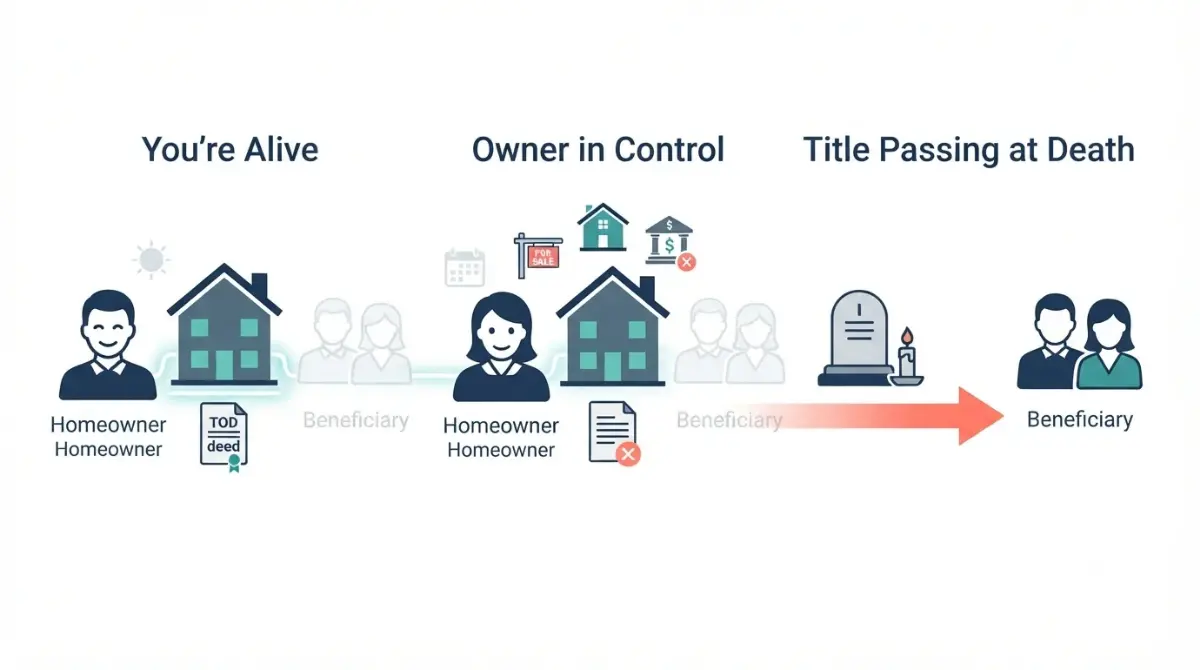
Until you die, the beneficiary has no legal interest in the home. You can sell, refinance, or cancel the deed without their consent.
🔍 How It Works: It works like a payable-on-death designation for a house. Nothing moves while you’re alive, and at death, title passes to your beneficiary.
How to revoke or change it
Record a revocation or a newer TOD deed; selling the property also ends it. For assets the deed can’t cover, see other ways to avoid probate.
Which states allow transfer on death deeds
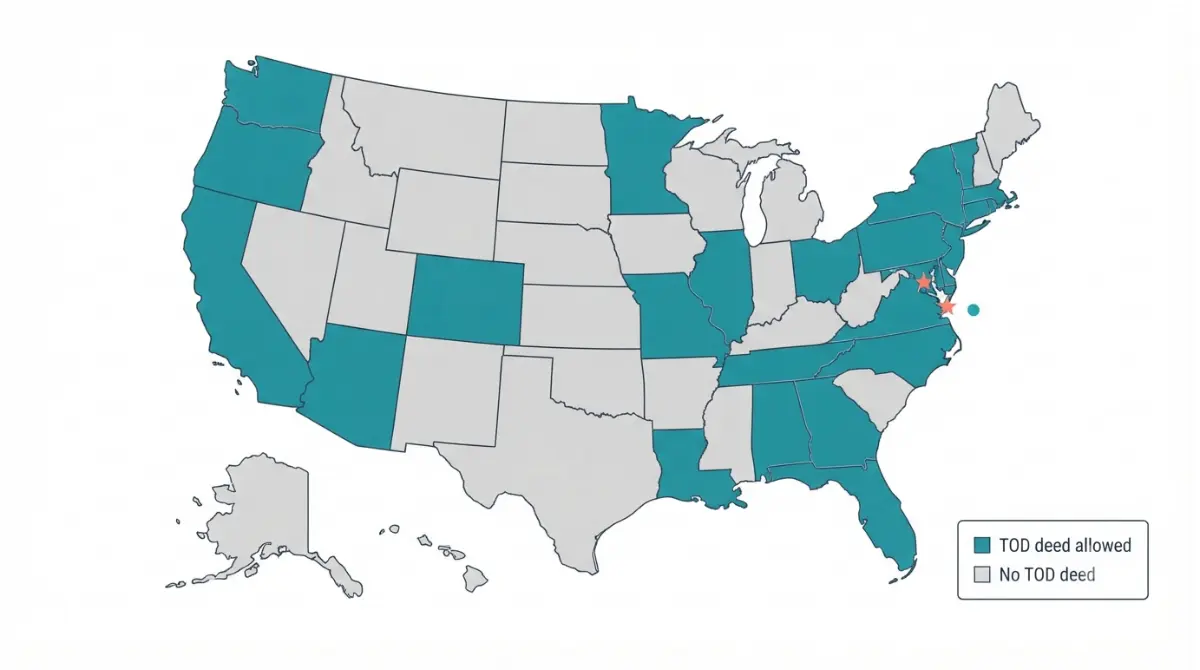
As of September 28, 2026, 33 states plus Washington, D.C., allow TOD deeds, and Maryland becomes the 34th state on October 1, 2026.
| State | Available since | Key detail |
|---|---|---|
| Alaska | 2014 | Uniform act |
| Arizona | 2002 | Early non-uniform statute |
| Arkansas | 2005 | Early non-uniform statute |
| California | Jan. 2016 | Current law expires Jan. 1, 2032 unless extended |
| Colorado | 2004 | Early non-uniform statute |
| Delaware | Dec. 5, 2025 | Notary and witnesses required |
| District of Columbia | Mar. 19, 2013 | Uniform act |
| Georgia | July 1, 2024 | State’s own statute |
| Hawaii | 2011 | Uniform act |
| Illinois | Jan. 1, 2012 | Called a “transfer on death instrument” |
| Indiana | 2009 | Early non-uniform statute |
| Kansas | 1997 | Early non-uniform statute |
| Maine | Sept. 1, 2019 | Uniform act |
| Maryland | Oct. 1, 2026 (upcoming) | Residence transfers exempt from recordation and transfer taxes |
| Minnesota | 2008 | Insurer must cover beneficiary up to 30 days |
| Mississippi | July 1, 2020 | State’s own act |
| Missouri | 1989 | First state to allow TOD deeds |
| Montana | 2007 | Later switched to uniform act |
| Nebraska | Jan. 1, 2013 | Two disinterested witnesses; record within 30 days |
| Nevada | 2003 | Later switched to uniform act |
| New Hampshire | 2024 | Uniform act |
| New Mexico | 2001 | Later switched to uniform act |
| New York | 2024 | Uniform act |
| North Dakota | 2011 | Uniform act |
| Ohio | 2000 | Early non-uniform statute |
| Oklahoma | 2008 | Early non-uniform statute |
| Oregon | Jan. 1, 2012 | Subject to state Medicaid claims if estate falls short |
| South Dakota | July 1, 2014 | Beneficiary liable for owner’s debts up to property value |
| Texas | Sept. 1, 2015 | Estates Code Chapter 114 |
| Utah | May 2018 | Uniform act |
| Virginia | July 1, 2013 | Exempt from recordation tax |
| Washington | 2014 | Uniform act |
| West Virginia | 2014 | Exempt from real estate transfer excise tax |
| Wisconsin | 2006 | Early non-uniform statute |
| Wyoming | 2013 | State health department notified of TOD deeds |
Sources: each row was verified against the state’s statute, session law, or legislative record, or a title-underwriter bulletin. Early-state years come from the Uniform Law Commission’s act commentary. Verified September 28, 2026.
Why sites disagree on the count
Guides online cite anywhere from 29 to 33 states because they count different things:
- Some count only uniform-act adopters, which were 19 states, D.C., and the U.S. Virgin Islands as of September 2025.
- Some count D.C. and territories as “states.”
- Some use signing dates instead of effective dates.
- Older lists miss the 2024–2025 additions.
New: Delaware and Maryland
Delaware has accepted TOD deeds since December 5, 2025.
📊 Data Point: Maryland’s TOD deed law takes effect October 1, 2026. It covers deeds signed earlier if the owner dies on or after that date, and exempts transfers of a primary or secondary residence from state recordation and county transfer taxes. — Source: Maryland SB 651/HB 738, signed May 26, 2026
No TOD deed: Florida and Pennsylvania
Florida uses an enhanced life estate (“Lady Bird”) deed instead. Pennsylvania has no TOD deed law yet; a bill to adopt the uniform act is pending.
How to create and record a TOD deed
Creating a TOD deed takes five steps:
- Confirm the state where the property sits allows it. You don’t need to live there.
- Copy the legal description from your current deed.
- Complete your state’s form, naming a primary and a backup beneficiary.
- Sign before a notary, plus witnesses where required, such as Delaware and Nebraska.
- Record it with the county recorder before death. In Nebraska, you must record it within 30 days of signing.
What you need
You need your current deed, each beneficiary’s full legal name, your state’s form, and the recording fee. The county recorder’s office can quote the fee.
Do you need a lawyer?
Many states don’t require one. Errors usually surface only after death, when no one can fix them.
✅ Action Step: Ask an estate planning attorney in the property’s state: “Does my deed need witnesses here, and what happens if my beneficiary dies before me?”
What heirs inherit: mortgage, taxes, and basis
The home passes as it is, with any mortgage or liens still attached.
The mortgage doesn’t disappear
The Garn-St Germain Act generally bars a lender from calling the loan due because a home passed to a relative at death. The heir isn’t personally liable for the loan but can choose to assume it.
💡 Expert Note: The CFPB has clarified mortgage rules for surviving family members so heirs can be added to a loan without requalifying as brand-new borrowers.
Step-up in basis
For inherited property, the IRS generally sets your cost basis at the fair market value on the date of death.
🔍 How It Works (hypothetical): A parent paid $150,000 for a home that is worth $400,000 at death, and the heir sells it for $410,000. The heir’s taxable gain is about $10,000 before selling costs, not $260,000. Test your own figures with our capital gains tax calculator.
✅ Action Step: Get an appraisal dated near the date of death. Then ask a CPA: “What records prove my stepped-up basis, and do any exceptions in IRS Publication 551 apply to me?”
6 risks of a transfer on death deed
A TOD deed avoids probate, but it doesn’t solve everything else.
Medicaid estate recovery
1. Medicaid may reach the home. Federal law lets states recover long-term care costs from assets that skip probate. Oregon’s statute, for example, makes TOD property subject to state medical assistance claims when the probate estate falls short.
2. Creditors aren’t cut off. Under the uniform act, if the probate estate can’t pay valid claims, those claims can be enforced against the TOD property.
Beneficiary dies first
3. No automatic backup. In D.C. and other uniform-act jurisdictions, a beneficiary’s share lapses if they die before you. Name a contingent beneficiary to avoid this.
4. Co-heir conflict. Multiple beneficiaries generally take equal shares as co-owners, who must agree on a sale.
Insurance and title gaps
5. Insurance gaps. Minnesota requires insurers notified of a TOD deed to cover the beneficiary for up to 30 days, and Nebraska added a similar protection in 2025. Don’t assume your state has one.
6. Unrecorded deeds fail. A deed that wasn’t recorded before death does nothing, and the home goes through probate anyway.
✅ Action Step: Ask an elder law attorney: “Does our state recover Medicaid costs from property that passes outside probate?” Our guide to choosing an estate planning attorney covers what to check.
TOD deed vs living trust vs Lady Bird deed
A TOD deed is a narrow tool, so it helps to know where it fits and where a trust does the job better.
When a TOD deed fits
A TOD deed fits best when all three of these are true:
- You’re passing one property, or a few in the same state.
- Your beneficiaries are adults.
- You don’t need anyone managing the home if you become incapacitated.
When to choose a trust
A living trust handles minors, several properties, and incapacity. Lady Bird deeds exist in a handful of mostly Southern states. Compare the options in our will vs. trust guide.
📊 Data Point: A TOD deed doesn’t shrink a taxable estate, but the federal basic exclusion is $15 million for deaths in 2026. — Source: 26 U.S.C. § 2010(c)(3)
Transfer on death deed FAQ
1. Does a transfer on death deed avoid probate?
Yes. A TOD deed recorded before the owner’s death passes the property directly to the named beneficiary outside probate.
2. Which states allow TOD deeds?
As of September 2026, 33 states plus Washington, D.C., allow transfer on death deeds, and Maryland joins October 1, 2026.
3. Does Florida allow transfer on death deeds?
No. Florida has no TOD deed law; homeowners there use an enhanced life estate, or “Lady Bird,” deed instead.
4. Can a TOD deed be revoked?
Yes. You can revoke a TOD deed anytime before death by recording a revocation or a newer deed.
5. What happens to the mortgage on a TOD deed property?
The mortgage stays attached, but federal law generally stops lenders calling the loan due when a home passes to a relative at death. A HUD-approved housing counselor can explain your servicer options.
6. Does a TOD deed protect a home from Medicaid?
Not always. Federal law lets states recover Medicaid costs from assets that skip probate, so a TOD deed may not shield the home. Ask an elder law attorney how your state handles recovery.
7. Is a TOD deed better than a living trust?
A TOD deed is simpler for one property and adult heirs; a trust better handles minors, several properties, and incapacity. An estate planning attorney can compare both for your situation.
8. Do heirs get a step-up in basis with a TOD deed?
Generally yes. An heir’s basis is usually the property’s fair market value on the date of death, per IRS guidance. Confirm your basis with a CPA before selling.
9. What if the TOD deed beneficiary dies first?
The share can lapse unless the transfer on death deed names a contingent beneficiary, so name a backup when you sign.
10. Do you need a lawyer for a TOD deed?
Many states don’t require one, but TOD deed errors usually surface after death, when nobody can correct them.
11. Is Maryland adding transfer on death deeds?
Yes. Maryland’s TOD deed law takes effect October 1, 2026, and exempts residence transfers from state recordation and county transfer taxes
Your next step
A transfer on death deed is inexpensive and revocable, but it only works if your state allows it and you record it correctly. Find your state above, name a backup beneficiary, and have an attorney check the form before you sign.
Related Articles
 Estate Planning
Living Will vs Health Care Proxy and Who Speaks for You
September 29, 2026 Estate Planning
A Clear Blended Family Estate Planning Guide for Stepkids
October 5, 2026 Estate Planning
The estate planning checklist, ordered so nothing gets overlooked
September 19, 2026 Estate Planning
A Clear Price Guide to the Best Online Will Service
September 22, 2026 Estate Planning
Assets Not Covered by a Will and the Hidden Rules on Who Inherits
September 16, 2026 Estate Planning
Gifting a House vs Inheritance and What Your Child Will Owe
September 26, 2026 Estate Planning
Will vs Trust and How to Find the Right Fit for Your Family
September 17, 2026 Estate Planning
Key Rules for the $19,000 Annual Gift Tax Exclusion and Form 709
September 24, 2026 Estate Planning
Online Will vs Lawyer Decisions Made Clear for Your Family
September 21, 2026
Informational disclaimer
The content on Finance Authority Hub is provided for general informational and educational purposes only and should not be considered personalized financial, investment, tax, legal, or professional advice. Financial decisions depend on your individual goals, income, risk tolerance, location, and regulatory situation. Before acting on any information, strategy, estimate, or calculator result, consult a qualified licensed professional who can evaluate your specific circumstances.