How to Avoid Probate With the Right Tool for Each Asset
Avoiding probate often starts with a free form: POD bank accounts are FDIC-insured up to $250,000 per beneficiary, and each asset needs its own tool.
In This Article
Why a will alone still sends your assets to probate
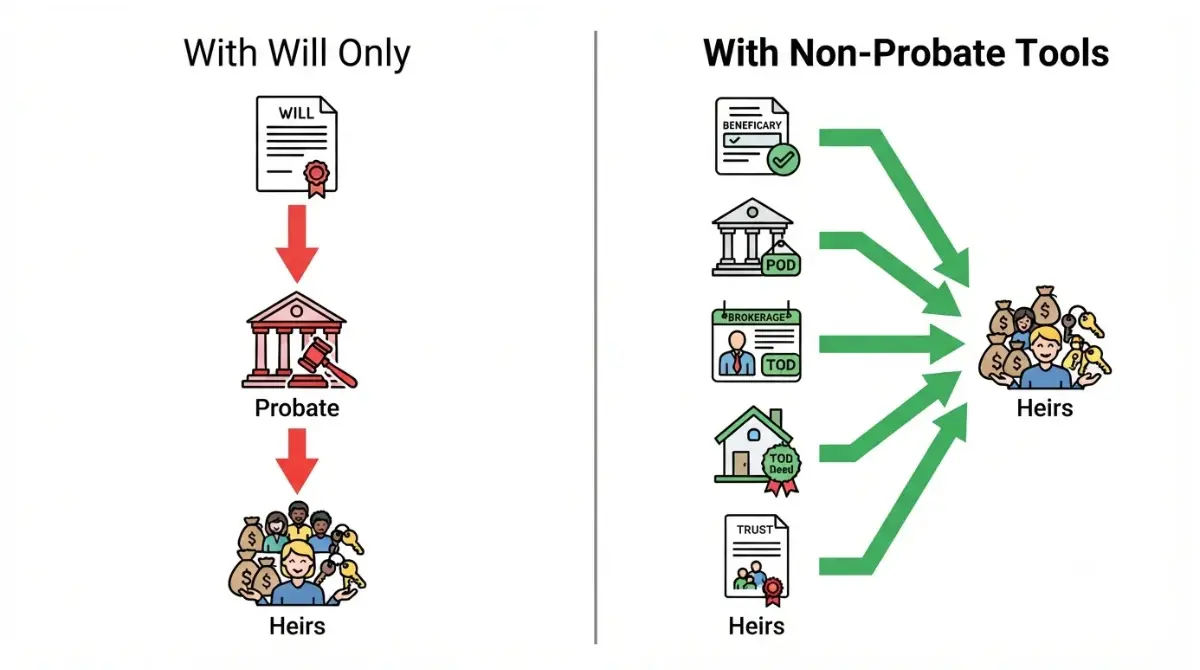
A will doesn’t avoid probate. It’s the document the probate court validates before anything is distributed.
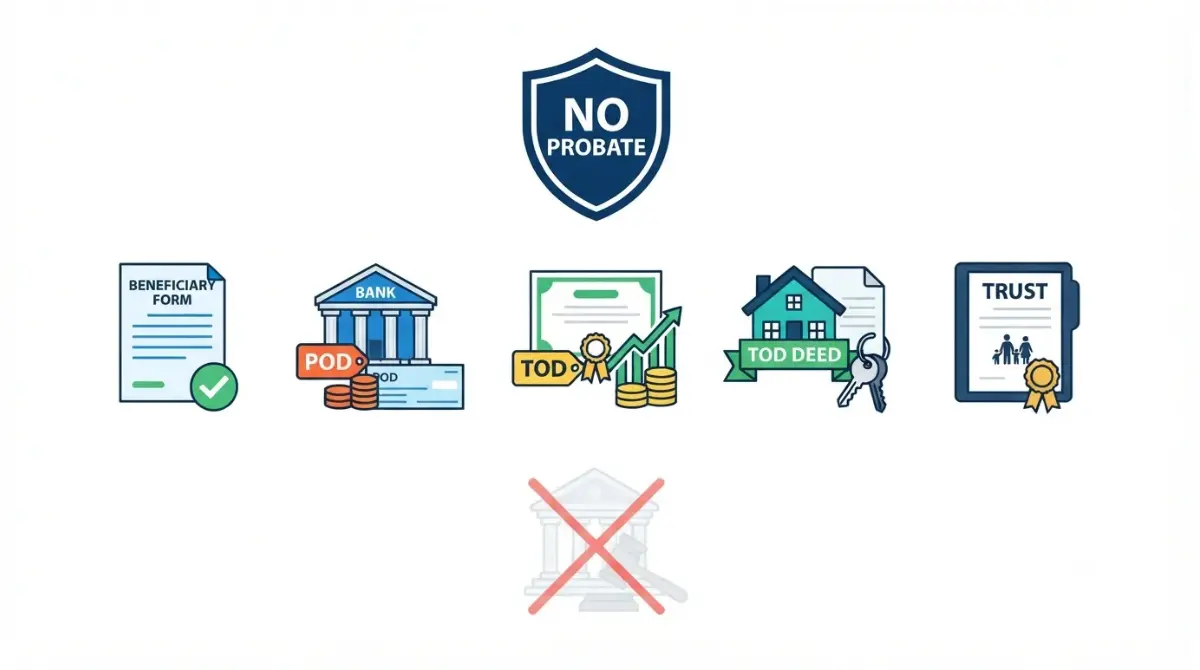
To skip court, an asset needs its own transfer instruction. That’s the same rule behind the assets that pass outside your will. Five tools do it:
- Beneficiary forms for retirement accounts and life insurance (Section 3)
- POD and TOD accounts for bank and brokerage money (Section 3)
- Transfer-on-death deed for your home (Section 4)
- Joint ownership with right of survivorship (Section 4)
- Revocable living trust for multiple assets or states (Section 5)
Helping an aging parent? Read Sections 4 and 7 first.
ℹ️ Financial Disclaimer: This article is educational only and isn’t personalized legal, tax, investment, insurance, or lending advice. Probate and property-transfer rules vary by state. Consult a licensed estate planning attorney, a CPA, or a fiduciary financial advisor before retitling assets or signing a deed or trust.
What probate costs you — and when it’s worth keeping
Probate is the court-supervised process of validating a will, paying debts, and distributing what’s left. Our guide to how the probate process works walks through each step.
How long probate can take
Probate often runs for months, and disputes can stretch it much longer. Heirs usually wait until the court finishes. Real estate in a second state can trigger a separate ancillary probate there.
When probate actually helps
Court supervision isn’t always bad. If an estate has heavy debts, many creditors, or heirs likely to fight, a judge acts as a neutral referee.
Tools 1–2: beneficiary forms, POD and TOD accounts
Beneficiary designations are the simplest way to avoid probate. You fill out a form, and the account passes straight to the person you name.
POD bank accounts and FDIC coverage
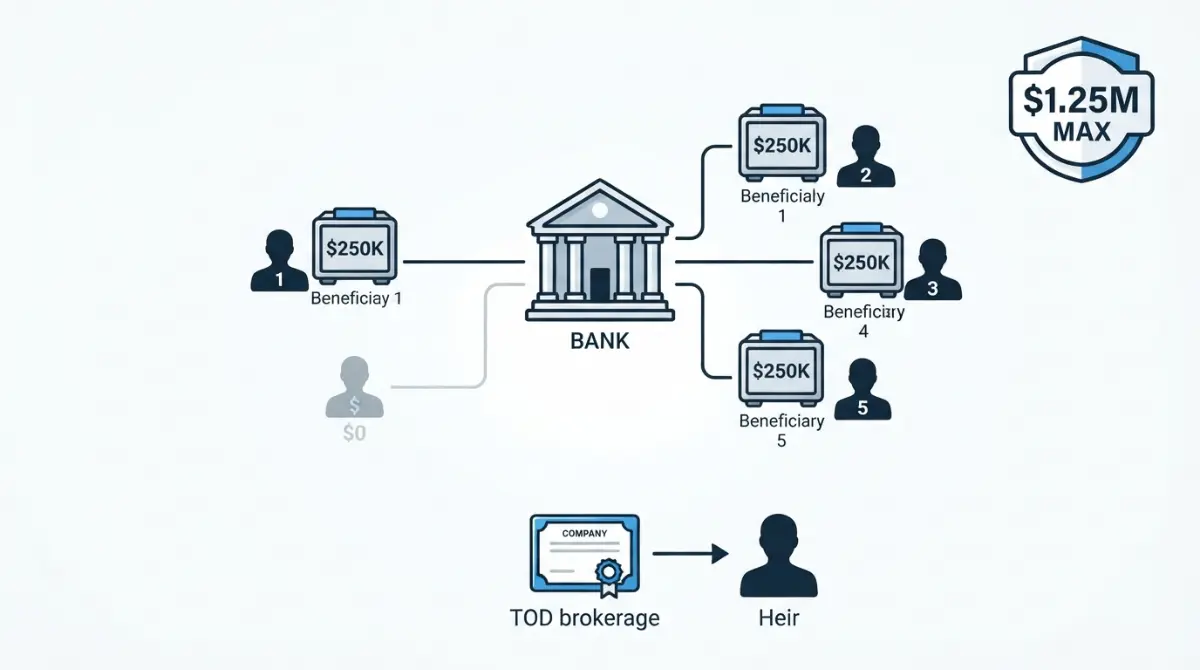
A payable-on-death (POD) account pays your beneficiaries at your death. They have no access while you’re alive. The FDIC’s trust account coverage rules treat these deposits specially.
🔍 How It Works: The FDIC insures POD deposits at $250,000 per eligible beneficiary, up to $1,250,000 per owner at one bank. One owner naming three children gets 3 × $250,000 = $750,000 of coverage. Adding a fourth and fifth child reaches the cap, and a sixth adds nothing. All your trust-type accounts at that bank are added together.
TOD brokerage accounts and retirement beneficiaries
A transfer-on-death (TOD) registration does the same for stocks and funds. The heir re-registers the securities by sending a death certificate and an application to the transfer agent, as Investor.gov explains for TOD accounts. IRAs pass by their own form, but heirs then face inherited IRA withdrawal rules.
✅ Action Step: This week, log in to every bank, brokerage, and retirement account. Confirm that a primary and a contingent beneficiary are on file.
Tools 3–4: TOD deeds and joint ownership for your home
Your home is where most probate plans stall, because deeds don’t come with a beneficiary line by default.
Does your state allow a transfer-on-death deed?
A transfer-on-death deed names who inherits your home. You can still sell it, refinance it, or revoke the deed. About 30 states plus DC allow these deeds, and the list is growing: New York’s law took effect in July 2024, and Maryland’s takes effect October 1, 2026. The deed generally must be recorded with the county before death.
Joint tenancy: simple, but you give up control
Joint ownership with right of survivorship passes property to the surviving owner automatically. But a joint account holder can withdraw funds without your consent, and the money can be reached if they’re sued. Putting a child on your deed is a lifetime gift, so compare gifting a house versus leaving it as an inheritance first.
⚠️ Costly Mistake: Adding an adult child to your bank account “to avoid probate” makes them a co-owner today. A POD designation reaches the same result at death without handing over access now.
✅ Action Step: Ask a local estate planning attorney: “Does our state allow a TOD deed, and how would Medicaid estate recovery treat a home passed this way?”
Tool 5: a revocable living trust — and what it won’t do
A revocable living trust avoids probate because the trust owns the assets, while you control them as trustee during your life.
How funding the trust keeps assets out of court
Signing the trust document isn’t enough. Each asset must be retitled into the trust, as covered in how to fund a living trust. Trusts earn their cost with multi-state property, minor heirs, or privacy needs; see will vs. trust.
Probate avoidance isn’t estate tax avoidance
Trust property still counts toward your taxable estate. Most families still owe no federal estate tax because the threshold is high. Our explainer covers how the estate tax exemption works.
📊 Data Point: The federal estate and gift tax basic exclusion amount for 2026 is $15,000,000 per individual. Source: IRS, What’s New — Estate and Gift Tax, citing Public Law 119-21.
✅ Action Step: Ask an estate planning attorney: “Given my assets and states, what would a trust add that beneficiary forms and a TOD deed don’t?”
Which probate-avoidance tool fits each asset you own
Match each asset to its tool, then close the gaps.
Asset-to-tool matching table
| Asset | Tool | Typical Cost | You Keep Control? | Key Detail |
|---|---|---|---|---|
| Bank accounts | POD designation | Usually free | Yes | FDIC: $250,000 per beneficiary, $1,250,000 cap per owner per bank |
| Brokerage accounts | TOD registration | Usually free | Yes | Brokers decide whether to offer TOD |
| IRA / 401(k) | Beneficiary form | Free | Yes | Heirs face inherited-account rules |
| Home | TOD deed or trust | Recording or attorney fees | Yes | TOD deed depends on your state |
| Multiple assets or states | Revocable living trust | Attorney-drafted | Yes, as trustee | Must be funded; still counts for estate tax |
Sources: FDIC, Investor.gov, IRS, state statutes. Last verified September 2026.
The 10-minute starting checklist
- List every asset that has no beneficiary or TOD instruction. Those assets are your probate exposure.
- Check whether your state allows a TOD deed.
- Price a trust using our breakdown of estate planning costs, then work through the full estate planning checklist.
Five mistakes that drag assets back into probate
Most probate surprises come from forms that were never finished or never updated.
Outdated or missing beneficiaries
- No beneficiary: a brokerage account without a TOD beneficiary or a surviving joint owner may need a court-appointed executor to move it.
- No contingent beneficiary: if your only beneficiary dies first, the asset can fall back into your estate.
- Unfunded trust: anything left in your own name goes through probate anyway.
Moving states without updating documents
State law governs these tools, so moving can change what works. FINRA’s guide to brokerage accounts at death recommends updating documents after a move and telling family where accounts are held. Heirs should also understand the step-up in basis on inherited stock and can estimate a later sale with the capital gains tax calculator.
Frequently asked questions about avoiding probate
1. Does a will avoid probate?
No. A will is the document the probate court validates, so assets passing only under a will still go through probate.
2. What assets don’t go through probate?
Assets with a named beneficiary, POD or TOD registration, surviving joint owner, TOD deed, or trust ownership generally avoid probate.
3. What is a payable-on-death account?
A payable-on-death account is a bank account that passes directly to named beneficiaries at death, with no access for them before then.
4. Is a POD account FDIC insured?
Yes. POD deposits are insured up to $250,000 per eligible beneficiary, capped at $1,250,000 per owner at one bank.
5. What is a transfer-on-death deed?
A transfer-on-death deed names who inherits your home at death, while you keep full power to sell, refinance, or revoke it.
6. Does every state allow a transfer-on-death deed?
No. About 30 states plus DC allow transfer-on-death deeds, and Maryland’s law takes effect October 1, 2026. Confirm your state’s rules with an estate planning attorney.
7. Is joint ownership a good way to avoid probate?
Joint ownership avoids probate but makes the co-owner an owner now, with access to funds and exposure to their creditors. Ask an estate planning attorney about gift implications first.
8. Do I need a living trust to avoid probate?
Not always. A living trust mainly helps with multi-state property, minor heirs, or privacy; beneficiary forms cover most accounts. Ask an attorney what a trust adds for you.
9. Does avoiding probate avoid estate tax?
No. Trust and beneficiary assets still count toward your estate, and the 2026 federal basic exclusion is $15,000,000 per person. Ask a CPA about state estate taxes.
10. How do heirs claim a TOD brokerage account?
The TOD beneficiary re-registers the securities, usually by sending a death certificate and a re-registration application to the transfer agent.
11. What if I own property in more than one state?
Property in a second state can trigger ancillary probate there. A funded living trust or a TOD deed can help avoid probate for it. Confirm with an attorney in each state.
Your next step to keep assets out of probate
Start with the free step: confirm beneficiaries on every account this week. Then decide on your home, either with a TOD deed if your state allows one or with a funded living trust. An estate planning attorney can confirm which tool your state’s law supports.
Related Articles
 Estate Planning
How to make a will and avoid the errors that void it
September 18, 2026 Estate Planning
The Right Way to Know When to Update Your Estate Plan
October 5, 2026 Estate Planning
What Your Agent Can Legally Do Under a Durable Power of Attorney
September 29, 2026 Estate Planning
The Portability Election and Your Spouse’s Overlooked Exemption
September 24, 2026 Estate Planning
Assets Not Covered by a Will and the Hidden Rules on Who Inherits
September 16, 2026 Estate Planning
How to Choose an Estate Planning Attorney You Can Verify
September 22, 2026 Estate Planning
When an Irrevocable Trust Is the Right Trade for Your Family
September 29, 2026 Estate Planning
A Clear Price Guide to the Best Online Will Service
September 22, 2026 Estate Planning
A Clear Look at What Happens If You Die Without a Will
September 30, 2026
Informational disclaimer
The content on Finance Authority Hub is provided for general informational and educational purposes only and should not be considered personalized financial, investment, tax, legal, or professional advice. Financial decisions depend on your individual goals, income, risk tolerance, location, and regulatory situation. Before acting on any information, strategy, estimate, or calculator result, consult a qualified licensed professional who can evaluate your specific circumstances.