
Split Your Tax Refund With Form 8888 and Pick the Smart Order
Splitting a tax refund changed in December 2025: if IRS processing is delayed, Form 8888 now sends everything to your last valid account.
In This Article
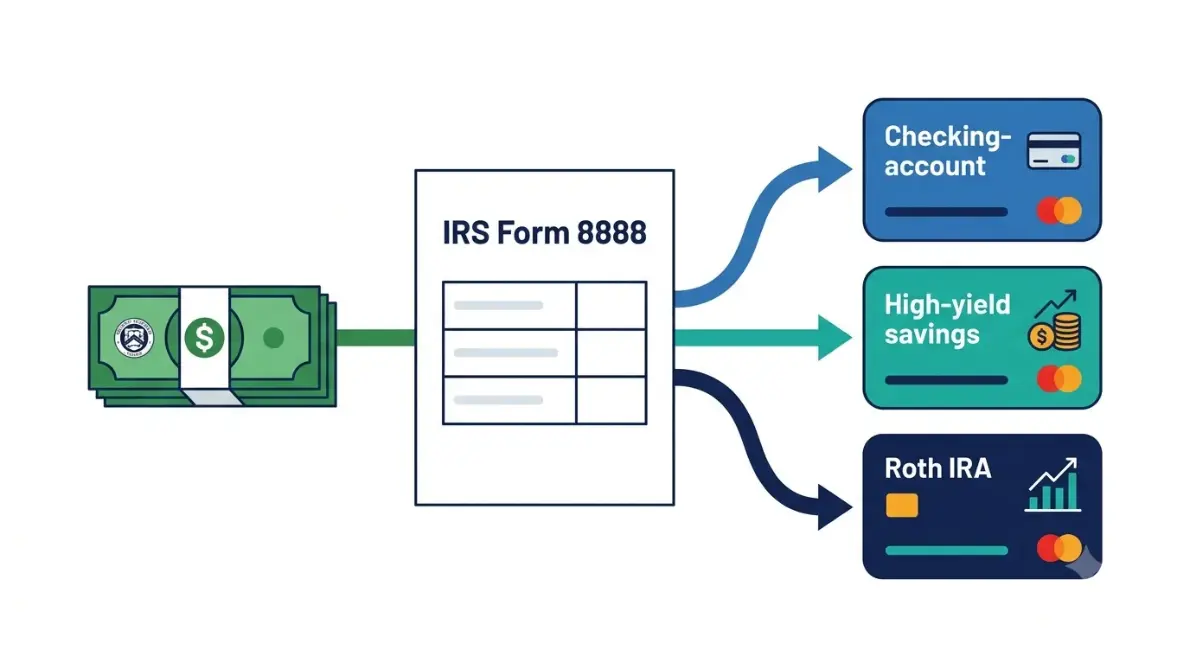
Can you split a tax refund into more than one account?
Yes. The IRS lets you split a federal tax refund among up to three accounts, in any proportion, with at least $1 each. E-filers use tax software, paper filers attach Form 8888, and the IRS says splitting doesn’t delay your refund.
Find your situation:
- Saving part of it: decide where to put your tax refund, then see which account goes last.
- Funding an IRA or HSA: check the contribution-year rule.
- Refund smaller than expected: read the offset rules.
- Deposit rejected: see the CP53E notice section.
ℹ️ Financial Disclaimer: This article is educational only, not personalized tax, investment, lending/credit, insurance, or debt-relief advice. Consult a CPA, fiduciary advisor, or qualified attorney before acting.
What Form 8888 does now, after the December 2025 changes
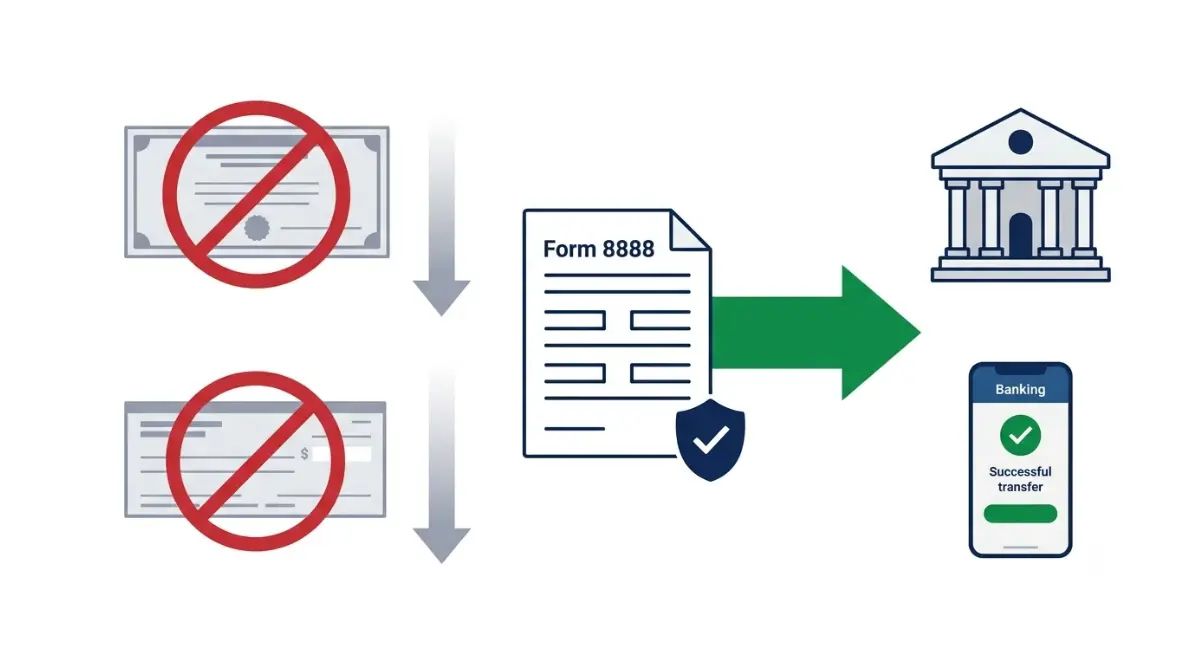
Form 8888, revised in December 2025, now only splits a direct-deposit refund among two or three U.S. accounts.
Savings bonds are gone
Buying savings bonds with a refund, whether paper I bonds or a TreasuryDirect deposit, is discontinued. Electronic I bonds are still sold directly through TreasuryDirect.
No paper-check portion anymore
Under Executive Order 14247, the IRS generally stopped issuing paper refund checks after September 30, 2025, with limited exceptions; the IRS guidance on electronic refund payments explains why. No bank account? Review other ways to receive a refund.
📊 Data Point: Electronic refunds arrive in under 21 days in most cases; mailed refunds can take 6 weeks or longer. — Source: IRS Modern Payments page (September 2026).
How to fill out Form 8888, line by line
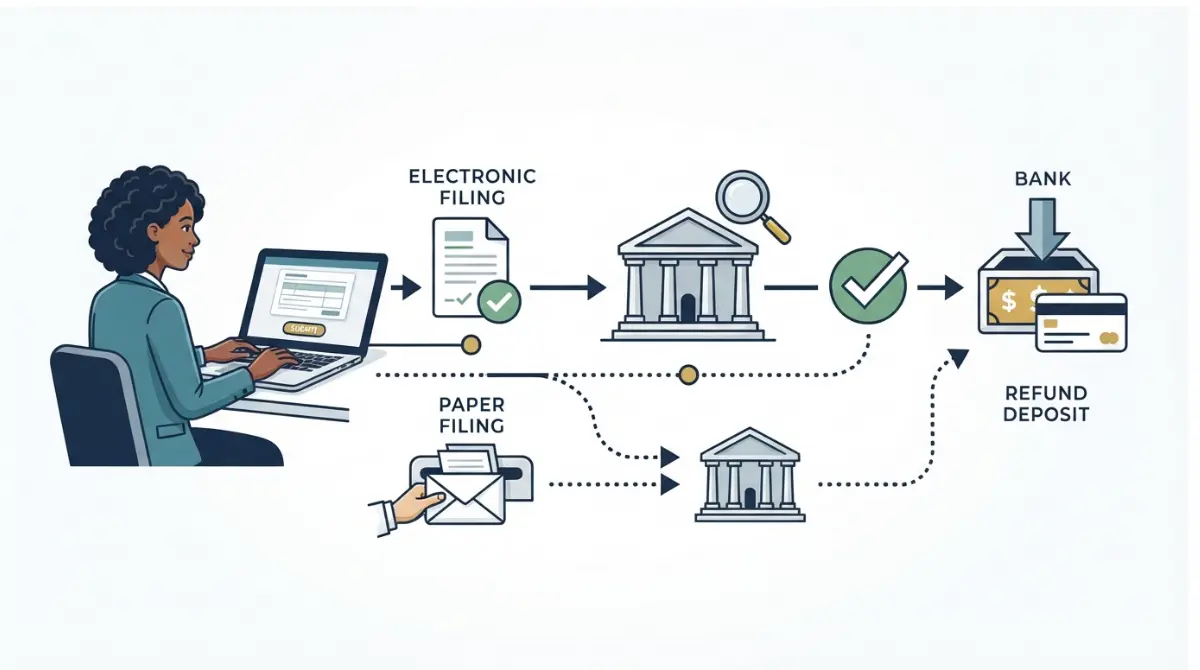
You can split a refund whether you e-file or file on paper.
E-filing: where the split option lives
Choose direct deposit in your software, add up to three accounts, and it builds Form 8888. E-filed Form 1040-X refunds for tax year 2021 or later can be split too.
Paper filing: lines 1a through 5
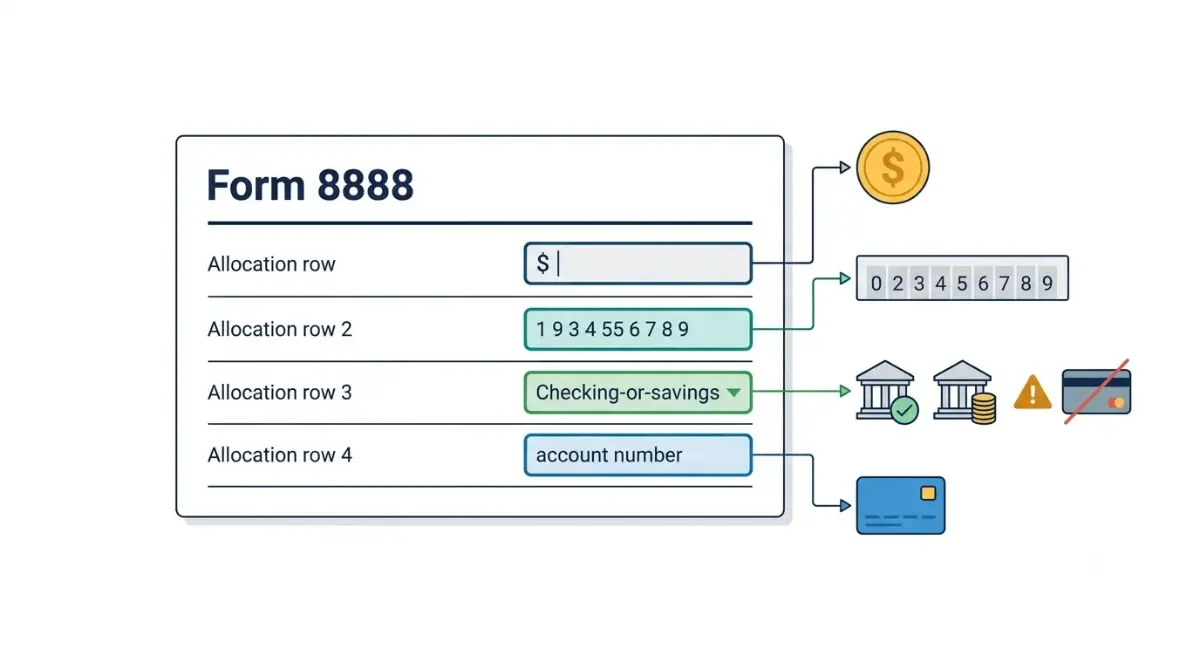
Complete these lines on the current Form 8888 and its instructions and attach it to your Form 1040:
- Amounts (1a–3a): at least $1 per account.
- Routing numbers (1b–3b): nine digits, starting with 01–12 or 21–32.
- Account type (1c–3c): Checking or Savings; ask your IRA, HSA, or brokerage firm.
- Account numbers (1d–3d): up to 17 characters, hyphens included, no spaces.
- Total (line 5): must equal your refund, so estimate your refund before you file.
⚠️ Costly Mistake: Never use the number on the front of a debit card; it may differ from your account number. Cross-outs or white-out on a paper form get the allocation rejected.
Which account should go last on your split?
Line order decides where your money lands when something goes wrong.
A $2,400 refund, split three ways
| Account (line) | Requested | After a $500 math-error cut | If IRS processing is delayed | Key Detail |
|---|---|---|---|---|
| Roth IRA (line 1) | $600 | $600 | $0 | Reached last by IRS cuts |
| High-yield savings (line 2) | $1,200 | $1,200 | $0 | Cut only after line 3 |
| Everyday checking (line 3) | $600 | $100 | $2,400 | Absorbs cuts and delays |
Illustrative; calculated from Form 8888 (Rev. December 2025) rules.
🔍 How It Works: Math-error cuts come off line 3, then 2, then 1; increases go to the last account listed. A processing delay sends the whole refund to the last valid account.
The line-order rule of thumb
List your most flexible account, usually everyday checking, last, because it may receive everything or lose the most. Older guides say delays favor the first account, but that rule changed.
First, run the refund formula on your own numbers and use the budget calculator to set your savings share.
Sending part of your refund to an IRA or HSA
Refunds can fund tax-advantaged accounts, but timing rules are strict.
Eligible and ineligible accounts
Traditional, Roth, and SEP IRAs qualify; SIMPLE IRAs don’t. An existing health savings account, Archer MSA, or Coverdell ESA also works.
Telling your custodian the contribution year
IRS deposits don’t state a contribution year, so tell your trustee, or it may count the money as current-year. A prior-year deposit must land by the return’s due date, not counting extensions. See the refund-to-IRA contribution deadline and current IRA contribution limits.
✅ Action Step: Ask a CPA or enrolled agent: “If my refund is offset or late, how do I keep this IRA or HSA contribution valid for the year I’m claiming?”
What happens to a split refund when it’s reduced
Two agencies can reduce a split refund, using different rules.
IRS reductions: bottom-up
For back federal taxes or an Earned Income Tax Credit amount held for review, the IRS cuts your last-listed account first.
Fiscal Service offsets: lowest routing number first
The Bureau of the Fiscal Service collects past-due state tax, child support, and federal nontax debts like student loans, starting with the lowest routing number, so line order can’t shield an account; see how refund offsets reduce your refund.
🔍 How It Works: The Fiscal Service’s notice lists your original refund, the offset, and the agency paid. Dispute the debt with that agency, not the IRS, per the IRS explanation of reduced refunds.
Why a split deposit gets rejected, and what happens next
Most rejections trace back to an account mismatch.
Name, joint-account and three-deposit-limit problems
A deposit fails if the name doesn’t match, a bank refuses a joint refund in an individual account, or three refunds already went to that account this year. Only your own account, your spouse’s on a joint return, or a joint account qualifies. A rejected portion goes to the last valid account listed.
The CP53E notice and its 30-day window
If no account works, a CP53E notice gives you 30 days to add one online, one time; otherwise a paper check follows after six weeks. The IRS asks for banking details only by mail and can’t change them after receiving your return; if your refund shows approved but never arrived, start there.
Frequently asked questions about splitting a tax refund
1. Can I split my tax refund into multiple accounts?
Yes. You can split a tax refund among up to three accounts, with at least $1 going to each.
2. Is there a minimum amount to split a tax refund?
Each deposit in a split tax refund must be at least $1; divide the rest however you like.
3. Can I still buy savings bonds with my tax refund?
No. Using a tax refund to buy paper I bonds or TreasuryDirect savings bonds has been discontinued.
4. Can I split my tax refund between direct deposit and a paper check?
No. Form 8888 now splits a tax refund only among direct-deposit accounts, and paper refund checks are largely phased out.
5. Does splitting a tax refund delay it?
No. The IRS says splitting a tax refund doesn’t delay it; electronic refunds usually beat mailed ones.
6. What happens if one account rejects my split refund?
That deposit’s share of your split refund goes to the last valid account you listed on Form 8888.
7. Can I deposit my tax refund into someone else’s account?
No. A tax refund can go only to your own, your spouse’s (joint return), or a joint account.
8. Can part of my tax refund go to an IRA or HSA?
Yes. A traditional, Roth, or SEP IRA, or an existing HSA, can receive part of a tax refund. A CPA can confirm contribution-year timing.
9. What happens to a split refund if it’s offset?
IRS cuts to a split refund start with the last-listed account; Fiscal Service offsets start at the lowest routing number. A CPA can help you dispute a debt.
10. Can I split a refund on an amended return?
Yes. Attach Form 8888 to an e-filed Form 1040-X for tax year 2021 or later to split the amended refund. A CPA can confirm whether amending makes sense.
11. Can I change my refund split after filing?
Generally no. Once the IRS receives your return, it can’t change the account details for your refund split.
Your next step before filing
Choose up to three accounts, verify every number, and list your whole-refund backup account last. Then use the emergency fund calculator to set a target and the savings calculator to watch it grow.
Related Articles
 Tax Refund
 Delayed and Bills Running Late? Find the Cause First
October 7, 2026 Tax Refund
How to Make a Smart Tax Refund IRA Contribution for 2026
October 15, 2026 Tax Refund
A Smart Way to Plan Around Your PATH Act Refund Date
October 8, 2026 Tax Refund
How a Tax Refund Affects SSI, SNAP and Medicaid Benefits
October 16, 2026 Tax Refund
A Clear Look at Tax Refund vs Owing, Run as Math
October 12, 2026 Tax Refund
Do You Need to File to Get a Tax Refund If You Owe Nothing?
October 12, 2026 Tax Refund
Is Your Tax Refund Lower Than Last Year? Find the Real Reason
October 10, 2026 Tax Refund
What a Tax Refund Advance Loan Really Costs You
October 16, 2026 Tax Refund
 Without Bank Account? Your Clear Options Explained
October 9, 2026
Informational disclaimer
The content on Finance Authority Hub is provided for general informational and educational purposes only and should not be considered personalized financial, investment, tax, legal, or professional advice. Financial decisions depend on your individual goals, income, risk tolerance, location, and regulatory situation. Before acting on any information, strategy, estimate, or calculator result, consult a qualified licensed professional who can evaluate your specific circumstances.