
How to Make a Smart Tax Refund IRA Contribution for 2026
Tax refund IRA contribution rules share one $7,500 limit across traditional and Roth, and the year you tell your custodian decides which year counts.
In This Article
Can you put your tax refund into an IRA?
Which accounts accept a refund
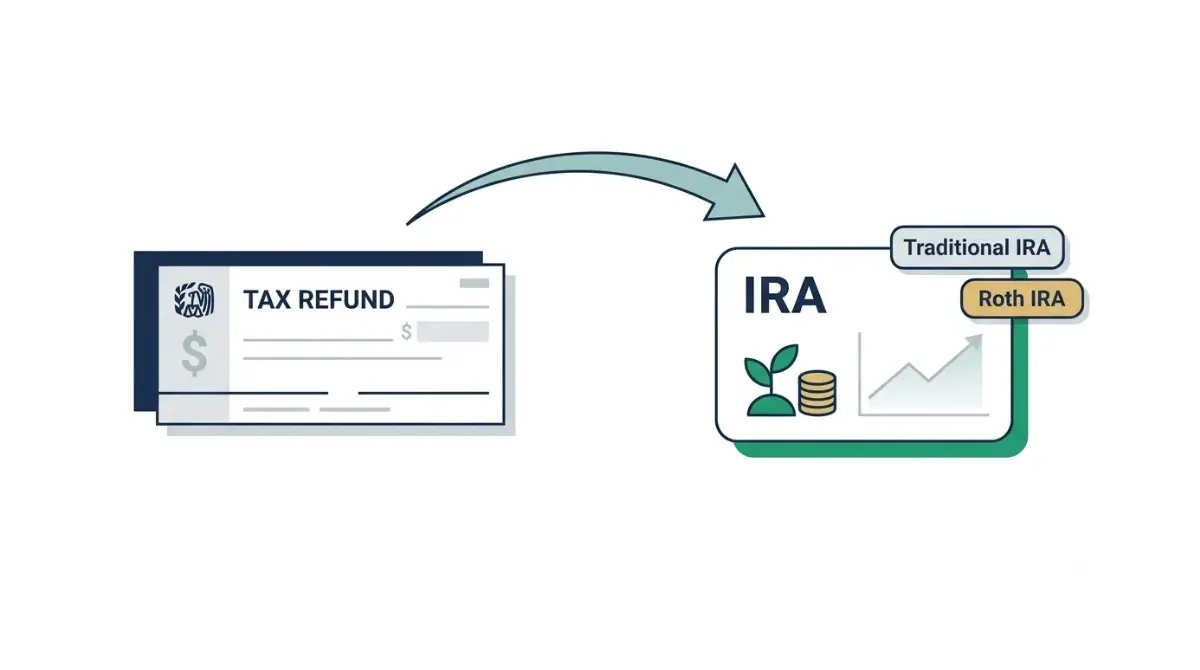
Yes. You can send all or part of your federal refund into a traditional IRA, Roth IRA or SEP IRA you already own, but not a SIMPLE IRA. The catch: you must tell your custodian which tax year the deposit is for, or it may assume the wrong one.
Which situation are you in?
- No IRA yet: open one first; the refund needs an account number.
- Choosing Roth or traditional: compare the income tests below.
- In debt or short on savings: run the tax refund formula first.
ℹ️ Financial Disclaimer: This article is for education only and isn’t personalized investment, tax, lending, insurance or debt-relief advice. IRA rules depend on your income, filing status and workplace plan, so consult a CPA or fiduciary advisor before acting.
How to send your refund to an IRA with Form 8888
Your refund can only land in an IRA that already exists, so the work starts before you file.

One account vs split deposit
- Open the IRA and note its routing and account numbers.
- Sending everything there? Enter those numbers on your return.
- Splitting the refund? File Form 8888 for two or three accounts, at least $1 each.
- Tell your custodian which tax year the deposit is for.
🔍 How It Works: If processing is delayed, the IRS sends the entire refund to the last valid account on Form 8888. Make that account one you’d accept receiving it all.
What can go wrong at the bank
The account must be in your name, and the IRS isn’t responsible for a refund sent to wrong numbers.
How much of your refund can go into an IRA in 2026?
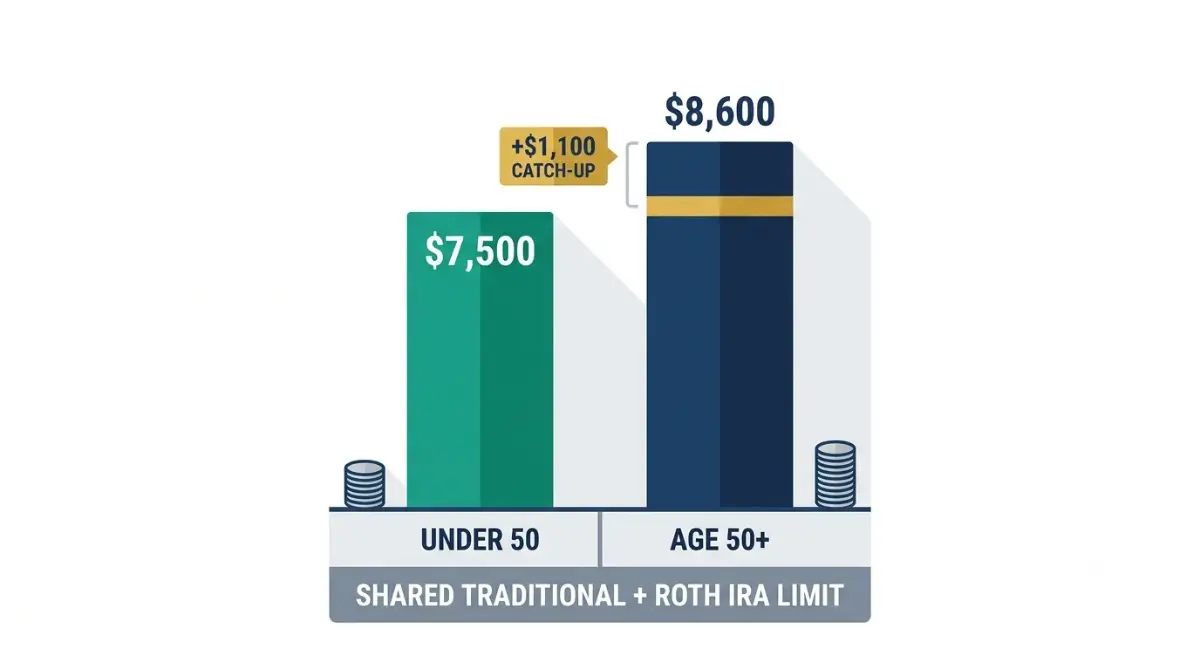
For 2026, you can contribute up to $7,500 across all your IRAs, or $8,600 if you’re 50 or older.
| Saver | 2026 limit | Key Detail |
|---|---|---|
| Under 50 | $7,500 | Shared by traditional and Roth IRAs |
| 50 or older | $8,600 | Includes a $1,100 catch-up |
Source: IRS Notice 2025-67; IRS retirement topics page on IRA limits.
The standard limit
Your taxable compensation lowers the cap if it’s smaller than the limit.
📊 Data Point: The IRA limit rose to $7,500 for 2026 from $7,000 — Source: IRS announcement of 2026 limits, November 2025.
Age 50+ catch-up
Savers age 50 or older by year-end can add a $1,100 catch-up contribution.
Traditional and Roth share one limit
Putting $4,000 in a Roth leaves $3,500 for a traditional IRA, never $7,500 in each.
Traditional or Roth: which fits a refund deposit?
Two income tests decide what a deposit can do for you.
| Account | 2026 MAGI range that limits it | Key Detail |
|---|---|---|
| Roth IRA | Single $153,000–$168,000; joint $242,000–$252,000 | Never deductible |
| Traditional IRA | Covered at work: single $81,000–$91,000; joint $129,000–$149,000 | Deduction shrinks; contributing is still allowed |
Source: IRS cost-of-living notice for 2026.
Roth income limits
Roth eligibility shrinks as MAGI rises through its range; see traditional vs Roth IRA for a full comparison.
Traditional IRA deduction with a workplace plan
With no workplace plan for you or your spouse, the deduction has no income cap.
A possible Saver’s Credit
Lower-income savers may also claim the Saver’s Credit; 2026 AGI limits are $40,250 (single) and $80,500 (joint).
✅ Action Step: Ask a CPA whether your contribution is deductible, Roth-eligible, or both, given your MAGI and workplace plan.
What is the deadline to put your refund in an IRA?
For 2026, the deadline is your return’s due date, usually April 15, 2027, and the money must be in the account by then. A filing extension doesn’t move it, according to IRS Publication 590-A.
Which year does the deposit count for?
Tell your custodian the deposit is for 2026; otherwise it can assume the year you filed, 2027.
What if the refund arrives late?
A deposit that misses the date isn’t a 2026 contribution; you’d amend your return and drop any IRA deduction claimed.
⚠️ Costly Mistake: A late refund can’t count for 2026. If it hasn’t arrived as the due date nears, fund the IRA from other money by that date.
Worked example: does your refund fit under the limit?
Use this check on your own numbers; the figures are illustrative, not a real taxpayer.
Step 1: find your room
Subtract what you’ve already added for 2026 from the limit. With $4,000 added, a saver under 50 has $3,500 of room, so a $2,400 refund fits.
Step 2: test Roth eligibility
A single filer with $160,500 MAGI sits halfway through the $153,000–$168,000 range, leaving about half the limit, or $3,750. The IRS worksheet in Publication 590-A gives your exact amount.
Step 3: plan for a reduced refund
If a $600 offset trims a $2,400 refund sent only to your IRA, $1,800 arrives, and you’d cover the $600 by the due date.
🔍 How It Works: Past-due federal tax comes off the last-listed account first; other debts, like student loans, come off the lowest routing number first.
✅ Action Step: Have a CPA verify your MAGI and the worksheet, then test growth with our retirement calculator.
Refund-to-IRA mistakes that trigger penalties or re-filing
Wrong year or late deposit
If you skip the year designation, your custodian may log the deposit for 2027. Say “tax year 2026” before you file.
Refund reduced or delayed
Offsets for past debts can shrink the deposit, and the IRS isn’t responsible for refunds sent to wrong account numbers. Weigh paying down debt first too.
Overfunding the IRA
Contributions above your limit face a 6% tax for each year the excess stays in the account. Withdrawing the excess and its earnings by the due date, including extensions, avoids it, per IRS guidance on excess contributions.
✅ Action Step: Overfunded? Ask a CPA how to correct it before the due date.
Tax refund IRA contribution FAQs
1. Can you put your tax refund in an IRA?
Yes. A tax refund IRA contribution can go to a traditional, Roth or SEP IRA you’ve already opened, though not a SIMPLE IRA.
2. How do I deposit my refund into an IRA?
Enter the IRA’s routing and account numbers on your return or Form 8888, then tell your custodian which tax year the deposit is for.
3. What is the 2026 IRA contribution limit?
The 2026 IRA contribution limit is $7,500, or $8,600 at age 50 or older, shared across traditional and Roth IRAs.
4. What is the deadline for a refund IRA contribution?
For 2026 the deadline is April 15, 2027 for most people, and a filing extension doesn’t move it.
5. Can I put my refund in a Roth IRA?
Yes, if your MAGI is under the Roth range; single filers phase out between $153,000 and $168,000 for 2026. A CPA can confirm your range.
6. Is a refund-funded IRA contribution deductible?
A refund-funded traditional IRA contribution may be deductible, depending on workplace-plan coverage and income; Roth contributions never are. A CPA can confirm your deduction.
7. Does the IRS tell my IRA which year the deposit is for?
No. You must tell your custodian the tax year; otherwise it can assume the year you filed your return.
8. Can I split my refund between an IRA and my bank account?
Yes. Form 8888 splits a refund among two or three accounts, with at least $1 going to each.
9. What if my refund is reduced or offset before it reaches my IRA?
An offset shrinks the deposit. Cover the shortfall from other money by the due date, or amend your return to drop the deduction. A CPA can help you amend.
10. Can a tax refund go into a SIMPLE IRA?
No. The IRS allows refund deposits into traditional, Roth and SEP IRAs, but not SIMPLE IRAs.
11. What happens if I put too much in an IRA?
Excess IRA contributions face a 6% tax for each year they remain, unless withdrawn with earnings by the due date, including extensions. A CPA can help correct it.
Your next step before you file
Before you file, check three things: room under the limit, eligibility for your account type, and a deposit that lands by the due date. If your cushion is thin, size it first with our emergency fund calculator.
Related Articles
 Tax Refund
How a Tax Refund Affects SSI, SNAP and Medicaid Benefits
October 16, 2026 Tax Refund
Smart Ways to Estimate Your Tax Refund Before Filing
October 10, 2026 Tax Refund
Clear Signs of a Smaller Tax Refund Next Year
October 10, 2026 Tax Refund
The Right Way to Check Your Tax Refund Status With the IRS
October 6, 2026 Tax Refund
Do You Need to File to Get a Tax Refund If You Owe Nothing?
October 12, 2026 Tax Refund
What a Tax Refund Advance Loan Really Costs You
October 16, 2026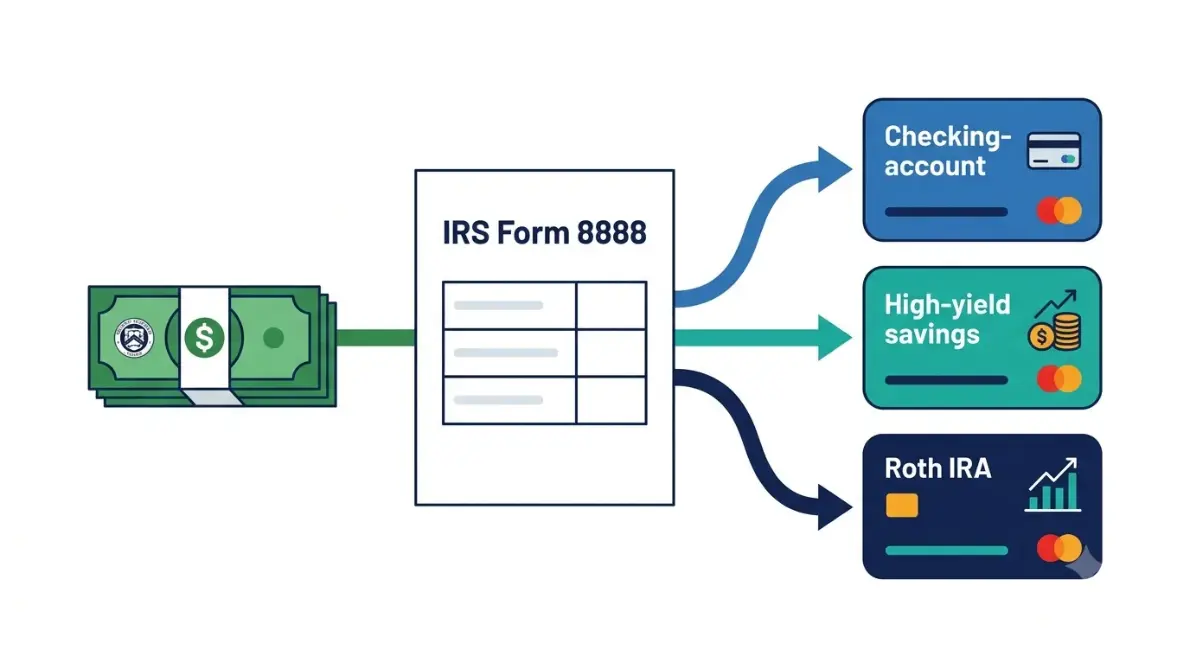 Tax Refund
Split Your Tax Refund With Form 8888 and Pick the Smart Order
October 16, 2026 Tax Refund
A Clear Look at Tax Refund vs Owing, Run as Math
October 12, 2026 Tax Refund
The Right Way to Tell a Tax Refund Offset From a Correction
October 8, 2026
Informational disclaimer
The content on Finance Authority Hub is provided for general informational and educational purposes only and should not be considered personalized financial, investment, tax, legal, or professional advice. Financial decisions depend on your individual goals, income, risk tolerance, location, and regulatory situation. Before acting on any information, strategy, estimate, or calculator result, consult a qualified licensed professional who can evaluate your specific circumstances.