
Do You Need to File to Get a Tax Refund If You Owe Nothing?
Need to file to get a refund? The IRS said $1.2 billion in 2022 refunds was unclaimed in March 2026, so timing matters.
In This Article
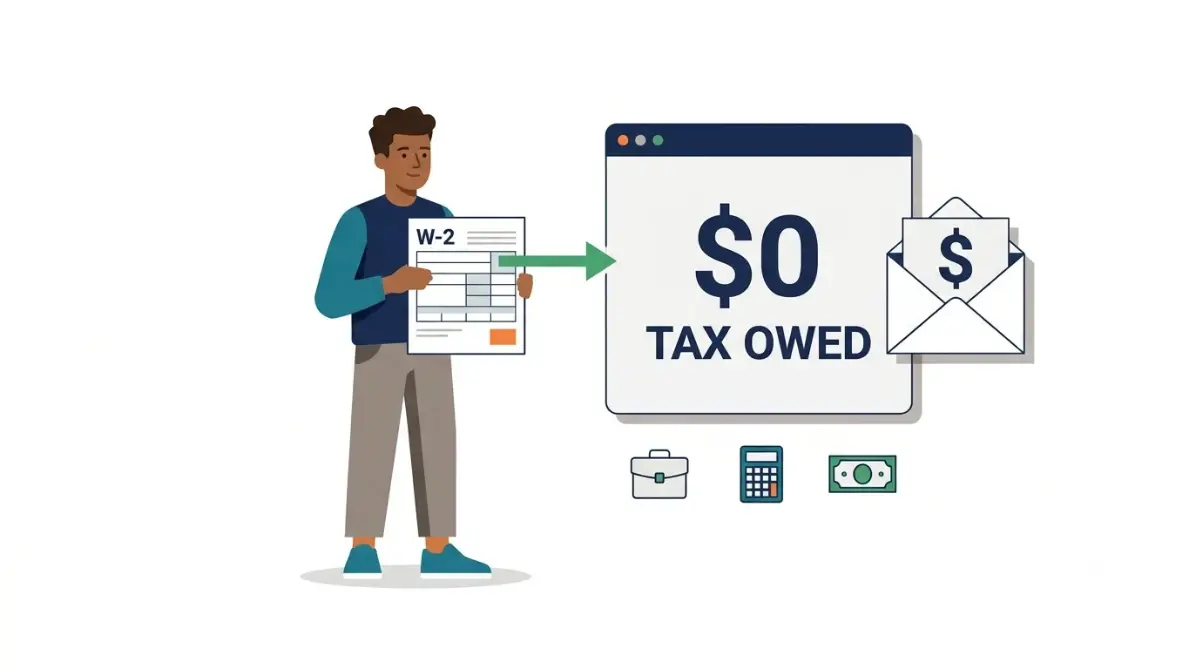
Do you need to file to get a refund? The short answer
Yes. To get back federal income tax withheld, or to collect a refundable credit, you must file a return, even if you earned too little to owe tax (IRS Publication 501). The IRS gives you three years to claim it.
Part-time workers and students: start at the income thresholds. Gig workers: try the Refund-or-Skip Test. Behind on earlier years: see the three-year clock.
Required to file vs. entitled to a refund
Being required to file depends on gross income; being owed a refund depends on withholding and credits. See how they combine in the tax refund formula.
What to have in front of you
Have your W-2s and 1099s.
ℹ️ Financial Disclaimer: This article is general education about federal income tax, not personalized tax, investment, lending, insurance or debt-relief advice. Rules depend on your filing status, income and past returns. Before acting, confirm your situation with an IRS-certified preparer, an enrolled agent, a CPA, or a qualified attorney.
Who must file a 2025 return: the income thresholds
A single filer under 65 must file a 2025 return with gross income, meaning income before deductions, of at least $15,750. The filing threshold varies by status and age.
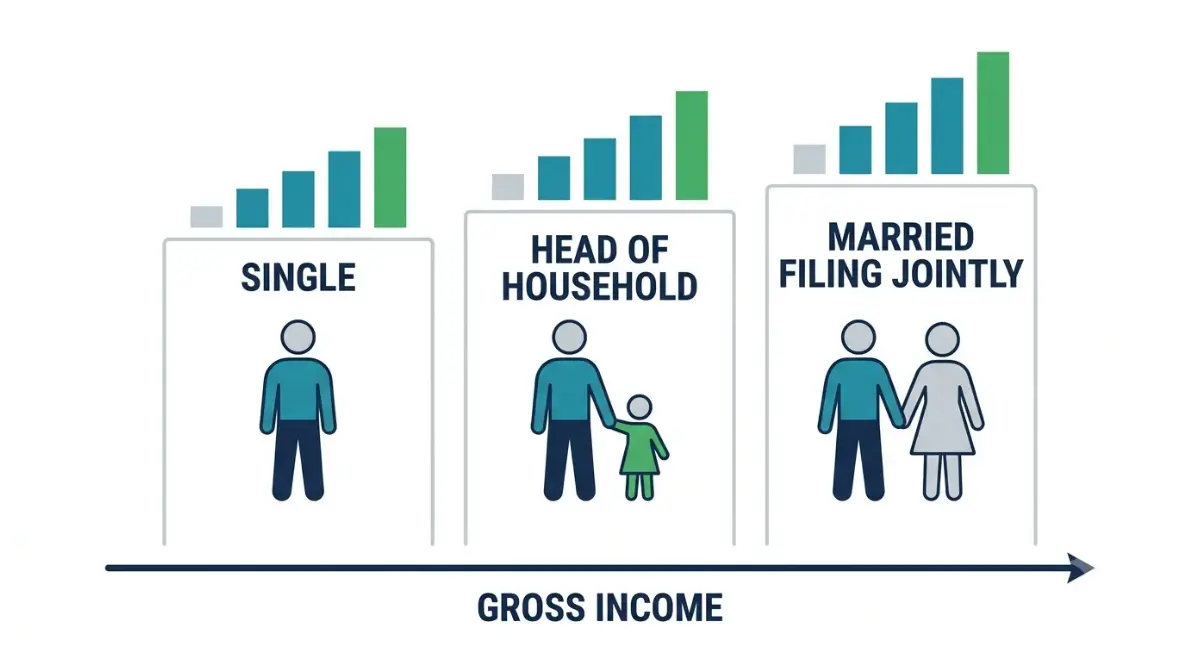
The threshold table
| Filing status and age | Must file at gross income of | Key detail |
|---|---|---|
| Single, under 65 | $15,750 | Most common case |
| Single, 65 or older | $17,750 | Born before January 2, 1961 |
| Head of household, under 65 | $23,625 | Unmarried with a qualifying person |
| Head of household, 65 or older | $25,625 | Born before January 2, 1961 |
| Married filing jointly, both under 65 | $31,500 | One spouse 65+: $33,100; both 65+: $34,700 |
| Qualifying surviving spouse, under 65 | $31,500 | Widow(er) with a dependent child |
| Married filing separately, any age | $5 | Nearly everyone in this status must file |
Source: IRS Publication 501, Table 1, tax year 2025 (return due April 15, 2026). Use the current-year publication for later years.
Social Security, side income and special cases
Social Security benefits are generally excluded unless half your benefits plus other income tops $25,000 ($32,000 joint). Net self-employment earnings of $400 or more require a return.
Dependents and students
A single dependent under 65, including a student someone else claims, must file with unearned income over $1,350 or earned income over $15,750; a combined-income test also applies.
When you can skip filing and when you shouldn’t
Not being required to file doesn’t mean you should skip it.
The Refund-or-Skip Test
Yes or no?
- Was federal income tax withheld from your pay?
- Did you pay estimated tax?
- Did you earn within the Earned Income Tax Credit limits?
- Do you have a child or school costs that may earn a credit?
- Does a special filing rule apply?
A yes to 1–4 means filing can pay. A yes to 5, such as $400 of self-employment earnings, means filing is required.
Example: wages under the threshold
Illustrative: a single filer earns $9,200 in wages with $410 withheld. Filing isn’t required, but no tax is owed.
🔍 How It Works: Your refund equals tax withheld minus tax owed: $410 − $0 = $410.
Example: small side income changes the answer
Add $450 of net self-employment earnings: filing is now required because earnings reach $400, though gross income stays under $15,750. Estimate your refund before filing.
✅ Action Step: Ask a VITA volunteer or CPA whether special rules apply to your 1099 or health-coverage forms.
What not filing costs you: the three-year clock
Three years from the return’s due date is how long you have to claim a refund for an unfiled year (IRS refund time limits). Withheld tax counts as paid on that date.
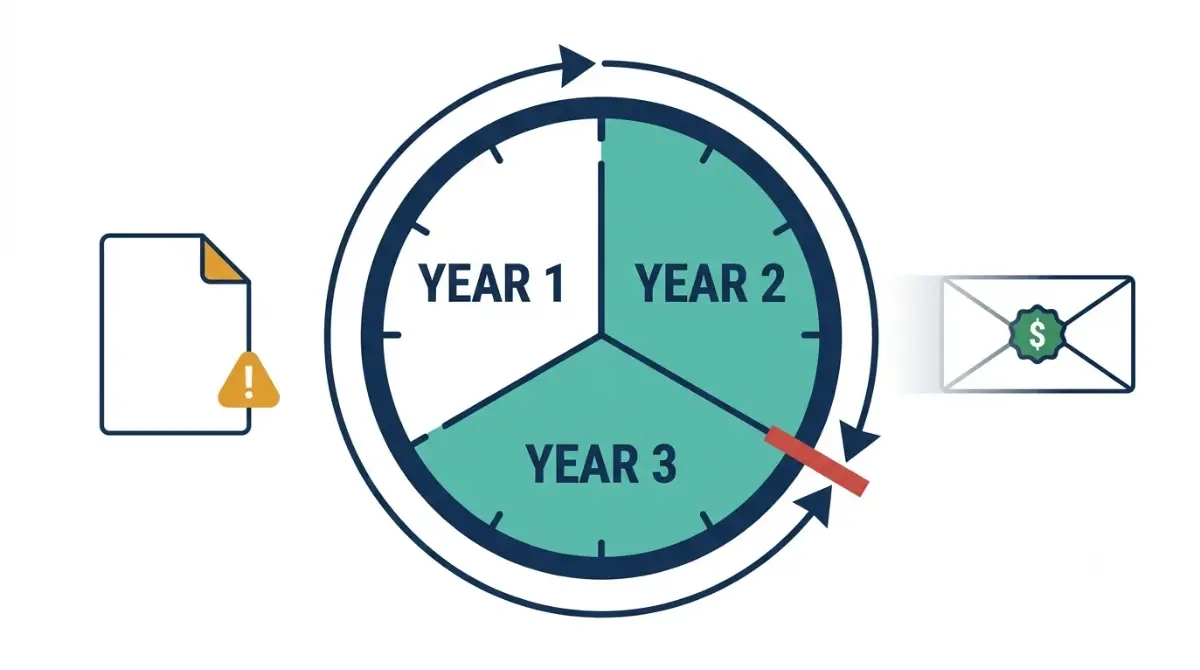
How the three-year rule works
🔍 How It Works: The failure-to-file penalty is 5% a month of tax owed after payments and credits. With nothing owed, 5% of $0 is $0.
Claim-by calendar
| Tax year | Return due | Claim by | Key detail |
|---|---|---|---|
| 2022 | April 2023 | April 15, 2026 | Passed; date stated by the IRS |
| 2023 | April 2024 | April 2027 | Derived from the three-year rule |
| 2024 | April 2025 | April 2028 | Derived from the three-year rule |
| 2025 | April 2026 | April 2029 | Derived from the three-year rule |
Source: IRS, “Time you can claim a credit or refund” and IRS news release IR-2026-37. The last three dates are derived; confirm the exact day on the IRS page.
📊 Data Point: Tax year 2022: about 1.3 million people left roughly $1.2 billion unclaimed (median refund $686) — Source: IRS news release IR-2026-37, March 20, 2026.
What can hold or reduce an old refund
Unfiled later returns can hold a 2022 refund, and the IRS can apply a refund to amounts you owe.
✅ Action Step: Ask an enrolled agent or CPA which past years are still open and what your IRS transcript shows.
Refundable credits that pay out when you owe $0
A refundable credit pays you the leftover amount even after your tax reaches $0.
Earned Income Tax Credit (2025 limits)
| Qualifying children | Maximum credit | AGI limit, single or head of household | AGI limit, married filing jointly | Key detail |
|---|---|---|---|---|
| 0 | $649 | $19,104 | $26,214 | Age 25 to under 65 |
| 1 | $4,328 | $50,434 | $57,554 | Child must meet IRS tests |
| 2 | $7,152 | $57,310 | $64,430 | Child must meet IRS tests |
| 3 or more | $8,046 | $61,555 | $68,675 | Child must meet IRS tests |
Source: IRS EITC tables, tax year 2025, reviewed May 8, 2026; age rule from the IRS “Who Qualifies for the EITC” page. Investment income must be $11,950 or less.
These are maximums. Illustratively, a single filer’s $12,000 of earned income, with no children, is under the $15,750 filing threshold yet inside the $19,104 limit.
Additional Child Tax Credit
The IRS lists up to $2,200 per child for the Child Tax Credit and up to $1,700 refundable (ACTC), with at least $2,500 of earned income. Refunds claiming them can’t arrive before mid-February.
Other credits that need a return
Up to $1,000 of the American opportunity credit is refundable, and the premium tax credit is another reason to file.
✅ Action Step: Ask a VITA volunteer: “Do my children and income meet the EITC and ACTC rules?”
How to file with little or no income, step by step
Use IRS Free File, Free File Fillable Forms, or a VITA site to file at no cost.
Pick a free filing option
- IRS Free File guided software: free at $89,000 AGI or less.
- Fillable Forms: any income, no state return.
- VITA free tax help sites serve people earning about $70,244 or less; limits vary.
- Sign with last year’s AGI or a self-select PIN.
If the return is for an earlier year
Free File handles only current-year returns, so file earlier years on paper or at a VITA site. Check the IRS page for Free File’s closing date.
Track your refund
Where’s My Refund updates about 24 hours after you e-file this year’s return and four weeks after paper filing.
Mistakes that cost low earners their refund
Three mistakes turn owed money into lost money.
Waiting for the IRS to send it
Withheld tax comes back only when you file, and after the window closes it becomes U.S. Treasury property (IRS, “Don’t lose your refund by not filing”). Fix: file, even late.
Skipping a return that was actually required
Self-employment earnings of $400 or more, advance premium tax credit payments, and HSA distributions each require a return.
⚠️ Costly Mistake: Some sites list $17,550 or $17,650 for single filers 65+. Pub 501 says $17,750.
Ignoring unfiled years
Unfiled 2023 and 2024 returns can hold a 2022 refund, and how long a refund takes depends on how you file.
✅ Action Step: Ask a VITA volunteer or the Taxpayer Advocate Service how to get IRS transcripts for missing years and file them in order.
Frequently asked questions (FAQ)
1. Do I need to file taxes if I made less than the standard deduction?
You must file only if gross income reaches your threshold, but recovering withheld tax still requires a return. A CPA or VITA volunteer can confirm.
2. Can I get a refund if I don’t file?
No. Getting back withheld tax or a refundable credit requires a filed return, so you must file.
3. How long do I have to file to claim a refund?
You generally have three years from the return’s due date to claim a refund; afterward it becomes Treasury property.
4. Is there a penalty for filing late if I’m owed a refund?
The failure-to-file penalty is based on tax owed, so a late return with none owed generally has no penalty. A CPA can confirm.
5. How much income do I need to file taxes?
For 2025, a single filer under 65 must file with gross income of at least $15,750.
6. Can I get the EITC if I’m not required to file?
Yes. You claim the Earned Income Tax Credit by filing, even when income is below the filing threshold.
7. Should I file if only a little was withheld?
Yes. If any federal tax was withheld, filing returns it; it comes back only through a filed return.
8. Do I have to file if I only get Social Security?
Generally not. Social Security is usually excluded unless half your benefits plus other income exceeds $25,000.
9. Do dependents or students have to file?
Dependents have separate thresholds: a single dependent under 65 generally must file above $1,350 unearned or $15,750 earned income.
10. Can I file for free?
Yes. IRS Free File guided software is free at $89,000 AGI or less; Fillable Forms has no income limit, and VITA offers free help.
11. What if I haven’t filed in previous years?
File within the three-year window; Free File can’t process earlier years, so use paper or VITA help. A CPA can sort the order.
Your next step
Run the Refund-or-Skip Test with your W-2. If withholding or a refundable credit applies, file free before your claim-by date; with no tax due, no failure-to-file penalty applies.
Related Articles
 Tax Refund
A Clear Walk Through the Tax Withholding Estimator Screens
October 13, 2026 Tax Refund
What to Do With Tax Refund Money in a Clear, Simple Order
October 15, 2026 Tax Refund
A Clear Look at Why the Average Tax Refund Keeps Changing
October 9, 2026 Tax Refund
Clear Signs of a Smaller Tax Refund Next Year
October 10, 2026 Tax Refund
Is Your Tax Refund Lower Than Last Year? Find the Real Reason
October 10, 2026 Tax Refund
A Clear Way to Adjust Your W-4 Refund Up or Down
October 12, 2026 Tax Refund
A Smart Way to Plan Around Your PATH Act Refund Date
October 8, 2026 Tax Refund
The Right Way to Tell a Tax Refund Offset From a Correction
October 8, 2026 Tax Refund
The Right Way to Answer IRS Letter 5071C and Release Your Refund
October 17, 2026
Informational disclaimer
The content on Finance Authority Hub is provided for general informational and educational purposes only and should not be considered personalized financial, investment, tax, legal, or professional advice. Financial decisions depend on your individual goals, income, risk tolerance, location, and regulatory situation. Before acting on any information, strategy, estimate, or calculator result, consult a qualified licensed professional who can evaluate your specific circumstances.