
A Clear Way to Adjust Your W-4 Refund Up or Down
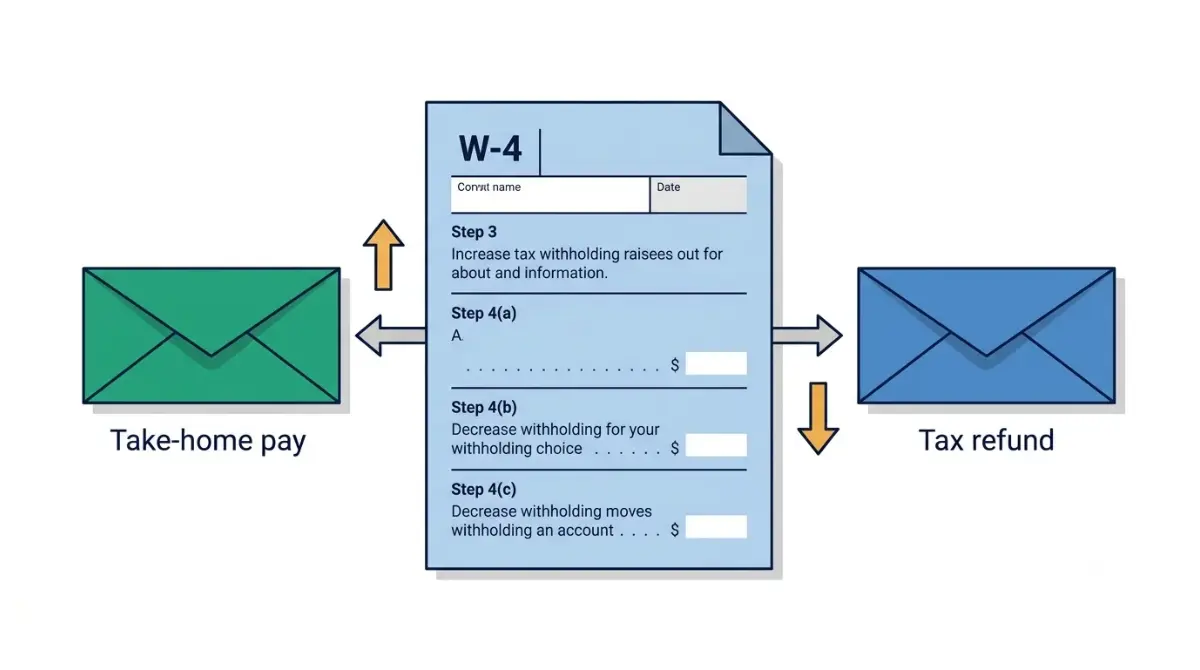
Adjusting your W-4 refund comes down to two lines: Step 3 is a yearly amount, Step 4(c) is taken from every paycheck, so timing matters.
In This Article
Which W-4 change fits what you want?
Your refund is the gap between what your employer withheld and what you owe, and your Form W-4 controls how much is withheld.
📊 Data Point: The IRS reported an average refund of $3,276 through May 8, 2026, up 11.5% from $2,939 a year earlier. Source: IRS filing season statistics, week ending May 8, 2026.
Is a big refund good?
A refund means more was withheld than your tax required, though some refunds include refundable credits.
Which section should you read?
- More take-home pay: see how to shrink your refund.
- A bigger refund: see Step 4(c).
- Not owing: see how big a refund should be.
ℹ️ Financial Disclaimer: This article is general education about federal income tax withholding and the penalty for underpaying tax, not tax, legal or financial advice. Amounts and rules are federal and for tax year 2026; state withholding is separate. Before changing your Form W-4, ask a CPA or enrolled agent how it applies to your pay.
How your W-4 steers your refund
Step 3 and Step 4(b) lower withholding; Step 4(a) and Step 4(c) raise it.
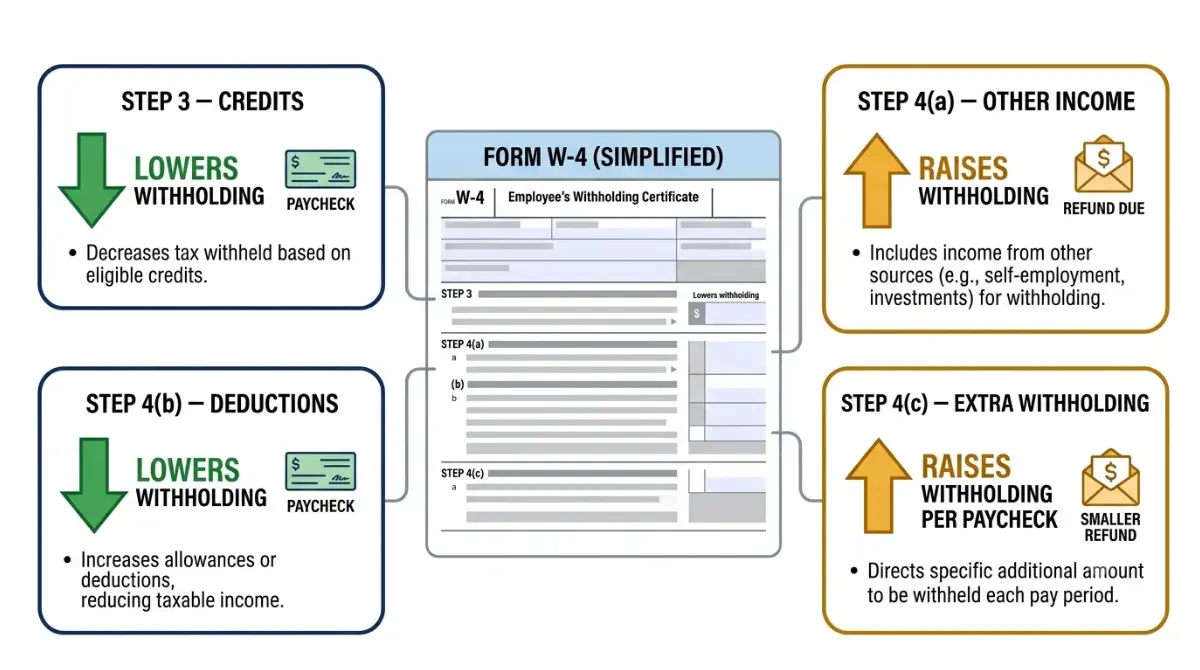
The four lines and which way they push
| W-4 line | Effect | Unit |
|---|---|---|
| Step 3, credits | Lowers | Per year |
| Step 4(b), deductions | Lowers | Per year |
| Step 4(a), other income | Raises | Per year |
| Step 4(c), extra withholding | Raises | Per pay period |
Source: IRS Tax Withholding Estimator FAQs (reviewed March 26, 2026); Form W-4 (2026).
What Step 4(c) does
🔍 How It Works: Step 3 is a yearly total spread over the year; Step 4(c) is extra tax taken from each paycheck, lowering it and raising your refund or lowering what you owe.
Your refund is what was prepaid through withholding minus what you owe, the arithmetic in our tax refund formula with worked examples.
2026 W-4 numbers that move your refund
The 2026 Form W-4 lists $2,200 per qualifying child, adds worksheet lines for tips, overtime, vehicle loan interest and seniors (each with its own income limit), and has an exempt-from-withholding box.
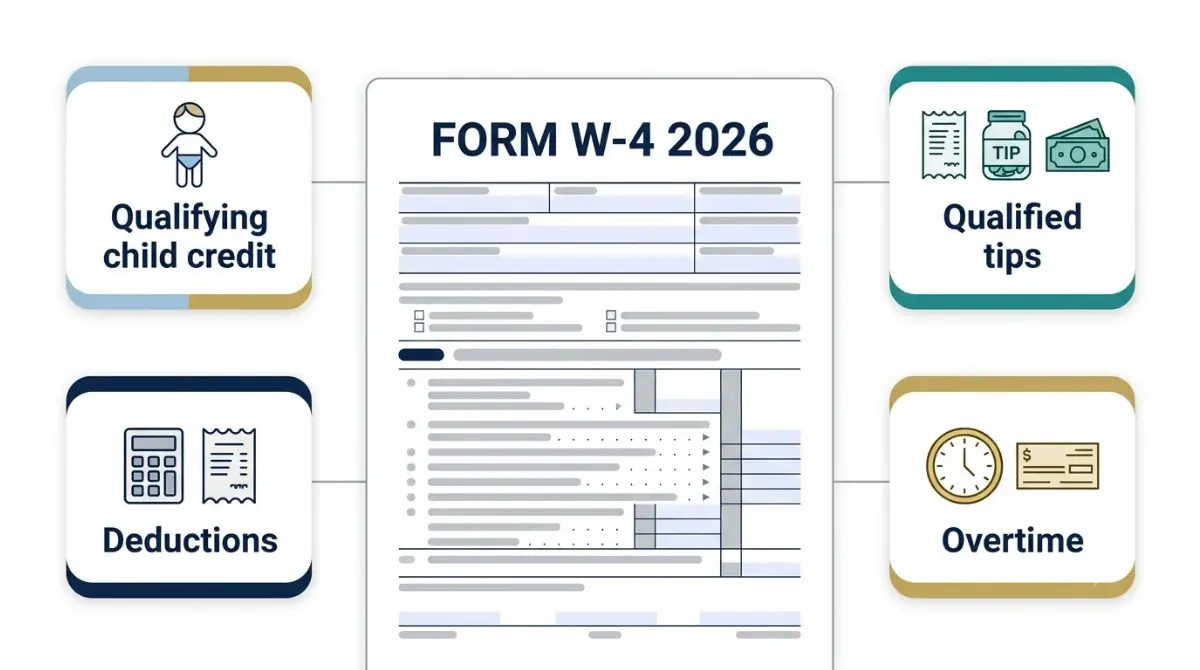
Step 3 credits and the standard deduction
| Line | 2026 amount | Key detail |
|---|---|---|
| Child credit, Step 3(a) | $2,200 per child under 17 | Income $200,000 or less ($400,000 joint) |
| Standard deduction | $16,100 single; $32,200 joint; $24,150 head of household | Used if Step 4(b) is blank |
| Tips and overtime, Step 4(b) | Tips up to $25,000; overtime up to $12,500 ($25,000 joint) | Income under $150,000 ($300,000 joint) |
Source: 2026 Form W-4 and instructions, Step 3 and Deductions Worksheet.
Step 4(b) deductions
Leave Step 4(b) blank and withholding uses the standard deduction. Test your taxable income in our 2026 tax brackets and deduction calculator.
How to shrink your refund, step by step
To shrink your refund, run the IRS Tax Withholding Estimator with your latest pay stubs, then give your employer the pre-filled Form W-4 it produces.
Run the IRS estimator
Gather your latest pay stubs; the estimator takes about 25 minutes. Enter this period’s withholding and the year-to-date total separately, and leave out state, Medicare and Social Security.
Enter the amount in Step 3
The pre-filled form’s Step 3 amount targets a $0 refund; entering more may leave you owing.
After a mid-year change, you may need to update it again in late December. Complete a new W-4 whenever changes would alter its entries, and check withholding every January. Preview the change in our paycheck calculator.
✅ Action Step: Ask a CPA or enrolled agent: “Should my change go on Step 3 or Step 4(b)?”
How to grow your refund with Step 4(c)
To get a bigger refund, enter the extra tax you want withheld each pay period on Step 4(c) of Form W-4; each paycheck shrinks by that amount.
The per-paycheck formula
🔍 How It Works: Extra per paycheck = target extra refund ÷ pay periods remaining.
| Target | Pay schedule | Periods left | Step 4(c) per paycheck |
|---|---|---|---|
| $1,300 | Biweekly | 26 | $50.00 |
| $1,300 | Biweekly | 10 | $130.00 |
| $1,300 | Monthly | 12 | $108.33 |
Illustrative arithmetic, not IRS figures.
Why pay periods left matter
The same $1,300 costs $50 per paycheck with 26 left but $130 with 10 left. For mid-year changes, the IRS estimator counts withholding already taken.
✅ Action Step: Ask a CPA or enrolled agent: “How much extra can I withhold if my pay varies?”
How big should your refund be?
Most taxpayers avoid the underpayment penalty if they owe less than $1,000 after withholding and refundable credits, or if they paid at least 90% of this year’s tax or 100% of last year’s, whichever is smaller, per IRS Topic no. 306.
The IRS penalty line
Some higher-income and farm or fishing filers face special rules. Estimate your tax with our income tax calculator and compare it with your withholding.
When a cushion makes sense
| Situation | Target | Key detail |
|---|---|---|
| One steady job | Near $0 | Estimator’s Step 3 amount targets $0 |
| Income that swings | Modest buffer | Editorial view, not an IRS rule |
| Two jobs or bonuses | Run the estimator first | The form lists these as reasons to |
General education, not IRS guidance.
✅ Action Step: Ask a CPA or enrolled agent: “Which safe-harbor number applies to my income?”
W-4 mistakes that cause a surprise bill
Two setup errors can lead to a surprise bill, and both are fixable.
Two jobs, one set of entries
Complete Steps 3 through 4(b) on only one W-4, ideally the highest-paying job’s, and use the estimator for accuracy (see the estimator FAQs).
Exempt is not a shortcut
You can claim exemption only if you had no federal income tax liability in 2025 and expect none in 2026.
⚠️ Costly Mistake: Claiming exemption stops federal income tax withholding, so you may owe tax and penalties at filing, and you must submit a new W-4 by February 16, 2027. If you are unsure, run the estimator first.
✅ Action Step: Ask a CPA or enrolled agent: “Do I meet both exemption conditions?”
Adjust W-4 refund: your questions answered
1. How do I adjust my W-4 to get a smaller refund?
Run the IRS estimator with a recent pay stub, then give your employer the pre-filled W-4 it produces. Ask a CPA or enrolled agent how this applies to your pay.
2. How do I adjust my W-4 to get a bigger refund?
Enter the extra tax you want withheld each pay period on Step 4(c); each paycheck shrinks by that amount. Ask a CPA or enrolled agent how this applies to your pay.
3. What does Step 4(c) do on a W-4?
It sets extra tax withheld each pay period, lowering your paycheck and raising your refund or reducing what you owe. Ask a CPA or enrolled agent how this applies to your pay.
4. What changed on the 2026 Form W-4?
The 2026 form lists $2,200 per qualifying child and adds worksheet lines for tips, overtime, vehicle loan interest and seniors.
5. How do I know how much to enter in Step 3?
Use the estimator’s recommended amount, which targets a $0 refund; entering more than that may leave you owing. Ask a CPA or enrolled agent how this applies to your pay.
6. Can I change my W-4 anytime?
Complete a new W-4 when changes in your situation would change its entries, and check your withholding every January, per the IRS. Ask a CPA or enrolled agent how this applies to your pay.
7. What if I have two jobs?
Complete Steps 3 through 4(b) on only one W-4, ideally the highest-paying job’s, and use the estimator for accuracy. Ask a CPA or enrolled agent how this applies to your pay.
8. Will I owe a penalty if I cut withholding too far?
Most taxpayers avoid it by owing under $1,000 after withholding, or paying 90% of this year’s tax or 100% of last year’s, whichever is smaller. Ask a CPA or enrolled agent how this applies to your pay.
9. What refund should I aim for?
The estimator’s Step 3 amount targets a $0 refund; a small buffer when income varies is general education, not an IRS rule. Ask a CPA or enrolled agent how this applies to your pay.
10. Can I claim exempt from withholding?
Only if you had no federal income tax liability in 2025 and expect none in 2026; then submit a new W-4 by February 16, 2027. Ask a CPA or enrolled agent how this applies to your pay.
11. Is a big refund good?
A big refund means more was withheld than you owed, or refundable credits applied; it is your money returned, not extra income. Ask a CPA or enrolled agent how this applies to your pay.
Your next step
Run the IRS Tax Withholding Estimator with a recent pay stub, give your employer the pre-filled Form W-4, and check again in late December and every January. If your situation is complicated, ask a CPA or enrolled agent which withholding target avoids a penalty without over-withholding.
Related Articles
 Tax Refund
 Delayed and Bills Running Late? Find the Cause First
October 7, 2026 Tax Refund
What a Tax Refund Advance Loan Really Costs You
October 16, 2026 Tax Refund
Self-Employed Tax Refund or Bill? A Clear 2026 Walkthrough
October 14, 2026 Tax Refund
Where to Put Tax Refund Money for a Smart 3-Month Hold
October 15, 2026 Tax Refund
Clear Signs of a Smaller Tax Refund Next Year
October 10, 2026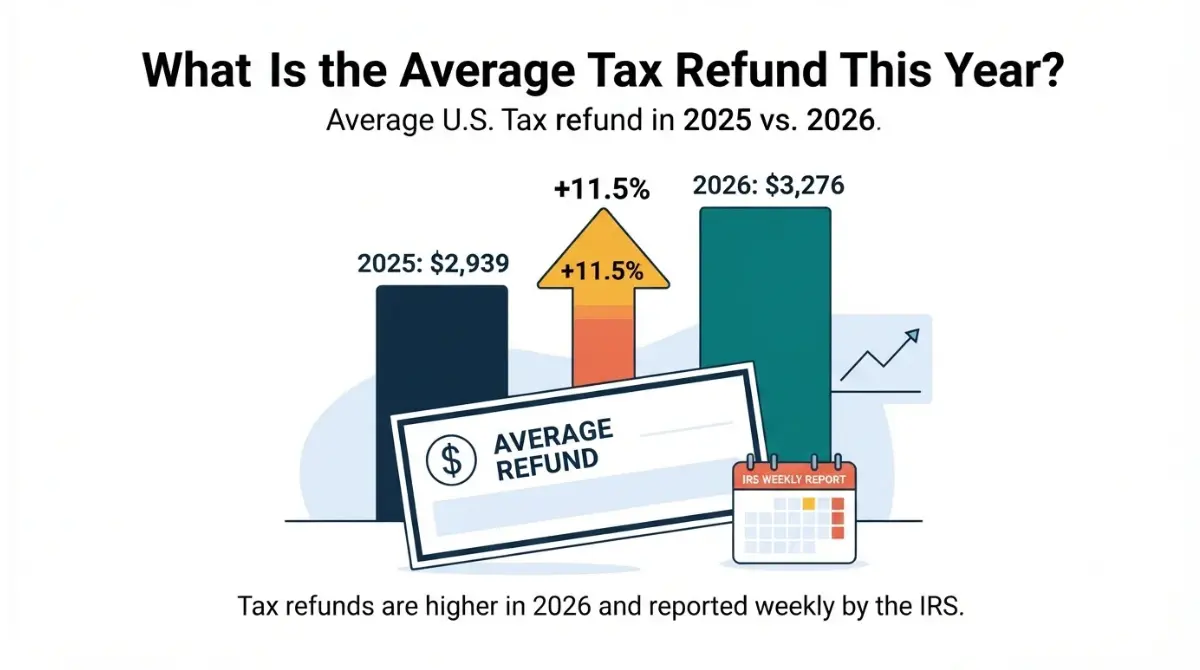 Tax Refund
A Clear Look at Why the Average Tax Refund Keeps Changing
October 9, 2026 Tax Refund
What to Do With Tax Refund Money in a Clear, Simple Order
October 15, 2026 Tax Refund
A Clear Tax Refund Formula You Can Run on Your Own Numbers
October 6, 2026 Tax Refund
How Injured Spouse Relief Returns Your Share of a Joint Refund
October 21, 2026
Informational disclaimer
The content on Finance Authority Hub is provided for general informational and educational purposes only and should not be considered personalized financial, investment, tax, legal, or professional advice. Financial decisions depend on your individual goals, income, risk tolerance, location, and regulatory situation. Before acting on any information, strategy, estimate, or calculator result, consult a qualified licensed professional who can evaluate your specific circumstances.