
A Clear Tax Refund Formula You Can Run on Your Own Numbers
Your tax refund formula is one subtraction. Refundable credits, up to $1,700 per child in 2026, can push a refund past what was withheld.
In This Article
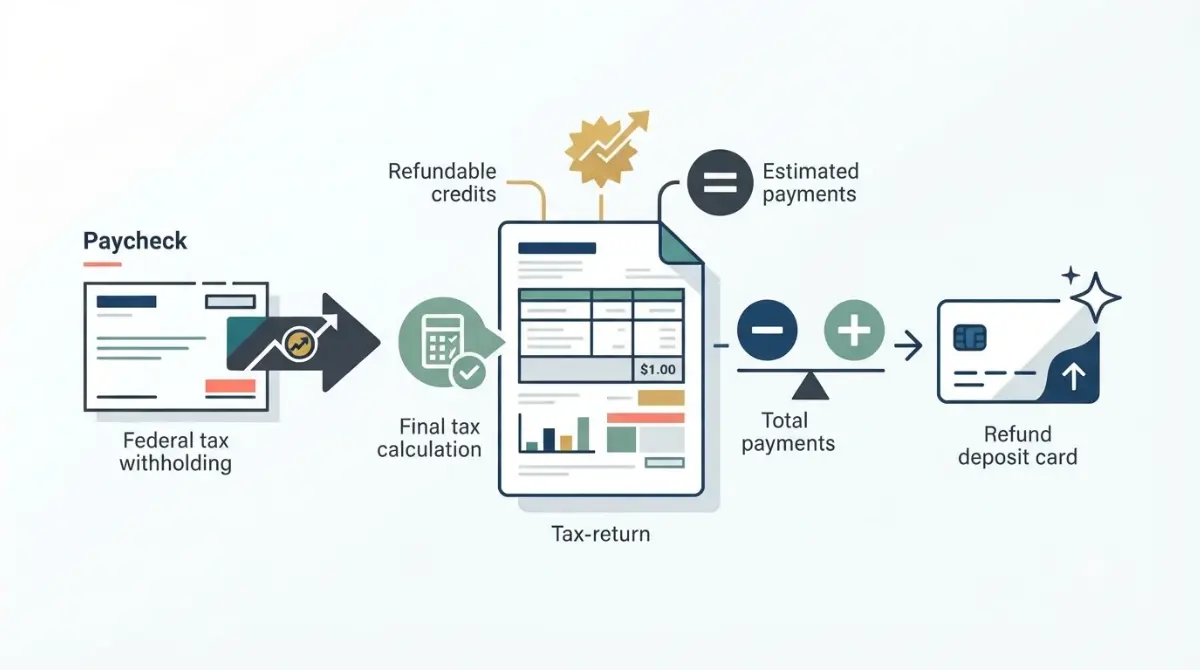
The tax refund formula: how your number gets made
You open your tax software, or your last pay stub of the year, and a number appears. It’s smaller than you hoped, or bigger than you can explain. It isn’t random.
The tax refund formula is one subtraction: what you’ve already paid the IRS, minus the tax you actually owe. A refund is an overpayment, not a bonus.
Start here: pick the situation that fits you
- My refund is smaller than expected. Read the formula section, then “Why your refund is big or small” and “Why your refund is smaller than expected, or late.”
- I want to fix this year before December. Go to “Why your refund is big or small” and “Should you aim for a big refund?”
- I’m new to this. Read the formula, then the step-by-step calculation.
- I have kids or a low income. Read the credits section and the three worked examples.
- I might owe. Read the withholding, “smaller than expected” and decision sections.
What you’ll be able to calculate by the end
You’ll estimate your own refund or balance due, tell which credits add to a refund, and check your withholding. Three 2026 households show every subtraction.
ℹ️ Financial Disclaimer: This article is general education, not tax, legal or financial advice, and covers federal income tax computation, payroll withholding and Form W-4 changes, tax credits and eligibility, refund timing and offsets, and underpayment penalty and interest. Figures are for tax year 2026 unless labeled otherwise; state income tax is calculated separately and isn’t covered. A CPA or Enrolled Agent can apply these rules to your facts.
What is the tax refund formula? Payments minus tax owed
Refund = total payments − total tax after credits. Total payments are tax you already paid, through withholding, estimated payments and refundable credits. Total tax is what the rate table says you owe, minus nonrefundable credits. A positive result is a refund; a negative result is a balance due.
The formula in one line
Refund = (withholding + estimated payments + refundable credits) − (tax from the rate table − nonrefundable credits)
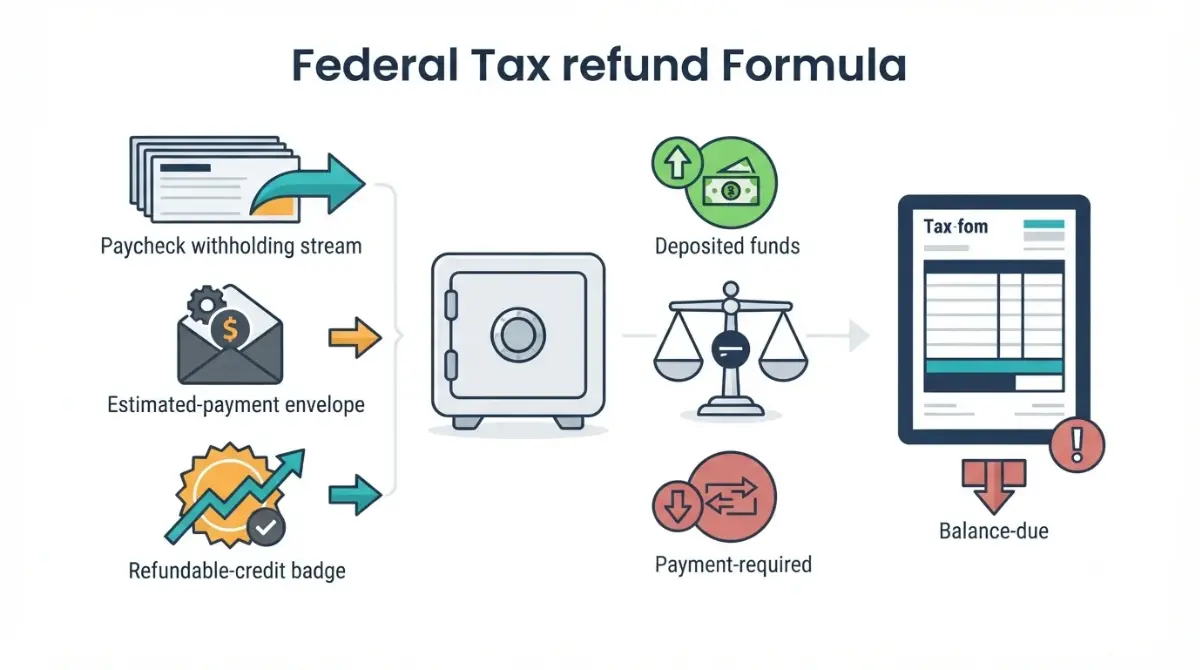
🔍 How It Works: Think of a running tab: your employer sends the IRS a slice of every paycheck, and your return settles the difference.
| Side of the ledger | Item | Where you’ll see it |
|---|---|---|
| Payments | Federal income tax withheld | W-2, Box 2 |
| Payments | Estimated tax payments | Sent during the year |
| Payments | Refundable credits | Credit forms on Form 1040 |
| Tax owed | Tax on taxable income | Rate table |
| Tax owed | Nonrefundable credits | Can’t push tax below $0 |
Source: IRS “About refunds” page; IRS instructions for Forms W-2 and W-3.
Bucket 1: what you’ve already paid
For most employees, federal income tax withheld is the biggest item. Refundable credits sit here too, which is why a refund can exceed what was withheld.
Bucket 2: what you actually owe
Start from taxable income, apply the rate table, then subtract nonrefundable credits. Your effective tax rate is lower than your top bracket, since each rate applies only to its own slice.
Why a refund is an overpayment, not a bonus
Per the IRS, a refund is money back because you paid more tax than you owed. A bigger one means smaller paychecks.
Federal and state refunds are separate
Your state runs its own calculation; this covers the federal return only.
How to calculate your federal tax refund step by step
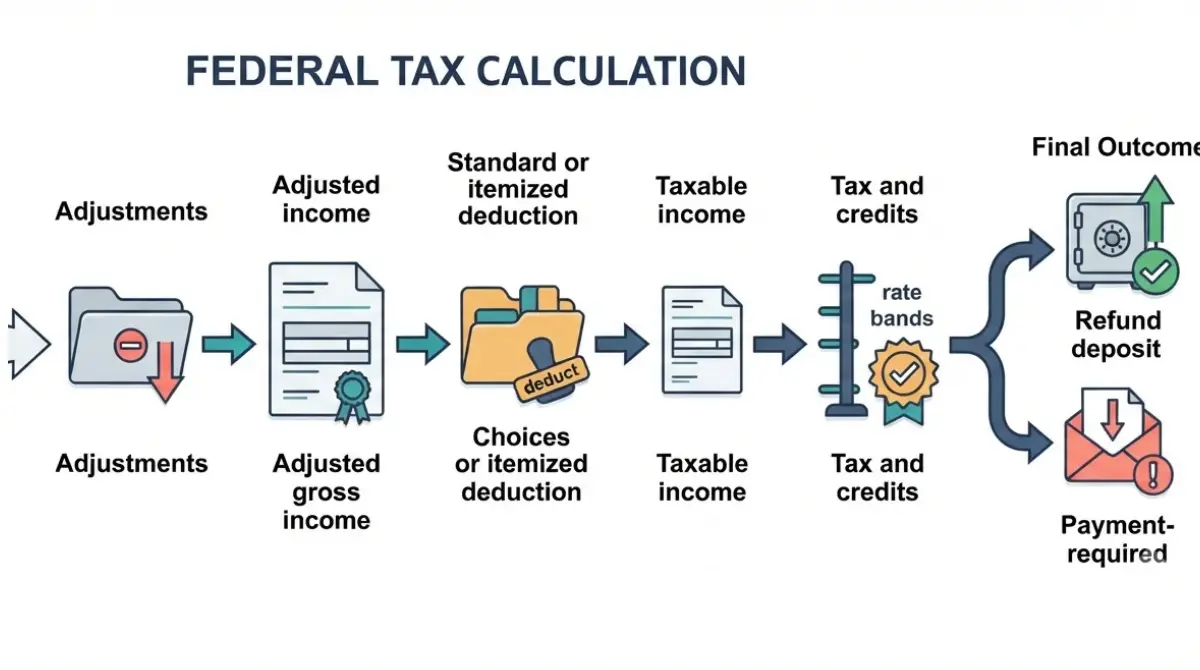
Six steps take you from income to refund:
- Add up all your income for the year.
- Subtract adjustments to reach adjusted gross income (AGI).
- Subtract the standard deduction to reach taxable income.
- Apply the rate table to find your tax.
- Subtract nonrefundable credits from that tax.
- Compare the result with withholding plus refundable credits.
Start with income and the standard deduction
For 2026, the standard deduction is $16,100 for single filers and married people filing separately, $32,200 for married couples filing jointly, and $24,150 for heads of household, per IRS tax inflation adjustments for tax year 2026 and Revenue Procedure 2025-32. Itemize instead if your deductions add up to more. Try our 2026 tax brackets and deduction calculator.
Apply the 2026 tax rate table
The seven rates are 10%, 12%, 22%, 24%, 32%, 35% and 37%, each applying only to its own slice of income.
🔍 How It Works: A single filer with $45,900 of taxable income pays 10% on the first $12,400 ($1,240) and 12% on the next $33,500 ($4,020). Total: $5,260. Reaching the 12% bracket never taxed earlier dollars at 12%.
To use it, take the tax from the highest row at or below your taxable income, then add the next rate times the income above that row’s limit. Income above the 35% row is taxed at 37%.
| Rate | Single: income up to → tax | Married filing jointly | Head of household |
|---|---|---|---|
| 10% | $12,400 → $1,240 | $24,800 → $2,480 | $17,700 → $1,770 |
| 12% | $50,400 → $5,800 | $100,800 → $11,600 | $67,450 → $7,740 |
| 22% | $105,700 → $17,966 | $211,400 → $35,932 | $105,700 → $16,155 |
| 24% | $201,775 → $41,024 | $403,550 → $82,048 | $201,750 → $39,207 |
| 32% | $256,225 → $58,448 | $512,450 → $116,896 | $256,200 → $56,631 |
| 35% | $640,600 → $192,979.25 | $768,700 → $206,583.50 | $640,600 → $191,171 |
Source: IRS Revenue Procedure 2025-32, tax year 2026 tables. Each cell: top of bracket, then total tax at that income.
Subtract credits, then compare to payments
Payments above your tax mean a refund; payments below it mean a balance due.
A $1,000 deduction vs a $1,000 credit
A deduction lowers taxable income, saving only your rate’s share: $120 in the 12% bracket. A credit cuts the tax itself, saving $1,000.
Refundable vs nonrefundable tax credits: what adds to a refund
Is the child tax credit refundable? Partly. For 2026 it’s worth up to $2,200 per qualifying child under 17, and up to $1,700 can come back as a refund even if you owe no tax (Revenue Procedure 2025-32).
Nonrefundable credits can only cut your tax to zero
A nonrefundable credit sits on the tax side. With $1,000 of tax and a $1,500 credit, the extra $500 is lost.
Refundable credits count as payments
A refundable credit sits on the payments side, so you can get money back even when you owe no tax, per the IRS.
Child tax credit and the $1,700 refundable part
The credit first reduces your tax; only the leftover can be refunded, up to $1,700 per child. That refundable part is 15% of earned income above $2,500 (IRS Schedule 8812 instructions). The child must be under 17 at year-end with a valid Social Security number, and the full credit phases out above $200,000 of income ($400,000 joint).
Earned income tax credit: the 2026 maximums
The earned income tax credit is fully refundable. Its 2026 maximum is $664 with no qualifying children, $4,427 with one, $7,316 with two and $8,231 with three or more, unless investment income exceeds $12,200 (Revenue Procedure 2025-32).
| Credit | Side of the ledger | Key detail |
|---|---|---|
| Nonrefundable credits | Tax | Can’t reduce tax below $0 |
| Child tax credit | Tax first | Leftover moves to payments, up to $1,700 per child |
| Earned income tax credit | Payments | 2026 maximum $664 to $8,231 |
✅ Action Step: Ask a CPA or Enrolled Agent: “Given my custody arrangement and filing status, which credits can I claim, and how do they interact?”
Tax refund math: three real examples with 2026 numbers
A single filer earning $62,000 owes $5,260 on $45,900 of taxable income. With $6,300 withheld, the refund is $1,040, about $87 a month.
Assumptions: federal tax only; wages equal taxable wages; standard deduction; no other income or credits except those named; children under 17 with valid Social Security numbers; investment income under the earned income credit limit. Withholding is assumed, not an IRS figure. These illustrate the math; they don’t predict your return.
| Ledger line | A: Single, $62,000 | B: Married, 2 kids, $98,000 | C: Head of household, 1 child, $20,000 |
|---|---|---|---|
| Standard deduction | −$16,100 | −$32,200 | −$24,150 (more than wages) |
| Taxable income | $45,900 | $65,800 | $0 |
| Tax from rate table | $5,260 | $7,400 | $0 |
| Child tax credit applied to tax | $0 | −$4,400 | $0 |
| Tax owed | $5,260 | $3,000 | $0 |
| Withholding (assumed) | $6,300 | $5,200 | $600 |
| Refundable credits | $0 | $0 | $6,127 |
| Total payments | $6,300 | $5,200 | $6,727 |
| Refund | $1,040 | $2,200 | $6,727 |
| Per month | about $87 | about $183 | about $561 |
Source: IRS Revenue Procedure 2025-32 (2026 standard deductions, rate tables, child tax credit, earned income credit).
Example A: single filer, $62,000 in wages
Tax is $1,240 + 12% × $33,500 = $5,260, or 11.5% of taxable income and 8.5% of wages. With only $4,900 withheld, the same return shows a $360 balance due.
Example B: married couple, two kids, $98,000
Tax is $2,480 + 12% × $41,000 = $7,400. The child tax credit, 2 × $2,200 = $4,400, leaves $3,000 of tax. Withholding of $5,200 produces a $2,200 refund; withholding of $3,000 would produce $0.
Example C: head of household, one child, $20,000
Wages sit below the $24,150 standard deduction, so tax is $0. The refundable child tax credit adds $1,700, and the earned income credit adds $4,427 (one child, earned income above the $13,020 full-credit amount, income below the $23,890 phase-out start). Only $600 of the $6,727 refund was the household’s own withholding.
What the three examples teach
The formula never changes; the inputs do. A’s refund is overwithholding, B’s depends on a credit absorbing tax, and C’s comes from refundable credits. Estimate your own tax with our income tax calculator, then compare it with Box 2 of your W-2.
Why your refund is big or small: withholding and your W-4
Withholding is the one input you control during the year.
Withholding is a prepayment, not a tax
🔍 How It Works: Your employer sends part of each paycheck to the IRS based on your Form W-4. That’s a prepayment toward your tax bill. Over 12 months, a $1,040 refund is about $87 a month and a $2,200 refund about $183: money that wasn’t in your paychecks.
How to check yours with the IRS estimator
The IRS Tax Withholding Estimator is built for people with W-2 jobs or pension or annuity income. This article explains the math behind its output.
- Gather your latest pay stubs (and your spouse’s, if filing jointly).
- Open the estimator; it takes about 25 minutes.
- Review the result, which includes a pre-filled Form W-4.
- Give the updated W-4 to your employer.
- Recheck in late December.
Changing your W-4 during the year
You can give your employer a new W-4 anytime. See how take-home pay is built in our paycheck calculator.
⚠️ Costly Mistake: Fixing this year’s withholding in the fall can leave next year’s wrong. The IRS says that if you change withholding during the year, you may need to update it again in late December.
If you have income with no withholding
If much of your income has no withholding, you typically make estimated tax payments instead; the estimator is designed for W-2 and pension income.
✅ Action Step: Ask a CPA or Enrolled Agent: “I have a second job or side income. How should I set my W-4 so I neither owe nor over-withhold?”
What is the average tax refund? What IRS data shows
Through May 8, 2026, the IRS reported an average refund of $3,276, up 11.5% from $2,939 at the same point in 2025.
📊 Data Point: The IRS had issued 99,138,000 refunds totaling $324.757 billion through May 8, 2026. Source: IRS filing season statistics, week ending May 8, 2026.
The 2026 season so far vs 2025
That’s the latest weekly report the IRS lists for the 2026 season. Figures are cumulative, for current-year returns. The data doesn’t say why the average rose.
Why an average isn’t your number
An average blends small and large refunds. Yours depends on your own withholding, income and credits.
How the average moved week by week
| Cumulative through | 2026 average | Same point, 2025 | Change |
|---|---|---|---|
| February 13, 2026 | $2,476 | $2,169 | +14.2% |
| March 6, 2026 | $3,676 | $3,324 | +10.6% |
| April 24, 2026 | $3,268 | $2,945 | +11.0% |
| May 8, 2026 | $3,276 | $2,939 | +11.5% |
Source: IRS weekly filing season statistics. The IRS notes that early-season figures exclude refunds on a PATH Act hold.
Why your refund is smaller than expected, or late
How long does a refund take? Per the IRS “About refunds” page, an e-filed return typically gets a refund in about 3 weeks, and a mailed return in 6 or more. Status shows 24 hours after e-filing.
| What you received | Likely cause | First step |
|---|---|---|
| A notice from the IRS | Adjustment | Read it; follow its deadline |
| A notice from the Bureau of the Fiscal Service | Debt offset | Follow its instructions |
Source: IRS “Reduced refund” page.
Adjustments the IRS makes to your return
If your refund is lower than you computed, the IRS lists these causes: math errors, ineligible credits or deductions, prior-year tax owed, and underpaid estimated tax. Read the notice instead of guessing.
Offsets: debts that reduce a refund
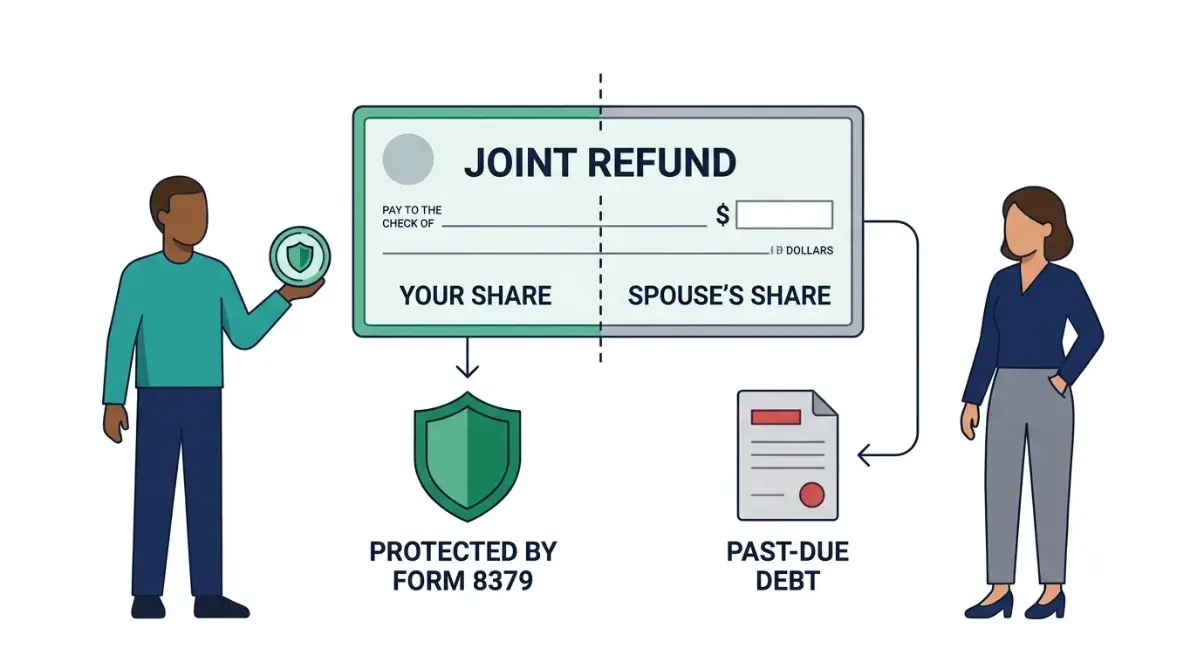
Under the Treasury Offset Program, the Bureau of the Fiscal Service can apply a refund to past-due child support, federal non-tax debts, state income tax obligations or certain state unemployment debt, per the IRS “Reduced refund” page. Injured spouse relief may apply on a joint return.
How long a refund should take
Direct deposit is faster and more secure than a paper check. You have 3 years to claim.
EITC and ACTC refunds: the mid-February hold
By law, the IRS can’t issue refunds claiming the earned income or additional child tax credit before mid-February.
If you owe instead: interest basics
Unpaid tax accrues interest: 7% a year, compounded daily, for the fourth quarter of 2026 (IRS release IR-2026-98). It builds only on the unpaid amount, so paying part sooner helps.
✅ Action Step: Ask a CPA or Enrolled Agent: “My return was adjusted. How do I read the notice and respond before its deadline?”
Should you aim for a big refund? How to set your withholding
October through December is the last stretch when a withholding change can still affect this year’s result.
A refund is your own money coming back
A refund is an overpayment you lent the IRS during the year. The IRS generally doesn’t charge the underpayment penalty if you owe under $1,000 after withholding and credits, or paid at least 90% of this year’s tax or 100% of last year’s, whichever is smaller (IRS Topic 306). Higher-income filers face a stricter prior-year test.
Three withholding targets and what each trades off
This ladder is our editorial framework, not IRS guidance. It recommends no target.
| Target | Trade-off | Tends to fit |
|---|---|---|
| A: Near zero | Bigger paychecks; thin margin for error | Steady, predictable income |
| B: Small buffer | Slightly smaller paychecks; room for surprises | Variable income or two jobs |
| C: Large refund | Smaller paychecks all year; works like forced saving | People who find saving hard |
The October–December checkpoint
Run the estimator with your latest pay stub, which shows year-to-date withholding, and compare the result with your chosen target. If you change withholding, set a late-December reminder.
What to do with a refund or a balance due
A refund can go to debt, savings or a planned expense; our budget calculator helps map it. If you owe, paying by the due date limits interest.
✅ Action Step: Ask a CPA or Enrolled Agent: “Given how much my income varies, what withholding target is safest for me?”
Tax refund formula FAQs
1. What is the formula for a tax refund?
The tax refund formula is total payments minus total tax after credits; a positive result is a refund, a negative one a balance due.
2. Can you get a refund if you owe no income tax?
Yes. Refundable credits, such as the earned income tax credit or up to $1,700 per child of the child tax credit, can pay out. Ask a CPA or Enrolled Agent about your case.
3. Is the child tax credit refundable?
Partly. For 2026 the credit is up to $2,200 per qualifying child, and up to $1,700 of it can be refunded. Ask a CPA or Enrolled Agent about your case.
4. What is the average tax refund?
The IRS reported an average refund of $3,276 through May 8, 2026, versus $2,939 at the same point in 2025.
5. How long does it take to get a refund?
Per the IRS, e-filed returns typically get refunds in about 3 weeks; mailed returns take 6 or more.
6. Why was my refund reduced?
Your return may have been adjusted, or the Bureau of the Fiscal Service may have offset a debt such as past-due child support. Ask a CPA or Enrolled Agent about your case.
7. How do I change my withholding?
Use the IRS Tax Withholding Estimator with a recent pay stub, then give your employer the updated Form W-4 it produces. Ask a CPA or Enrolled Agent about your case.
9. Is a big tax refund good?
A big refund means you overpaid during the year. It isn’t extra income; it costs you smaller paychecks. Ask a CPA or Enrolled Agent about your case.
Your next step before the year ends
What to do this month
If your number has been stressing you, one action helps most: check your withholding with the IRS Tax Withholding Estimator before December, using your latest pay stub. Then download the Refund Math Worksheet, a printable ledger for your own numbers. No sign-up needed.
Before your next withholding change, ask a CPA or Enrolled Agent: “Given my income and credits, what withholding target avoids an underpayment penalty without over-withholding?”
Where to go next
- Estimate your tax with the income tax calculator.
- See your paycheck in the paycheck calculator.
- Find Box 2 in our W-2 box guide.
Our figures come from IRS pages and Revenue Procedure 2025-32, checked October 6, 2026.
Related Articles
 Tax Refund
How Injured Spouse Relief Returns Your Share of a Joint Refund
October 21, 2026 Tax Refund
Where to Put Tax Refund Money for a Smart 3-Month Hold
October 15, 2026 Tax Refund
The Right Way to Tell a Tax Refund Offset From a Correction
October 8, 2026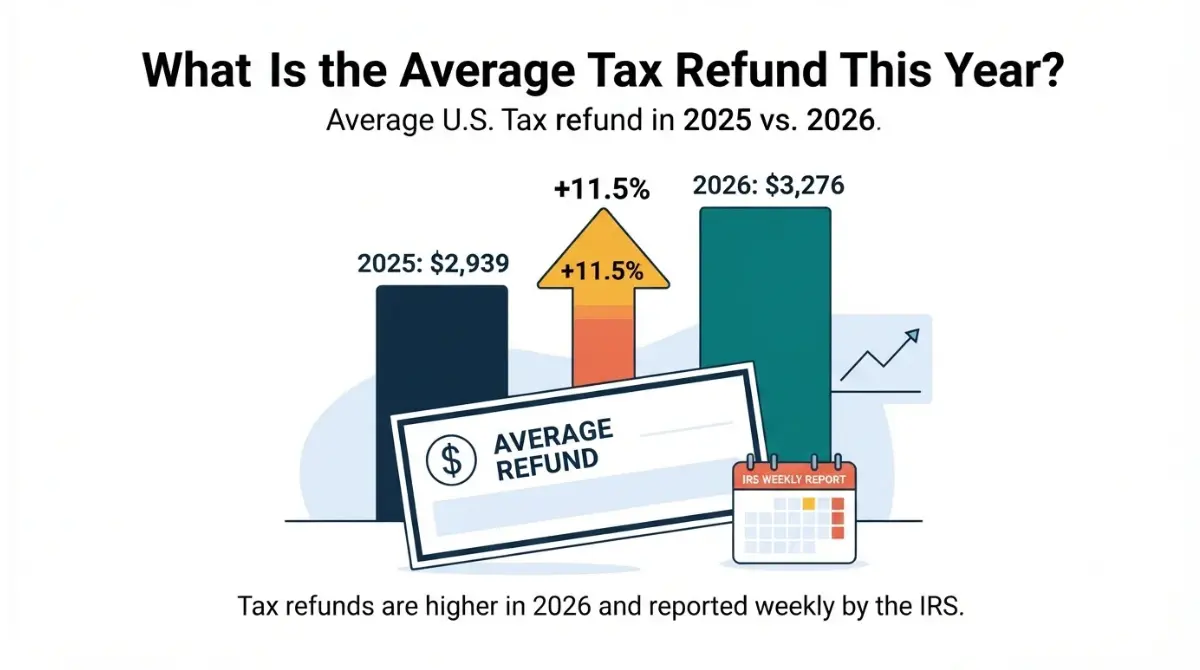 Tax Refund
A Clear Look at Why the Average Tax Refund Keeps Changing
October 9, 2026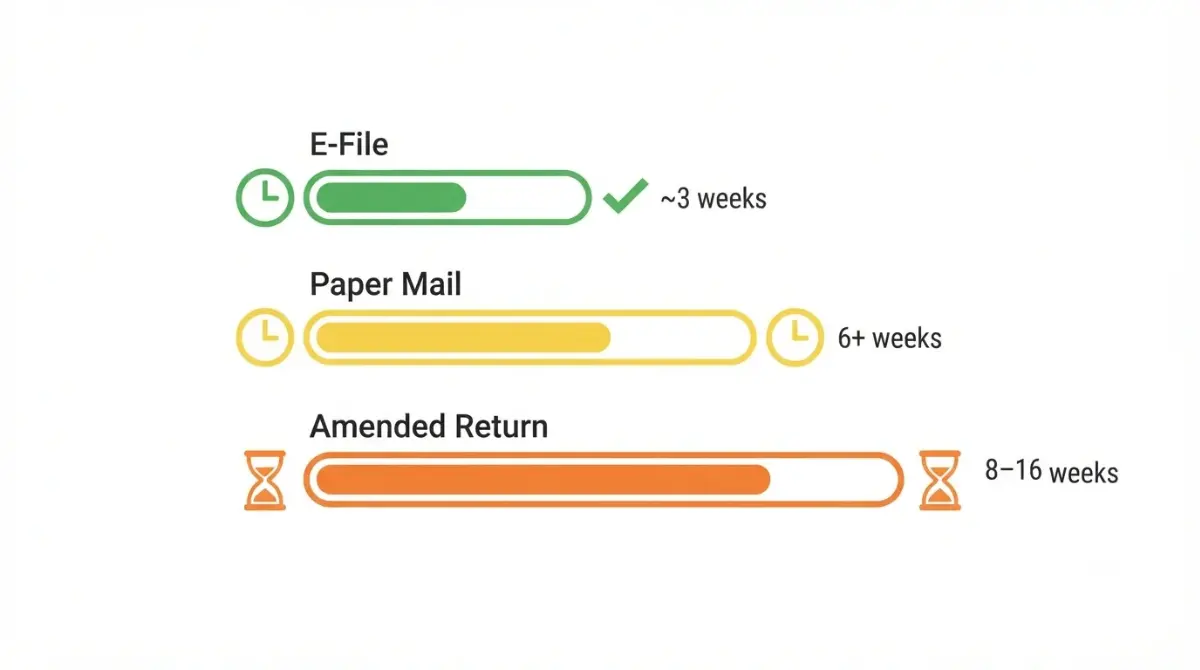 Tax Refund
A Clear Tax Refund Schedule, From Filing Day to Deposit Day
October 7, 2026 Tax Refund
How to Make a Smart Tax Refund IRA Contribution for 2026
October 15, 2026 Tax Refund
The Key Return in Your Amended Return Refund Timeline
October 9, 2026 Tax Refund
A Clear Look at Tax Refund vs Owing, Run as Math
October 12, 2026 Tax Refund
A Clear Walk Through the Tax Withholding Estimator Screens
October 13, 2026
Informational disclaimer
The content on Finance Authority Hub is provided for general informational and educational purposes only and should not be considered personalized financial, investment, tax, legal, or professional advice. Financial decisions depend on your individual goals, income, risk tolerance, location, and regulatory situation. Before acting on any information, strategy, estimate, or calculator result, consult a qualified licensed professional who can evaluate your specific circumstances.