
Your Parent Died Without a Will? Take the Right Steps in Order
Parent died without a will? One surprise: the $255 Social Security death payment usually skips adult children. Here is who qualifies.
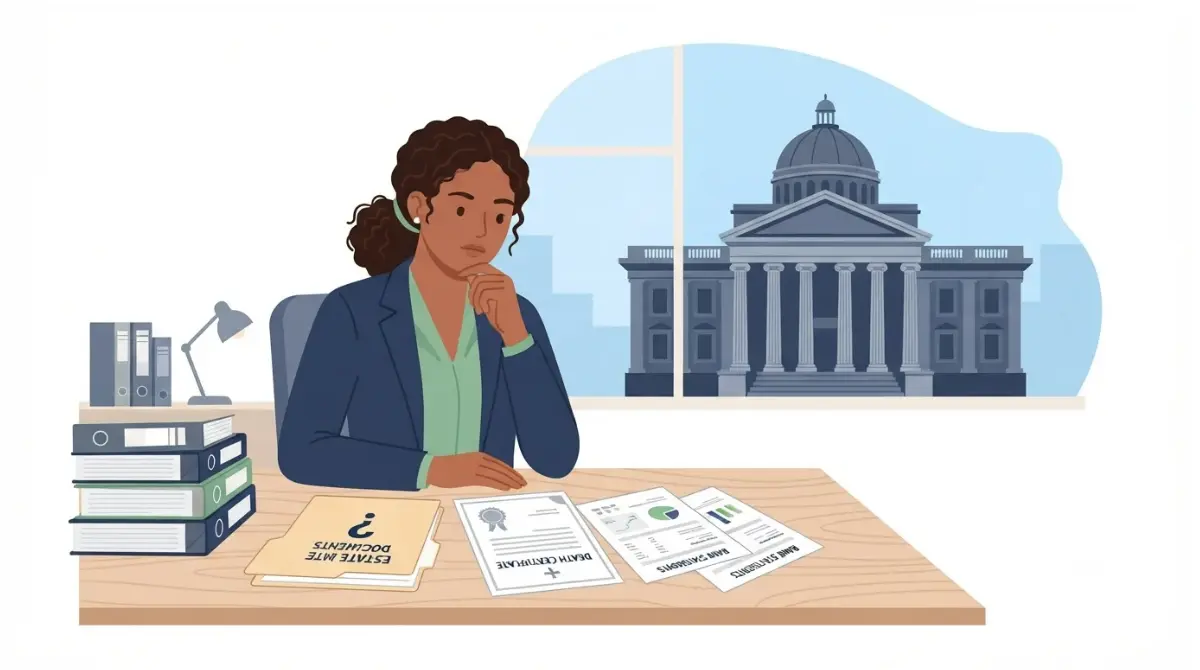
In This Article
Parent died without a will: where to start
A parent who dies without a valid will is called intestate, and state law decides who inherits. You can take a few steps right away, but almost anything involving their accounts or property waits until a court gives someone authority to act.
This guide runs week by week. If you’re next of kin, start with week one. If you’re worried about debt, go to the debt section. If you may become administrator, read the probate and tax sections.
ℹ️ Financial Disclaimer: This is general education on probate, estate administration, taxes, and debt collection, not legal, tax, or debt advice. Rules vary by state. Consult a probate attorney licensed in your parent’s state, a CPA for tax filings, or a nonprofit credit counselor for debt questions.
First week: what you can do before court approval

Safe steps don’t touch your parent’s accounts or property.
Safe steps now
- Secure the home, mail, and important papers.
- Order certified death certificates through the funeral home.
- Confirm the death was reported to Social Security.
- Search for a will, then call a probate attorney.
What waits for court approval
| When | Task | Court authority needed? |
|---|---|---|
| Weeks 2–4 | Flag credit files as deceased | Spouse or authorized person |
| Months 1–3 | Access accounts, sell property, pay bills | Yes, generally |
| Months 3+ | File estate tax returns | Yes, through the representative |
General education; state rules vary.
🔍 How It Works: A court-issued letter of administration is your proof of authority; without it, banks and buyers have no reason to deal with you.
The $255 Social Security payment
Funeral homes generally report the death. If none did, call the Social Security Administration at 1-800-772-1213. For ongoing benefits, see Social Security survivor benefits.
📊 Data Point: The one-time death payment is $255, for a qualifying spouse or, if none, an eligible child. An adult child generally needs a disability that began by age 21. Source: Social Security Administration, Publication No. 05-10008.
Weeks 2–4: find every account and protect their identity
Now map what your parent owned and owed.
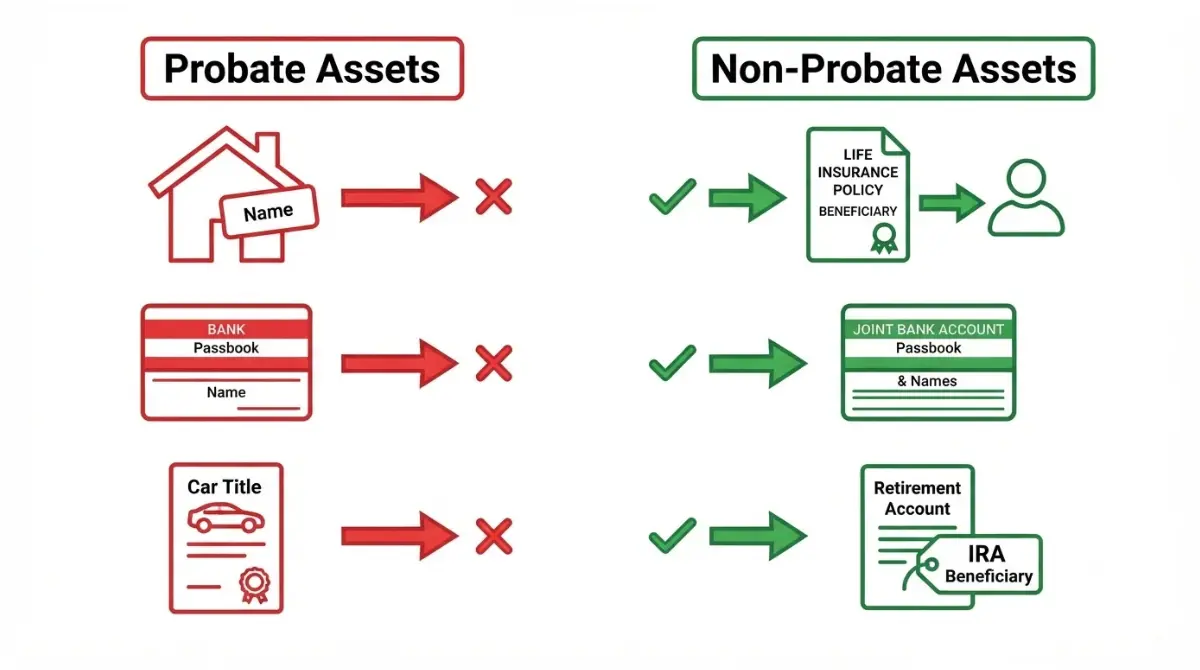
Sort probate from non-probate assets
Assets with a named beneficiary or survivorship title usually pass outside the will; assets in your parent’s name alone do not. Our pillar guide shows which assets skip probate.
Flag credit files and check reports
Notifying one credit bureau is enough; it passes the deceased notice to the other two. Only a spouse or legally authorized representative can send it, so until you’re appointed, Social Security and creditors typically report the death themselves. Requesting their credit reports also needs proof of authority, such as letters.
Look once more for a will
An unrevoked older will is the one the court probates, so ask relatives and your parent’s attorney and accountant first.
Are you responsible for your parent’s debts?
Debts are paid from your parent’s estate, not your own money, unless you shared legal responsibility.
The estate pays first
CFPB guidance on a deceased person’s debts says debts are paid from what your parent left behind under state law, and if the estate can’t cover them, the debt generally goes unpaid.
When you could be responsible
You could owe if you co-signed, held a joint account, or another exception applies.
What collectors can and can’t do
A collector generally must give you details about the debt in the first conversation or within five days, and can’t say or hint that you must pay from your own money.
✅ Action Step: Ask a probate attorney: “Which of these debts could reach me personally in my state, and who should collectors contact?”
Months 1–3: probate, an administrator, and who inherits
When there’s no will, the probate court appoints an administrator, usually after a close relative files a petition.
Petitioning for authority
The petition asks the court to issue letters of administration. See what probate involves for the steps.
Who inherits by default
State law sets the order, typically a surviving spouse and children first, then parents, siblings, and more distant relatives; exact shares vary. If no relatives can be found, the estate goes to the state.
When a shortcut may exist
Many states offer simplified small-estate procedures below a dollar limit, and that limit varies by state.
✅ Action Step: Ask a probate attorney: “Does this estate qualify for our state’s small-estate procedure, and who has priority to be appointed?”
Taxes after a parent dies: what the estate must file
An estate generally files its own income tax return, Form 1041, when it has $600 or more in gross income.
Two returns, two forms
Your parent’s final Form 1040 and the estate’s Form 1041 are separate, and the estate needs its own employer identification number, per the IRS.
Federal estate tax
📊 Data Point: The federal basic exclusion amount is $15,000,000 for 2026. Source: IRS, What’s New — Estate and Gift Tax.
Estates below that amount generally owe no federal estate tax, though some states levy their own.
Worked example: selling an inherited house
Suppose your parent paid $90,000 for a house worth $310,000 at death, and you sell for $315,000 (hypothetical; costs ignored). The IRS says inherited property’s basis is generally its date-of-death value, so your gain is $315,000 − $310,000 = $5,000, not $225,000. See how a step-up in basis works or use the capital gains tax calculator.
✅ Action Step: Ask a CPA: “Does this estate need a Form 1041, and what is our basis in each asset?”
Mistakes to avoid while the estate is unsettled
Acting before you’re appointed
Selling, distributing, or paying out estate property before a court appoints you can expose you to legal risk.
Paying from your own money
⚠️ Costly Mistake: Don’t pay a collector from your own funds just because they called. Unless you shared responsibility for the debt, it belongs to the estate.
Common questions about a parent dying without a will
1. What happens if a parent dies without a will?
State law and a probate court decide who inherits and who administers the estate when a parent dies without a will.
2. Who inherits if my parent had no will?
When a parent dies without a will, state law sets the order, typically spouse and children first, then parents.
3. Do I need probate if there’s no will?
Assets in your parent’s sole name generally go through probate, while assets with a named beneficiary or survivorship title usually skip it.
4. Who becomes administrator if there’s no will?
Without a will, the probate court appoints an administrator, usually a close relative who files a petition.
5. Can I access my parent’s bank account?
Generally not: sole-name accounts wait for court-appointed authority unless you’re a joint owner or named beneficiary.
6. Am I responsible for my parent’s debts?
Generally no: the estate pays your parent’s debts, unless you co-signed, held a joint account, or another exception applies. Ask a probate attorney which exceptions apply in your state.
7. Must I report my parent’s death to Social Security?
Funeral homes generally report the death; if none did, call the Social Security Administration with your parent’s identifying details.
8. Do adult children get the $255 Social Security death payment?
Usually not: the $255 goes to a spouse or eligible child, and an adult child needs a disability that began by age 21.
9. How do I prevent identity theft after a parent dies?
Notify one credit bureau and it passes the deceased notice to the other two, but only a spouse or authorized representative can send it.
10. Does the estate owe federal estate tax?
The 2026 federal exclusion is $15,000,000; estates below it generally owe no federal estate tax, though some states levy their own. Ask a CPA whether your parent’s estate is affected.
11. Does an estate file its own tax return?
Yes, an estate with $600 or more in gross income files Form 1041, separate from your parent’s final Form 1040. Ask a CPA which returns this estate needs.
Your next step this week
Confirm Social Security was notified and call a probate attorney about petitioning the court; those two steps unlock everything else. Last reviewed September 30, 2026. AI tools were used in drafting; figures were checked against the cited sources.
Related Articles
 Estate Planning
Living Will vs Health Care Proxy and Who Speaks for You
September 29, 2026 Estate Planning
How a Special Needs Trust Can Protect SSI and Medicaid
September 30, 2026 Estate Planning
 for Unmarried Couples and the Overlooked Gaps
October 2, 2026 Estate Planning
The Right Way to Know When to Update Your Estate Plan
October 5, 2026 Estate Planning
States With Inheritance Tax, Estate Tax Limits and Who Pays
September 24, 2026 Estate Planning
How to set up a living trust the right way, step by step
September 18, 2026 Estate Planning
Online Will vs Lawyer Decisions Made Clear for Your Family
September 21, 2026 Estate Planning
A Clear Signing Order for Estate Planning After Diagnosis
October 2, 2026 Estate Planning
When an Irrevocable Trust Is the Right Trade for Your Family
September 29, 2026
Informational disclaimer
The content on Finance Authority Hub is provided for general informational and educational purposes only and should not be considered personalized financial, investment, tax, legal, or professional advice. Financial decisions depend on your individual goals, income, risk tolerance, location, and regulatory situation. Before acting on any information, strategy, estimate, or calculator result, consult a qualified licensed professional who can evaluate your specific circumstances.