
How a Tax Refund Affects SSI, SNAP and Medicaid Benefits
Tax refund on SSI in 2027? The resource limit is still $2,000, and a state refund you keep counts the next month. Here is how the 12-month clock runs.
In This Article
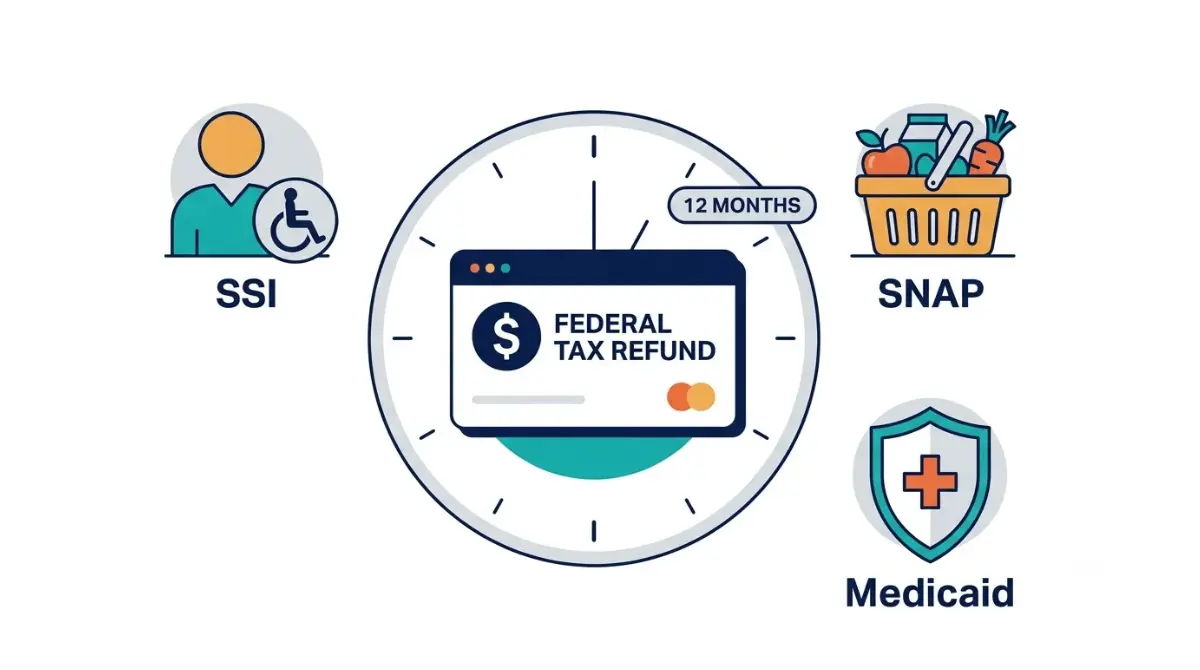
Will a tax refund cut your SSI, SNAP or Medicaid?
Your refund usually won’t cost you the benefits you depend on, but one exception catches people every year.
The short answer
A federal tax refund isn’t counted as income for SSI, SNAP or Medicaid, and it isn’t counted as an asset for 12 months. A state tax refund follows different rules, and that’s where most problems start.
Find your program
- On SSI: read the SSI section, then the 12-month clock example.
- On SNAP: go to the SNAP asset-test section.
- On Medicaid, or helping a parent with long-term care: start with the Medicaid section.
ℹ️ Financial Disclaimer: This article is general education about how federal and state tax refunds affect eligibility for SSI, SNAP and Medicaid, including Medicaid long-term care. It isn’t tax, legal or benefits advice, and state rules vary. Before acting, confirm your situation with the agency that pays your benefits, a CPA or enrolled agent for tax questions, or an elder-law attorney for long-term care planning.
The federal rule: refunds aren’t income for 12 months
One federal law sets the starting point for all three programs.
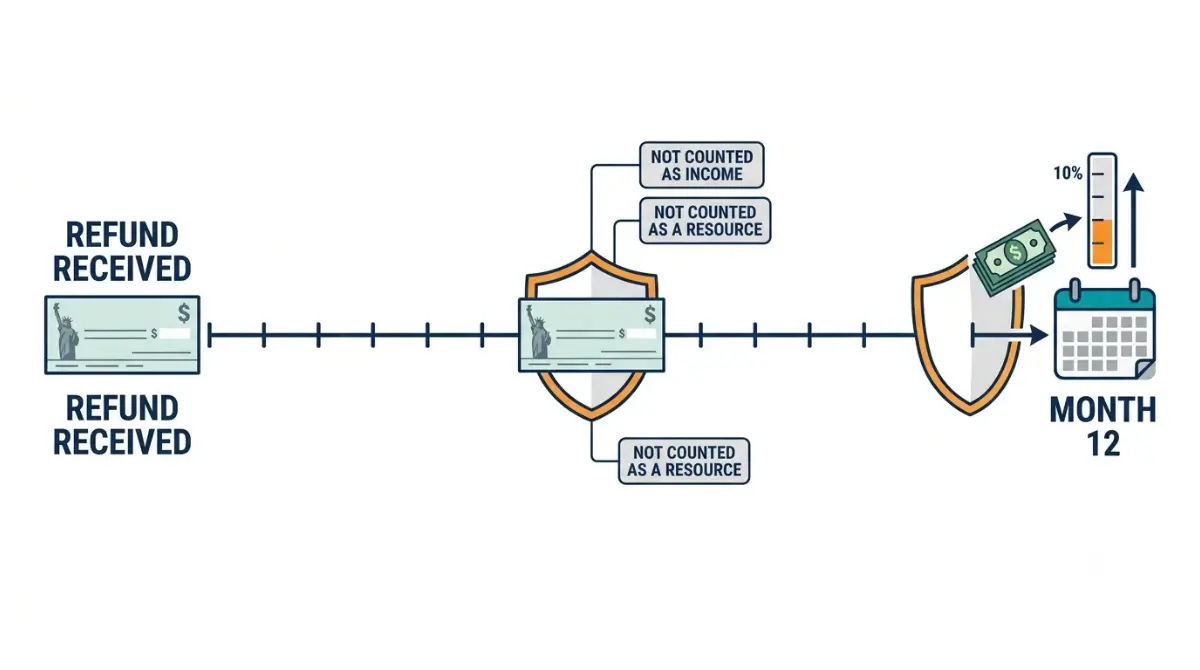
What 26 U.S.C. § 6409 says
Under 26 U.S.C. § 6409, federal programs, and state programs funded partly with federal money, can’t count a federal refund as income. They also can’t count it as a resource for 12 months after you receive it. Here’s how your federal refund is calculated.
Income vs resources: two different tests
| Test | What it asks | Key detail: federal refund |
|---|---|---|
| Income | What came in this month? | Not counted |
| Resources | What do you hold on a set date? | Not counted for 12 months |
Source: 26 U.S.C. § 6409.
Does the EITC count?
No. The earned income tax credit arrives as a federal refund, and the IRS’s guidance on disability and the EITC confirms it isn’t counted as income. Unsure you must file? Check whether you need to file to get a refund.
SSI: your refund and the $2,000 resource limit
SSI has the tightest asset rules of the three programs.
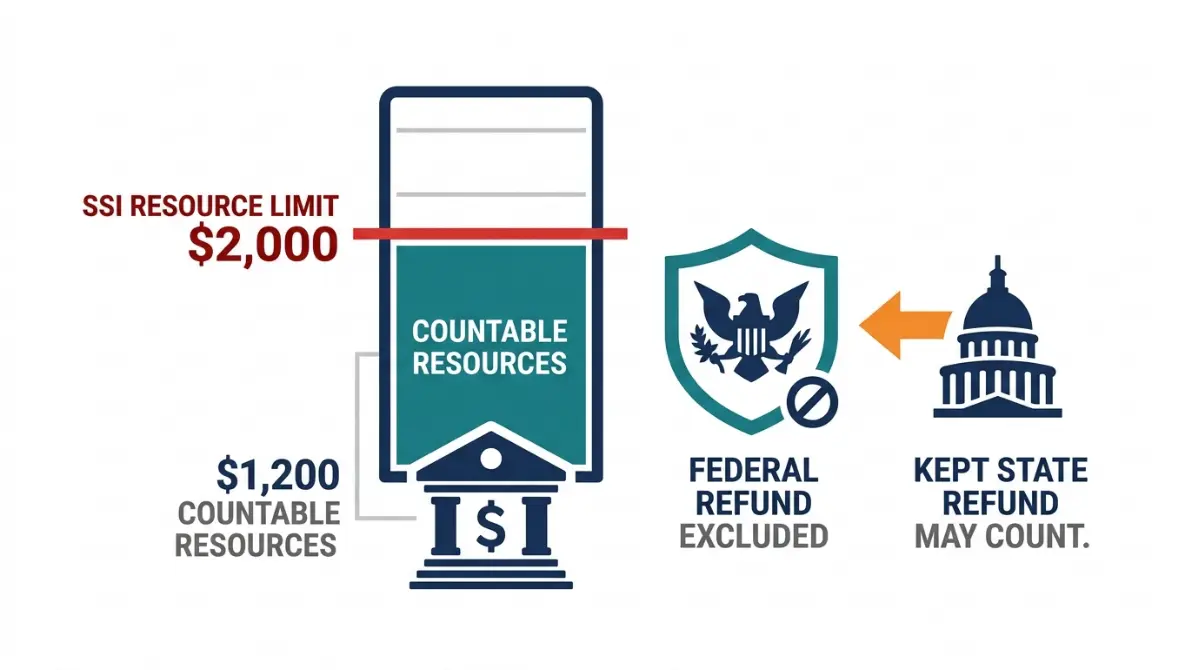
Is a tax refund income for SSI?
No. The Social Security Administration treats any refund of income tax you already paid, federal or state, as not income (SSA POMS SI 00815.270).
The 2027 SSI limits
📊 Data Point: For 2027, the SSI resource limit stays at $2,000 for an individual and $3,000 for a couple. After a 3.6% cost-of-living adjustment, the maximum federal payment rises to $1,029 and $1,544 a month. Source: SSA 2027 COLA Fact Sheet, October 2026.
The month-after rule
🔍 How It Works: SSA checks resources at the first moment of each month (20 CFR 416.1207). A federal refund is excluded for the 12 months after the month you receive it. A state refund you keep counts from the next month (POMS SI 01130.676).
✅ Action Step: Ask your SSA office or a benefits counselor: “What proof do you need to exclude my federal refund?”
SNAP: how a refund is treated in the asset test
SNAP applies the same federal rule, with its own asset limits.
Refunds aren’t counted as SNAP income
USDA’s Food and Nutrition Service tells states to ignore a federal refund as SNAP income and to exclude it from assets for 12 months.
FY2027 SNAP asset limits
| Household | Asset limit, Oct 2026–Sep 2027 | Key detail |
|---|---|---|
| A member is 60+ or disabled | $4,750 | Up from $4,500 |
| All other households | $3,000 | Unchanged |
Source: USDA FY2027 SNAP cost-of-living memo, August 21, 2026.
Many states waive the asset test, so ask your state SNAP office whether yours does.
The subtract-the-refund test
🔍 How It Works: States subtract any federal refund received in the last 12 months from your countable assets. If what remains is under the limit, you pass.
Medicaid: why your type of coverage changes the answer
Medicaid runs two sets of financial rules, and a refund matters differently under each.
MAGI Medicaid: no asset test
Most adults under 65, parents and children qualify under MAGI rules, which CMS confirms use no asset test. A federal refund isn’t income either, so it generally has no effect.
Seniors, disability and long-term care
Non-MAGI Medicaid covers people 65+, many disability groups, long-term care and the Medicare Savings Programs, and it keeps a resource test. CMS guidance excludes a federal refund from resources for 12 months. If a relative relies on a trust, see how a special needs trust protects SSI and Medicaid.
When a state refund can count under MAGI
Rules vary by state. Arizona, for example, counts a state refund as MAGI income only if the person itemized and deducted state income taxes.
✅ Action Step: Ask your state Medicaid agency: “Do you disregard state tax refunds, and for how long?” For long-term care, consult an elder-law attorney before moving any refund money.
A worked example: your 12-month refund clock
The 12 months start the month after the money lands.
Assumptions: a single SSI recipient with $1,200 in checking gets a $2,500 federal refund in March 2027 and a $400 state refund in April. The dollar amounts are illustrative.
| Date | What happens | Countable SSI resources |
|---|---|---|
| March 2027 | Federal refund arrives | Not income |
| April 1, 2027 | Federal exclusion begins | $1,200 ✓ |
| May 1, 2027 | Kept state refund counts | $1,600 ✓ |
| April 1, 2028 | $1,000 federal leftover counts | $2,200 ✗ |
Sources: SSA POMS SI 01130.676; 20 CFR 416.1207; SSA 2027 COLA Fact Sheet ($2,000 limit).
When the clock starts
The arrival month sets every date, so check when EITC and ACTC refunds arrive.
What happens in month 13
The leftover $1,000 becomes countable and pushes this person over $2,000. A $900 state refund would have done the same in May 2027.
The same refund under SNAP
An elderly SNAP household with $3,500 saved holds $6,000 once the refund arrives. Subtract the refund and $3,500 remains, under the $4,750 limit.
Three refund mistakes that can cost benefits
Most refund problems come from timing and records, not the refund.
Treating a state refund like a federal one
The 12-month protection doesn’t cover state refunds for SSI. SNAP varies by state: North Dakota counts a state refund as an asset when received, while New York exempts it for 12 months.
⚠️ Costly Mistake: Keeping a state refund past its arrival month is a common way SSI recipients exceed $2,000. Plan how you’ll use it that month.
Forgetting the end date
Mark month 12 on a calendar, and use a budget calculator to plan the refund before then.
Our guides on what to do with your tax refund and where to hold a refund can help you choose an account you can trace.
Not keeping proof
Keep your return and deposit statement, because SSA treats mixed money as non-refund cash spent first. No bank account? See refund options that still leave a record.
Tax refund and benefits FAQs
1. Does a tax refund count as income for SSI?
No. SSA doesn’t count federal or state tax refunds as SSI income; only a kept state refund counts as a resource. Confirm your case with your local SSA office.
2. Does a tax refund affect SNAP benefits?
A federal tax refund isn’t SNAP income, and SNAP excludes it from the asset test for 12 months. Confirm with your state SNAP office.
3. Does a tax refund affect Medicaid?
A federal tax refund isn’t Medicaid income, and non-MAGI Medicaid excludes it from resources for 12 months. Confirm with your state Medicaid agency.
4. Does the EITC count as income for benefits?
No. An EITC refund is a federal tax refund, so federally funded programs can’t count it as income. A CPA or enrolled agent can confirm your EITC eligibility.
5. How long can I keep a tax refund on SSI?
SSI excludes a federal tax refund for 12 months after the month you receive it; leftovers count afterward. Ask SSA how it will track your refund.
6. Do state tax refunds count for SSI?
A state tax refund isn’t SSI income, but a kept state refund counts as a resource the following month. Ask SSA whether another exclusion applies.
7. What happens to my tax refund after 12 months?
Any federal tax refund you still hold counts toward your program’s asset or resource limit from then on. Confirm the end date with your agency.
8. What is the SSI resource limit for 2027?
The 2027 SSI resource limit is $2,000 for an individual and $3,000 for a couple.
9. What is the SNAP asset limit?
Through September 2027, the SNAP asset limit is $3,000, or $4,750 with a member 60+ or disabled.
10. Does Medicaid have an asset test?
MAGI Medicaid has no asset test; non-MAGI Medicaid, covering many seniors and long-term care, generally does. An elder-law attorney can explain your state’s long-term care rules.
11. Should I report my tax refund to my benefits agency?
Ask your agency how it wants a tax refund reported, and keep your return and deposit statement. Your caseworker can confirm the reporting deadline.
Your next step before the refund arrives
Write down two dates: the month your refund arrives and the month its exclusion ends. Then estimate your refund and ask your SSA office or state agency how they’ll treat it. Federal refunds are protected for a year; state refunds often aren’t. If you help a parent, share both dates with their caseworker.
Related Articles
 Tax Refund
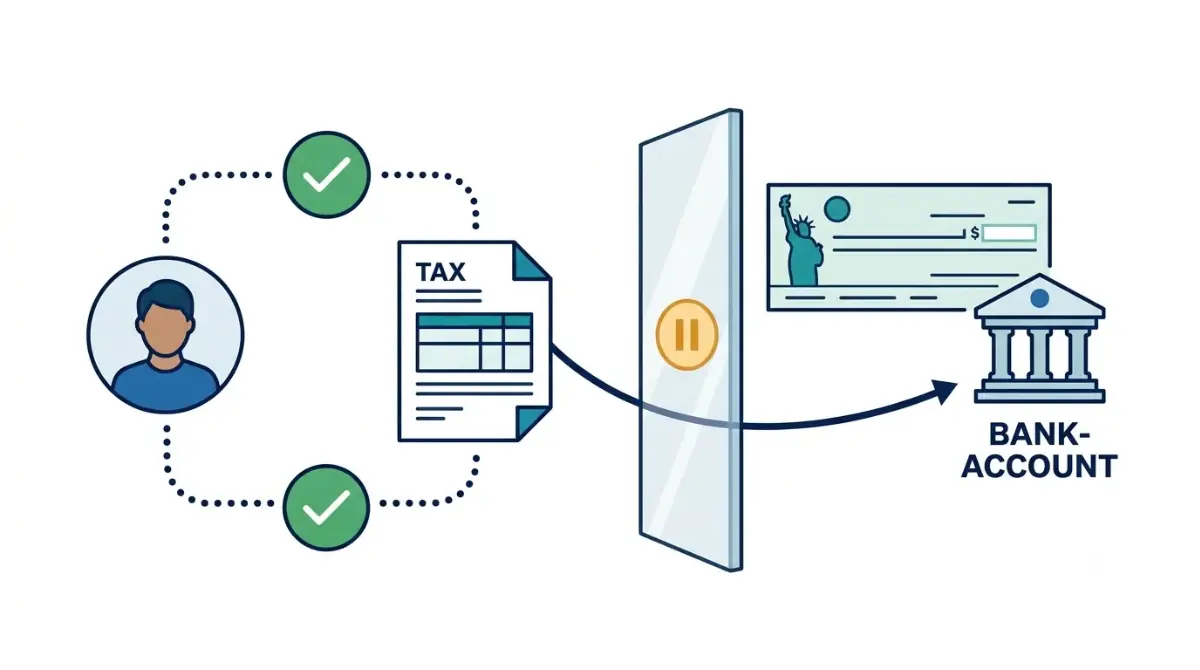
The Right Way to Answer IRS Letter 5071C and Release Your Refund
October 17, 2026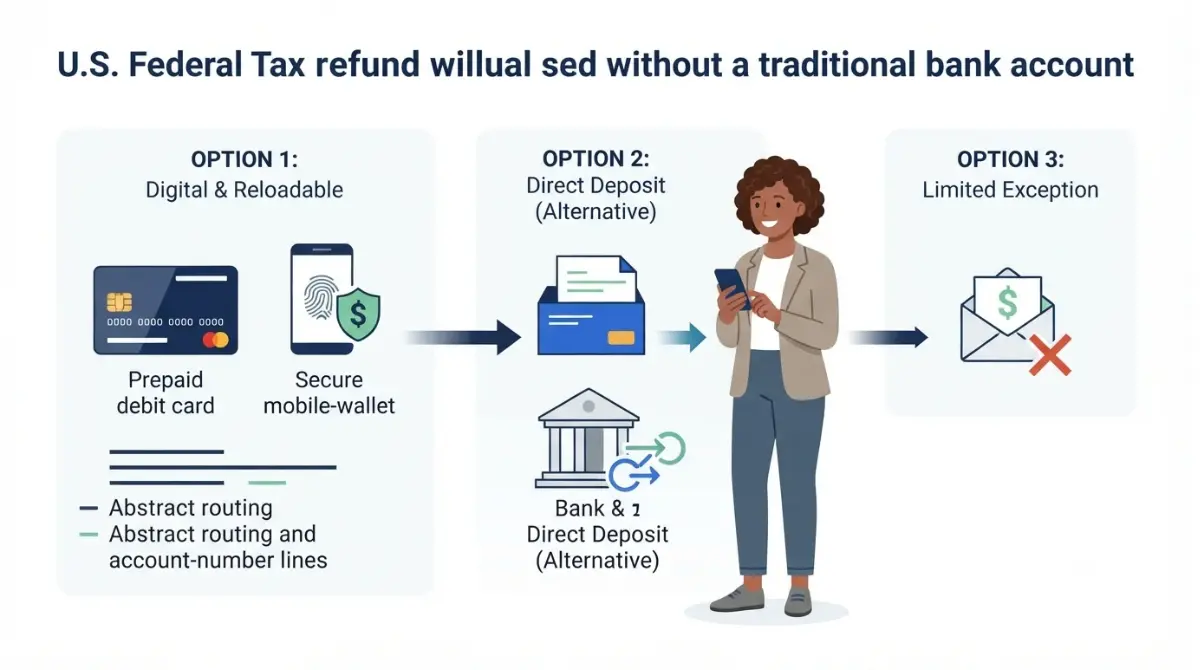 Tax Refund
 Without Bank Account? Your Clear Options Explained
October 9, 2026 Tax Refund
Clear Signs of a Smaller Tax Refund Next Year
October 10, 2026 Tax Refund
A Clear Way to Adjust Your W-4 Refund Up or Down
October 12, 2026 Tax Refund
Refund Approved but No Deposit? A Clear Way to Find It
October 7, 2026 Tax Refund
 Delayed and Bills Running Late? Find the Cause First
October 7, 2026 Tax Refund
A Clear Walk Through the Tax Withholding Estimator Screens
October 13, 2026 Tax Refund
Where to Put Tax Refund Money for a Smart 3-Month Hold
October 15, 2026 Tax Refund
A Clear Tax Refund Schedule, From Filing Day to Deposit Day
October 7, 2026
Informational disclaimer
The content on Finance Authority Hub is provided for general informational and educational purposes only and should not be considered personalized financial, investment, tax, legal, or professional advice. Financial decisions depend on your individual goals, income, risk tolerance, location, and regulatory situation. Before acting on any information, strategy, estimate, or calculator result, consult a qualified licensed professional who can evaluate your specific circumstances.