
What Medicare Savings Program income limits are worth to you
Medicare Savings Program income limits are built from one figure nobody shows you: the $1,330 monthly poverty guideline, plus a $20 disregard.
In This Article
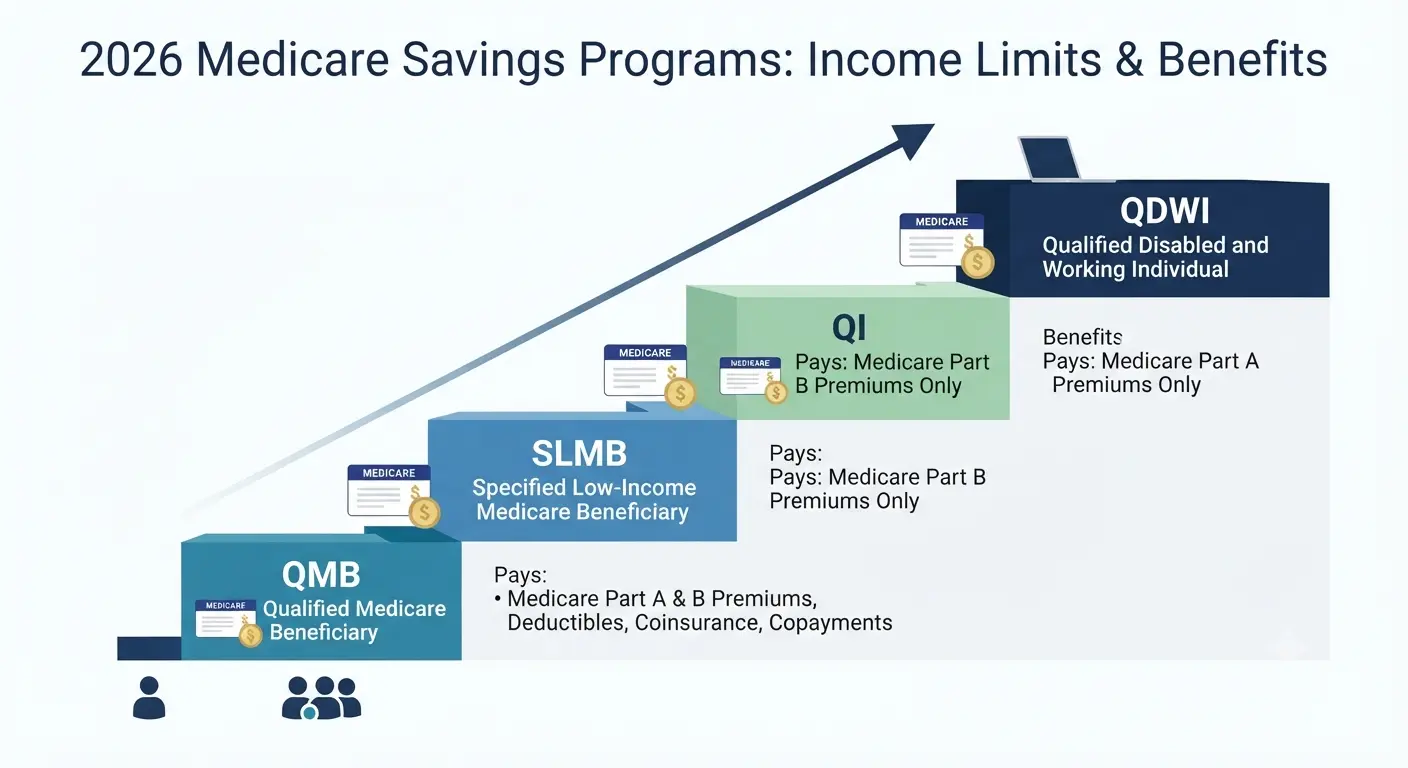
Four programs, four different income limits, and the one that applies depends on which line your monthly income falls under.
Checking a number against your own Social Security deposit? Start with the table. Sitting just above one of these limits? Section four matters more to you than the table does. Helping a parent? Section six has the application route.
Medicare Savings Program income limits in 2026 run from $1,350 to $5,405 a month for one person. The lowest limit buys the most help.
| Program | Individual | Married couple | Resource limit | Key detail |
|---|---|---|---|---|
| QMB | $1,350 | $1,824 | $9,950 / $14,910 | Premiums plus deductibles, coinsurance, copays |
| SLMB | $1,616 | $2,184 | $9,950 / $14,910 | Part B premium only |
| QI | $1,816 | $2,455 | $9,950 / $14,910 | Part B premium only; reapply every year |
| QDWI | $5,405 | $7,299 | $4,000 / $6,000 | Part A premium only |
Source: SSA’s published MSP income and resource limits, effective February 26, 2026, confirmed against Medicare.gov. Figures apply to the 48 states and DC; Alaska and Hawaii are higher. These are the same bills covered in the five separate bills that make up Medicare.
ℹ️ Financial Disclaimer: This article is general education about a government benefits program, not personalized advice on lending, credit, tax, insurance, investment, or debt relief. Only your state Medicaid agency can determine whether you qualify for a Medicare Savings Program. For help with your own figures, contact your state Medicaid office or a State Health Insurance Assistance Program counselor; for tax or legal questions raised by your situation, consult a CPA or a qualified attorney.
What each program actually pays for
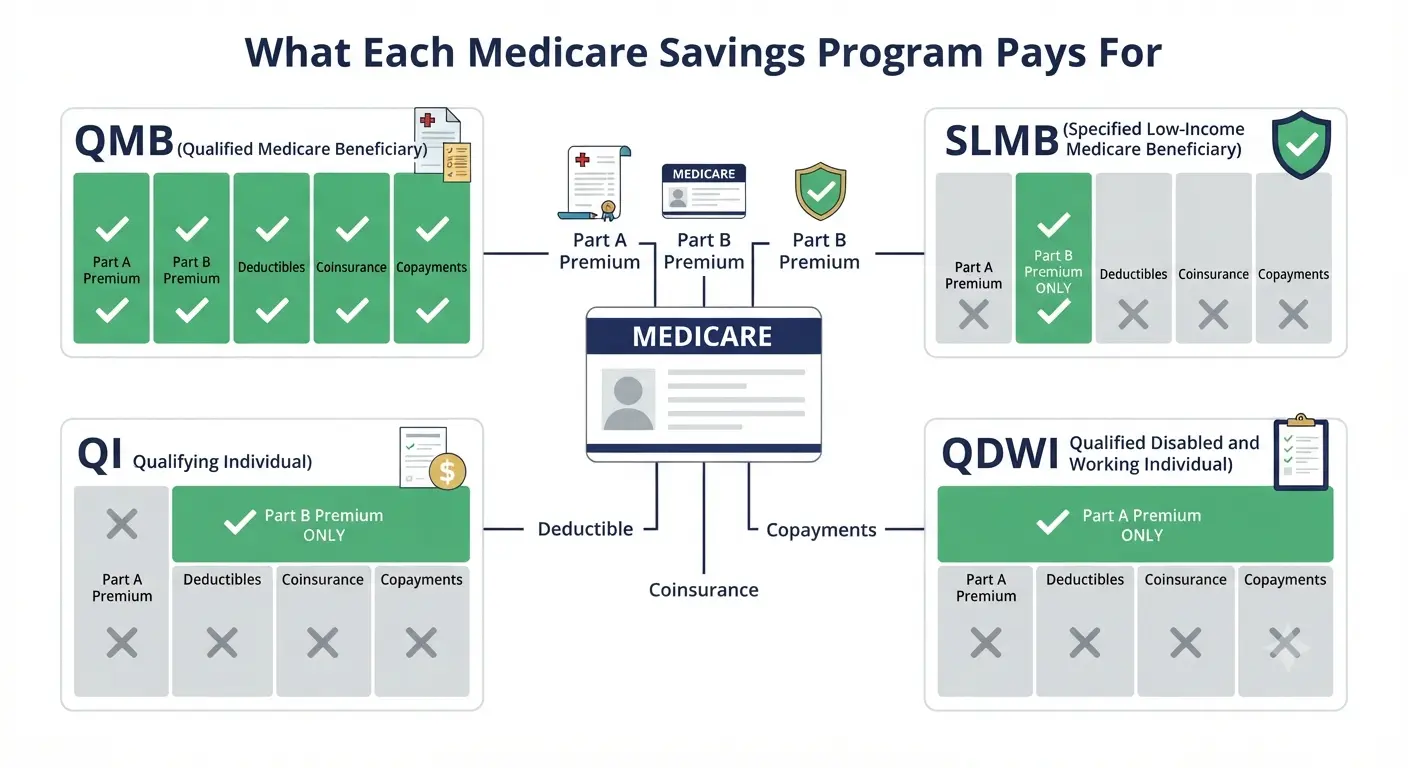
The Qualified Medicare Beneficiary program carries the lowest income limit and the largest benefit.
QMB: premiums plus cost sharing
QMB covers Part A and Part B premiums along with the deductibles, coinsurance and copayments Medicare would otherwise leave to you. Providers who accept Medicare are not permitted to bill a QMB enrollee for that cost sharing.
SLMB and QI: the Part B premium only
These two pay the same benefit and differ only by income band. At the 2026 rate, that is $2,434.80 a year staying in your deposit rather than leaving it — worth understanding alongside what drives the standard Part B premium.
QDWI: the Part A premium
QDWI is narrow. It covers the Part A premium for people under 65 who had a disability, returned to work, and lost premium-free Part A.
📊 Data Point: The standard Medicare Part B premium is $202.90 a month in 2026, and the annual Part B deductible is $283 — Source: Centers for Medicare & Medicaid Services, November 2025.
Where these numbers come from
Each limit is a percentage of the federal poverty guideline plus a flat $20 — arithmetic no competing page shows, which is why people subtract that $20 a second time and rule themselves out.
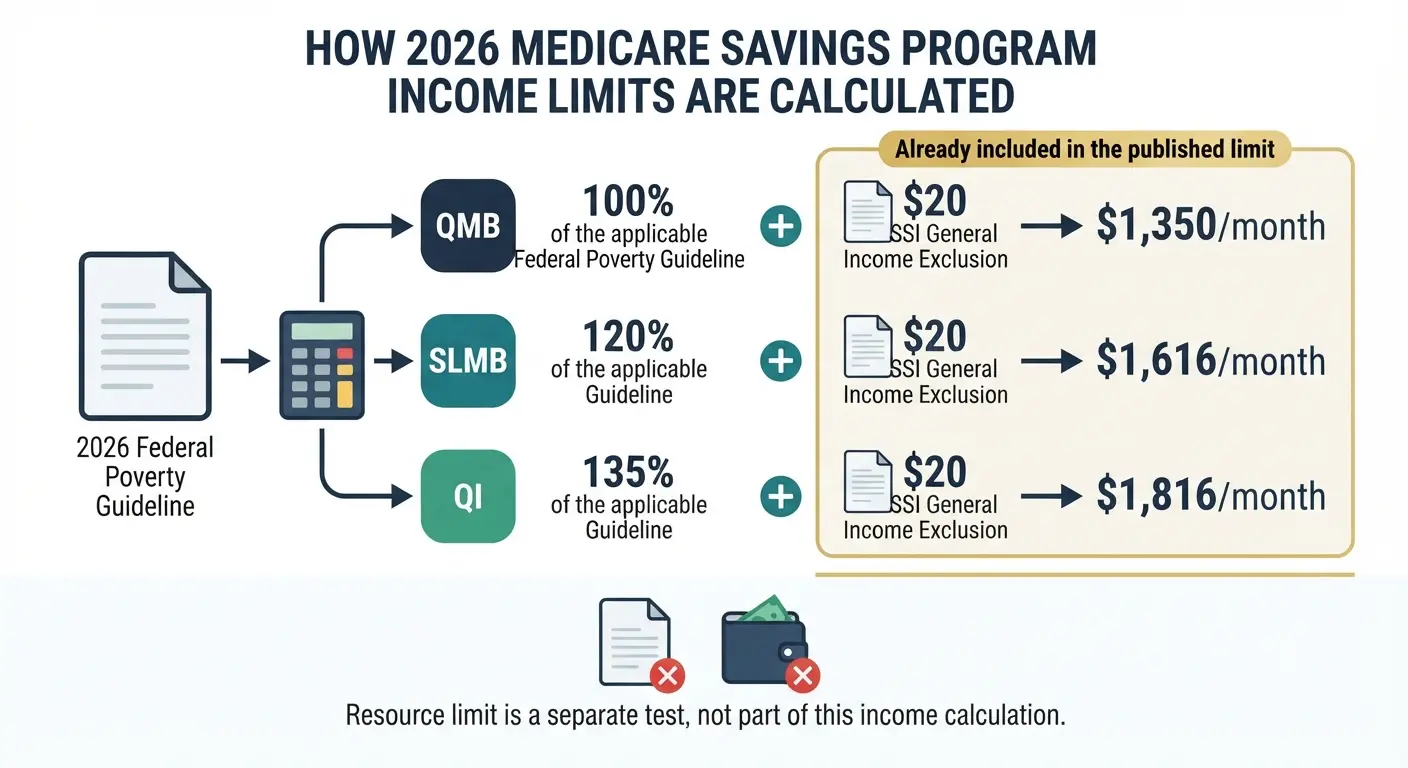
🔍 How It Works: HHS set the 2026 guideline for one person in the 48 states and DC at $15,960 a year, or $1,330 a month. QMB takes 100% of that plus $20, giving $1,350. SLMB takes 120% ($1,596) plus $20, giving $1,616. QI takes 135% ($1,795.50, rounded up to $1,796) plus $20, giving $1,816. For a couple the guideline is $21,640 a year — $1,803.33 a month, which CMS rounds up to $1,804 before adding $20, giving $1,824. Figures from the HHS poverty guidelines published in January 2026 and SSA’s limit tables.
The $20 is already in the number
That $20 is the SSI general income exclusion, and the published limits already include it. Compare your gross monthly income to the figure in the table as it stands.
The resource limit is separate
QMB, SLMB and QI share a 2026 resource limit of $9,950 for one person and $14,910 for a couple.
Over the limit? Four reasons to apply anyway
Four situations let you qualify above the published number:
- Not all income counts. Most states apply SSI counting rules, which exclude several categories of income outright.
- Wages count differently than Social Security. Under SSA’s income rules, the first $65 of monthly earnings and half of everything above $65 are not counted.
- Your state may use higher limits or apply disregards the federal table does not show.
- Medicare says to apply regardless. Its guidance states plainly that you should still apply even if you do not think you qualify.
A countable income figure is what your state actually measures — not the gross number on your bank statement.
✅ Action Step: Call your state Medicaid office or a SHIP counselor and ask: “What income and resource disregards does this state apply to MSP applications, and does this state use an asset test at all?”
How your state changes the answer
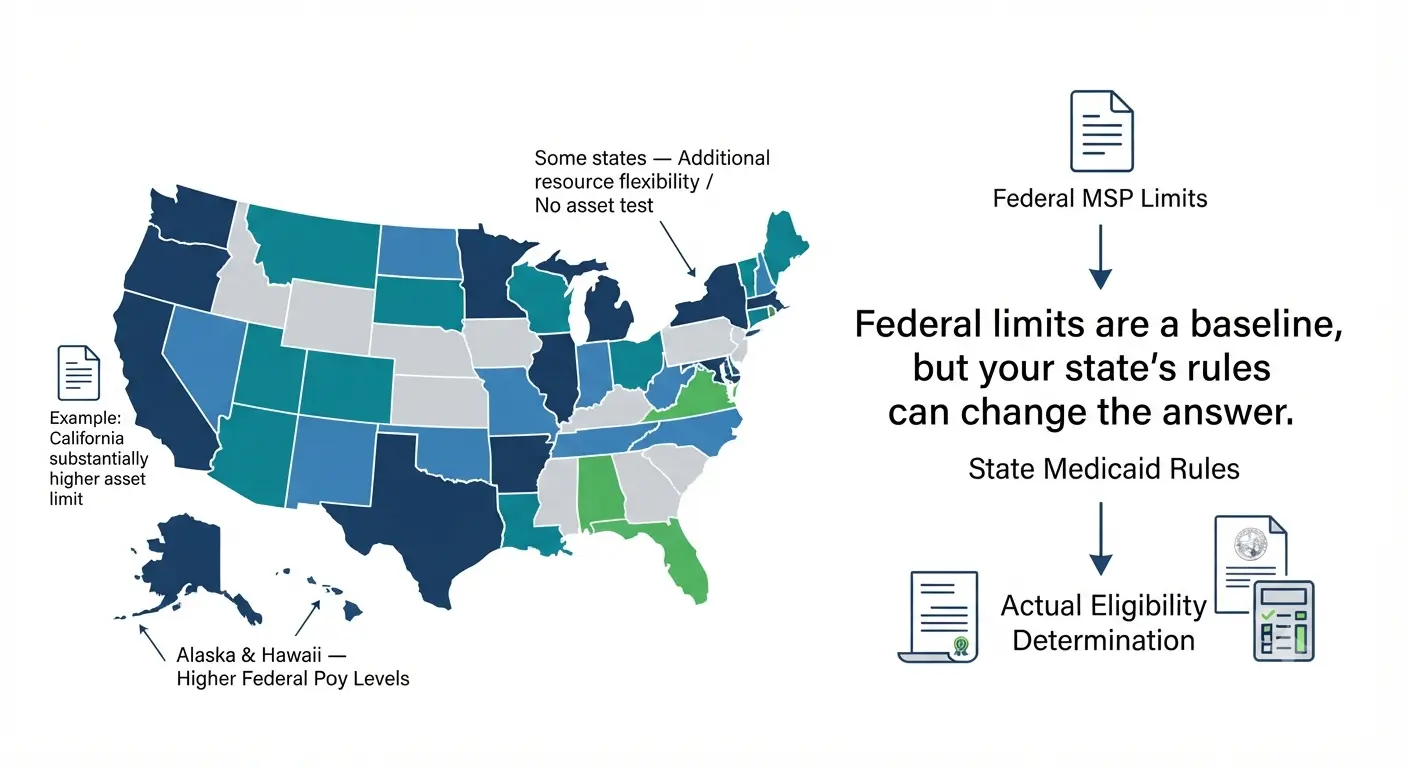
The federal figures are a floor, not a ceiling. State Medicaid agencies may disregard income and resources above the federal standard, and several have removed the resource test entirely.
Alaska and Hawaii
Both use higher limits. Alaska’s QMB limits are $1,683 for an individual and $2,275 for a couple; Hawaii’s are $1,550 and $2,095.
States that set their own terms
California raised its MSP asset limit to $130,000 for an individual effective January 1, 2026 — more than thirteen times the federal figure. Couple limits vary the same way, which matters for what Medicare costs a married couple.
⚠️ Costly Mistake: Treating the federal table as your state’s rule. A reader in a no-asset-test state who skips applying because of savings has given up roughly $2,400 a year over a limit their state does not enforce.
How to apply, step by step
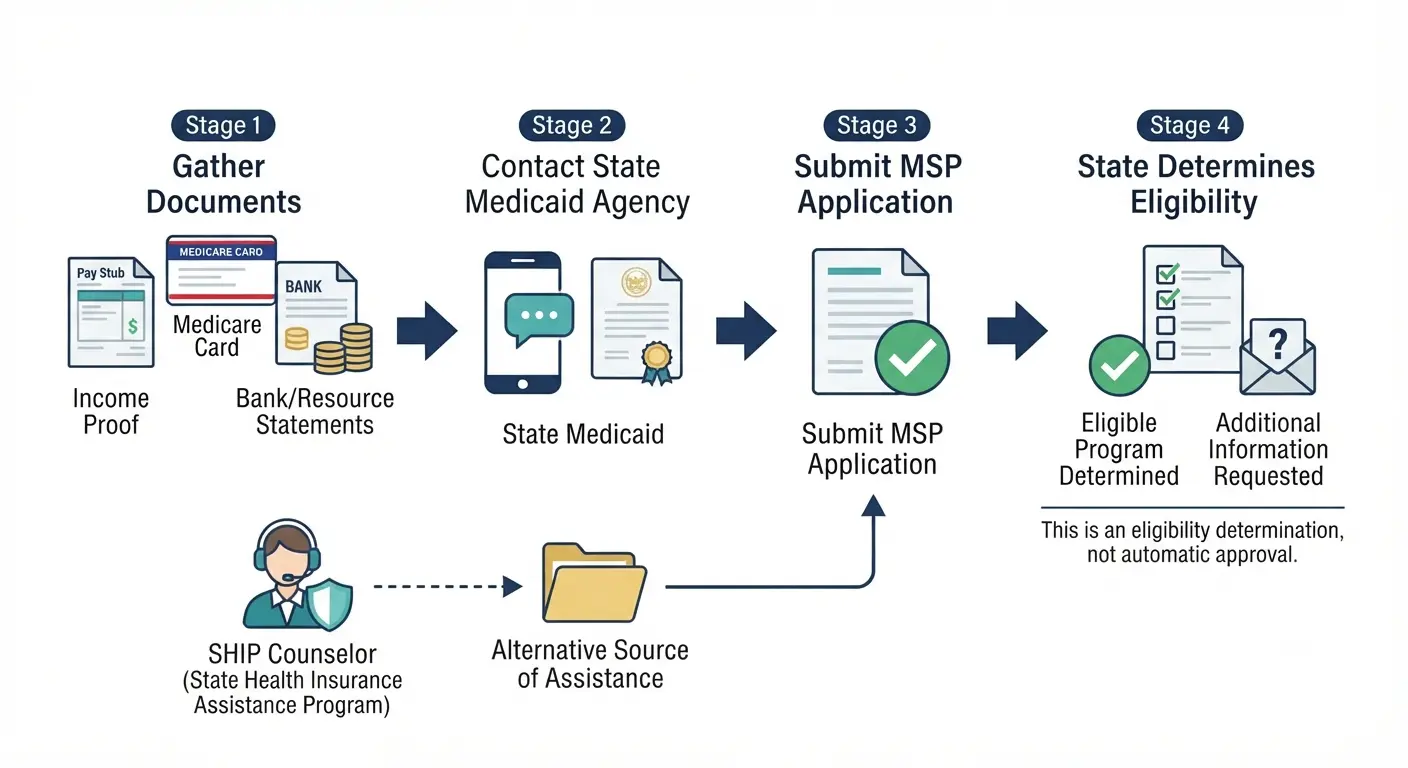
Applications go to your state Medicaid office — not to Medicare, and not to Social Security.
- Gather proof of income, your Medicare card, and recent statements for bank accounts and other countable resources.
- Contact your state’s Medicaid agency and request an MSP application.
- Apply even if a figure looks slightly too high; the state determines which program fits.
Approval in QMB, SLMB or QI also deems you eligible for Extra Help with Part D drug costs, capping covered drugs at $12.65 each in 2026.
💡 Expert Note: Medicare’s own guidance notes that QI is approved first-come, first-served, with priority to people who received it the previous year — so filing early in the year matters.
Mistakes that cost people this benefit
Letting QI lapse
QI requires a fresh application every year. Missing it does not pause the benefit — it ends it.
Paying a bill you do not owe
Providers cannot bill a QMB enrollee for Medicare-covered cost sharing. Show your Medicare card and your QMB or Medicaid card at every visit, and report improper bills to your state Medicaid office rather than paying them.
If the premium relief changes your monthly picture, the budget calculator shows what the difference covers.
Common questions about Medicare Savings Program income limits
1. What are the Medicare Savings Program income limits?
For one person in 2026: $1,350 for QMB, $1,616 for SLMB, $1,816 for QI, and $5,405 for QDWI.
2. What is the difference between QMB, SLMB and QI?
QMB covers premiums plus cost sharing. SLMB and QI cover the Part B premium only, differing by income band.
3. Does SLMB pay my Part B premium?
Yes. SLMB covers the full standard Part B premium, which is $202.90 a month in 2026.
4. What is the resource limit?
QMB, SLMB and QI use $9,950 for an individual and $14,910 for a couple. QDWI uses $4,000 and $6,000.
5. Is the $20 disregard already included?
Yes. The published limits already include the $20 SSI general income exclusion, so do not subtract it again.
6. Can I qualify if I am still working?
Possibly. The first $65 of monthly earnings and half of everything above $65 are not counted. Confirm with your state Medicaid office.
7. Do income limits differ by state?
Yes. States may disregard additional income or resources, and some apply no asset test. Contact your state Medicaid office.
8. Are limits higher in Alaska and Hawaii?
Yes. Alaska’s QMB limit is $1,683 for an individual; Hawaii’s is $1,550, against $1,350 elsewhere.
9. Where do I apply?
Through your state Medicaid agency, which determines which Medicare Savings Program you qualify for.
10. Does an MSP qualify me for Extra Help?
Yes. QMB, SLMB and QI enrollees automatically get Extra Help, capping covered drugs at $12.65 each in 2026.
11. Can a provider bill me if I have QMB?
No. Medicare providers cannot bill QMB enrollees for covered cost sharing. Report improper bills to your state Medicaid office.
What to do next
Compare your gross monthly income to the four figures in the table. Then call your state Medicaid office or a SHIP counselor — particularly if you are above the line, because the published number is a federal floor, and your state may not be using it.
Related Articles
 Medicare
A clear view of the Medicare Part B premium 2026 increase
August 29, 2026 Medicare
The real limits of the Medicare Part D cap in 2026 and 2027
August 31, 2026 Medicare
Why the Medicare Part A Deductible Often Repeats in One Year
August 31, 2026 Medicare
The real cost behind your Medicare Part B deductible
August 29, 2026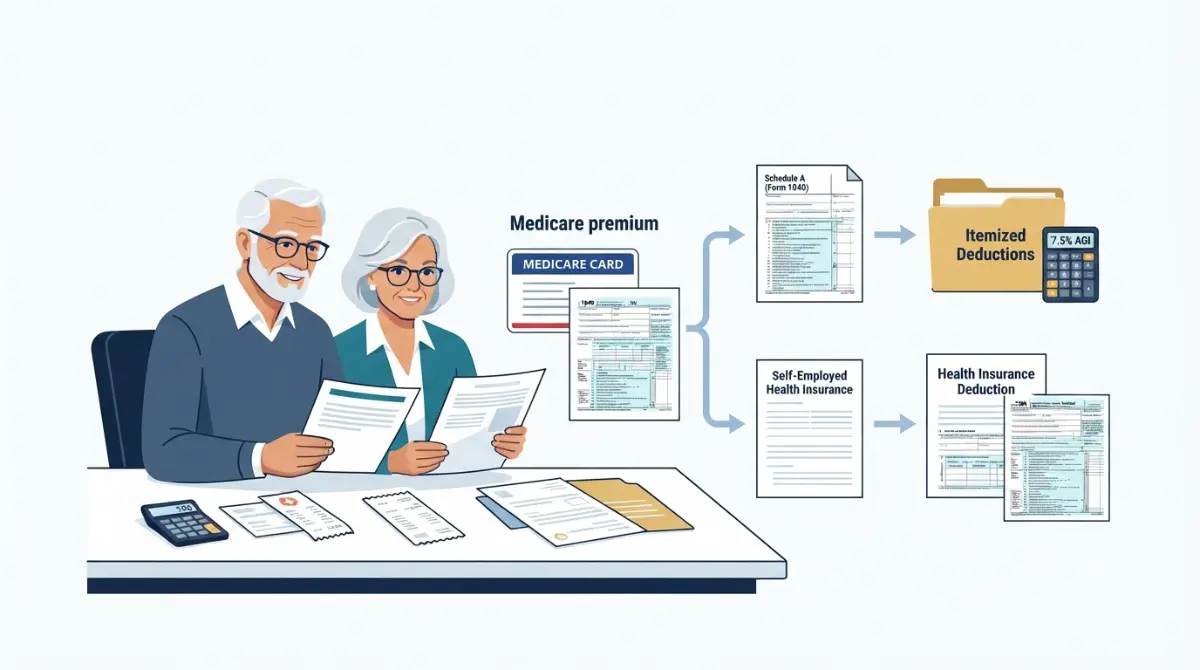 Medicare
Are Medicare premiums tax deductible? What most retirees miss
September 12, 2026 Medicare
The real Medicare cost per year, added up line by line
September 2, 2026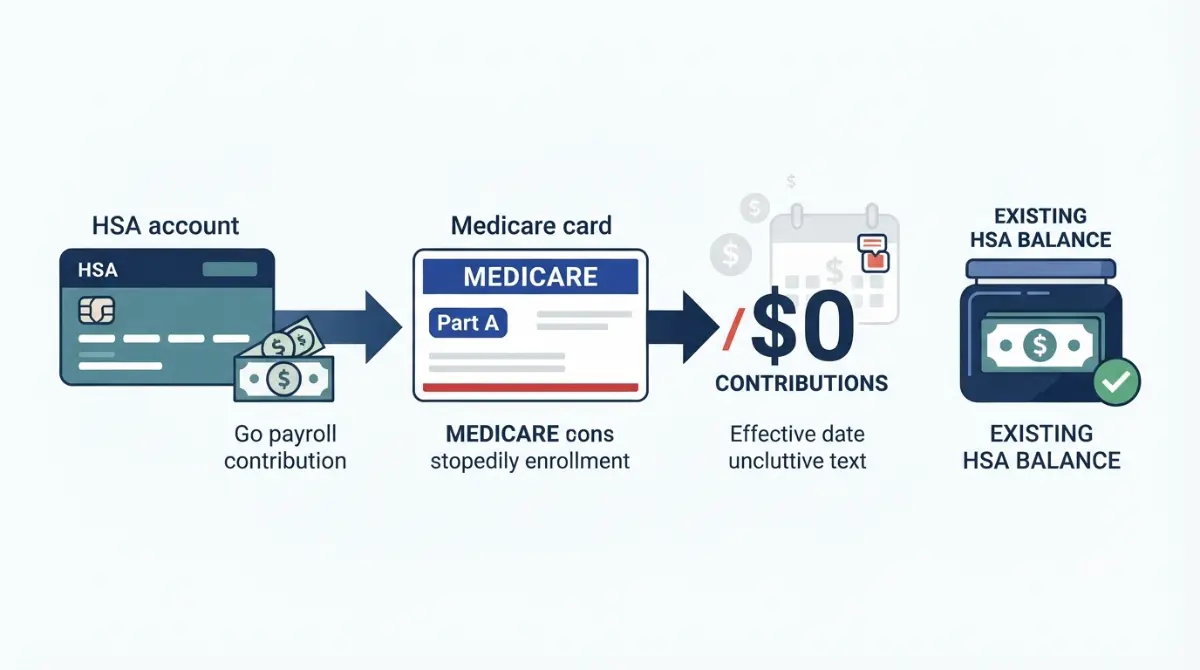 Medicare
HSA and Medicare rules that can create a surprise tax bill
September 12, 2026 Medicare
What health insurance really costs when retiring before 65
September 8, 2026 Medicare
How the IRMAA income lookback sets your first Medicare premium
September 4, 2026
Informational disclaimer
The content on Finance Authority Hub is provided for general informational and educational purposes only and should not be considered personalized financial, investment, tax, legal, or professional advice. Financial decisions depend on your individual goals, income, risk tolerance, location, and regulatory situation. Before acting on any information, strategy, estimate, or calculator result, consult a qualified licensed professional who can evaluate your specific circumstances.