
Are Medicare premiums tax deductible? What most retirees miss
Medicare premiums are tax deductible, but Part B’s $202.90 a month rarely clears the 7.5% floor — and clearing it is only the first of two hurdles.
In This Article
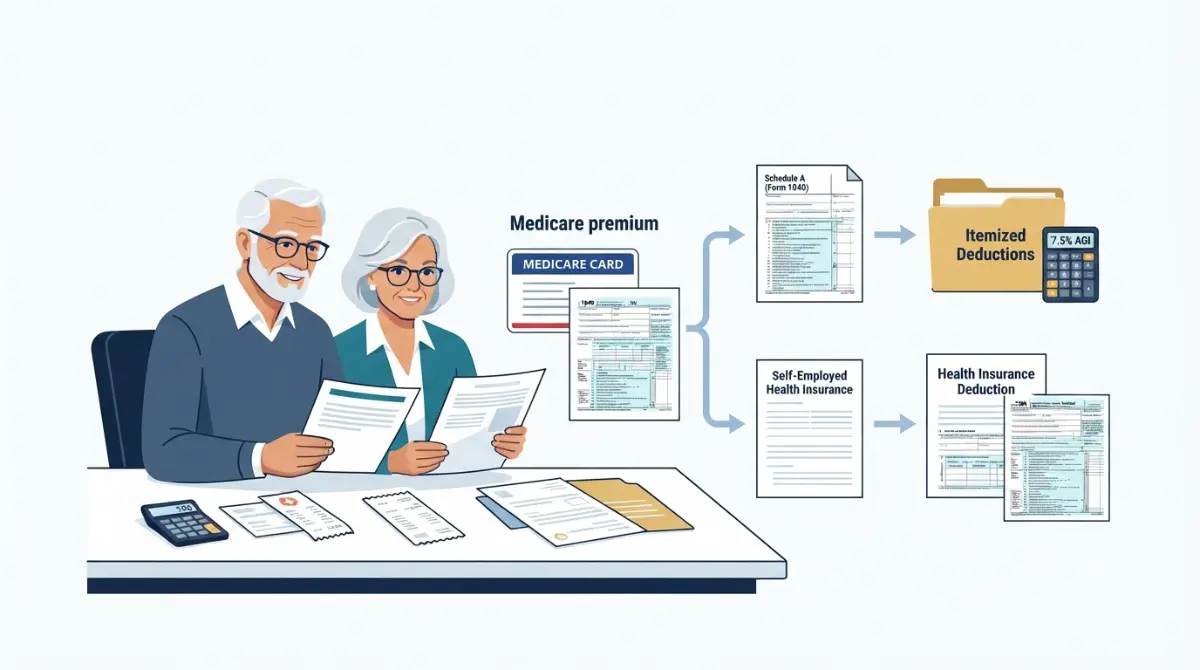
The short answer, and which route applies to you
Yes. Medicare premiums count as a qualified medical expense under IRS rules. But “deductible” and “worth deducting” are two different things, and for most retirees the second one quietly fails.
There are two separate legal routes. Only one will apply to you.
If you’re retired and not working
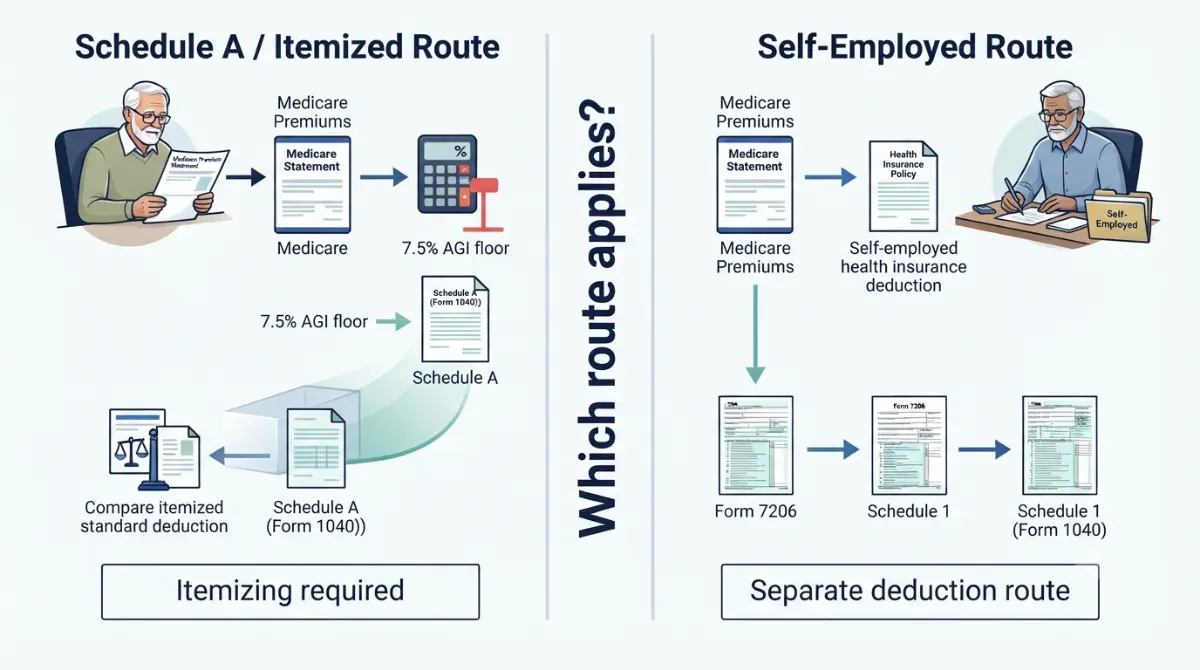
You’re on Route 1. Premiums go on Schedule A as an itemized deduction, behind two hurdles that Section 4 walks through with real numbers.
If you have self-employment income
You’re on Route 2. Premiums come off your income directly, with no hurdles and no itemizing. Skip ahead to Section 5.
Most readers are on Route 1. Most readers on Route 1 end up deducting nothing — and knowing that in the next four minutes saves you an afternoon with a shoebox of receipts.
ℹ️ Financial Disclaimer: This article is general tax and financial education, not personalized advice. It covers federal income tax treatment, health insurance, and Medicare enrollment — all regulated activities where your own facts change the answer. Nothing here is a recommendation to claim, or not claim, a deduction on your return. Before acting, consult a CPA, an enrolled agent, or a tax attorney about your specific situation, and a licensed insurance agent or your State Health Insurance Assistance Program about coverage decisions.
Which Medicare premiums the IRS counts
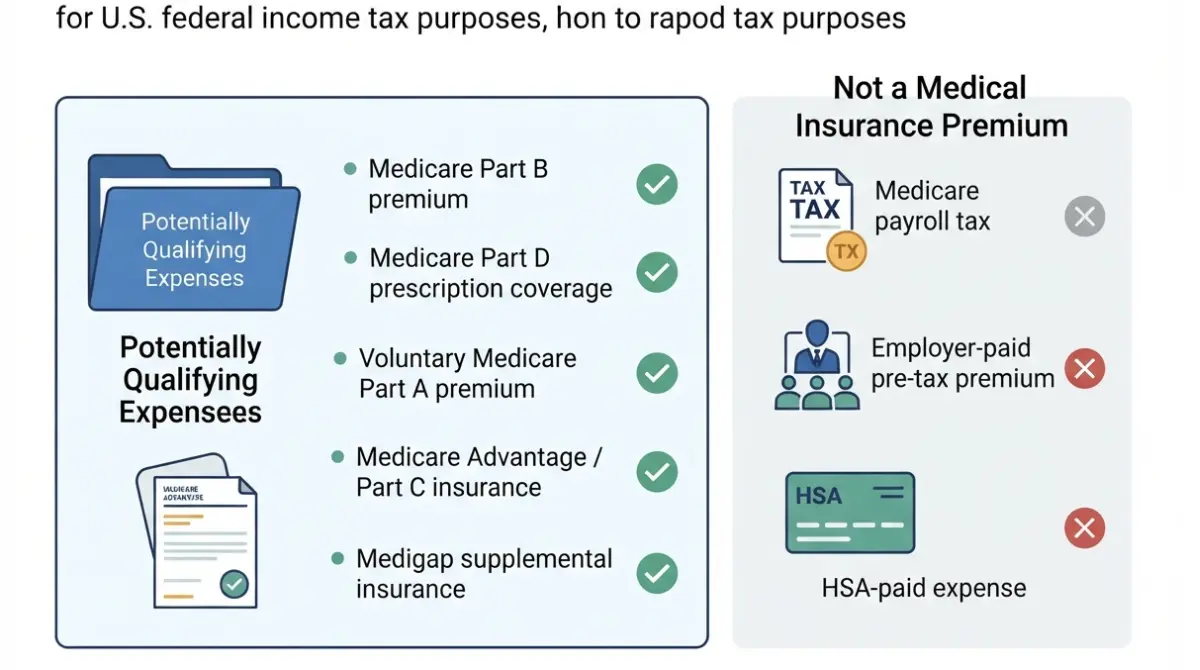
IRS Publication 502 names three Medicare premiums as qualified medical expenses outright.
What counts:
- Part B premiums — Publication 502 states these are a medical expense, and points you to your Social Security statement for the amount.
- Part D premiums — included as a medical expense.
- Part A premiums — but only if you voluntarily enrolled because you weren’t covered under Social Security.
- Part C and Medigap premiums — these qualify under the publication’s general rule that premiums for policies covering medical care are includible, rather than being named individually.
What doesn’t count:
- The Medicare payroll tax. Publication 502 is explicit that taxes imposed by a government unit aren’t insurance premiums.
- Premiums your employer paid pre-tax. That money was never taxed, so there’s no second break.
- Anything you paid with a tax-free health savings account distribution.
Premiums taken from your Social Security check
They still count. The Social Security Administration withholds the money, but you paid it — which is why Publication 502 sends you to your SSA statement to find the figure.
What Medicare premiums actually cost in 2026
The standard Part B premium is $202.90 a month in 2026. You need the annual figure, not the monthly one, to test it against the threshold in the next section.
| Medicare cost | Monthly, 2026 | Annual | Key detail |
|---|---|---|---|
| Part B standard premium | $202.90 | $2,434.80 | Up $17.90 from $185.00 in 2025 |
| Part B deductible | — | $283 | Up $26 from 2025 |
| Part A deductible | — | $1,736 | Inpatient hospital, per benefit period |
| Part A premium (voluntary, full) | $565 | $6,780 | Fewer than 30 quarters of coverage |
| Part A premium (voluntary, reduced) | $311 | $3,732 | 30+ quarters, 45% reduction |
Monthly figures: CMS 2026 Medicare Parts A & B premiums and deductibles. Annual columns calculated from those monthly amounts. Part D plan premiums vary by plan and have no single national figure.
If your income triggers a surcharge
Higher earners pay an income-related monthly adjustment amount on top of the standard premium — $284.10 to $689.90 a month for Part B in 2026, and $14.50 to $91.00 for Part D. It’s based on your income from two years earlier. A surcharge is part of your premium, so it’s deductible on exactly the same basis as the base amount. Our guide to how the IRMAA income tiers are set and appealed covers the brackets.
Part B is only one of the five separate Medicare bills you actually pay.
Route 1: the two hurdles you have to clear
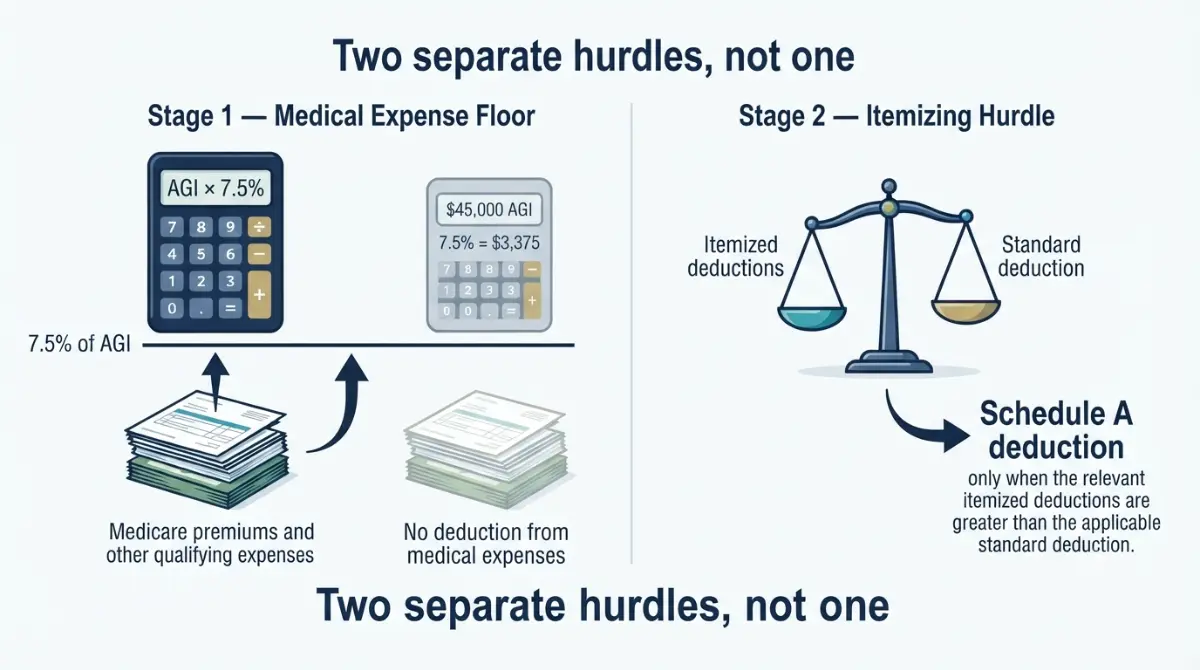
Multiply your AGI by 0.075. That result is your floor — you deduct only medical expenses above it, and only if you itemize.
Hurdle one: 7.5% of your income
🔍 How It Works: The 7.5% figure is a floor, not a cap and not a threshold you have to beat to deduct anything at all. If your AGI is $45,000, your floor is $3,375. Spend $4,000 on medical care and you deduct $625 — the amount above the floor, not the whole $4,000.
Here’s what that means for a single filer whose only medical costs are Medicare:
| Your AGI | 7.5% floor | Part B premiums alone | Clears the floor? | Key detail |
|---|---|---|---|---|
| $30,000 | $2,250 | $2,434.80 | Yes, by $185 | Rare — and $185 is the whole deduction |
| $45,000 | $3,375 | $2,434.80 | No | Short by $940 |
| $60,000 | $4,500 | $2,434.80 | No | Short by $2,065 |
| $80,000 | $6,000 | $2,434.80 | No | Short by $3,565 |
| $100,000 | $7,500 | $2,434.80 | No | Short by $5,065 |
Floors calculated at 7.5% of AGI per Publication 502. Premium figure from the CMS 2026 table above.
Hurdle two: beating the standard deduction
Clearing the floor earns you nothing unless your total itemized deductions beat your standard deduction. For 2026 that’s $16,100 for a single filer, plus $2,050 more at age 65 — $18,150 before you deduct a dollar.
⚠️ Costly Mistake: People gather receipts for weeks, clear the 7.5% floor by a few hundred dollars, then discover their whole Schedule A totals $12,000 against an $18,150 standard deduction. Run hurdle two first. It takes ninety seconds and it’s the one that usually decides the answer.
A worked example. Single, 67, AGI $45,000, Medicare only. Part B premiums of $2,434.80 plus the $283 Part B deductible come to $2,717.80 — still $657 short of the floor. Even after clearing it, everything else on Schedule A would need to carry them past $18,150.
✅ Action Step: Before sorting a single receipt, ask a CPA or enrolled agent one question: “Given my total medical spend this year, does itemizing beat my standard deduction — and would bunching next year’s elective procedures into one year change that?” Our 2026 tax brackets and deduction guide has the amounts for other filing statuses.
Route 2: the self-employed deduction that skips both hurdles
Yes, and without itemizing. The self-employed health insurance deduction takes Medicare premiums off your income directly, with no 7.5% floor and no Schedule A.
Who qualifies
Three conditions have to hold, and if any fails, the route closes:
- You have net profit from self-employment, partnership earnings, or S-corporation wages as a more-than-2% shareholder.
- The plan is established under that business.
- You weren’t eligible for a subsidized employer plan — yours or a spouse’s — in the months you’re claiming.
How it’s filed
💡 Expert Note: The IRS instructions for Form 7206 state that Medicare premiums you voluntarily pay for insurance in your name, similar to qualifying private health insurance, can be used to figure this deduction. The result carries to Schedule 1 of Form 1040. The deduction can’t exceed your net earnings from that business.
Same filer as Section 4 — AGI $45,000 — but with self-employment income instead of a pension. The full $2,434.80 comes off the top, where Route 1 gave them nothing.
✅ Action Step: Ask a CPA or enrolled agent: “Was I eligible for a subsidized employer plan in any month this year, and does that disqualify those months for me?” The month-by-month eligibility test is where this deduction is most often claimed wrongly.
Four mistakes that cost people this deduction
Each of these is an error a careful person makes.
- Counting money you never paid tax on. Pre-tax employer premiums and anything paid from an HSA are already untaxed. Our guide to how HSAs and Medicare interact covers the overlap.
- Counting the Medicare payroll tax. It’s a tax, not a premium.
- Not keeping the record. Your SSA statement documents withheld premiums; nothing documents the copays, dental work and prescriptions that actually get you over the floor.
- Chasing a deduction when you qualify to stop paying. If your income is low enough that Medicare premiums alone approach 7.5% of it, check the Medicare Savings Program income limits first. A program that covers your Part B premium outright is worth far more than any deduction on it.
What changed for 2026
One 2025 law change moved this answer, and most published guidance hasn’t caught up.
Seniors 65 and older can claim a separate $6,000 deduction for tax years 2025 through 2028, phasing out above $75,000 of income for single filers and $150,000 for joint filers. It’s available whether or not you itemize.
📊 Data Point: 2026 standard deduction — $16,100 single, $32,200 married filing jointly, $24,150 head of household, plus $2,050 per qualifying condition for unmarried filers age 65 or blind. Source: IRS, 2026 standard deduction.
The effect is counterintuitive. The bar for itemizing didn’t move down for seniors in 2026 — it moved up. Route 1 is harder to reach this year, not easier.
Common questions about deducting Medicare premiums
1. Are Medicare Part B premiums tax deductible?
Yes. Publication 502 lists Part B premiums as a qualified medical expense, deductible on Schedule A above the 7.5% floor.
2. Can I deduct Medicare premiums without itemizing?
Only through the self-employed health insurance deduction. Everyone else must itemize on Schedule A. Confirm your eligibility with a CPA.
3. Are Medigap premiums tax deductible?
Yes. Medigap covers medical care, so its premiums qualify under the general insurance-premium rule in Publication 502.
4. Is Medicare Part A tax deductible?
Only if you voluntarily enrolled because you weren’t covered under Social Security. Premium-free Part A costs nothing, so there’s nothing to deduct. Ask a CPA if unsure.
5. Are IRMAA surcharges tax deductible?
Yes. The surcharge is part of your Medicare premium and deductible on the same basis as the standard amount.
6. Do premiums withheld from my Social Security check still count?
Yes. You paid them. Publication 502 directs you to your SSA statement to find the exact Part B amount.
7. Are Medicare Advantage premiums tax deductible?
Yes. A Part C plan is insurance covering medical care, so premiums you pay out of pocket qualify.
8. What is the 7.5% rule for medical expenses?
You deduct only unreimbursed medical expenses above 7.5% of your AGI — at $45,000 AGI, only spending past $3,375.
9. Can I deduct my spouse’s Medicare premiums?
Yes, if you itemize and were married when the expense was paid. Self-employed filers should confirm spousal coverage rules with a CPA.
10. Can I claim Medicare premiums I missed in a past year?
Yes. File Form 1040-X, generally within three years of the original return. A CPA can confirm your window.
11. Does clearing the 7.5% floor guarantee a deduction?
No. Your total itemized deductions must also beat your standard deduction — $18,150 for a single filer aged 65 in 2026.
Where to go from here
Most retirees clear neither hurdle, and that’s useful to know before you spend a weekend on receipts. Most self-employed filers over 65 win outright and should be claiming this already.
Two next steps. Retired: total this year’s medical spend against 7.5% of your AGI before gathering anything. Self-employed: ask your preparer about Form 7206.
Related Articles
 Medicare
Medigap Plan G vs Plan N and the Key Costs That Differ
September 9, 2026 Medicare
Medicare Advantage vs Medigap when the costly year arrives
September 8, 2026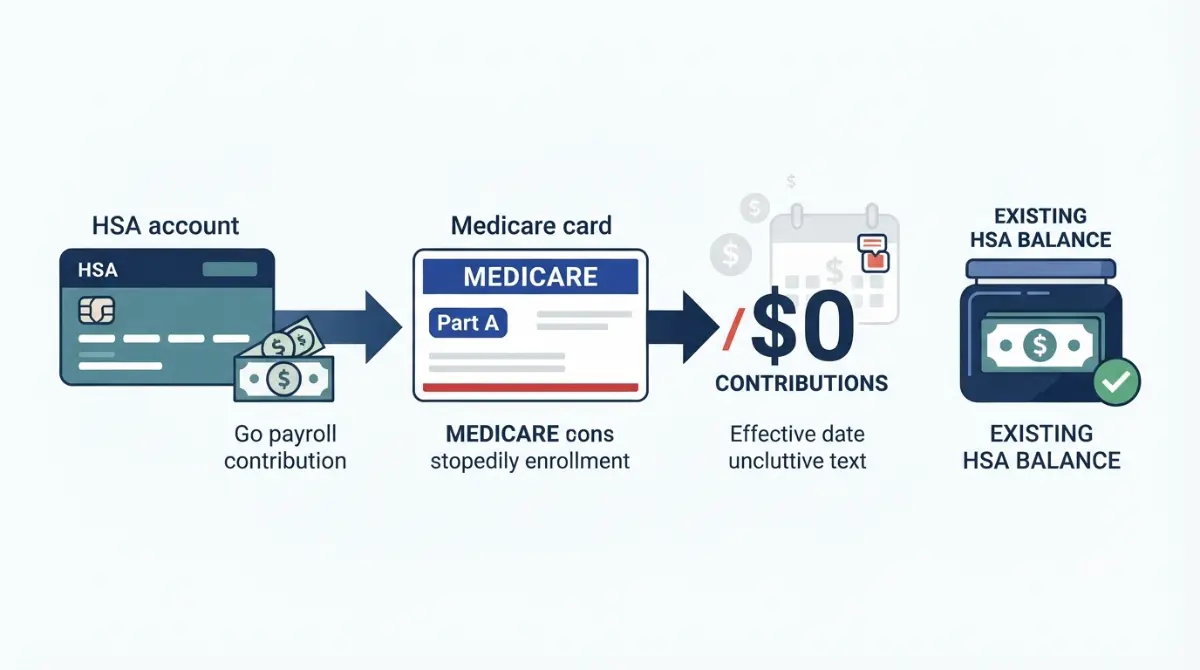 Medicare
HSA and Medicare rules that can create a surprise tax bill
September 12, 2026 Medicare
Why IRMAA after a spouse dies often arrives years later
September 3, 2026 Medicare
The real limits of the Medicare Part D cap in 2026 and 2027
August 31, 2026 Medicare
Medicare Costs: Five Separate Bills, Not One Premium
August 26, 2026 Medicare
Who actually owes the Medicare Part A late enrollment penalty
September 5, 2026 Medicare
Switching from Medicare Advantage to Medigap has a hidden step
September 9, 2026 Medicare
Why the Medicare Part A Deductible Often Repeats in One Year
August 31, 2026
Informational disclaimer
The content on Finance Authority Hub is provided for general informational and educational purposes only and should not be considered personalized financial, investment, tax, legal, or professional advice. Financial decisions depend on your individual goals, income, risk tolerance, location, and regulatory situation. Before acting on any information, strategy, estimate, or calculator result, consult a qualified licensed professional who can evaluate your specific circumstances.