Who actually owes the Medicare Part A late enrollment penalty
Medicare Part A late enrollment penalties can reach about 1% of beneficiaries: those without 40 quarters of covered work. Here’s what CMS charges them.

In This Article
Most people never owe this penalty — here’s who does
If you or your spouse worked roughly ten years in the United States, this penalty cannot reach you. CMS reports that approximately 99% of Medicare beneficiaries pay no Part A premium at all, because they hold at least 40 quarters of Medicare-covered employment.
The Medicare Part A late enrollment penalty reaches one group: people who must buy Part A because they don’t have those quarters.
Who has to buy Part A
You buy in when neither you nor your spouse reached 40 quarters, roughly ten years of paying Medicare payroll tax. That usually reflects a career spent partly abroad or years spent caring for family. If you’re unsure where you stand, start with how Social Security work credits are earned.
Why premium-free Part A is penalty-proof
Free Part A carries no late penalty, ever, though the Part A hospital deductible still applies to every hospital stay. Medicare bills you separately for each part, and this penalty attaches to one bill only.
ℹ️ Financial Disclaimer: This article is general financial education about Medicare enrollment costs, not personalized advice. It does not provide investment, tax, lending or credit, insurance, or debt relief recommendations. Medicare eligibility and enrollment determinations are made by the Social Security Administration, not by this publication. Before acting, consult a free State Health Insurance Assistance Program (SHIP) counselor, a fiduciary financial advisor, a CPA, or a qualified attorney about your own circumstances.
How the Part A penalty is calculated, and when it stops
The Medicare Part A late enrollment penalty lasts for twice the number of years you delayed signing up. Delay two years, pay it for four. Medicare’s own example uses exactly that case: two years eligible without enrolling means four years of the higher premium.

The 10% is flat, it doesn’t grow
A five-year delay carries the same 10% surcharge as a one-year delay. Only the duration scales. This is the opposite of how the Part B penalty behaves, and it’s the most common misreading of the rule.
Working out your end date
Take the full years you went without Part A, double them, and count forward from your enrollment date. Enroll in 2026 after a two-year delay and your last penalty payment falls in 2030.
🔍 How It Works: Two numbers drive this penalty. The rate is fixed at 10% of your monthly premium, whatever your delay. The duration is your delay in whole years, multiplied by two. Nothing compounds and nothing accumulates while you wait.
Full rules sit in Medicare’s official late enrollment penalty guidance.
What the Part A penalty costs in 2026
| Length of delay | Penalty lasts | Cost at $311/mo tier | Cost at $565/mo tier | Key detail |
|---|---|---|---|---|
| 1 year | 2 years | $746.40 | $1,356.00 | 30–39 quarters vs under 30 |
| 2 years | 4 years | $1,492.80 | $2,712.00 | Medicare’s own example case |
| 3 years | 6 years | $2,239.20 | $4,068.00 | Rate stays 10% throughout |
| 5 years | 10 years | $3,732.00 | $6,780.00 | Longest realistic delay |
Premiums: CMS, 2026 Medicare Parts A & B Premiums and Deductibles, published 14 November 2025. Totals are our calculation at 2026 rates held constant; Part A premiums reset annually, so treat multi-year totals as estimates.

Your two possible premium tiers
Your Part A premium cost depends on quarters worked. With 30 to 39 quarters you pay $311 monthly in 2026. With fewer than 30, you pay $565. Both figures come from CMS’s 2026 premium and deductible figures.
What the surcharge adds each month
Ten percent of $311 is $31.10. Ten percent of $565 is $56.50. Your monthly Part A bill becomes $342.10 or $621.50. For the wider picture, see what Medicare costs across a full year.
Why a late Part A signup costs more than the Part A penalty
Yes, you must take Part B to buy Part A. CMS requires anyone buying premium Part A to also enroll in, or already have, Part B, and to stay enrolled in Part B to keep it.

The second premium nobody warns you about
That means a late Part A enrollment usually means a late Part B enrollment too, and the standard Part B premium is $202.90 monthly in 2026.
A two-year delay, priced in full
Medicare’s published 2026 example puts a two-year Part B delay at a 20% penalty, or $243.50 monthly. Add the $621.50 Part A figure and the real bill is $865.00 a month.
⚠️ Costly Mistake: Budgeting only for the Part A penalty. The Part A surcharge here is $56.50 monthly and ends after four years. The Part B side is $40.58 monthly and never ends, because the Part B late enrollment penalty is charged for as long as you hold Part B. Over twenty years, the smaller penalty costs far more.
When the Part A penalty doesn’t apply, or can be erased
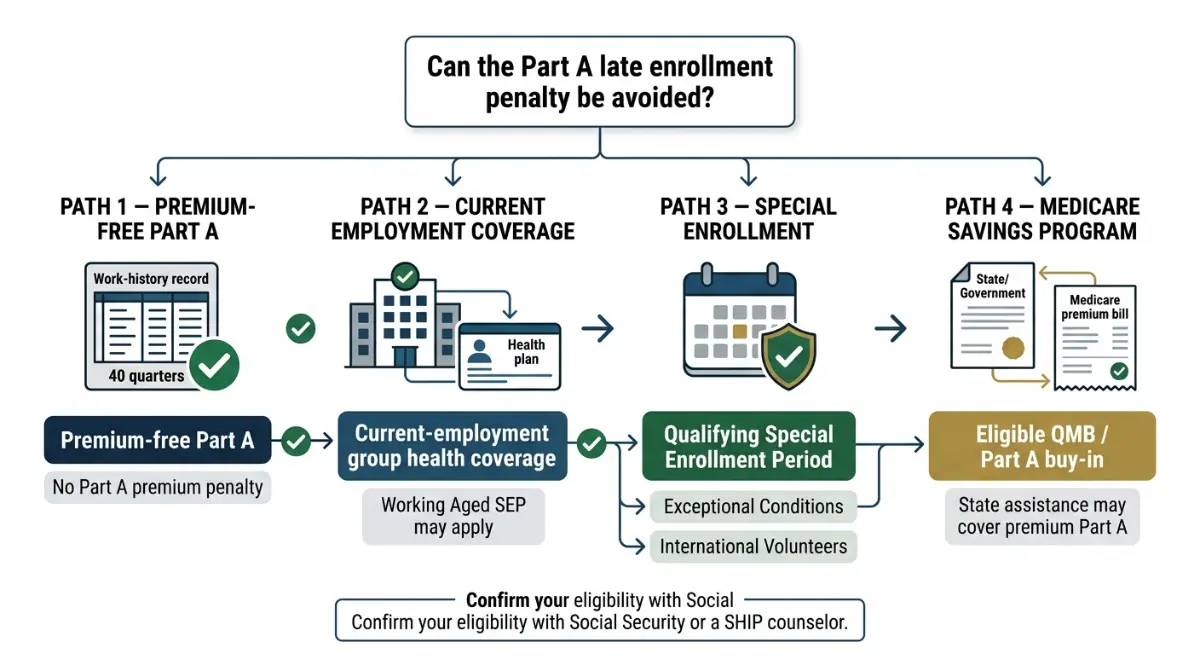
Some readers owe nothing. CMS lists specific conditions that reduce this penalty or remove it, and the Social Security Administration makes the determination, not this article.
Employer coverage months don’t count against you
If you were covered by a group health plan through current employment, CMS excludes those months from the penalty calculation entirely. Years spent working past 65 with employer coverage can shrink the count to zero.
Two enrollment periods carry no penalty at all
Enrolling through an Exceptional Conditions Special Enrollment Period or the International Volunteers period means no penalty is applied. The exceptional conditions list, effective January 2023, covers declared emergencies and disasters, employer or health plan misrepresentation, release from incarceration, and Medicaid termination. Full conditions sit in CMS’s enrollment and Special Enrollment Period rules.
If the premium is unaffordable: the state route
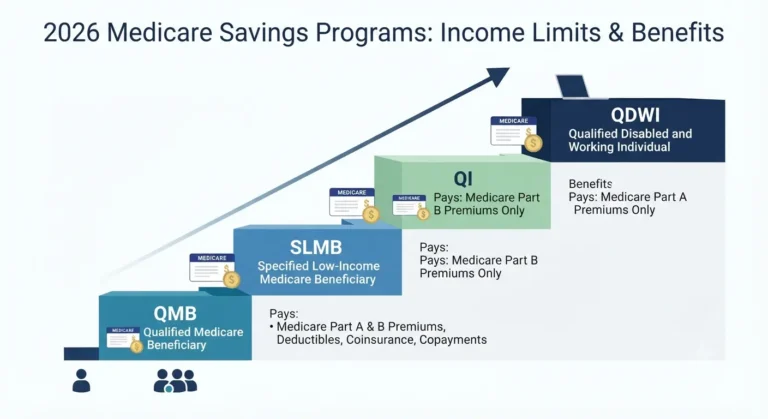
📊 Data Point: CMS lists 36 states and the District of Columbia as Part A “buy-in” states, where the Qualified Medicare Beneficiary program pays the Part A premium. In those states, CMS confirms the state pays only the base premium, and if QMB coverage later ends, the beneficiary pays the standard premium with no late enrollment penalty, even if they were paying one before. — Source: CMS, FAQs about Medicare Part A and B Buy-in. State counts are updated as states join, so confirm yours.
✅ Action Step: Before you file anything, call your free State Health Insurance Assistance Program counselor and ask two specific questions: “Which months of my group health plan coverage are excluded from my penalty calculation?” and “Is my state a Part A buy-in state?” Programs that help pay Medicare premiums are handled by your state Medicaid agency.
When you can sign up if you missed your window
Your General Enrollment Period runs 1 January to 31 March every year. Miss it and you wait twelve months for the next one.
Coverage starts the month after you file
File in March and coverage begins in April. CMS applies the same rule to premium Part A and Part B, so plan for the gap. Medicare’s sign-up timing questionnaire confirms which window applies to you.
The three forms and what each does
- CMS-18-F-5 enrolls you in Part A, and in Part B at the same time.
- CMS-L564 proves employer coverage, filed alongside a Working Aged Special Enrollment Period claim.
- CMS-10797 claims an Exceptional Conditions Special Enrollment Period.
All three go to the Social Security Administration, the same agency handling applications for Social Security, reachable at 1-800-772-1213.
Four assumptions that trigger the Part A penalty
Assumptions about your record
“My husband worked forty years, so I’m covered” is the most common. A spouse’s record only helps if that spouse actually reached the quarters, so check errors in your Social Security earnings record and how Medicare costs work for a married couple before deciding.
Assumptions about timing
The Working Aged Special Enrollment Period ends eight months after employment or coverage ends, whichever comes first. Letting it lapse is expensive, and the Part D penalty follows its own separate clock.
💡 Expert Note: A common point of confusion is treating COBRA or retiree coverage as protection. CMS bases the Working Aged exclusion on coverage tied to current employment. Once employment ends, the eight-month clock is already running.
Medicare Part A late enrollment penalty: common questions
1. How much is the Medicare Part A late enrollment penalty?
It adds 10% to your monthly premium: $31.10 at the $311 tier, or $56.50 at the $565 tier in 2026.
2. How long does the Part A late enrollment penalty last?
Twice the number of years you delayed. A two-year delay means four years of the higher premium, then it stops.
3. Does the Part A penalty apply if I get premium-free Part A?
No. If you hold 40 quarters of Medicare-covered employment, you pay no Part A premium and no penalty can apply.
4. Can the Medicare Part A late enrollment penalty be waived?
Yes. Exceptional Conditions and International Volunteers Special Enrollment Periods carry no penalty, and Part A buy-in states remove it. Confirm your eligibility with a SHIP counselor or the Social Security Administration.
5. Does the Part A penalty get bigger the longer I wait?
The rate stays at 10% regardless. Only the duration grows, at two penalty years for every year you delayed.
6. When can I sign up for Part A if I missed my Initial Enrollment Period?
The General Enrollment Period runs 1 January to 31 March annually, with coverage starting the month after you file.
7. Do I have to enroll in Part B to buy Part A?
Yes. CMS requires premium Part A buyers to hold Part B, and to stay enrolled in Part B to keep Part A. A SHIP counselor can confirm your combined premium.
8. Does working past 65 with employer coverage cause a Part A penalty?
Not if the coverage came from current employment. CMS excludes those months from the calculation entirely. Ask SSA which months they counted.
9. How much is Medicare Part A per month in 2026 if I have to buy it?
$311 monthly with 30 to 39 quarters of coverage, or $565 monthly with fewer than 30 quarters.
10. What happens to the Part A penalty if I qualify for a Medicare Savings Program?
In Part A buy-in states, the state pays the base premium and no penalty follows you afterward. Confirm your state’s arrangement with your Medicaid agency.
11. Is the Part A penalty the same as the Part B penalty?
No. Part A is 10% for twice your delay, then it ends. Part B is 10% per full year, charged permanently. A SHIP counselor can price both.
Your next step
This is the one Medicare penalty with a last payment. Part B and Part D surcharges follow you for life; this one expires on a date you can calculate today.
Check your quarters with Social Security before 31 March, then work the premium into your monthly plan with our budget calculator. A free SHIP counselor can confirm your penalty months before you file.
Informational disclaimer
The content on Finance Authority Hub is provided for general informational and educational purposes only and should not be considered personalized financial, investment, tax, legal, or professional advice. Financial decisions depend on your individual goals, income, risk tolerance, location, and regulatory situation. Before acting on any information, strategy, estimate, or calculator result, consult a qualified licensed professional who can evaluate your specific circumstances.