The real cost behind your Medicare Part B deductible
Medicare’s Part B deductible hit $283 in 2026, the largest rise since 2022. The figure most people quote is only the first of three costs.

In This Article
What the Part B deductible costs you, and what comes next
The Medicare Part B deductible is $283 in 2026, an increase of $26 from $257 in 2025, per the 2026 CMS fact sheet on Part A and Part B premiums and deductibles. You pay that amount yourself before Original Medicare pays toward covered services.
The 2026 figure, and how much it moved
After you meet it, Medicare pays 80% of the approved amount and you pay 20%. Nothing caps that 20% in a calendar year.
Why the number alone won’t tell you what you’ll owe
If a bill just surprised you, the next two sections trace where the money went. If you are new to Medicare and building a budget, start at the seven-year table. If $283 is a real hardship, one program pays it in full. If you still work past 65, the tax section is written for you.
This deductible is one of five separate Medicare bills, not the whole cost of coverage.
ℹ️ Financial Disclaimer: This article is educational and is not personalized advice on investments, taxes, lending or credit, insurance, or debt relief, and it is not medical advice or a determination of your coverage. Medicare rules and figures change annually and vary by state and by individual circumstance. Before acting, consult a fiduciary financial advisor, a CPA or enrolled agent, a qualified attorney, or your free State Health Insurance Assistance Program (SHIP) counselor.
How the $283 and the 20% actually fit together
The most expensive misunderstanding in Part B is what the 20% applies to. It is 20% of the Medicare-approved amount, which is the price Medicare sets for a service, not 20% of whatever your provider writes on the bill.
What “Medicare-approved amount” means on your bill
When a provider accepts assignment, they agree to treat Medicare’s approved amount as payment in full. Your 20% is calculated from that figure.

When the deductible resets, and when it doesn’t
The Part B deductible is paid once per calendar year and resets on 1 January. The Part A hospital deductible, $1,736 in 2026, works differently: it applies per benefit period and can be charged more than once in the same year.
Your monthly Part B premium of $202.90 is separate again, and paying it does not count toward the deductible. If you have not yet separated those two bills in your head, start with what the monthly Part B premium actually costs.
The ceiling that isn’t there
🔍 How It Works: Original Medicare has three stages and only two of them stop. The premium is fixed monthly. The deductible stops at $283. The 20% coinsurance has no annual maximum, so it continues for as long as you need covered care. Supplemental coverage is what supplies the ceiling Original Medicare does not have.
What your first four appointments actually cost
After the deductible you pay 20% of the approved amount. The bill that confuses people is the one where the deductible runs out mid-invoice.

Running the $283 down, visit by visit
The approved amounts below are illustrative. Medicare sets them per service and per locality, so substitute your own from your Medicare Summary Notice.
| Visit | Approved amount | Toward deductible | Your coinsurance | You pay |
|---|---|---|---|---|
| 1. Office visit | $180 | $180 | $0 | $180 |
| 2. Lab work | $95 | $95 | $0 | $95 |
| 3. Specialist | $250 | $8 | $48.40 | $56.40 |
| 4. Follow-up | $150 | $0 | $30 | $30 |
Illustrative arithmetic using the verified 2026 deductible of $283 and the published 20% coinsurance rule. Approved amounts are hypothetical.
The bill where the deductible ends and the 20% starts
Visit 3 is the crossover. The first $8 finishes the $283, and the remaining $242 splits 80/20, so you owe $8 plus $48.40. Nothing on that bill is an error, which is exactly why it generates so many phone calls.
Why there’s no natural stopping point
Visit 4 costs $30, and so would visits 5 through 40. It helps to build the deductible into a monthly budget rather than treating it as a single January expense.
How the Part B deductible has moved since 2020
The annual increase has been steady in one direction with a single exception.
| Year | Part B deductible | Change | Key detail |
|---|---|---|---|
| 2020 | $198 | — | Baseline |
| 2021 | $203 | +$5 | Smallest rise in the series |
| 2022 | $233 | +$30 | Reserve built for a new Alzheimer’s drug |
| 2023 | $226 | −$7 | Only decline in the series |
| 2024 | $240 | +$14 | Return to trend |
| 2025 | $257 | +$17 | — |
| 2026 | $283 | +$26 | Largest dollar rise in the series |
Source: each row taken from the CMS “Medicare Parts A & B Premiums and Deductibles” fact sheet for its year.

The one year it went down, and why
CMS attributed the 2023 decline to excess reserves in the Part B account of the Supplementary Medical Insurance Trust Fund, after spending on Aduhelm came in far below projection. That was a one-off correction, not a change in direction.
What the 2026 jump means against a 2.8% COLA
📊 Data Point: The 2026 Part B deductible rose about 10.1% while the 2026 Social Security cost-of-living adjustment was 2.8%. In dollars the gap is narrower than that ratio suggests: the COLA added roughly $56 a month to the average retired worker’s benefit, more than the $17.90 monthly premium increase. — Source: SSA, October 2025; Congressional Research Service report 94-803.
Who can pay the $283 for you
Three structures change who pays this bill. None of them is a recommendation here, and the right one depends on your Medicare eligibility date and your income.
Medigap: only two plans cover it, and both are closed to new enrollees
Medigap Plans C and F are the only supplement plans that pay the Part B deductible, and the Medicare Access and CHIP Reauthorization Act of 2015 barred newer policies from covering it. Anyone first eligible for Medicare on or after 1 January 2020 cannot buy either. Plan G covers Part B excess charges but not the deductible.
Medicare Advantage: a different structure, not a smaller deductible
Medicare Advantage plans replace Original Medicare’s cost sharing with their own deductibles and copays, and they carry an annual out-of-pocket maximum that Original Medicare lacks. See how Medicare Advantage handles cost sharing.
Medicare Savings Programs: when the government pays all of it
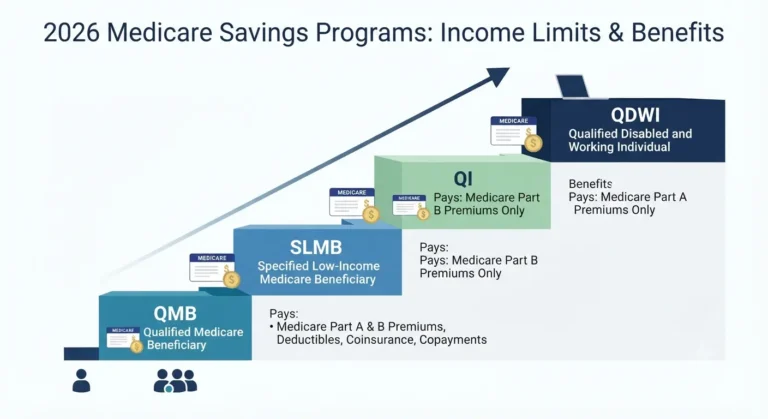
The Qualified Medicare Beneficiary program pays Part A and Part B premiums, deductibles, coinsurance and copayments, and federal law bars providers from billing enrollees for that cost sharing. For 2026 the federal monthly income limit is $1,350 for an individual and $1,824 for a couple, with resource limits of $9,950 and $14,910, per SSA POMS HI 00815.023. States may set higher limits and some have removed the resource test entirely.
✅ Action Step: If your income is anywhere near those figures, apply anyway. SSA’s own guidance instructs staff to encourage people whose income or resources look somewhat too high to apply, because state rules vary. Call your free SHIP counselor and ask: “Given my Medicare eligibility date, which supplement plans can I still buy, and does my income qualify me for a Medicare Savings Program in this state?”
Can you deduct the $283 on your tax return?
Two gates stand between the deductible and a tax deduction, and most people clear neither.
The two gates: itemising, and the 7.5% floor
IRS Publication 502 allows unreimbursed medical expenses on Schedule A only to the extent they exceed 7.5% of adjusted gross income, and only if you itemise instead of taking the standard deduction. Your Part B deductible and coinsurance are qualifying expenses; whether they help depends on how adjusted gross income is calculated and what else you spent.
The different rule if you’re self-employed
Self-employed filers with a profit may deduct qualifying health insurance premiums above the line, with no 7.5% floor. That fork covers premiums only. The $283 deductible and your 20% coinsurance stay on Schedule A subject to the floor, for everyone.
✅ Action Step: Ask a CPA or enrolled agent: “Given my AGI and my total unreimbursed medical costs this year, does itemising beat my standard deduction, and does any part of my Medicare cost qualify above the line?”
Three things people get wrong about the $283
Preventive care doesn’t touch your deductible
Most Medicare-covered preventive services cost nothing and the deductible does not apply, provided your provider accepts assignment. Your annual wellness visit and covered screenings do not draw down the $283. See the preventive services Medicare covers at no cost.
A non-participating provider can bill above the approved amount
⚠️ Costly Mistake: Under 42 CFR § 414.48, a non-participating provider may charge up to 115% of the physician fee schedule amount. That excess is yours to pay on top of your ordinary cost sharing. The limit does not apply to durable medical equipment, and some states cap it lower, so ask “do you accept Medicare assignment?” before the appointment, not after the bill.
The figure you read somewhere may be wrong
Two live websites currently publish incorrect 2026 deductibles, one of them citing CMS for a number CMS never published. Check any figure against the CMS fact sheet and confirm its date before you budget from it.
Medicare Part B deductible: common questions
1. How much is the Medicare Part B deductible?
The Medicare Part B deductible is $283 in 2026, an increase of $26 from the $257 deductible in 2025.
2. Does the Medicare Part B deductible reset every year?
Yes. It resets each calendar year on 1 January, unlike the Part A deductible, which applies per benefit period.
3. What do you pay after meeting the Part B deductible?
You pay 20% of the Medicare-approved amount for most covered services, not 20% of what your provider bills.
4. Is there a limit on Medicare Part B out-of-pocket costs?
No. Original Medicare has no annual out-of-pocket maximum, so the 20% coinsurance continues for as long as you need care.
5. Do preventive services count toward the Part B deductible?
No. Most covered preventive services cost nothing and the deductible does not apply when your provider accepts assignment.
6. Does Medigap Plan G cover the Part B deductible?
No. Plan G covers Part B excess charges but not the deductible itself. Ask a SHIP counselor which plans you remain eligible to buy.
7. Can you still buy Medigap Plan F?
Only if you were first eligible for Medicare before 1 January 2020. MACRA closed Plans F and C to everyone newer. Confirm your eligibility date with SHIP.
8. Do Medicare Advantage members pay the Part B deductible?
No. Advantage plans use their own deductibles and copays, plus an annual out-of-pocket cap. Compare total costs with a SHIP counselor.
9. Is the Medicare Part B deductible tax deductible?
Only if you itemise and your unreimbursed medical costs exceed 7.5% of adjusted gross income. Confirm with a CPA before filing.
10. Who pays the Part B deductible if your income is low?
The Qualified Medicare Beneficiary program pays Part B deductibles, coinsurance and premiums within its limits. Apply through your state Medicaid agency.
11. Can a doctor charge more than the Medicare-approved amount?
Yes. A non-participating provider may bill up to 115% of the fee schedule amount, though this excludes durable medical equipment.
What to do with this number
You now know that $283 is the start of the bill rather than the end of it, and that the 20% behind it has no ceiling in Original Medicare.
The one step worth taking this week: check whether your income falls near the Medicare Savings Program limits, and call SHIP before your next enrolment window if it does.
Re-check the deductible each November, when CMS publishes the following year’s figure.
Informational disclaimer
The content on Finance Authority Hub is provided for general informational and educational purposes only and should not be considered personalized financial, investment, tax, legal, or professional advice. Financial decisions depend on your individual goals, income, risk tolerance, location, and regulatory situation. Before acting on any information, strategy, estimate, or calculator result, consult a qualified licensed professional who can evaluate your specific circumstances.