The real limits of the Medicare Part D cap in 2026 and 2027
The Medicare Part D cap stops at $2,100 in 2026. Premiums, Part B drugs, and non-formulary prescriptions never count toward it.

In This Article
How the $2,100 Part D cap works, and who it actually helps
The $2,100 cap is real protection, and it is the most misunderstood number in Medicare.
Where to start depends on what you’re facing
- Already past $2,100 this year? Your plan owes you nothing further on covered drugs.
- Steady, moderate drug costs? The threshold math below shows whether the cap is even in reach.
- A large prescription you can’t pay this month? Skip to the payment options.
- Comparing plans for 2027? Every number changes on January 1.
- Managing a parent’s medications? Start with what counts toward the cap.
- Limited income? Two federal programs will help you more than the cap does.
The one thing the cap does not do
The cap limits what you pay for covered drugs and nothing else. Premiums, income surcharges, and prescriptions your plan doesn’t cover all sit outside it. That is why it helps a small group enormously and most enrollees not at all.
Drug coverage is one of five separate Medicare bills, and this cap touches part of one of them. FinanceAuthorityHub is not a Medicare agent or broker and receives no compensation from any insurer or plan sponsor.
ℹ️ Financial Disclaimer: This article covers health insurance and Medicare plan selection, prescription drug and formulary decisions, tax and income-related premium surcharges, the Medicare Prescription Payment Plan as a billing arrangement, and federal benefit eligibility. It is educational only, not personalized insurance, tax, or medical advice, and FinanceAuthorityHub is not affiliated with or endorsed by CMS or the federal Medicare program. Your costs depend on your plan, formulary, income, and state, and only Medicare Plan Finder and a plan’s own Evidence of Coverage are authoritative for a specific plan. Consult a State Health Insurance Assistance Program counselor, a licensed agent, or a CPA before acting.
What the $2,100 Medicare Part D cap covers in 2026
In 2026, the Medicare Part D out-of-pocket cap is $2,100. Once your spending on covered prescription drugs reaches that amount, your plan pays the full cost of covered drugs for the rest of the calendar year.

When your plan starts paying 100%
The cap applies identically to stand-alone drug plans and to a Medicare Advantage plan that includes drug coverage. No enrollment or application is required; your plan tracks the running total.
Why the cap resets every January 1
🔍 How It Works: The cap is a calendar-year ceiling, not a lifetime one. Your deductible counts inside the $2,100, not on top of it, so a plan charging the full deductible has already moved you a meaningful distance toward the cap by the time you clear it. On January 1 the counter returns to zero.
What counts toward the cap and what leaves you exposed
Deductibles, copays, and coinsurance on covered drugs move you toward $2,100. Six common costs never do.
| What you pay | Counts toward $2,100? | Key detail |
|---|---|---|
| Deductible on covered drugs | Yes | Counted within the cap, not added to it |
| Copays and coinsurance | Yes | On formulary drugs only |
| Monthly plan premium | No | Continues all year, cap or no cap |
| Part D IRMAA surcharge | No | $14.50–$91.00 monthly in 2026 |
| Part B drugs | No | Infusions and injectables sit outside Part D |
| Non-formulary prescriptions | No | Full price, and no credit toward the cap |
Sources: Medicare.gov guidance on Part D out-of-pocket costs; Part D income-related adjustment amounts from the CMS 2026 premium notice, November 14, 2025.

Costs that never count, no matter how large
The exclusion that costs people most is the last row. A drug off your plan’s formulary is charged at full price and earns you nothing toward the ceiling, which is why formulary checking matters more than premium shopping.
⚠️ Costly Mistake: A $900 non-covered prescription is a double loss — you pay all of it, and you are no closer to $2,100 than before you filled it. The income surcharge that attaches to both your Part B and Part D premiums behaves the same way; reaching the cap does not stop it.
✅ Action Step: Ask your prescriber: “Is there a therapeutic alternative to this medication that is on my plan’s formulary, and at which tier?”
How much in drug costs it takes to reach the cap
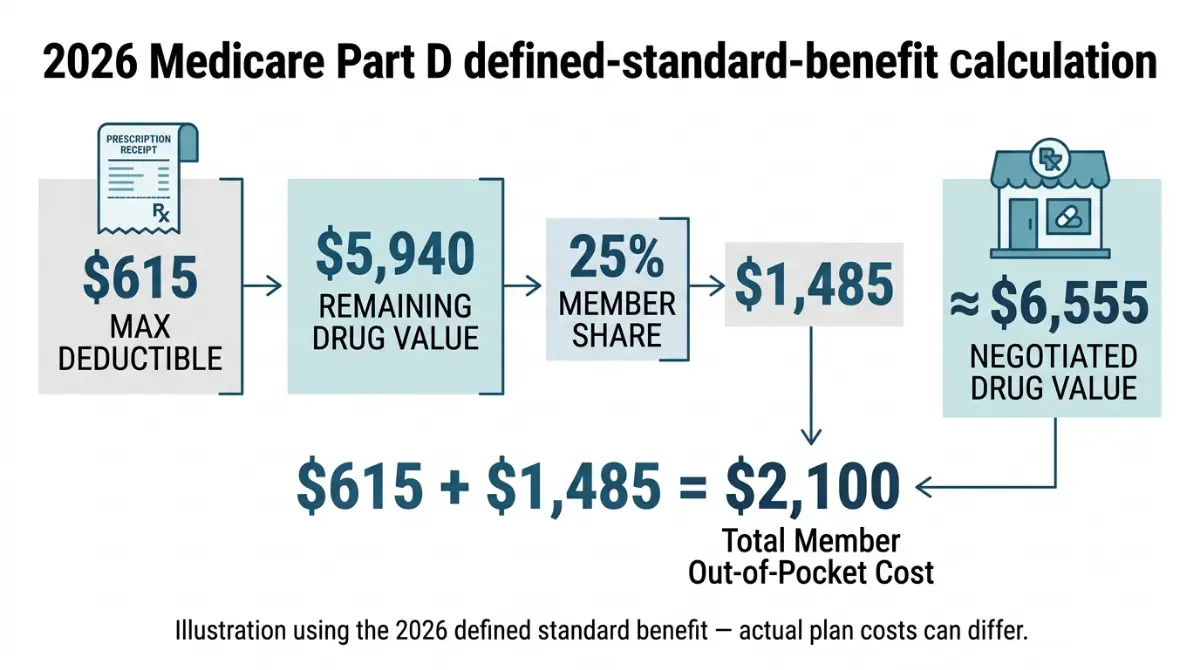
Under Medicare’s defined standard benefit, roughly $6,555 in negotiated drug value gets you to $2,100. You pay the first $615 in full, then 25% of everything above it until your share reaches the cap.
The arithmetic under the standard benefit
📊 Data Point: $615 (2026 maximum deductible) + 25% of $5,940 = $2,100. That puts the threshold at about $6,555 in negotiated drug value. In 2027, with a $700 deductible and a $2,400 cap, the same arithmetic gives roughly $7,500. Original FinanceAuthorityHub calculation from CMS defined-standard-benefit parameters.
Why your plan’s number will differ
That figure models the standard benefit, and almost no real plan matches it exactly. Plans waive deductibles on generic tiers, substitute flat copays for coinsurance, and set specialty-tier coinsurance above 25%.
Treat $6,555 as a reference point for whether the cap is plausibly within reach this year. It is not a prediction about your plan, and Medicare’s own before-you-decide guidance is clear that the cap is what it is regardless of how you pay.
The Part D cap rises to $2,400 in 2027
CMS has already finalized three of next year’s numbers. The out-of-pocket cap rises 14.3% and the deductible 13.8%.
| Plan year | Out-of-pocket cap | Maximum deductible | Key detail |
|---|---|---|---|
| 2025 | $2,000 | $590 | First year of the cap |
| 2026 | $2,100 | $615 | Current year |
| 2027 | $2,400 | $700 | Finalized April 6, 2026 |
Source: CMS Announcement of Calendar Year 2027 Medicare Advantage Capitation Rates and Part C and Part D Payment Policies, April 6, 2026, Attachment V.

The three numbers CMS has already finalized
The third is the premium base. The 2027 base beneficiary premium is $41.33, up from $38.99, and CMS has ended the Part D Premium Stabilization Demonstration after 2026, returning stand-alone plans to ordinary market pricing.
💡 Expert Note: The deductible rises about 14% for 2027 against roughly 4% the year before. The statutory formula tracks growth in average Part D spending per enrollee, not general inflation, so the parameters move with drug spending rather than with prices generally.
What is not settled until late September
Your own plan’s 2027 premium is not among these numbers. CMS publishes plan-specific premiums and the full plan landscape in mid-to-late September, and any figure circulating before then is an estimate.
What to do if you can’t afford the cost before the cap
Reaching $2,100 in February helps nobody who cannot pay February’s bill. Two federal mechanisms address that, and neither is the cap.
Spreading the cost across the year
The Medicare Prescription Payment Plan lets you pay nothing at the pharmacy and receive an interest-free monthly bill instead. It changes timing, not totals, and participation now renews automatically each year unless you switch plans or opt out.
⚠️ Costly Mistake: Your monthly bill is that month’s costs plus any prior balance, divided by the months left in the year. Opting in during October compresses the same amount into three bills instead of twelve, which can worsen the cash-flow problem you joined to fix. Run the figure against the rest of your fixed monthly costs first.
Programs that lower the cost outright
Extra Help, the Part D Low-Income Subsidy, pays your drug plan premium and deductible and cuts copays to a few dollars. Social Security determines eligibility. If you already qualify, your plan must send you an LIS rider by September 30 stating your exact 2027 premium, deductible, and copay amounts.
✅ Action Step: Ask a SHIP counselor — free, federally funded, paid no commission: “Given the month I’d be starting and what I’ve already paid this year, would the payment plan improve my monthly cash flow or make it worse?”
What to check before the December 7 deadline
Medicare Open Enrollment runs October 15 to December 7, 2026, for coverage starting January 1.
The two documents that arrive this autumn
Your plan must deliver your Annual Notice of Change by September 30. It states your 2027 premium, deductible, and formulary changes, and it is the only document that describes your actual plan rather than the standard benefit.
The single check worth doing first
✅ Action Step: Enter every medication into Medicare’s Plan Finder and compare estimated total annual cost, not monthly premium. Then ask a SHIP counselor: “Is every drug I take on this plan’s 2027 formulary, at what tier, and does the deductible apply to it?”
Every figure here was verified against CMS and Medicare.gov publications on the review date shown above, with each source and its release date named. Where no authoritative figure exists, we left the number out.
Common questions about the Part D cap
1. What is the Medicare Part D out-of-pocket maximum for 2026?
It is $2,100 on covered prescription drugs. After that, your plan pays the full cost for the rest of the year.
2. Is the Part D cap going up in 2027?
Yes. CMS finalized a $2,400 cap and a $700 maximum deductible for 2027 in April 2026.
3. Do my monthly plan premiums count toward the $2,100 cap?
No. Premiums sit outside the cap entirely and continue every month after you reach it. Confirm your plan’s premium with a SHIP counselor.
4. Does the cap include drugs covered under Medicare Part B?
No. Part B drugs such as infusions and injectables fall outside Part D and never count. A SHIP counselor can confirm which part covers a specific drug.
5. What happens after I reach the cap?
Covered prescriptions cost you nothing for the remainder of the calendar year, whichever plan type you hold.
6. Does the cap reset each year?
Yes, every January 1. Spending does not carry forward from the previous calendar year.
7. How much do I have to spend on drugs to reach $2,100?
About $6,555 in negotiated drug value under the standard benefit. Your plan’s structure will change that figure.
8. Does the cap apply to Medicare Advantage drug coverage?
Yes. Stand-alone drug plans and Medicare Advantage plans with drug coverage are subject to the same $2,100 limit.
9. What if my medication isn’t on my plan’s formulary?
You pay full price, and none of it counts toward the cap. Ask your prescriber about a covered therapeutic alternative.
10. Does the Medicare Prescription Payment Plan save me money?
No. It spreads the same out-of-pocket costs into interest-free monthly bills without reducing them. A SHIP counselor can assess your timing.
11. When can I change my Part D plan for 2027?
October 15 through December 7, 2026, with any change effective January 1. Review your Annual Notice of Change first.
Informational disclaimer
The content on Finance Authority Hub is provided for general informational and educational purposes only and should not be considered personalized financial, investment, tax, legal, or professional advice. Financial decisions depend on your individual goals, income, risk tolerance, location, and regulatory situation. Before acting on any information, strategy, estimate, or calculator result, consult a qualified licensed professional who can evaluate your specific circumstances.