
HSA and Medicare rules that can create a surprise tax bill
HSA and Medicare rules hinge on seven months, not six: your last legal contribution month sits one month before Part A backdates six months.
In This Article
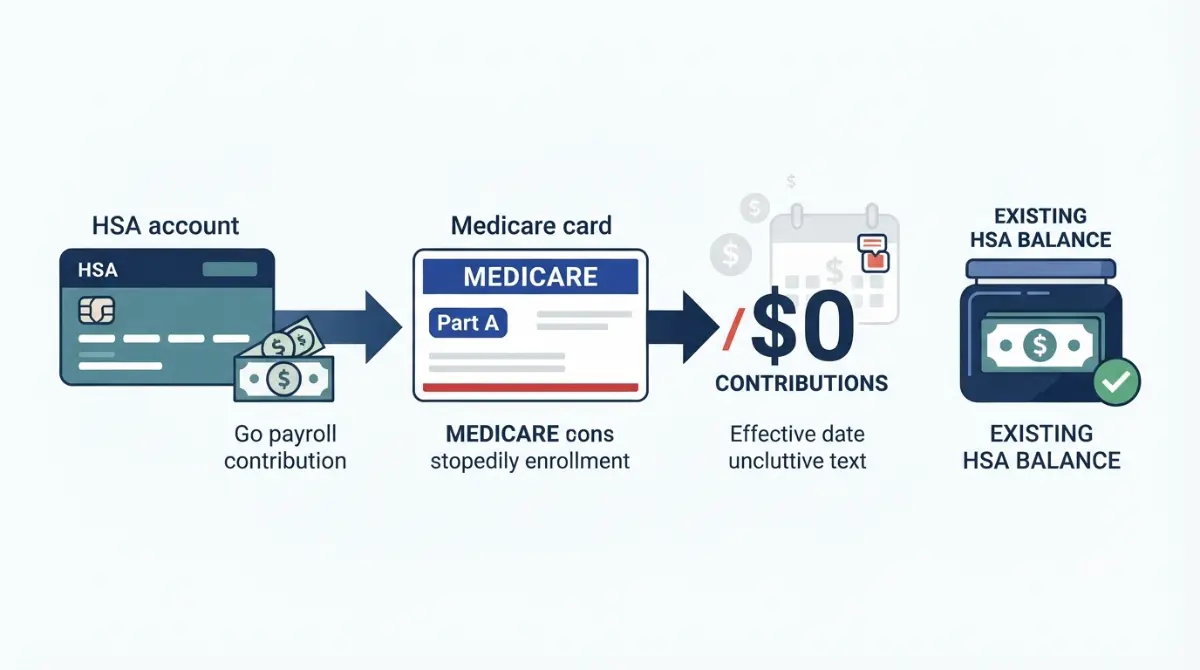
Medicare enrollment ends your ability to fund a health savings account, and the cutoff can land months before the day you sign up. Medicare Part A is often backdated, which retroactively turns contributions that were legal when you made them into excess ones.
The money already in your account is untouched. Only new deposits stop.
Read the part that matches where you are:
- Haven’t applied yet — find your exact stop month in the next section.
- Already applied — check your Part A effective date, then run the proration math.
- Already contributed past it — skip ahead to the correction steps.
This is not an edge case. Roughly one in five Americans 65 and older is still in the labor force, and many of them fund an HSA through payroll while Medicare paperwork moves in the background. For the wider picture, see what Medicare actually costs across its separate parts.
ℹ️ Financial Disclaimer: This article is general education, not personalized advice. Tax rules (HSA contributions, excise taxes, filing corrections), insurance decisions (Medicare, Medigap, Medicare Advantage), investment choices, lending, and debt matters all turn on facts specific to you. Consult a CPA or enrolled agent for tax questions, a fiduciary advisor for planning questions, and a qualified attorney where legal rights are involved before acting on anything here.
Why Medicare Part A alone ends your HSA contributions
No, you cannot keep contributing once Medicare starts. Beginning with the first month you are enrolled in Medicare, your contribution limit drops to zero — according to IRS Publication 969, it is not reduced or prorated for that month. It is zero.
What counts as disqualifying coverage
Any part of Medicare counts. Part A, Part B, Part C, and Part D all disqualify you, and most people trip on Part A because it feels like a bonus rather than coverage.
📊 Data Point: About 99% of Medicare beneficiaries pay no Part A premium, because they have at least 40 quarters of Medicare-covered employment — Source: Centers for Medicare & Medicaid Services, 2026 Medicare Parts A & B Premiums and Deductibles fact sheet, November 2025.
Free does not mean invisible to the IRS. It is still disqualifying coverage.
Zero limit, not lost eligibility
🔍 How It Works: The statute (Internal Revenue Code §223(b)(7)) bars contributions for anyone “entitled to benefits” under Medicare. The IRS reads that as eligibility plus enrollment, then applies it month by month: each Medicare month carries a limit of zero, and your annual maximum is the sum of your monthly limits.
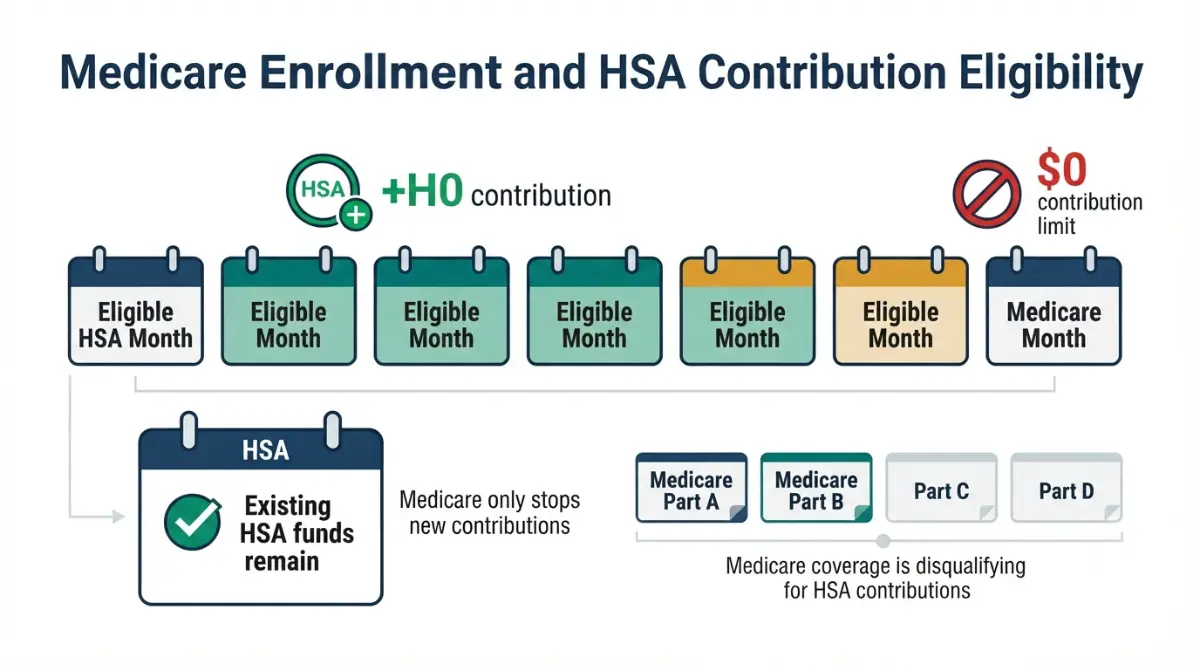
That distinction matters. You keep the account and you keep spending from it — the tax treatment that makes an HSA valuable survives. Only the funding stops.
The six-month lookback and your real stop date
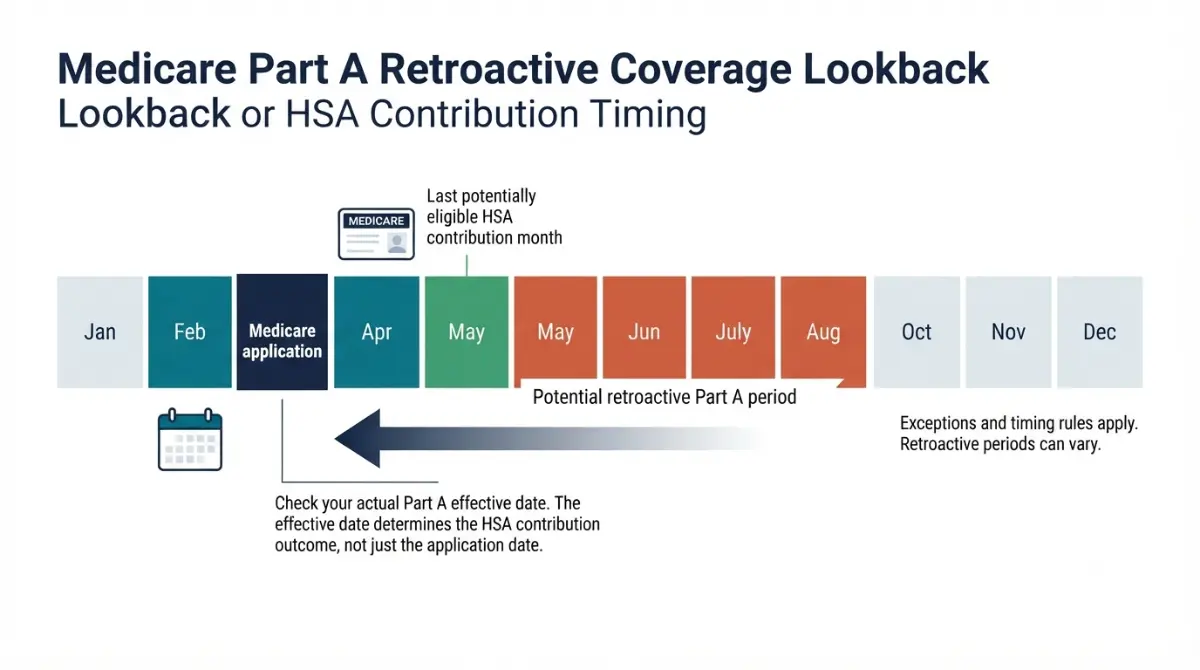
Stop contributing seven months before the month you file, not six. When you apply for Medicare or Social Security after 65, Part A entitlement is backdated to the sixth month before your application month, so the last month you can legally contribute is the one before the backdated window opens.
How Part A gets backdated
🔍 How It Works: Under 42 CFR §406.6(d)(4), an application filed more than six months after your first month of eligibility makes Part A retroactive to the sixth month before the month of filing. File in November, and Part A starts in May. Publication 969 then treats every contribution made inside that retroactive window as an excess contribution.
Finding your last contribution month
| If you file in | Part A starts | Last contribution month |
|---|---|---|
| January | July (prior yr) | June (prior yr) |
| February | August (prior yr) | July (prior yr) |
| March | September (prior yr) | August (prior yr) |
| April | October (prior yr) | September (prior yr) |
| May | November (prior yr) | October (prior yr) |
| June | December (prior yr) | November (prior yr) |
| July | January | December (prior yr) |
| August | February | January |
| September | March | February |
| October | April | March |
| November | May | April |
| December | June | May |
Derived from 42 CFR §406.6(d)(4) and IRC §223(b)(7). Applies to premium-free Part A when you file more than six months after turning 65.
When the lookback does not apply
Retroactive coverage never starts before your first month of eligibility — normally your 65th birthday month. Someone enrolling on time during their Initial Enrollment Period has a short lookback or none at all.
⚠️ Costly Mistake: Trusting the table over your paperwork. Confirm the effective date printed on your Medicare card or award letter — that date, not your application date, governs the tax outcome.
Prorating your limit for the enrollment year
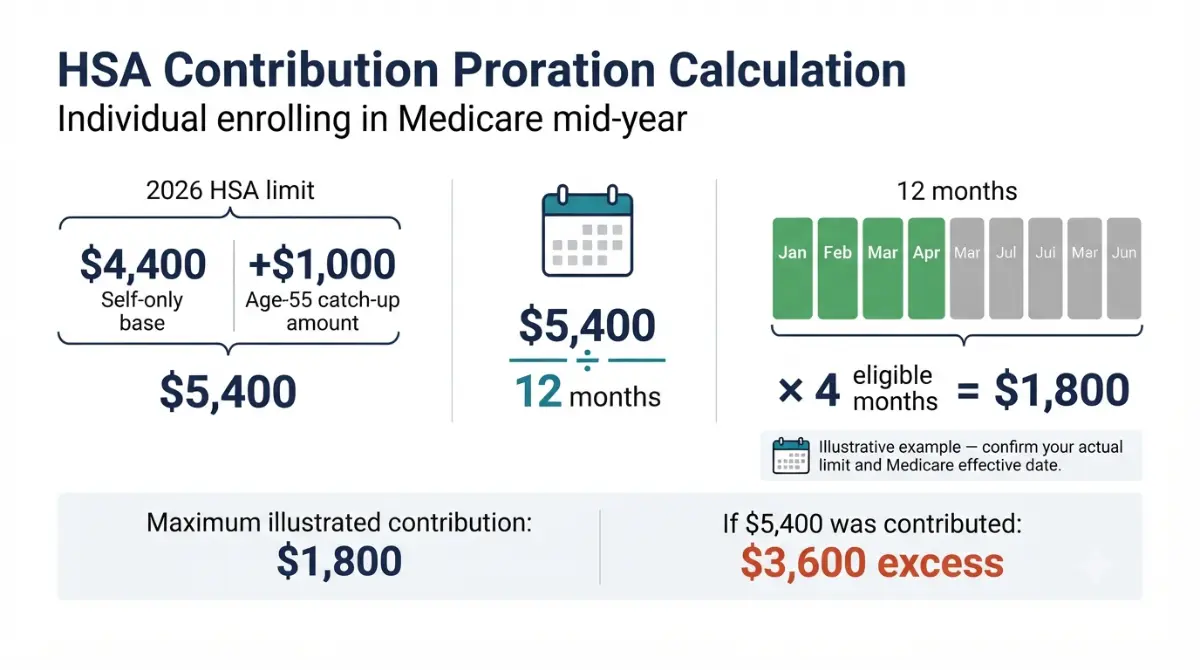
Your allowable contribution for the year Medicare begins is the annual limit divided by 12, multiplied by your eligible months. Eligibility is tested on the first day of each month.
The 2026 figures
For 2026, Revenue Procedure 2025-19 sets the limit at $4,400 for self-only coverage and $8,750 for family coverage. The age-55 catch-up contribution stays at $1,000.
A worked example
You turn 65 in March 2026, keep working under a self-only high-deductible plan, are over 55, and file for Social Security in November 2026. Part A backdates to May, leaving January through April — four eligible months.
Your limit: ($4,400 + $1,000) ÷ 12 × 4 = $1,800. If payroll deposited the full $5,400 across the year, $3,600 of it is excess.
The catch-up is prorated too
Publication 969 prorates the $1,000 alongside the base limit — a step most guides skip, and one that changes the number you put on Form 8889.
✅ Action Step: Ask a CPA or enrolled agent: “Given my Part A effective date, what is my allowable HSA contribution for this tax year, and does my Form 8889 need correcting?”
What your HSA can still pay for on Medicare
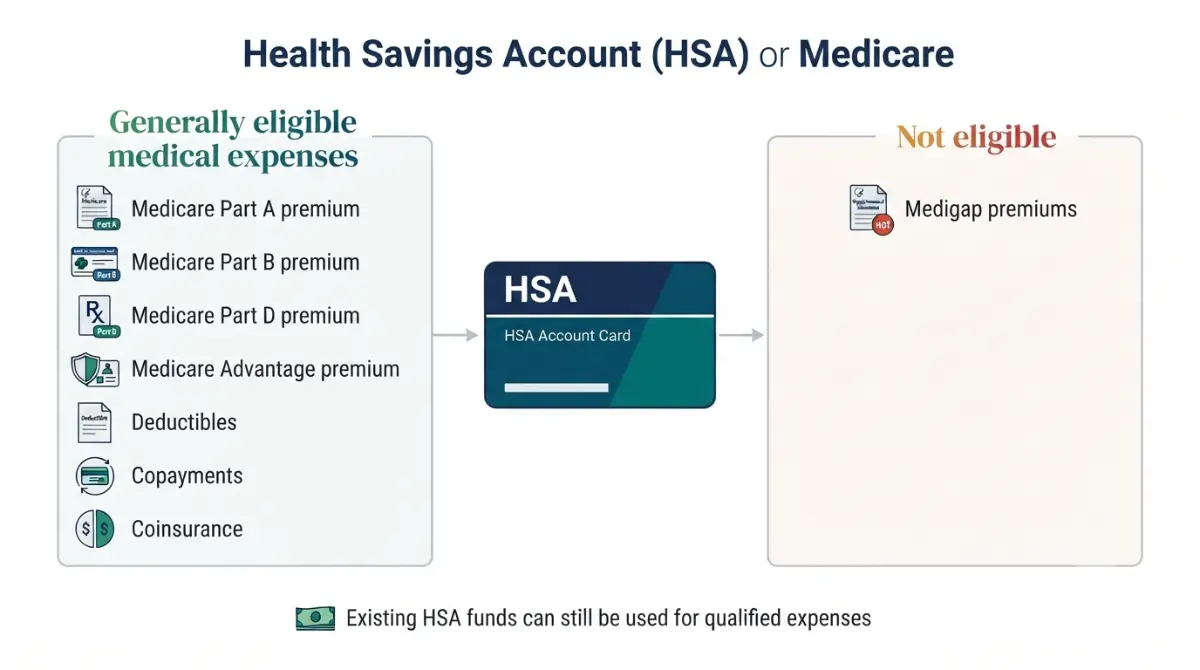
Your balance becomes a tax-free spending account for Medicare costs. Publication 969 allows premiums for Parts A, B, D, and Medicare Advantage once you are 65 or older, plus deductibles, copayments, and coinsurance.
The 2026 standard Part B premium is $202.90 a month, with a $283 annual deductible, per CMS. Income-related surcharges qualify as well, so IRMAA amounts can come from the account.
⚠️ Costly Mistake: Assuming supplemental coverage qualifies. Publication 969 excludes Medigap premiums by name — so a Plan G or Plan N premium comes from taxable dollars, while a Medicare Advantage premium does not.
Should you delay Medicare to keep contributing?
Delaying is only available under specific conditions. Penalty-free deferral of Part B generally requires active coverage from an employer with 20 or more employees, followed by an eight-month Special Enrollment Period.
Get that wrong and Medicare.gov’s penalty rules add 10% to your premium for each full 12-month period you could have enrolled — permanently.
⚠️ Costly Mistake: Claiming Social Security at or after 65 enrolls you in Part A automatically. You can believe you are delaying Medicare while a benefits application has already ended your HSA eligibility.
If you already contributed too much
This is routine, and people correct it every year. The excise tax is 6% of the excess, charged for each tax year it stays in the account, reported on Form 5329.
Withdrawing the excess plus its earnings before your filing deadline, extensions included, avoids that tax. Employer deposits count as yours, so you can owe on money you never chose to contribute — the same mechanic behind fixing an excess IRA contribution.
💡 Expert Note: Publication 969’s last-month rule carries a testing period running through December 31 of the following year. Anyone within 13 months of a likely Medicare start should avoid it, because a backdated Part A date can break the testing period after the fact and trigger income tax plus a 10% additional tax.
✅ Action Step: Call your HSA custodian and request a “removal of excess contribution” — a different transaction from an ordinary withdrawal — then ask a CPA whether Form 5329 and a corrected Form 8889 apply to your year.
HSA and Medicare rules: common questions
1. Can I contribute to an HSA if I only have Medicare Part A?
No. Any part of Medicare, including premium-free Part A, sets your HSA contribution limit to zero from that month forward.
2. How many months before Medicare should I stop HSA contributions?
Seven. Part A backdates six months from your application month, so your last legal contribution month sits one month before that window.
3. Does the six-month lookback apply if I enroll right at 65?
No. Retroactive coverage cannot begin before your first eligibility month, so on-time enrollment produces little or no lookback.
4. What is the 2026 HSA contribution limit?
For 2026, $4,400 for self-only coverage and $8,750 for family coverage, plus a $1,000 catch-up contribution at age 55.
5. How do I prorate my HSA limit for the enrollment year?
Divide the annual limit by 12, then multiply by your eligible months before Medicare began. Confirm your figure with a CPA before filing.
6. Is the $1,000 catch-up contribution prorated too?
Yes. Publication 969 prorates the catch-up on the same monthly basis as the base HSA contribution limit. A tax professional can verify your total.
7. Can I use my HSA to pay Medicare premiums?
Yes. Parts A, B, D, and Medicare Advantage premiums all qualify tax-free once you are 65 or older.
8. Can my HSA pay Medigap premiums?
No. Publication 969 excludes Medicare supplemental premiums by name, even though Medicare Advantage premiums qualify.
9. What is the penalty for contributing to an HSA while on Medicare?
A 6% excise tax on the excess, charged for every tax year the excess contribution remains in your account. Ask a CPA about your specific year.
10. How do I fix an excess HSA contribution?
Request a removal of excess contribution plus earnings from your custodian before your filing deadline, including extensions. Have a tax professional confirm the paperwork.
11. Does claiming Social Security stop my HSA contributions?
Yes. Claiming at or after 65 triggers automatic Part A enrollment, which ends HSA eligibility under the same rules. Discuss timing with a fiduciary advisor
What to do this week
Not yet applied: find your stop month above and tell payroll to end the deduction.
Already applied: pull your Medicare card or award letter and read the Part A effective date.
Already over-contributed: call your custodian today and ask for a removal of excess contribution.
If you are weighing what the untouched balance does from here, our retirement calculator models the account left invested.
Related Articles
 Medicare
Why IRMAA after a spouse dies often arrives years later
September 3, 2026 Medicare
What Medicare Savings Program income limits are worth to you
September 12, 2026 Medicare
How to appeal IRMAA and choose the right route
September 3, 2026 Medicare
Are Medicare premiums tax deductible? What most retirees miss
September 12, 2026 Medicare
The Medicare Part B late enrollment penalty rule people overlook
September 4, 2026 Medicare
Medigap Plan G vs Plan N and the Key Costs That Differ
September 9, 2026 Medicare
A clear view of the Medicare Part B premium 2026 increase
August 29, 2026 Medicare
Who actually owes the Medicare Part A late enrollment penalty
September 5, 2026 Medicare
When to sign up for Medicare and what a late start costs
September 5, 2026
Informational disclaimer
The content on Finance Authority Hub is provided for general informational and educational purposes only and should not be considered personalized financial, investment, tax, legal, or professional advice. Financial decisions depend on your individual goals, income, risk tolerance, location, and regulatory situation. Before acting on any information, strategy, estimate, or calculator result, consult a qualified licensed professional who can evaluate your specific circumstances.