
How to set up a living trust the right way, step by step
Setting up a living trust takes six steps. Your retitled bank account stays FDIC insured at $250,000 per beneficiary — but step six is where plans fail.

In This Article
What setting up a living trust actually involves
Setting up a revocable living trust takes six steps: choose the trust type, inventory what you own, draft the document, name a successor trustee, sign it under your state’s rules, and fund it by retitling your assets.
That last step is where most plans quietly fail.
Where you start depends on your situation. If you recently bought a home or had a child, the six-step process below is your section. Pre-retirees worried about incapacity should read what a trust actually changes, next. If you are still deciding whether you need one at all, jump to the do-it-yourself test in section five.
ℹ️ Financial Disclaimer: This article is educational and is not personalized investment, tax, lending, credit, insurance or debt-relief advice — and it is not legal advice. Trust law is set by each state, and the rules that govern your documents are the rules where you live. Consult a fiduciary advisor, a CPA, or an estate-planning attorney licensed in your state before acting on anything here.
What a living trust does — and what it doesn’t
A living trust holds legal title to your property while you keep complete control of it during your lifetime.
Probate avoidance is the real benefit
Assets titled in the trust reach your beneficiaries under its terms without passing through probate court. That keeps the transfer private and usually quicker.
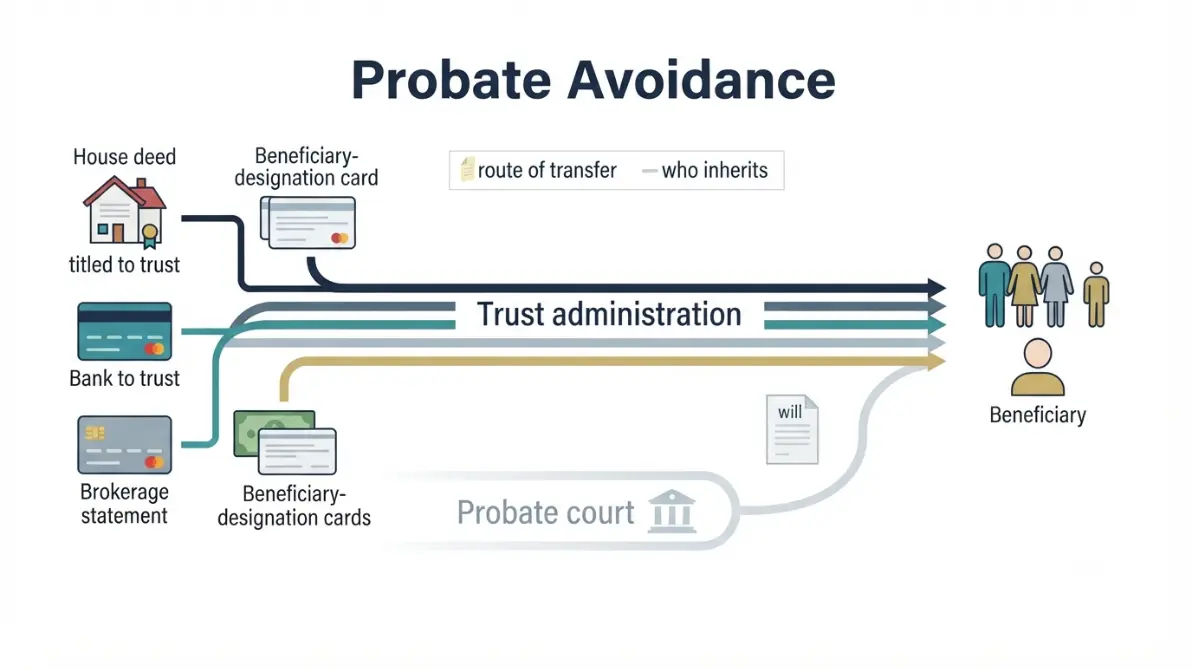
It does not change who inherits. It changes the route your property takes to get there — and some property travels outside both a trust and a will, as covered in assets a will never controls.
A living trust does not cut your estate tax
No — revocable trust assets remain part of your taxable estate.
📊 Data Point: The federal basic exclusion amount is $15,000,000 per person for 2026 — Source: IRS guidance on estate taxes, reflecting the amount set for decedents dying in 2026. Federal estate tax is not the reason most households create a trust. State estate and inheritance taxes can apply at far lower thresholds.
You can change or cancel it at any time
Revocable means what it says. While you are alive and mentally competent, you can amend the terms, add assets, or revoke the trust entirely.
The 6 steps to set up a revocable living trust
Setting up a revocable living trust takes six steps:
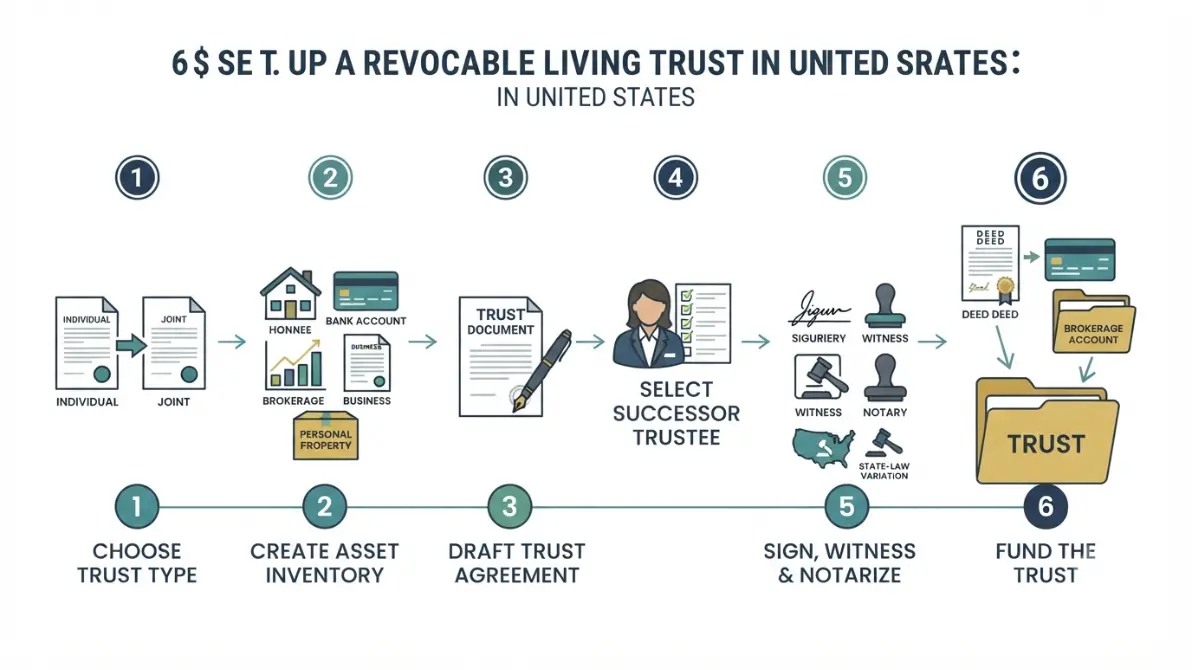
- Choose the trust type — an individual trust for your own property, or a joint trust if you and a spouse hold assets together.
- Inventory what you own — real estate, bank and brokerage accounts, business interests, and valuable untitled property.
- Draft the trust document — naming yourself as grantor and initial trustee, and naming your beneficiaries.
- Name a successor trustee — and confirm they accept before you file the document away.
- Sign it under your state’s rules — signing, notarization and witness requirements vary by state.
- Fund the trust — retitle each asset into the trust’s name.
Steps 4–6 carry the real weight
The successor trustee takes on genuine obligations. The CFPB’s guides for financial caregivers set out four duties a trustee owes: act in the beneficiary’s interest, manage money and property carefully, keep trust assets separate from their own, and keep good records.
Ask them before you name them.
You still need a will alongside it
A trust cannot name guardians for minor children. If you are weighing the two instruments, how a trust compares with a will covers the trade-offs — and the home equity calculator helps you size the asset that usually dominates step two.
✅ Action Step: Ask an estate-planning attorney licensed in your state one specific question before drafting: “What are my state’s signing and witnessing requirements for a trust, and does my deed need to be recorded to be effective?”
Funding the trust: how each asset gets retitled
Funding the trust means changing the title on each asset from your name to the trust’s name — and each asset class uses a different instrument.
The trust funding matrix
| Asset | Retitling instrument | Key detail |
|---|---|---|
| Home or land | New deed | Must be recorded with the county recorder |
| Bank accounts | Account re-registration | Handled at the branch; beneficiaries named in bank records |
| Brokerage accounts | Account re-registration | Your custodian processes it; cost basis is unaffected |
| Business interests | Assignment of membership or shares | Check your operating agreement first |
| Untitled property | Written assignment | No third party needed; keep it with the trust |
What stays out: retirement accounts
Retirement accounts pass by beneficiary designation, not by deed, and retitling one can carry tax consequences. Those forms control the account regardless of what your trust says — the same mechanics that drive the 10-year rule on inherited IRAs.
Are trust bank accounts still FDIC insured?
Yes — and moving a checking account into your trust does not reduce its coverage.
🔍 How It Works: The FDIC multiplies the number of trust owners by the number of eligible beneficiaries by $250,000. A trust checking account with one owner and three named beneficiaries is insured to $750,000. The ceiling is $1,250,000 per owner at one bank once five or more beneficiaries are named — Source: FDIC deposit insurance rules for trust accounts.
DIY template or estate-planning attorney?
A template is often enough when your estate is simple: property in one state, no business interest, and beneficiaries who can receive their share outright.
When you need a lawyer
Three facts move you to an attorney: real property in more than one state, a closely held business interest, or a beneficiary who needs structured distributions.
What a living trust costs
No federal agency publishes attorney fee data, so this article will not print a cost range it cannot source. A trust costs meaningfully more than a simple will, and pricing turns on your state and your complexity.
⚠️ Costly Mistake: Every price range you find on this topic traces back to a company selling trust documents. Treat those figures as marketing, not data. Ask for a flat fee in writing, covering the deed preparation and recording, before any work starts.
✅ Action Step: Ask an estate-planning attorney: “Given my assets and the states they sit in, does a trust do anything a will and correct beneficiary designations would not?”
Taxes and paperwork once the trust exists
For most people, a revocable trust changes nothing about their tax life.
Does your trust need its own EIN?
Generally no, while you are living.
🔍 How It Works: A revocable living trust is generally treated as a grantor trust, meaning the IRS looks through it to you. Trust income is generally reported on your own Form 1040 rather than on a separate trust return, and a separate EIN is generally not required during your lifetime — Source: IRS Instructions for Form 1041, grantor type trusts.
What changes when you die
The trust becomes irrevocable, obtains its own EIN, and your successor trustee administers it under its written terms.
✅ Action Step: Ask a CPA: “Which grantor-trust reporting method should my trust use, and does it need an EIN for the way my accounts are titled?”
Four mistakes that make a living trust useless
The document is not the plan. The titles on your assets are the plan.
⚠️ Costly Mistake: A signed but unfunded trust controls nothing. Anything still in your own name at death goes through probate exactly as it would have without the trust — and your family pays for a document that did no work.
The four failures
- Signing it and never funding it — fix it by working through the matrix above, asset by asset.
- Buying new assets and forgetting to retitle them — fix it with one retitling check each year.
- Skipping the pour-over will — it catches whatever you missed, and the witness rules for making a will still apply to it.
- Expecting creditor protection — because you keep control, revocable trust assets stay reachable by your creditors while you are alive.
Living trust questions people ask most
1. How much does it cost to set up a living trust?
Costs vary by state, attorney and complexity, so request a flat fee in writing before any work begins. Consult an estate-planning attorney about your situation.
2. Do I still need a will if I have a living trust?
Yes. A pour-over will catches assets you never retitled and names guardians for minor children, which a trust cannot do.
3. Does a living trust reduce estate taxes?
No. Revocable trust assets stay in your taxable estate, and the 2026 federal exclusion is $15 million per person. Consult a CPA about your own exposure.
4. Does my revocable trust need its own EIN?
Generally no while you are living — the trust reports under your Social Security number as a grantor trust. Confirm your method with a CPA.
5. What happens to my trust when I die?
It becomes irrevocable, obtains its own EIN, and your successor trustee distributes assets under the trust’s written terms.
6. Are bank accounts inside a living trust FDIC insured?
Yes — $250,000 per eligible beneficiary, capped at $1,250,000 per owner once five or more beneficiaries are named.
7. Can I set up a living trust without a lawyer?
Sometimes. Signing and funding must still satisfy your state’s requirements, and an unfunded trust controls nothing. Consult an attorney licensed in your state.
8. What does funding a living trust mean?
Retitling assets into the trust’s name — recording a new deed, re-registering accounts, and assigning untitled personal property.
9. Should retirement accounts go into a living trust?
Generally no. Retirement accounts pass by beneficiary designation instead. Ask a CPA before changing how any retirement account is titled.
10. Can I change or cancel a living trust?
Yes. While you are alive and competent, you can amend the terms, add assets, or revoke the trust entirely.
11. Does a living trust protect assets from creditors?
No. Because you keep control, revocable trust assets remain reachable by your creditors during your lifetime. Consult an attorney about asset protection.
Your next step
Write your asset inventory before you spend a dollar. It is free, it takes an evening, and it tells you whether a trust does anything a will and correct beneficiary designations would not.
Then take that list to an estate-planning attorney licensed in your state.
Related Articles
 Estate Planning
 for Unmarried Couples and the Overlooked Gaps
October 2, 2026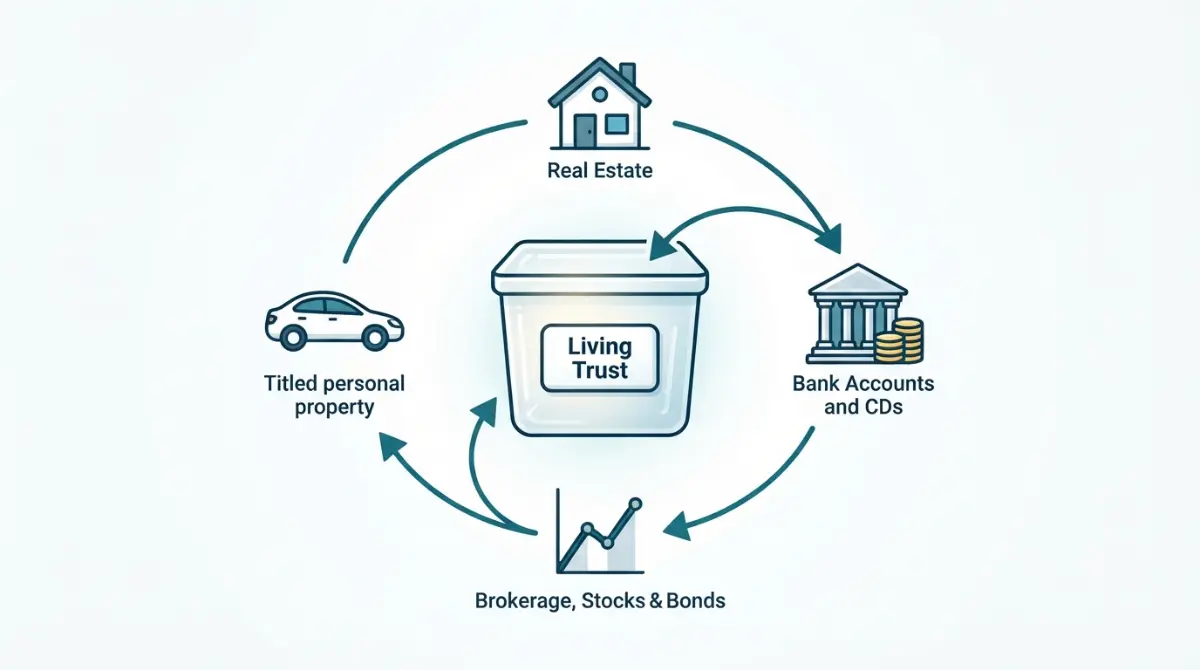 Estate Planning
The key steps to fund a living trust, asset by asset
September 19, 2026 Estate Planning
Gifting a House vs Inheritance and What Your Child Will Owe
September 26, 2026 Estate Planning
The Portability Election and Your Spouse’s Overlooked Exemption
September 24, 2026 Estate Planning
First Steps When a Parent Has Dementia and No Power of Attorney
October 1, 2026 Estate Planning
A Clear Look at Estate Planning Costs for a Will, Trust, and POA
September 21, 2026 Estate Planning
States With Inheritance Tax, Estate Tax Limits and Who Pays
September 24, 2026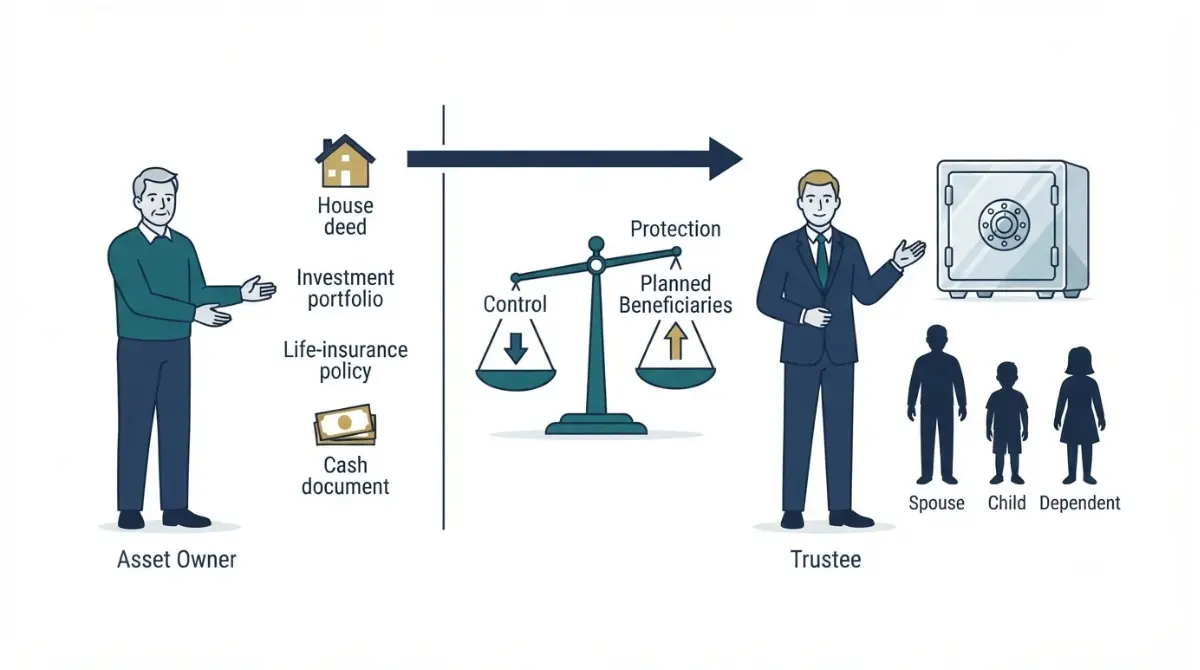 Estate Planning
When an Irrevocable Trust Is the Right Trade for Your Family
September 29, 2026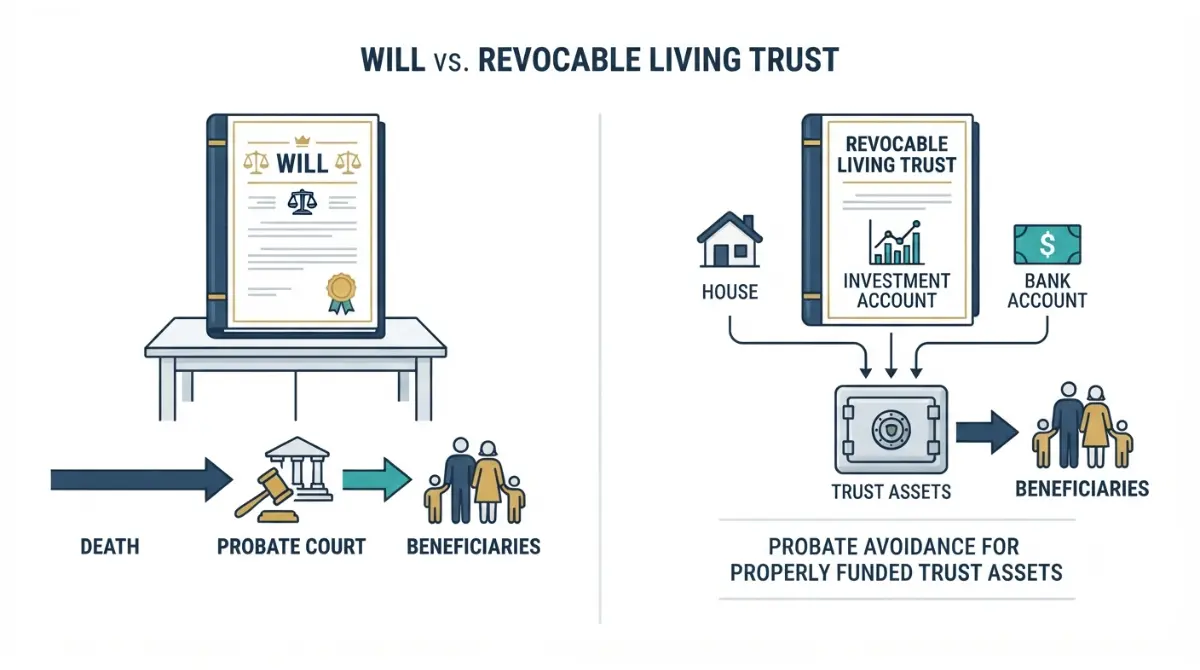 Estate Planning
Will vs Trust and How to Find the Right Fit for Your Family
September 17, 2026
Informational disclaimer
The content on Finance Authority Hub is provided for general informational and educational purposes only and should not be considered personalized financial, investment, tax, legal, or professional advice. Financial decisions depend on your individual goals, income, risk tolerance, location, and regulatory situation. Before acting on any information, strategy, estimate, or calculator result, consult a qualified licensed professional who can evaluate your specific circumstances.