
Smart Ways to Estimate Your Tax Refund Before Filing
Estimate your tax refund in two passes: a pay stub projection now, a W-2 check later. The IRS estimator takes about 25 minutes and doesn’t save entries.
In This Article
Can you estimate your tax refund before you file?
Yes. You can estimate your tax refund by comparing the tax you expect to owe with the federal tax withheld from your pay. This guide runs two passes: your latest pay stub, then your W-2.
Two moments to estimate: now and when your W-2 arrives
Run Pass 1 now to catch a withholding gap before December; run Pass 2 when your W-2 arrives. With a second job, a spouse or side income, read the estimator and mistakes sections too.
What an estimate can and can’t tell you
It shows a likely result, not a promise. Waiting on a refund date? See the timing section.
ℹ️ Financial Disclaimer: This is general education on federal tax estimates, withholding, credits and refund timing; it isn’t tax, investment, lending, insurance or debt-relief advice. Consult a CPA or Enrolled Agent for tax questions, a fiduciary advisor for investments, or an attorney for legal ones.
What you need to estimate your tax refund
Three papers cover almost every estimate, and each feeds a different side of the formula.
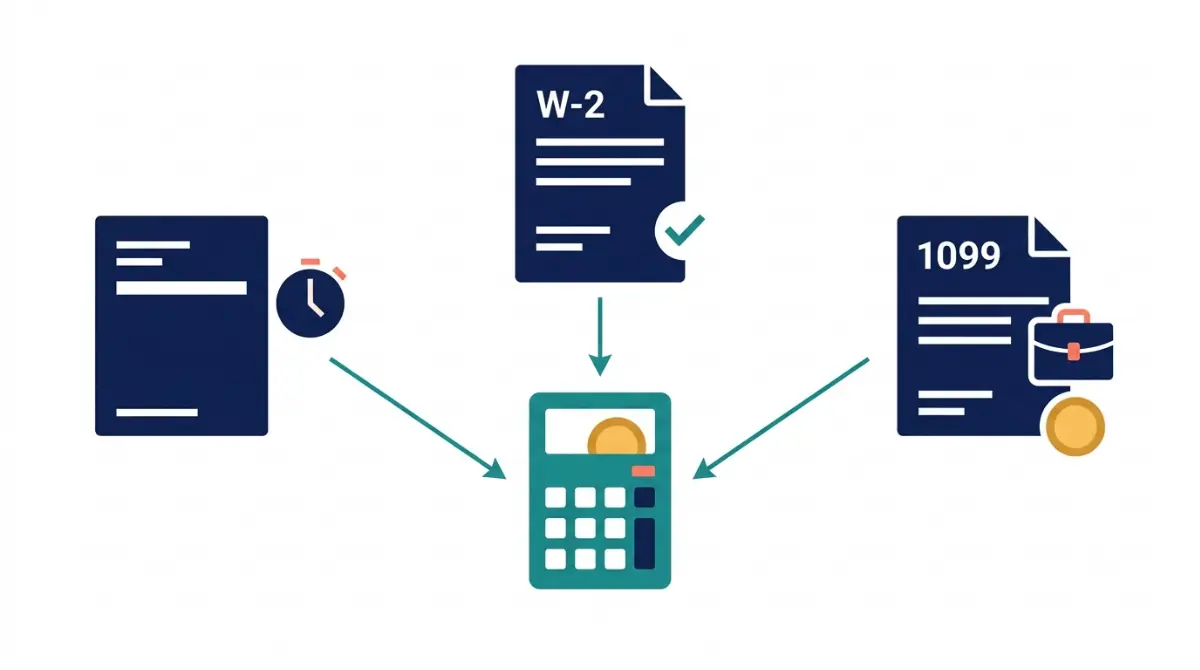
Which paper feeds which side of the formula
| Paper | Best For | Key Detail |
|---|---|---|
| Latest pay stub | Pass 1 projection | Year-to-date snapshot |
| Form W-2 | Pass 2 and filing | Box 2 shows withholding |
| 1099s, side-income records | The income side | Usually no withholding |
Source: papers listed by the IRS Tax Withholding Estimator.
Pay stub or W-2: which one to use
Use the stub to project the year and the W-2 to confirm it. Our W-2 box guide explains each box.
Estimate your tax refund by hand in two passes
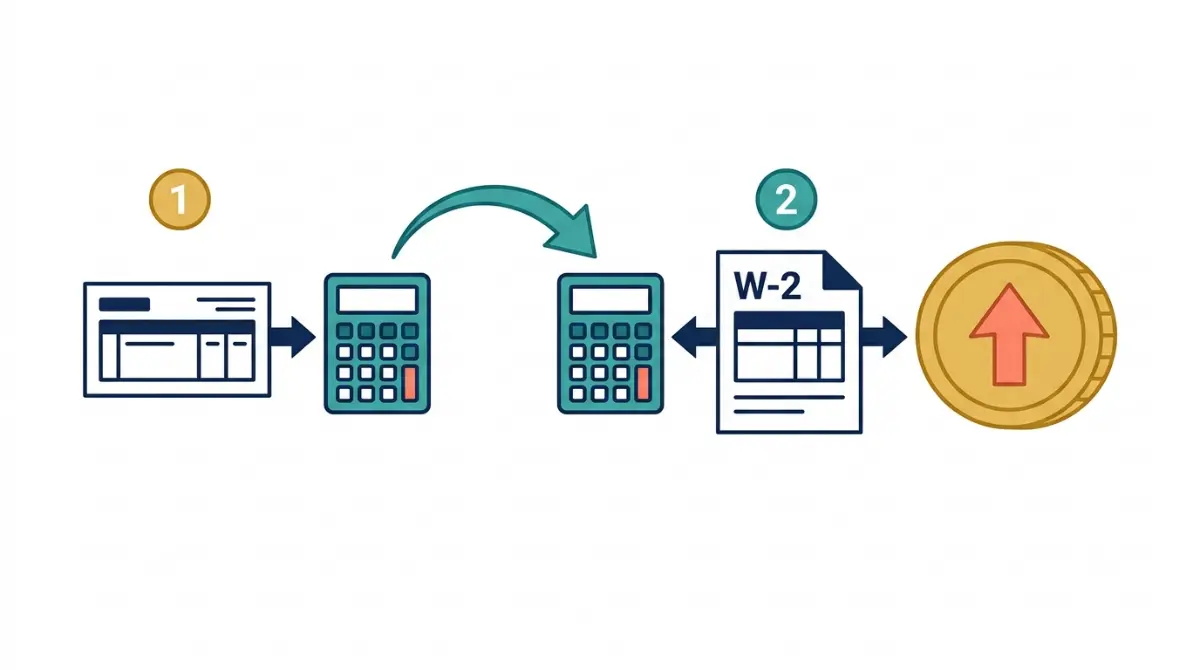
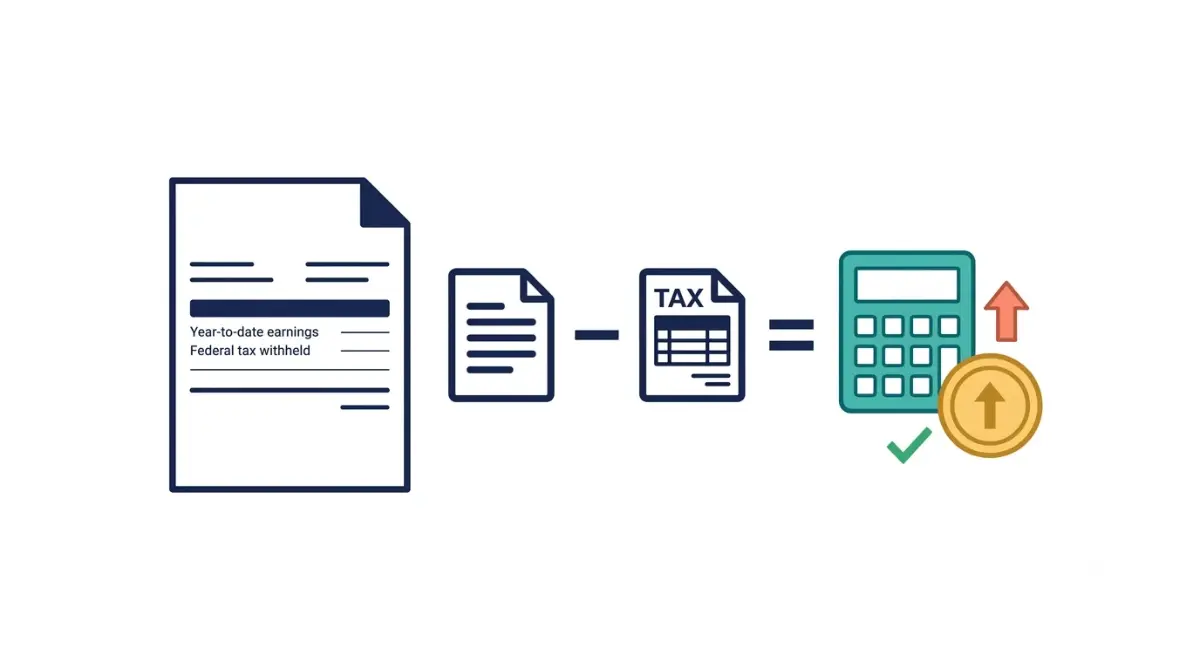
To estimate your tax refund, subtract your estimated tax from the federal tax already withheld or paid:
- Tax: income minus the standard deduction, then the 10% and 12% rates.
- Pass 1: project withholding from your latest stub.
- Pass 2: swap in the W-2 figure.
Pass 1: project from your latest pay stub
🔍 How It Works: A single filer in 2026 with $58,000 of wages and $300 of interest, minus the $16,100 standard deduction, has $42,200 of taxable income. Tax is $1,240 (10% of $12,400) plus $3,576 (12% of $29,800), or $4,816. A stub showing $4,600 withheld after 20 of 26 pay periods projects $5,980, so Pass 1 estimates a $1,164 refund.
Pass 2: re-run with your W-2
A W-2 showing $5,900 withheld gives $1,084; the $80 gap is why you re-run. Wages and withholding are illustrative; rates and deduction come from the IRS tax year 2026 inflation adjustments. Our tax refund formula and worked examples explain the subtraction; the 2026 tax brackets and deduction calculator checks taxable income.
Check your estimate with the IRS Tax Withholding Estimator
The IRS offers a free tool for W-2 and pension income.
How to use the estimator step by step
- Gather your latest pay stubs.
- Open the IRS Tax Withholding Estimator; it takes about 25 minutes and doesn’t save what you enter.
- Review how your withholding affects your refund or tax due.
- To change withholding, download the pre-filled Form W-4 for your employer.
The IRS says to recheck every January.
Estimator, calculator or tax software: which fits
| Tool | Best For | Key Detail |
|---|---|---|
| IRS estimator | Setting withholding | W-2 or pension income |
| Income tax calculator | Cross-checking Pass 1 | You enter every number |
| Paycheck calculator | Previewing a W-4 change | Shows per-paycheck effect |
| Filing software | The final return | Not an estimate tool |
✅ Action Step: Ask a CPA or Enrolled Agent: “With a second job or side income, how should I set my W-4 to avoid owing or over-withholding?”
What can move your tax refund estimate up or down
Credits, new deductions and unwithheld income move an estimate most.
Credits: refundable vs. nonrefundable
A refundable credit counts as a payment, so it can create a refund when you owe nothing; a nonrefundable credit only cuts tax to zero. For 2026 the child tax credit is up to $2,200 per child, up to $1,700 refundable (Revenue Procedure 2025-32).
Newer deductions the estimator now counts
Since March 2026 the estimator reflects deductions for tips, overtime, car loan interest and seniors (up to $6,000 per person); the IRS list of new deductions has details.
Income with no withholding
Side income adds taxable income without payments, and the estimator doesn’t cover it.
✅ Action Step: Ask a CPA or Enrolled Agent: “Which credits and deductions apply to my filing status and income?”
Average refund and timing: what to expect after you file
What the IRS data shows for 2026
📊 Data Point: Through May 8, 2026, the average refund was $3,276, up 11.5% from $2,939 a year earlier. Source: IRS filing season statistics, current-year returns.
How long a refund takes
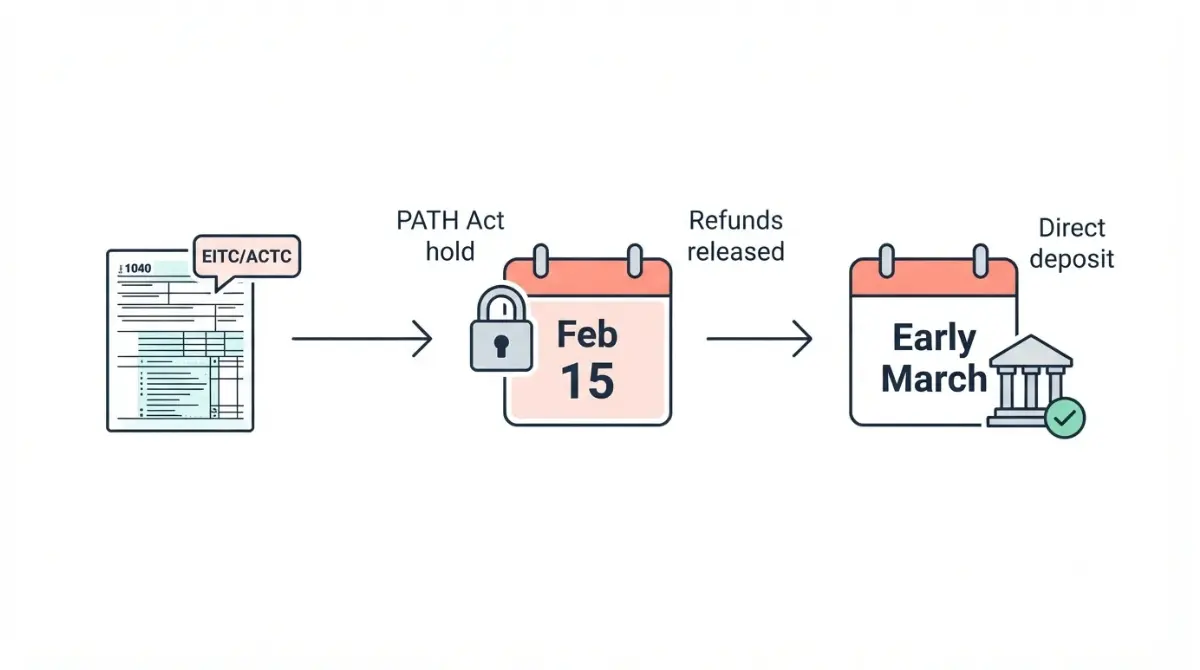
Per the IRS About refunds page, e-filed returns typically get refunds in about 3 weeks and mailed returns in 6 or more; our tax refund schedule shows typical timing. Earned income credit returns are held until mid-February (see the PATH Act refund date guide).
Why the final refund can differ
The IRS can reduce a refund for past-due debts such as child support or state tax. Compare a refund offset and a correction before assuming an error.
Common mistakes that throw off your refund estimate
Three habits cause most estimate errors.
Treating a pay stub like a W-2
A stub is a snapshot, so file only from the W-2 your employer issues. A projection also breaks if your pay changes mid-year.
Leaving out a second job, spouse or side income
Each extra paycheck changes both sides of the formula, so enter every job and a spouse’s stubs.
Changing withholding late in the year
The IRS says a mid-year change may need another update in late December. See what usually causes a smaller tax refund next year.
✅ Action Step: Ask a CPA or Enrolled Agent: “My income comes from several sources. What should I double-check before I file?”
Estimate tax refund FAQs
1. How can I estimate my tax refund before I file?
Subtract your estimated tax from the federal tax already withheld or paid, using your latest pay stub first, then your W-2. A CPA or Enrolled Agent can review your inputs.
2. Can I estimate my tax refund from a pay stub?
Yes, a stub projects your year, but only your W-2 shows final withholding, so re-run your estimate when it arrives.
3. What do I need to estimate my tax refund?
Gather recent pay stubs, your W-2, any 1099s and last year’s return, plus a spouse’s papers if filing jointly.
4. Does the IRS Tax Withholding Estimator show my refund?
It shows how withholding affects your refund or tax due, but only for W-2 jobs and pensions. A CPA or Enrolled Agent can review your inputs.
5. How accurate is a tax refund estimate?
An estimate is only as accurate as its inputs; in our example, swapping the stub for the W-2 moved it $80. A CPA or Enrolled Agent can review your inputs.
6. How long does a tax refund take after e-filing?
The IRS says an e-filed return typically gets a refund in about 3 weeks; mailed returns take 6 or more.
7. What is the average tax refund in 2026?
Through May 8, 2026, the IRS reported an average refund of $3,276, versus $2,939 a year earlier.
8. Why is my actual refund different from my estimate?
Offsets for past-due debts, IRS corrections, or withholding that differs from your projection can change the final refund. A CPA or Enrolled Agent can review your inputs.
9. Can I estimate my tax refund with side income?
Yes, add the income yourself; the IRS estimator covers only W-2 jobs and pensions with withholding. A CPA or Enrolled Agent can review your inputs.
10. Do refundable credits change my tax refund estimate?
Yes, refundable credits count as payments, so they can raise your refund or create one when you owe no tax. A CPA or Enrolled Agent can review your inputs.
Your next step before December 31
Run Pass 1 this month with your latest pay stub, then Pass 2 when your W-2 arrives. If the gap surprises you, recheck withholding with the IRS estimator. Plan any refund with our budget calculator, and ask a CPA or Enrolled Agent: “Given my income sources, what withholding avoids a surprise at filing?”
Related Articles
 Tax Refund
A Smart Way to Plan Around Your PATH Act Refund Date
October 8, 2026 Tax Refund
Where to Put Tax Refund Money for a Smart 3-Month Hold
October 15, 2026 Tax Refund
 Delayed and Bills Running Late? Find the Cause First
October 7, 2026 Tax Refund
A Clear Walk Through the Tax Withholding Estimator Screens
October 13, 2026 Tax Refund
Do You Need to File to Get a Tax Refund If You Owe Nothing?
October 12, 2026 Tax Refund
Clear Signs of a Smaller Tax Refund Next Year
October 10, 2026 Tax Refund
How a Tax Refund Affects SSI, SNAP and Medicaid Benefits
October 16, 2026 Tax Refund
 Without Bank Account? Your Clear Options Explained
October 9, 2026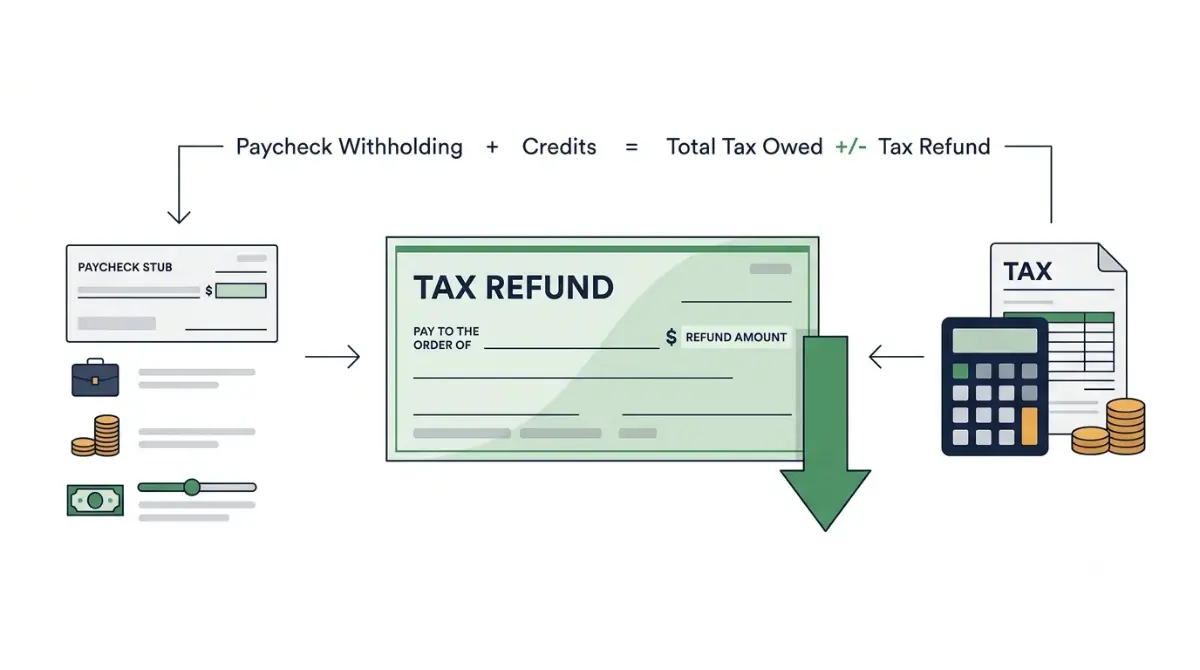 Tax Refund
Is Your Tax Refund Lower Than Last Year? Find the Real Reason
October 10, 2026
Informational disclaimer
The content on Finance Authority Hub is provided for general informational and educational purposes only and should not be considered personalized financial, investment, tax, legal, or professional advice. Financial decisions depend on your individual goals, income, risk tolerance, location, and regulatory situation. Before acting on any information, strategy, estimate, or calculator result, consult a qualified licensed professional who can evaluate your specific circumstances.