
Will vs Trust and How to Find the Right Fit for Your Family
A will or trust won’t control an account with a TOD form, since the named beneficiary inherits it. See what your paperwork already decides first.
In This Article
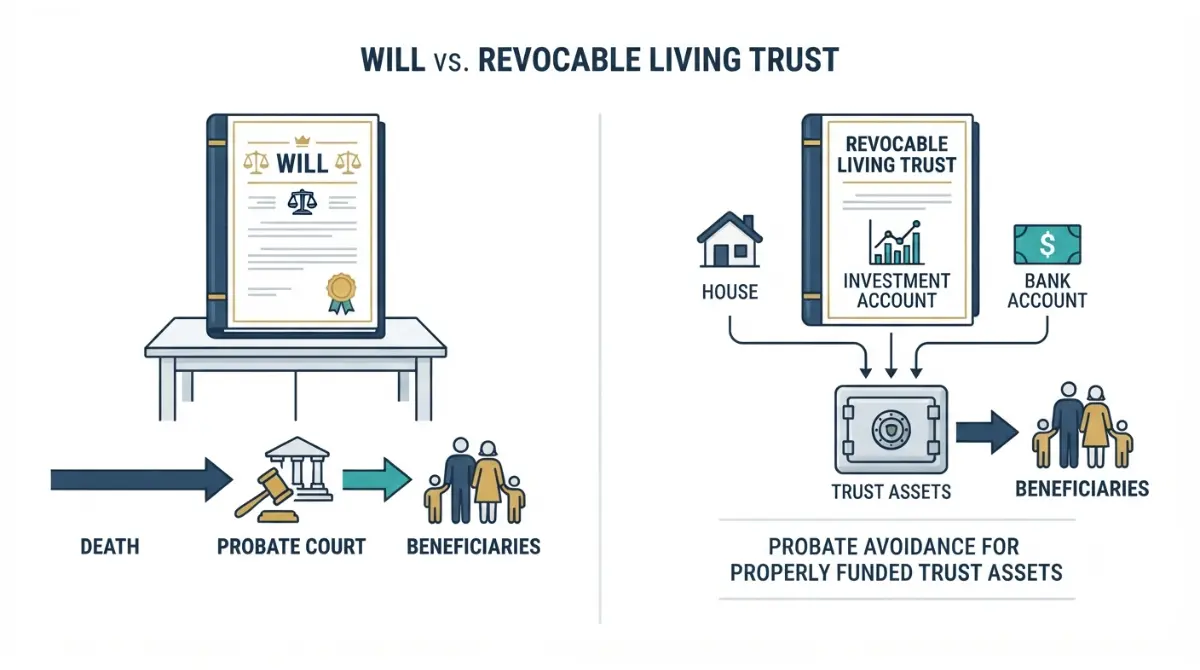
A will vs trust decision comes down to timing and reach. A will takes effect at death and passes through probate court. A revocable living trust works while you’re alive, and assets you move into it can skip probate.
Most families start with a will; some add a trust.
Find your starting point:
- Parents of children under 18: start with what a will does, then the Family Fit Check.
- Homeowners and pre-retirees: see how a trust works and the worked example.
- Settling a parent’s estate: go straight to the common mistakes.
ℹ️ Financial Disclaimer: This article is for educational purposes only and is not personalized legal, tax, investment, insurance, lending, or debt-relief advice. Estate planning rules vary by state. Before creating or changing a will, trust, or beneficiary designation, consult a state-licensed estate planning attorney, and consult a CPA or fiduciary advisor on tax and investment questions.
What a will does, and what it can’t control
A last will and testament directs who inherits your property.
Why parents of minors need a will either way
A will is where parents nominate a guardian for minor children, a job a living trust isn’t built for. Its executor settles the estate, usually through probate.
Assets that skip your will entirely
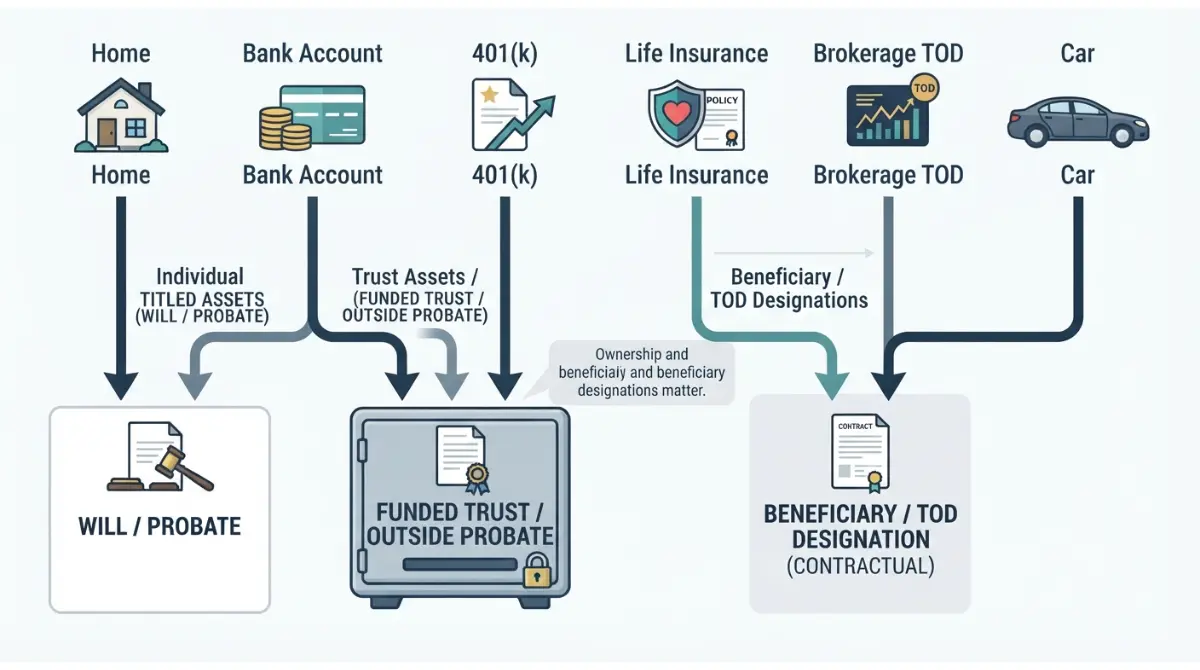
FINRA’s guide to transfer-on-death accounts notes that a TOD designation supersedes a will or trust. Joint accounts with right of survivorship also pass to the co-owner without probate. Both are among the assets a will doesn’t cover.
⚠️ Costly Mistake: If your will splits an account between two children but the TOD form names only one, that child alone inherits and has no obligation to share.
How a revocable living trust actually works
A revocable living trust holds your property during your life.
Grantor, trustee, beneficiary: who does what
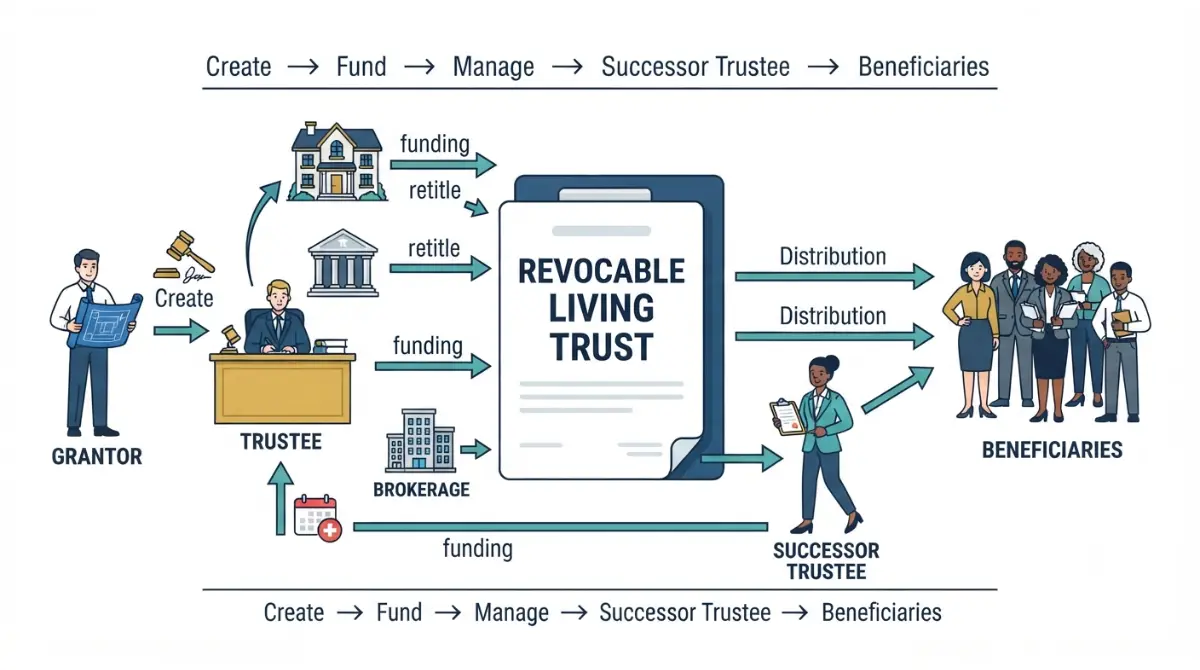
The grantor creates the trust and usually serves as trustee. A successor trustee steps in after the grantor’s death or disability, and beneficiaries receive the property.
Funding: the step that makes the trust work
🔍 How It Works: A trust controls only the assets retitled into its name, a step called funding. Per the CFPB’s explainer on revocable living trusts, a trust is ineffective until assets are transferred into it.
What happens if you become incapacitated
A successor trustee can manage trust assets if you can’t; a will has no effect until death. For taxes, the IRS says most revocable-trust owners can use Optional Method 1, its least burdensome reporting option.
Will vs. living trust: side-by-side comparison
Here’s the trade-off at a glance.
Probate, privacy, and incapacity
| Feature | Will | Living trust | Key Detail |
|---|---|---|---|
| Takes effect | At death | Once signed and funded | Controls funded assets only |
| Probate | Required | Avoided for funded assets | Probate is public |
| Incapacity | No effect | Successor trustee acts | Trust covers it |
| Guardian for minors | Yes | No | Parents need a will |
| Outside its reach | TOD, beneficiary accounts | Same, plus unfunded assets | Designations win |
Sources: CFPB; FINRA.
Do either of them cut estate taxes?
📊 Data Point: The federal basic exclusion amount is $15,000,000 for 2026 deaths, up from $13,990,000 in 2025. Source: IRS, What’s New — Estate and Gift Tax (updated July 2026).
For estates well below that line, federal estate tax doesn’t separate a will from a trust. Some states tax estates separately, so check yours.
Is a will enough, or do you need a living trust?
A trust may be worth raising with an estate planning attorney if several of these points fit you.
The 6-point Family Fit Check
- You want your home kept out of probate.
- You want estate details out of public court.
- You want someone ready to manage money if you can’t.
- You have a blended family or specific timing wishes.
- You own property in more than one state.
- Much of your wealth lacks beneficiary or TOD forms.
When a will alone is usually enough
If beneficiary designations already cover most of your wealth, a will may handle the rest. Parents still need one for guardianship.
✅ Action Step: Ask a state-licensed estate planning attorney: “What would a trust change for my family?”
Where your assets go: a worked example
This hypothetical household shows how much a will alone reaches.
Example household: what each asset follows
| Asset | Value | Passes by | Probate: will only | Probate: funded trust |
|---|---|---|---|---|
| Home, your name | $350,000 | Will | Yes | No |
| 401(k) | $120,000 | Beneficiary form | No | No |
| Work life insurance | $200,000 | Beneficiary form | No | No |
| Brokerage with TOD | $40,000 | TOD form | No | No |
| Checking, no POD | $15,000 | Will | Yes | No |
| Car | $18,000 | Will | Yes | Yes |
Hypothetical figures. Routing rules: FINRA; CFPB.
What changes if they fund a trust
With only a will, $383,000 of this $743,000 household goes through probate. Retitling the home and checking account into the trust shrinks that to the $18,000 car.
Heirs still face separate rules for an inherited 401(k). To gauge the insurance row, estimate how much life insurance your family needs.
Mistakes that quietly undo a will or trust
Small paperwork gaps can undo a plan.
Signing a trust but never funding it
⚠️ Costly Mistake: An unfunded trust controls nothing, so a home still titled in your name can land in probate anyway.
Forgetting beneficiary forms and the pour-over will
Beneficiary forms beat both documents, so review them after a marriage, divorce, or birth. Check how an annuity pays out at death and what heirs do with an inherited IRA. Attorneys often add a “pour-over” will that sweeps stray assets into the trust.
New trustees can use the CFPB’s guide for successor trustees.
✅ Action Step: Ask your estate planning attorney: “Is every asset titled in my trust or covered by a current beneficiary form?”
Will vs. trust: quick answers
1. Does a living trust avoid probate?
A living trust avoids probate only for assets moved into it; property left in your name can still face probate.
2. Do I still need a will if I have a trust?
Usually yes. A will covers assets outside the trust and lets parents name a guardian for minor children.
3. Can a living trust name a guardian for my children?
No. A living trust isn’t built for guardianship; parents nominate a guardian for minor children in a will.
4. Does a living trust reduce estate taxes?
Federal estate tax applies only above the $15,000,000 exclusion for 2026 deaths, so smaller estates rarely choose a trust for taxes. A CPA can confirm where your estate stands.
5. What happens if I don’t fund my living trust?
An unfunded living trust controls nothing, so assets outside it follow your will or beneficiary forms instead.
6. Does a beneficiary designation override a will?
Yes. A beneficiary or TOD designation supersedes your will, so the named person inherits that account.
7. Who manages a living trust while I’m alive?
Usually you do. The grantor typically serves as trustee until death or disability, then a successor trustee takes over.
8. Does a living trust need its own tax return?
The IRS says most revocable living trust owners can use Optional Method 1, its least burdensome reporting option. A CPA can confirm your filing method.
9. Is a will public record?
A will’s assets usually pass through probate, a public process, while funded living trust assets avoid it.
10. What if I’m incapacitated with only a will?
A will has no effect while you’re alive; a funded living trust lets a successor trustee step in.
11. Attorney or online service for a will or trust?
Simple situations may suit an online service, but blended families or multi-state property deserve an estate planning attorney’s review.
Your next step
A will is the foundation for most families, especially parents of minors. A funded living trust adds probate avoidance, privacy, and a ready manager if you can’t act. Run the Family Fit Check, then see a state-licensed estate planning attorney.
Related Articles
 Estate Planning
Smart Digital Assets Estate Planning Steps So Family Can Get In
October 5, 2026 Estate Planning
First Steps When a Parent Has Dementia and No Power of Attorney
October 1, 2026 Estate Planning
A Clear Signing Order for Estate Planning After Diagnosis
October 2, 2026 Estate Planning
Your Executor Duties After Someone Dies, in Plain English
October 1, 2026 Estate Planning
How a Special Needs Trust Can Protect SSI and Medicaid
September 30, 2026 Estate Planning
A Clear Blended Family Estate Planning Guide for Stepkids
October 5, 2026 Estate Planning
Naming a Guardian for Minor Children in Your Will, Step by Step
October 2, 2026 Estate Planning
Gifting a House vs Inheritance and What Your Child Will Owe
September 26, 2026 Estate Planning
Where a Transfer on Death Deed Works and Where It Goes Wrong
September 28, 2026
Informational disclaimer
The content on Finance Authority Hub is provided for general informational and educational purposes only and should not be considered personalized financial, investment, tax, legal, or professional advice. Financial decisions depend on your individual goals, income, risk tolerance, location, and regulatory situation. Before acting on any information, strategy, estimate, or calculator result, consult a qualified licensed professional who can evaluate your specific circumstances.