How to stop living paycheck to paycheck: a 30-day plan
Living paycheck to paycheck while $430 ahead each month? A worked example shows the $185 rent gap and the $400 reserve that evens out both checks.
In This Article
Rates and limits checked on October 23, 2026.
Why living paycheck to paycheck is often a timing problem
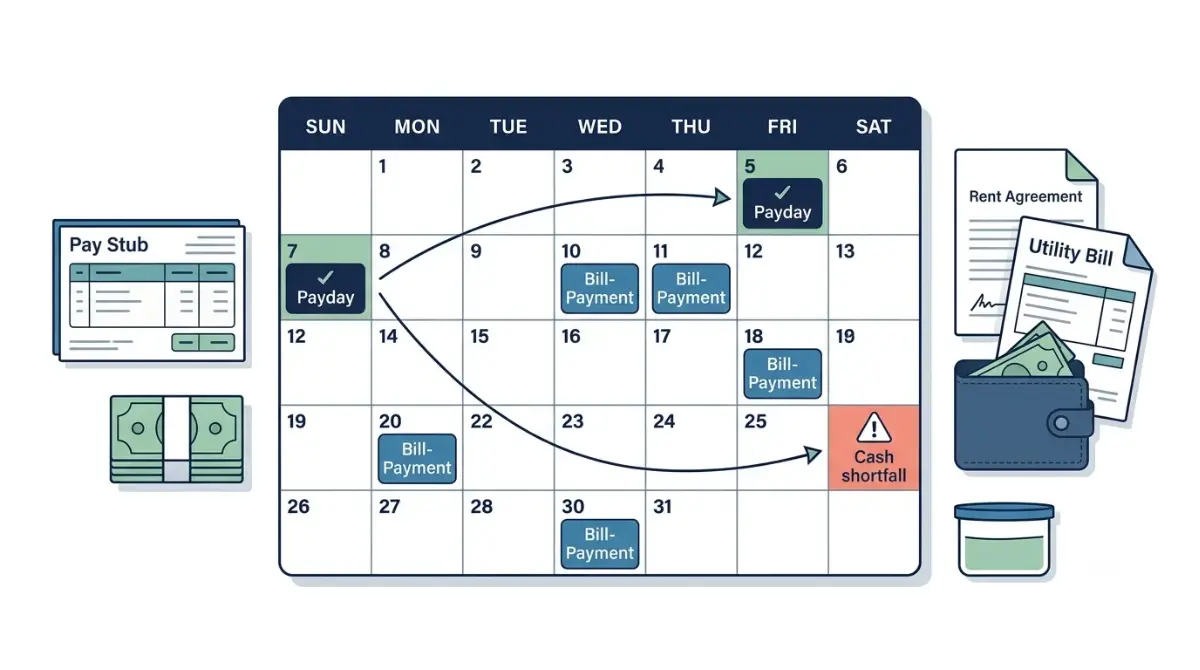
Rent is due on the 1st, and for many people paid every other week, the paycheck that has to cover it landed almost two weeks earlier. If your month adds up on paper but your account still runs dry before payday, the fix starts with matching each paycheck to the bills it carries, shifting money between the two, and sending a fixed amount to savings every payday.
Thin savings make a timing gap hurt more. In the Federal Reserve’s household survey for 2025, 63% of adults said they would cover a $400 emergency expense using only cash or its equivalent. That leaves 37% who would have to find the money some other way.
A three-month emergency fund comes later. In the next 30 days the goal is narrower: end a timing shortfall and start a buffer the size of one paycheck.
Is it a timing gap or a spending gap?
Add up a year of take-home pay, then divide by 12. If you’re paid every other week, multiply one check by 26; weekly, by 52; twice a month, by 24. For a typical check, the paycheck calculator shows your take-home amount, and hourly workers can turn an hourly rate into a yearly figure first.
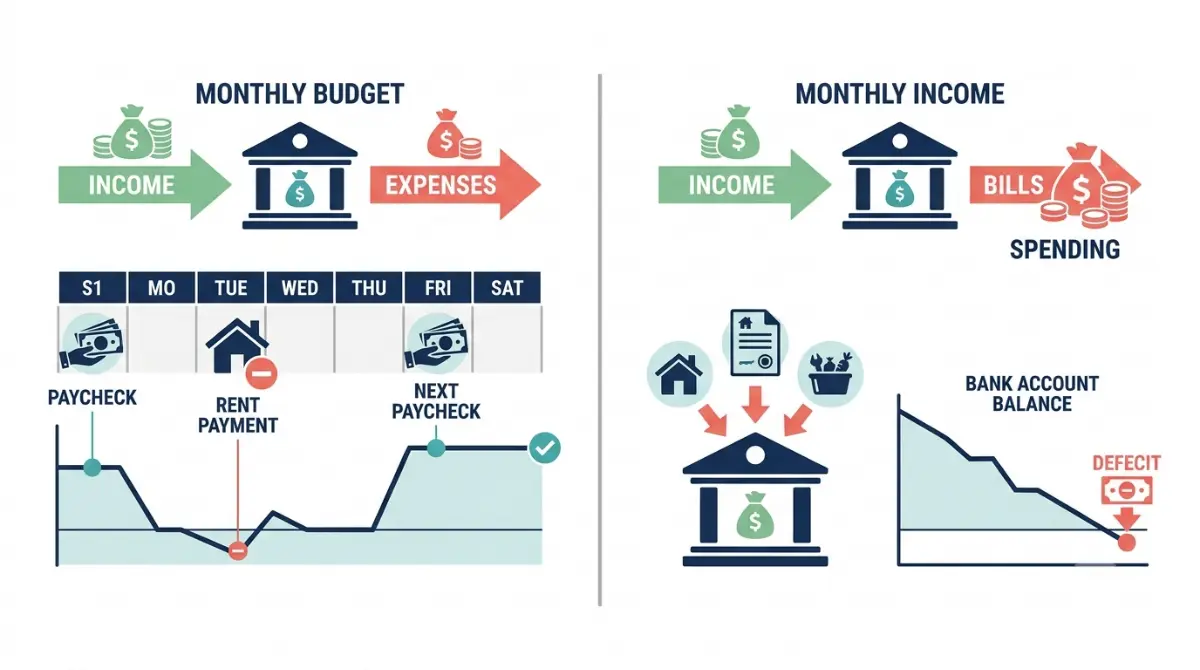
Next, total every monthly bill plus normal spending on food and fuel. Subtract that from the monthly take-home figure.
A positive result, with money still running out before payday, points to a timing gap. The month balances, but the bills don’t fall evenly across your checks. A negative result is a spending or income gap, and moving money between paychecks won’t close it. Card and loan payments are usually the first place to look, and the debt-to-income ratio calculator shows what share of your gross monthly income they take.
One household’s paychecks mapped against its bills
A single earner paid every other Friday takes home $1,620 per check. That comes to $42,120 a year, or $3,510 a month on average. Most months hold only two paydays, so an ordinary month brings in $3,240.
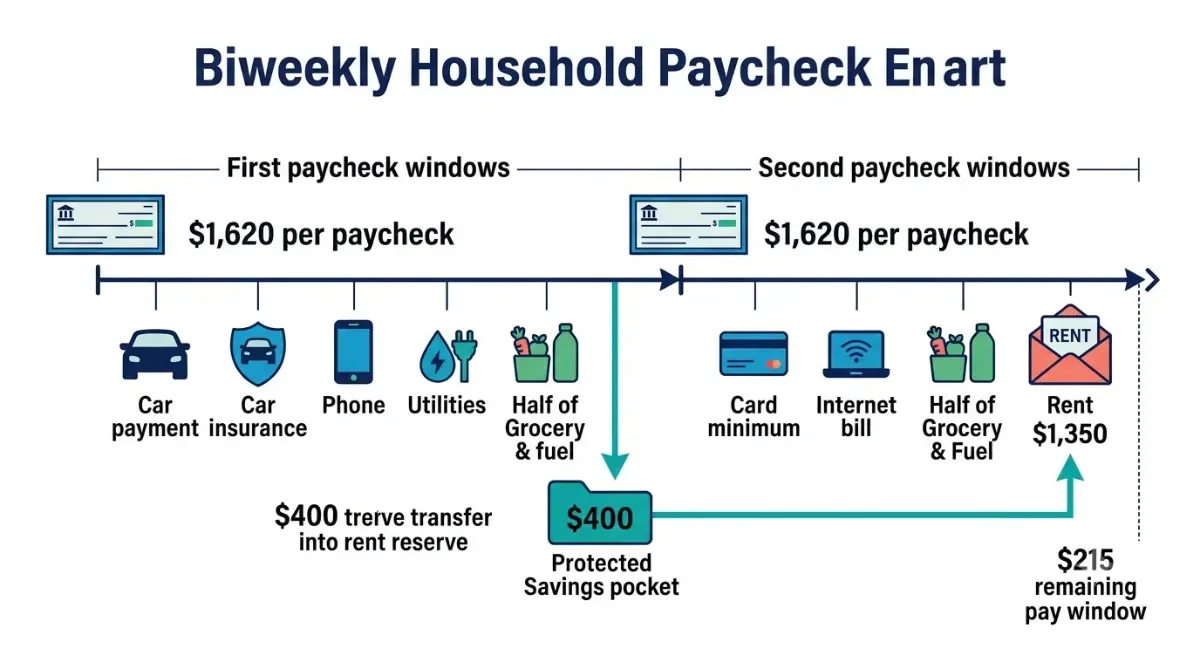
Example: the monthly bills are rent of $1,350 due on the 1st, a $310 car payment on the 5th, $140 car insurance on the 9th, a $75 phone bill on the 12th, $180 in utilities on the 18th, a $95 card minimum on the 22nd and $60 internet on the 25th. Those total $2,210. Groceries and gas add $600, for $2,810 in all, and the month ends $430 ahead.
With paydays on Feb. 5 and Feb. 19, 2027, the two pay windows look like this:
| Pay window | Due in this window | Paycheck | Left before the fix | Left after the fix |
|---|---|---|---|---|
| Feb. 5–18 | Car $310, insurance $140, phone $75, utilities $180, half of spending $300: $1,005 | $1,620 | $615 | $215 |
| Feb. 19–Mar. 4 | Card minimum $95, internet $60, March rent $1,350, other half of spending $300: $1,805 | $1,620 | −$185 | $215 |
Example household; figures add to $2,810 a month.
If the first window’s $615 gets spent, the second window comes up $185 short before March rent clears, even though the household is $430 ahead for the month.
The fix moves $400 from the Feb. 5 paycheck into a separate account held for rent. The first window then keeps $1,620 − $1,005 − $400 = $215. The second gets $1,620 + $400 − $1,805 = $215.
To check the monthly side, open the budget calculator and enter $3,240 as monthly income, the seven bills, and $600 for groceries and gas. The amount left over should match the $430 above.
Set up the 30 days in this order
Two paydays fall inside any 30-day stretch for a biweekly earner, and the setup below uses both.
- Days 1 to 3: list every bill with its due date and amount, then sort each into the window whose paycheck will pay it.
- Days 4 to 7: ask your card issuers and your insurer whether they will move a due date into the lighter window. A credit card’s due date must fall on the same day of the month every billing cycle, so the date you choose repeats each month.
- Days 8 to 10: schedule an automatic transfer of your rent reserve from the lighter paycheck into a separate account.
- Days 11 to 14: open a savings account kept apart from checking, and set an automatic transfer of each paycheck’s leftover amount on payday.
- Day 28: confirm both windows ended above zero, and adjust the reserve by the difference if one did not.
At $215 a check, a buffer equal to one paycheck ($1,620) takes eight paychecks: seven bring it to $1,505 and eight to $1,720. That is about 16 weeks. In the savings calculator, a $1,620 goal with $430 added each month lands just under four months.
Three-paycheck months in 2027
Paid every other Friday starting Jan. 8, 2027, you get three checks in April and October. Every biweekly schedule has at least two such months a year, and your first payday decides which ones.
| First payday | Weekday | Months with three paydays | Paydays in 2027 |
|---|---|---|---|
| Jan. 1, 2027 | Friday | January, July, December | 27 |
| Jan. 8, 2027 | Friday | April, October | 26 |
| Dec. 31, 2026 | Thursday | July, December | 26 |
| Jan. 7, 2027 | Thursday | April, September | 26 |
Computed from the 2027 calendar for pay every 14 days.
In the example, two checks already cover the $2,810 month, so a third $1,620 check can go to the buffer in one deposit. A 27-payday year raises one question for your payroll office: “Is my 2027 salary split across 26 or 27 paychecks?” For a salaried worker, the answer can change the size of every check.
A large tax refund is another source for the buffer. For tax year 2025 returns processed through May 8, 2026, the average refund was $3,276. Spread across 26 biweekly checks, a refund that size equals about $126 per paycheck.
If yours was close to that, changing your W-4 to shrink the refund moves part of it into each check during the year.
The take-home pay calculator shows what a withholding change does to one check. The income tax calculator estimates this year’s federal tax, so you can compare it with the amount being withheld.
If the gap shows up every month
Moving money between paychecks can’t help when the month itself spends more than it brings in. What’s left is smaller payments, more income or lower bills.
The credit card payoff calculator shows how long a balance lasts at the minimum payment and what it costs at your rate. If extra hours are on offer, the overtime calculator shows what a shift adds before tax.
When card payments are the main drain, a nonprofit credit counseling agency can review them with you. Ask the counselor: “Can a debt management plan lower my total monthly card payments, and what is the monthly fee?”
Before you sign: A two-week payday loan with a $15 fee per $100 borrowed works out to an APR of almost 400%, and payday loan rollovers stack those fees.
Earned wage access through an employer is a different product. A December 2025 CFPB advisory opinion treats qualifying programs as outside federal Truth in Lending rules, so their fees and tips are not finance charges disclosed as an APR. State rules differ. Before you agree to either product, run its fee through the APR calculator.
The rent reserve and savings transfer on your next payday
On your next payday, set both transfers to run before any bills post. The reserve comes out of the paycheck that carries fewer bills, sized so both windows end level, and the leftover goes to the separate savings account. In the example those amounts are $400 and $215; yours come from the two window totals you just built.
Two more questions people ask
What percentage of Americans live paycheck to paycheck?
The Federal Reserve’s household survey doesn’t ask it directly, and private surveys define the term differently, so their published shares vary. The closest Federal Reserve measure is the $400 question: 63% of adults would have covered it with cash in 2025.
Can a six-figure income still run out before payday?
Yes. Higher pay often comes with higher fixed bills, and one paycheck can still end up carrying the largest of them. The two-number test near the top of this page works at any income.
Informational disclaimer
The content on Finance Authority Hub is provided for general informational and educational purposes only and should not be considered personalized financial, investment, tax, legal, or professional advice. Financial decisions depend on your individual goals, income, risk tolerance, location, and regulatory situation. Before acting on any information, strategy, estimate, or calculator result, consult a qualified licensed professional who can evaluate your specific circumstances.