Trump account vs 529 — the smart order for your next dollar
Trump account vs 529 is the wrong question. The $1,000 seed is free money; the 529 is the only account where school withdrawals come out tax-free.
In This Article
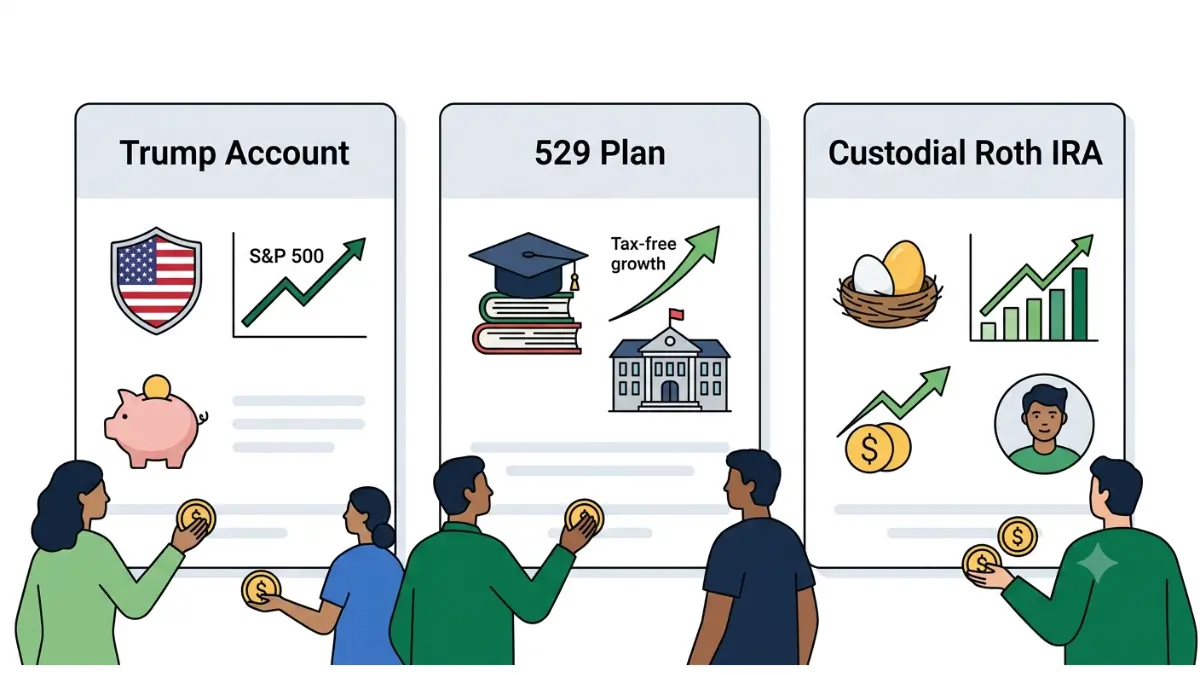
Trump Accounts began accepting money on July 4, 2026, and plenty of parents now wonder whether the 529 plan they have funded for years was a mistake. It wasn’t. These are three tools with three tax treatments, and most families who qualify for one qualify for two.
Where to start:
- Child born since January 2025 — Section 2, for the federal deposit you may not have claimed.
- Already funding a 529 — Section 6, for the order of operations.
- Teenager with a paycheck — Section 5, for the account that requires earned income.
- Applying for college aid — Section 5, which separates settled rules from open ones.
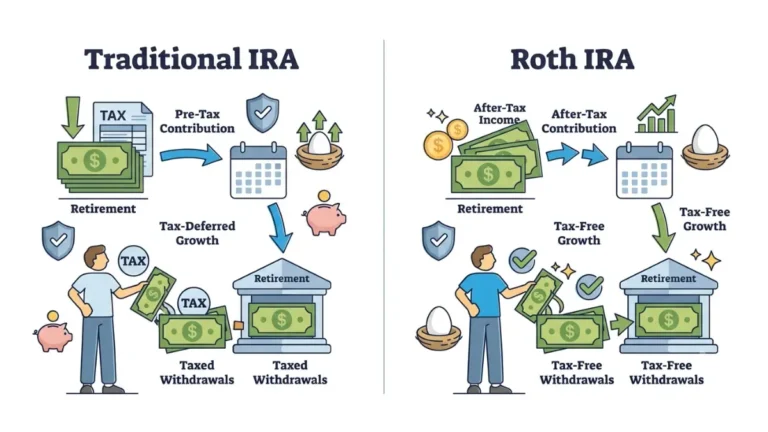
A Trump Account is legally a traditional IRA, not a new tax-free category, and that drives everything below. It also places these accounts inside the wider map of where each IRA type fits by income.
ℹ️ Financial Disclaimer: This article is educational and is not personalized investment, tax, lending, insurance, or debt-relief advice. Limits, tax treatment, and aid rules vary by family, state, and tax year. Consult a fiduciary advisor, a CPA or tax attorney, or an education-finance counselor before acting.
What a Trump Account actually is
A Trump Account is a traditional IRA for a child: growth is tax-deferred, withdrawals are taxed as ordinary income. A 529 plan grows tax-free for education. A custodial Roth IRA grows tax-free for retirement, but only if the child has earned income.
Created as Section 530A, these accounts could not accept a dollar before July 4, 2026 under the IRS guidance on Trump Accounts. One account per child.
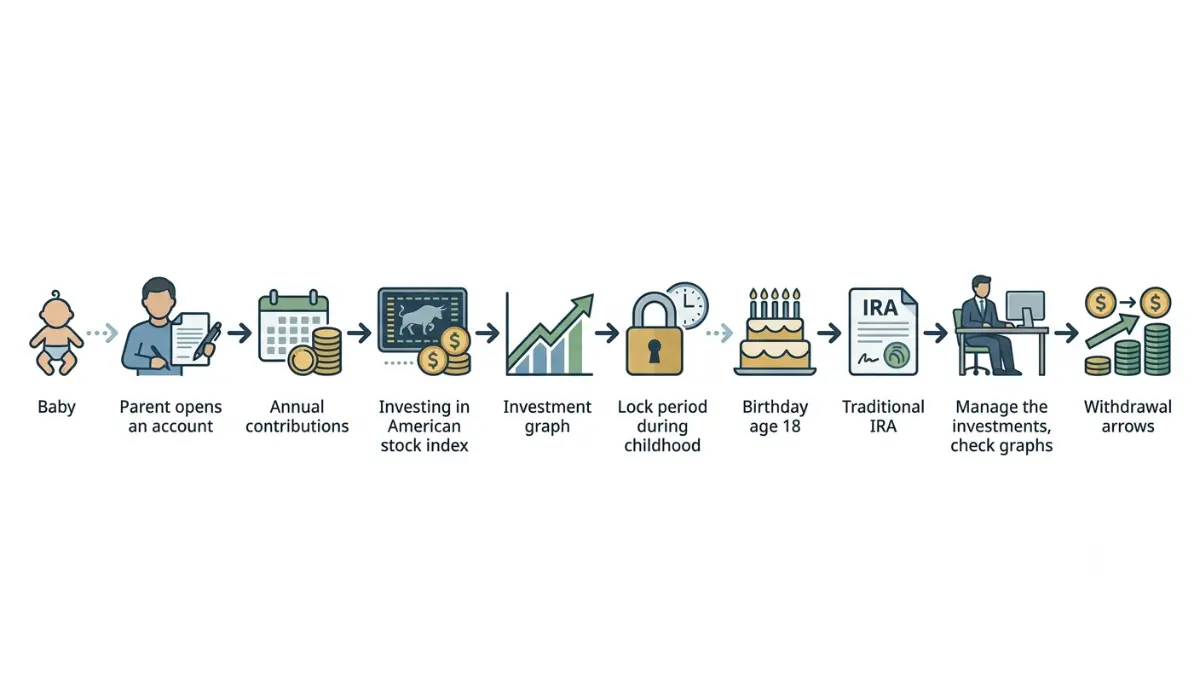
🔍 How It Works: The years before adulthood are the growth period. A parent or guardian picks investments and accepts contributions, but money cannot come out. Withdrawals open on January 1 of the year the child turns 18, after which the account behaves like any traditional IRA.
Who gets the $1,000 — and who doesn’t
Two rules get blurred. Any child not yet 18 by year-end can have an account; only U.S. citizen children born between January 1, 2025 and December 31, 2028 receive the one-time $1,000 pilot contribution.
Accounts open free through IRS Form 4547 or the Treasury portal — our guide covers how to file Form 4547 and claim the seed.
What you can put in, and who can add to it
Anyone may contribute up to a combined $5,000 a year per child, of which an employer may supply $2,500 free of the employee’s income tax. Both figures index to inflation after 2027.
Contributions are not capped by the child’s own earnings, unlike other IRAs. The balance must track the S&P 500 or another index of primarily American equities, per the Treasury notice on growth-period rules.
The three accounts side by side
Everything that separates them, in one place.
| Compare | Trump Account | 529 plan | Custodial Roth IRA | Key detail |
|---|---|---|---|---|
| Annual limit | $5,000, all donors combined | No federal cap; state limits apply | $7,500 (2026) or the child’s earnings, whichever is lower | The $5,000 is per child, not per person |
| Tax at withdrawal | Ordinary income | Free for education; otherwise taxed plus 10% | Free after 59½ and five years | The real dividing line |
| Access | Jan 1 of the year they turn 18 | Any time for qualified costs | Contributions any time; earnings at 59½ | Only the 529 works during school years |
| Pays for | Anything, under IRA rules | Education, including $20,000 a year of K-12 from 2026 | Anything, with penalties before 59½ | 529 uses widened in 2025 |
| Earned income | Not required | Not required | Required | Rules the Roth out for most children |
| Financial aid | Unsettled — federal guidance pending | Settled — parent asset, assessed at a maximum 5.64% | Excluded from reported FAFSA assets | Only the 529 row is decided law |
Sources: IRS guidance on Trump Accounts and Notice 2025-68; IRS 2026 retirement limits; Code Section 529 as amended 2025; Federal Student Aid methodology.
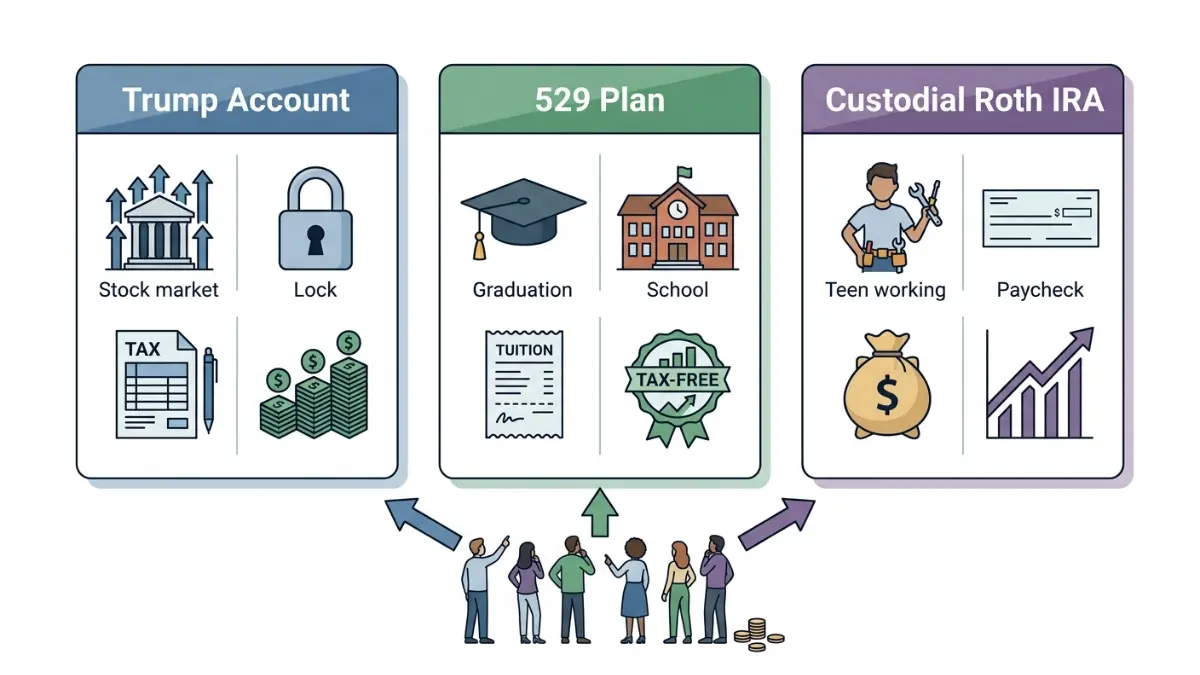
Where the money can go
The 529 is the only one built for school, and the 2025 law widened it. Qualified K-12 spending now reaches $20,000 a year per student, up from $10,000, and covers tutoring and curriculum materials, not just tuition. Before sizing any account, estimate what school will actually cost.
When the child can touch it
📊 Data Point: A Trump Account permits no withdrawals until January 1 of the calendar year the beneficiary turns 18 — Source: IRS, IR-2025-117 and Notice 2025-68, December 2025.
The tax difference is the whole ballgame
Every comparison reduces to one question: who pays tax on the growth, and when.
🔍 How It Works: Tax-deferred means you skip tax now and pay later. Tax-free means the growth is never taxed. A Trump Account is deferred — decades of gains come out as ordinary income. A 529 spent on school is genuinely tax-free federally.
What a Trump Account owes at withdrawal
Contributions from individuals use after-tax dollars and are not deductible, per the Congressional Research Service. Employer contributions go in untaxed. That split creates a basis calculation most coverage skips; our companion piece explains which contributions create basis and which don’t.
What happens on the child’s 18th birthday
The account becomes an ordinary traditional IRA the child controls. Standard rules follow, including the 10% early withdrawal penalty and its exceptions before age 59½.
✅ Action Step: Ask a CPA or tax attorney: “Given our bracket and our child’s likely bracket at 18, does converting this account to a Roth make sense, and in which tax year?”
The gift-tax question for grandparents
The 2026 annual gift tax exclusion is $19,000 per recipient. A 529 lets a donor front-load five years at once — 5 × $19,000, or $95,000.
Trump Accounts have no equivalent. Revenue Procedure 2026-25, issued June 29, 2026, created a safe harbor so contributing alone does not force a Form 709, but offers no front-loading.
What financial aid guidance does and doesn’t say yet
This is where competing articles go wrong, in both directions.
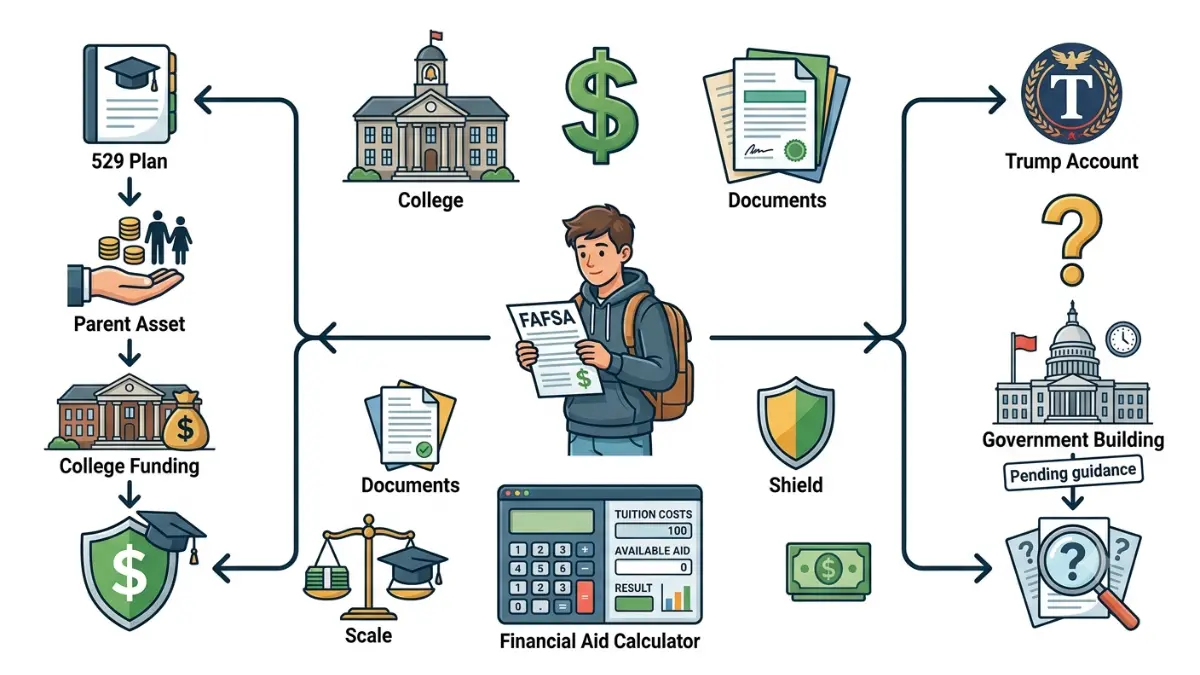
What’s settled about 529s
A parent-owned 529 is a parent asset, assessed at a maximum of 5.64%, against 20% for assets a student owns outright. Qualified withdrawals do not count as income at all. Our walkthrough of how the FAFSA calculates your Student Aid Index covers the mechanics.
What’s unresolved about Trump Accounts
💡 Expert Note: As of July 2026 the Department of Education had not issued guidance on reporting Trump Accounts on the FAFSA, as reported by CNBC on July 9, 2026. Analyses disagree — some treat the balance as a retirement account excluded from reported assets, others expect student-asset treatment at up to 20%. Neither reading is confirmed.
Both camps agree withdrawals count as student income, assessed more aggressively than assets. The practical answer does not depend on which wins: keep school money in the 529 and the question mostly stops mattering.
✅ Action Step: Ask a fee-only fiduciary advisor: “If Trump Account balances end up counted as student assets, how much would that change our expected aid at our income?”
The custodial Roth’s earned-income gate
A child may contribute only the lesser of documented earnings or the 2026 IRA contribution limit of $7,500. No job, no contribution — which rules this out for most children under 14. Our guide to the 2026 IRA contribution limits covers how the cap interacts with other accounts.
Where a teenager has real wages the case is strong. The five-year clock starting when the account opens runs independently of age, and you can project what a custodial Roth could hold.
Which account should get your next dollar
Yes, you can hold all three, and they carry separate limits. The sequence matters more than the choice.
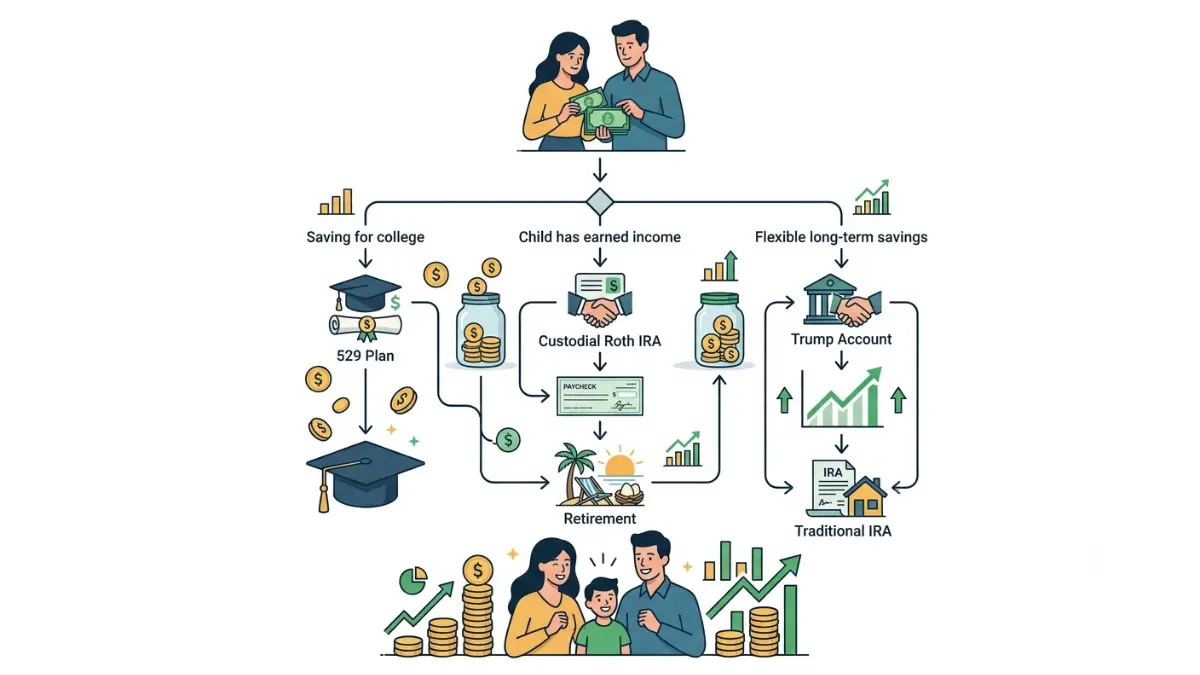
The order of operations
- Claim the $1,000 seed if your child was born in the 2025–2028 window. It costs nothing and forecloses nothing.
- Capture any employer contribution, because that money escapes your taxable income.
- Fund the 529 for anything earmarked for school — the only account where those withdrawals are federally tax-free.
- Fund a custodial Roth only if your child has documented earned income.
- Fund the Trump Account beyond the seed for money with no assigned purpose.
A worked example
🔍 How It Works: Set aside $2,000 a year for 18 years and you contribute $36,000. At an assumed 7% annual return that grows to roughly $68,000 — about $32,000 of it growth. This is an illustration, not a projection: it ignores fees, inflation and taxes, and real returns vary widely.
How that $32,000 is taxed is the whole argument. From a 529 spent on school it is federally tax-free; from a Trump Account it is ordinary income. Substitute your own figures with our compound growth calculator.
When the answer changes
The ordering shifts if your state offers no 529 deduction, if your child earns real wages, or if education savings already exceed what need-based aid actually covers.
Three mistakes families are already making
Each is costing real money right now.
Treating the $1,000 as a reason to stop funding a 529
The seed is worth claiming and too small to restructure a savings plan around. Redirecting years of education contributions into an account taxed as ordinary income trades a permanent advantage for one deposit.
Assuming “tax-advantaged” means tax-free
Growth-period investments are restricted to American equity index funds. There is no bond option, no target-date option, and no way to de-risk as the child nears 18.
Trusting contact from anyone who isn’t Treasury
⚠️ Costly Mistake: Treasury has warned that activation emails come only from no-reply@TrumpAccounts.Treasury.gov, and that it does not contact families by text or phone about activation. Anyone calling about your child’s account is almost certainly a scam. Opening an account is free — nobody should charge a fee.
Trump account vs 529: common questions
1. Is a Trump Account better than a 529?
Neither wins in the abstract. For money earmarked for education a 529 wins on tax treatment, since qualified withdrawals are federally tax-free while Trump Account withdrawals are ordinary income. For flexible money with no assigned purpose, the Trump Account fits better. Most families benefit from holding both.
2. Do Trump Accounts affect financial aid?
Partly unresolved. The Department of Education has not issued guidance on reporting Trump Account balances on the FAFSA, and published analyses disagree. Withdrawals do count as student income, which is assessed aggressively. A parent-owned 529 is settled law at a maximum 5.64%. Discuss your position with a financial-aid counselor.
3. Who qualifies for the $1,000?
The one-time $1,000 pilot contribution goes to U.S. citizen children born between January 1, 2025 and December 31, 2028 for whom an election is made. Children born outside that window can still hold a Trump Account — anyone not yet 18 by year-end qualifies — but receive no federal seed.
4. Can my child have a Roth IRA without a job?
No. A custodial Roth IRA requires documented earned income, and contributions cap at the lesser of those earnings or $7,500 for 2026. Babysitting or yard work can count if genuinely documented. This earned-income gate is why a Trump Account is often the only realistic option for younger children.
5. How much can you contribute each year?
A Trump Account accepts $5,000 a year across every contributor combined, not per person, of which an employer may provide $2,500. A custodial Roth IRA caps at $7,500 for 2026 or the child’s earnings, whichever is lower. A 529 has no federal annual cap.
6. Are Trump Account withdrawals taxed?
Yes. Because the account is legally a traditional IRA, withdrawals are taxed as ordinary income, and distributions before 59½ may face a 10% penalty unless an exception applies. Contributions from individuals are after-tax and create basis, changing the calculation. A CPA can model your outcome.
7. Can a Trump Account pay for college?
It can, at a cost. Money withdrawn is taxed as ordinary income even when spent on tuition, because education costs are a penalty exception rather than a tax exemption. A 529 spent on qualified education comes out federally tax-free instead. Ask a CPA before funding college this way.
8. What happens at 18?
From January 1 of the year the child turns 18, withdrawals become possible and the account is treated as an ordinary traditional IRA, controlled by the child. Standard IRA rules then apply, including the 10% early withdrawal penalty and its exceptions. A CPA can advise on conversion timing.
9. Can grandparents contribute?
Yes, and so can anyone else. The limit that matters is that the $5,000 annual cap applies per child, not per contributor. If two grandparents and both parents each contribute, their combined total still cannot exceed $5,000 that year. Coordinate before sending money.
10. Do I need to file a gift tax return?
Usually not. The 2026 annual gift tax exclusion is $19,000 per recipient, and Revenue Procedure 2026-25 created a safe harbor so contributing to a Trump Account does not by itself require a Form 709. Larger gifting plans get complicated quickly — check with a CPA or tax attorney.
11. Should I stop contributing to my 529?
Not because Trump Accounts exist. Redirect 529 money only if education savings already exceed what you expect school to cost, or if your state offers no deduction or credit. Below that threshold, the 529’s tax-free education withdrawals remain the strongest treatment available. A fiduciary advisor can set that threshold.
Where to go from here
These accounts are a sequence, not a contest. The seed is free money, the 529 is the school account, the custodial Roth needs a paycheck, and the Trump Account holds whatever has no name on it.
✅ Action Step: Check whether your child was born between January 1, 2025 and December 31, 2028. If so, file IRS Form 4547 or use the official Treasury portal and claim the $1,000.

Informational disclaimer
The content on Finance Authority Hub is provided for general informational and educational purposes only and should not be considered personalized financial, investment, tax, legal, or professional advice. Financial decisions depend on your individual goals, income, risk tolerance, location, and regulatory situation. Before acting on any information, strategy, estimate, or calculator result, consult a qualified licensed professional who can evaluate your specific circumstances.