
FAFSA 2026: File Today, Get $7,395+ (New SAI Rules)
The complete FAFSA 2026-27 guide: file today for up to $7,395 in Pell Grants. Learn the new SAI system, state deadlines, step-by-step filing process, and aid maximization tips.

In This Article
What Is FAFSA and Why File in 2026?
The Free Application for Federal Student Aid (FAFSA) is the gateway to over $150 billion in federal financial aid for college students across the United States. For the 2026-27 academic year, filing your FAFSA unlocks access to federal grants, work-study programs, and low-interest student loans that can make higher education affordable.
The 2026-27 FAFSA form became available on September 24, 2025—earlier than the traditional October 1 launch date. This accelerated timeline reflects significant improvements to the application process, including a streamlined 36-question format that replaces the previous 100+ question marathon.
What makes FAFSA 2026 different? The new form introduces same-day FSA ID creation, mobile-responsive design, and the Student Aid Index (SAI) calculation system that replaced the confusing Expected Family Contribution (EFC). These changes mean you can now create your account and submit your application on the same day, eliminating the old three-day verification wait.
Who Must File FAFSA in 2026?
Every college-bound student should file FAFSA, regardless of income level. Here’s why:
- Dependent students: Those under 24 who receive parental financial support
- Independent students: Those 24+, married, veterans, or with dependents
- Graduate students: Pursuing master’s or doctoral degrees
- Part-time students: Enrolled at least half-time in eligible programs
Even families earning six-figure incomes qualify for federal student loans and potential institutional aid. Many colleges require FAFSA completion to award their own merit-based scholarships, making it essential regardless of your expected aid eligibility.
Key Benefits of Filing FAFSA 2026
Filing your FAFSA application opens access to multiple funding sources:
- Federal Pell Grants: Up to $7,395 for the 2026-27 year (no repayment required)
- Federal work-study: Part-time campus employment
- Direct Subsidized Loans: Government pays interest while you’re in school
- Direct Unsubsidified Loans: Available regardless of financial need
- State grants: Many states use FAFSA data for their own aid programs
- College scholarships: Institutional aid often requires FAFSA submission
The earlier you file, the better your chances of maximizing need-based aid. Many state grant programs operate on a first-come, first-served basis, with funds depleting months before the federal deadline.
Understanding the Student Aid Index (SAI): What Changed in 2026
What Is SAI vs EFC?
The Student Aid Index (SAI) replaced the Expected Family Contribution (EFC) starting with the 2024-25 academic year, but 2026-27 brings critical new updates. Unlike EFC, which families often misinterpreted as the exact amount they’d pay for college, SAI is simply a number measuring your family’s financial strength.
SAI ranges from -1,500 to unlimited. Yes, negative numbers are possible—and they’re good news. An SAI of zero or below guarantees the maximum federal Pell Grant of $7,395 for 2026-27.
The key difference: EFC suggested a family contribution, while SAI measures eligibility for need-based aid. This terminology change reduces confusion about actual college costs, which depend on each school’s cost of attendance minus your total financial aid package.
How SAI Is Calculated for 2026-27
Your SAI calculation uses your family’s 2024 federal tax return data—the “prior-prior year” method. The official SAI formula considers four primary factors:
For dependent students:
- Parent adjusted gross income (AGI) from 2024 taxes
- Parent assets (excluding retirement accounts and primary residence)
- Student income above $11,770
- Student assets (assessed at 20% contribution rate)
Major 2026-27 calculation changes:
- Multiple students in college no longer reduces SAI
- Pre-tax 401(k)/403(b) contributions excluded from income
- Small family businesses (under 100 employees) excluded from assets
- Foreign income exclusion amounts now added to AGI for Pell eligibility
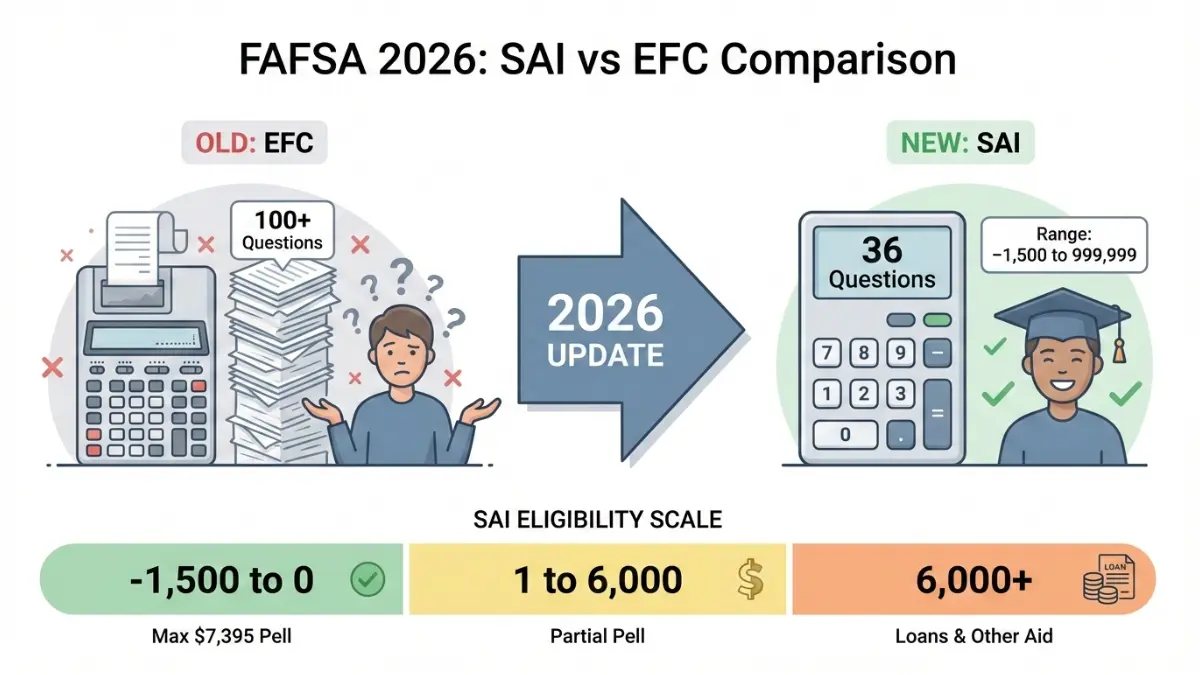
SAI Income Limits and Pell Grant Eligibility
Understanding SAI thresholds helps you estimate your aid eligibility before filing. Here’s how 2026-27 SAI numbers translate to federal aid:
| SAI Range | Pell Grant Eligibility | Other Federal Aid |
|---|---|---|
| -1,500 to 0 | Maximum $7,395 | Full eligibility |
| 1 to 6,000 | Partial Pell Grant | Full eligibility |
| 6,001 to 8,000 | Likely ineligible for Pell | Loans and work-study |
| 8,000+ | Pell ineligible | Federal loans available |
For families earning under $60,000 annually with typical assets, SAI usually qualifies you for maximum Pell Grant awards. Families earning $60,000-$100,000 may receive partial Pell Grants depending on family size and assets.
Foreign Income Exclusion (NEW August 2025 Update)
A critical August 2025 policy change affects FAFSA filers with foreign income exclusions. The Department of Education now adds foreign income exclusion amounts to your AGI when determining Pell Grant eligibility under the maximum Pell indicator calculations.
This means families working abroad who exclude foreign earned income from U.S. taxes will see that excluded amount factored back into the SAI formula. While this doesn’t change your SAI number for most aid calculations, it may affect automatic maximum Pell Grant qualification for lower-income families with international earnings.
If this applies to your situation, review the updated SAI calculation guide to understand how your specific circumstances affect aid eligibility.
How to File FAFSA 2026: Complete Step-by-Step Guide
Before You Start: Documents Needed
Gather these materials before beginning your FAFSA application to avoid delays:
Student documents:
- Social Security number (or Alien Registration Number)
- Driver’s license number (if applicable)
- 2024 federal tax return (Form 1040)
- W-2 forms from 2024
- Bank statements and investment records
Parent documents (for dependent students):
- Social Security numbers for both parents
- 2024 federal tax return
- Current asset values (savings, investments, real estate equity)
If you’re unsure about your 2024 tax return details, locate your adjusted gross income on Line 11 of Form 1040. This number is critical for accurate FAFSA completion.
Step 1: Create FSA ID (NEW: Same-Day Process)
Your FSA ID serves as your legal signature for all federal student aid documents. For 2026-27, the verification process now happens in real-time through Social Security Administration matching.
How to create your FSA ID:
- Visit StudentAid.gov/fsa-id
- Provide your Social Security number, name, date of birth
- Create username and password
- Enter email address and mobile number
- Complete identity verification questions
NEW for 2026: You can now use your FSA ID immediately to sign and submit your FAFSA. The old three-day waiting period has been eliminated for applicants with Social Security numbers, thanks to real-time SSA verification.
Step 2: Start Your FAFSA Application
Navigate to the official FAFSA website and select “Start the 2026-27 FAFSA.” The application asks who you are (student, parent, or preparer) before launching into seven main sections:
- Student demographics and school information
- Student financial information
- Parent demographics (if dependent)
- Parent financial information
- School selection (up to 20 institutions)
- Signatures and submission
- Review and confirmation
The mobile-responsive design works seamlessly on smartphones and tablets, allowing you to save progress and return later from any device.
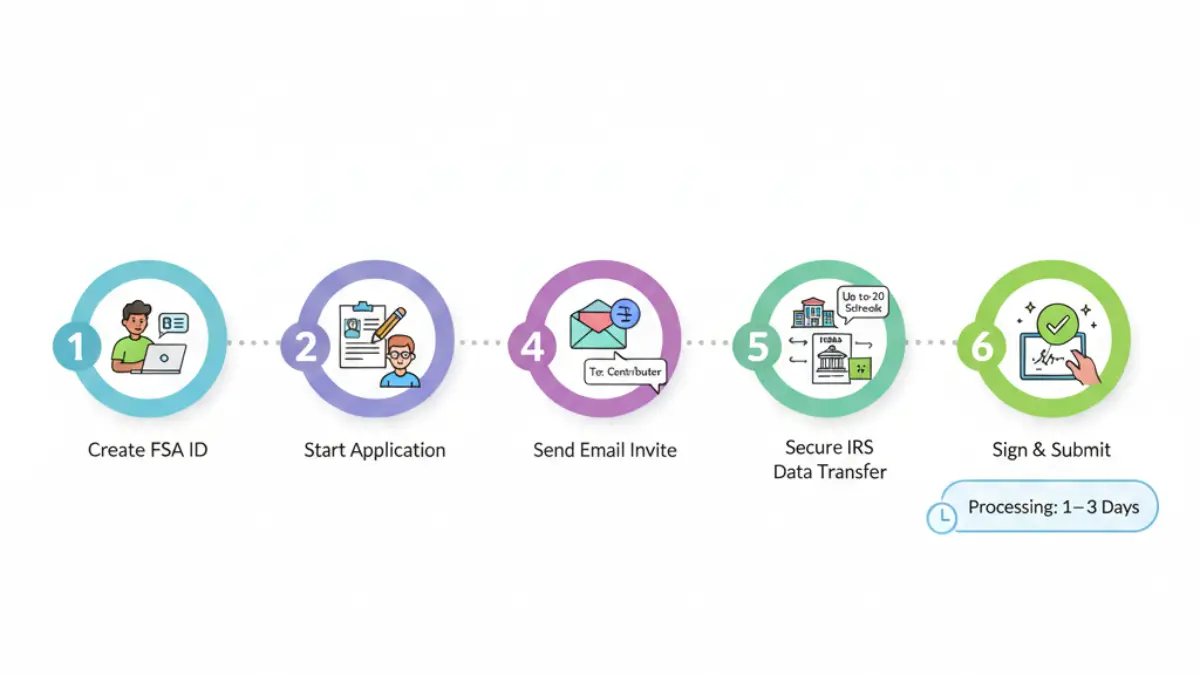
Step 3: Invite Contributors (Email-Only Method)
Contributors are anyone required to provide information on your FAFSA—typically parents for dependent students or spouses for married students. The 2026-27 form simplifies the invitation process dramatically.
How the new contributor system works:
- Enter your parent’s or spouse’s email address only (no SSN required upfront)
- They receive a secure invitation code
- Contributors log in using their own FSA ID
- They complete their section independently
- Their data automatically links to your FAFSA
This email-based system eliminates errors from incorrectly entered Social Security numbers and dates of birth. Contributors can use any email address—it doesn’t need to match their FSA ID email.
Step 4: IRS Data Direct Exchange
The Direct Data Exchange (DDX) automatically imports tax information from the IRS into your FAFSA, replacing the old IRS Data Retrieval Tool. This system is faster, more accurate, and reduces verification requests from colleges.
All contributors must consent to DDX transfer. When you consent, the IRS shares:
- Adjusted gross income
- Income tax paid
- Untaxed portions of IRA distributions
- IRA deductions and payments
If you filed taxes as “married filing separately” or have complex tax situations, you may need to manually enter some information. However, using DDX whenever possible significantly speeds up processing and reduces errors.
Step 5: List Colleges (Up to 20 Schools)
You can send your FAFSA information to up to 20 colleges, universities, or career schools. List schools strategically:
- Reach schools: Colleges where admission is competitive
- Match schools: Institutions where you meet typical admission criteria
- Safety schools: Colleges where you exceed admission standards
Schools receive identical FAFSA information regardless of list order. Many students list 10-15 schools to maximize aid comparison opportunities. If you later apply to additional colleges, you can add them through your online FAFSA account.
Step 6: Sign and Submit
Both student and all contributors must electronically sign using their FSA IDs. Missing signatures are among the most common FAFSA errors, delaying processing by weeks.
After signing, you’ll receive a confirmation page—save or screenshot this as proof of submission. Your FAFSA typically processes within 1-3 days for online submissions.
What Happens After You Submit
Within days of submission, you’ll receive your FAFSA Submission Summary via email. This document shows:
- Your calculated Student Aid Index (SAI)
- Schools that received your information
- Any errors or missing information requiring correction
Colleges access your FAFSA data and use it to create financial aid offers, typically arriving with admission decisions. Your SAI appears on all offers, showing how each school calculated your aid eligibility.
If you need to make corrections, log into your FAFSA account and update information before college deadlines. Many students update FAFSA data after completing taxes to ensure accuracy.
FAFSA Deadlines 2026: Federal, State, and College Deadlines
Federal Deadline: June 30, 2027
The federal FAFSA deadline for 2026-27 is June 30, 2027. Applications received after this date cannot access federal student aid for the 2026-27 academic year (July 1, 2026 – June 30, 2027).
However, waiting until June 2027 to file guarantees you’ll miss out on thousands in state and college aid. Many aid programs distribute funds on a first-come, first-served basis, depleting months before the federal deadline.
Why File Early: First-Come, First-Served Aid
State grant programs typically exhaust funding by late winter or early spring. Filing within weeks of the October opening date maximizes your access to:
- State need-based grants
- College institutional grants
- Federal Supplemental Educational Opportunity Grants (FSEOG)
- Federal work-study positions
Students who file FAFSA in October or November often receive $2,000-$5,000 more in grant aid than those filing in March or April, simply due to fund availability.
State Deadline Table (All 50 States)
Each state sets its own FAFSA deadline for state financial aid programs. Missing your state deadline means forfeiting thousands in potential grants.
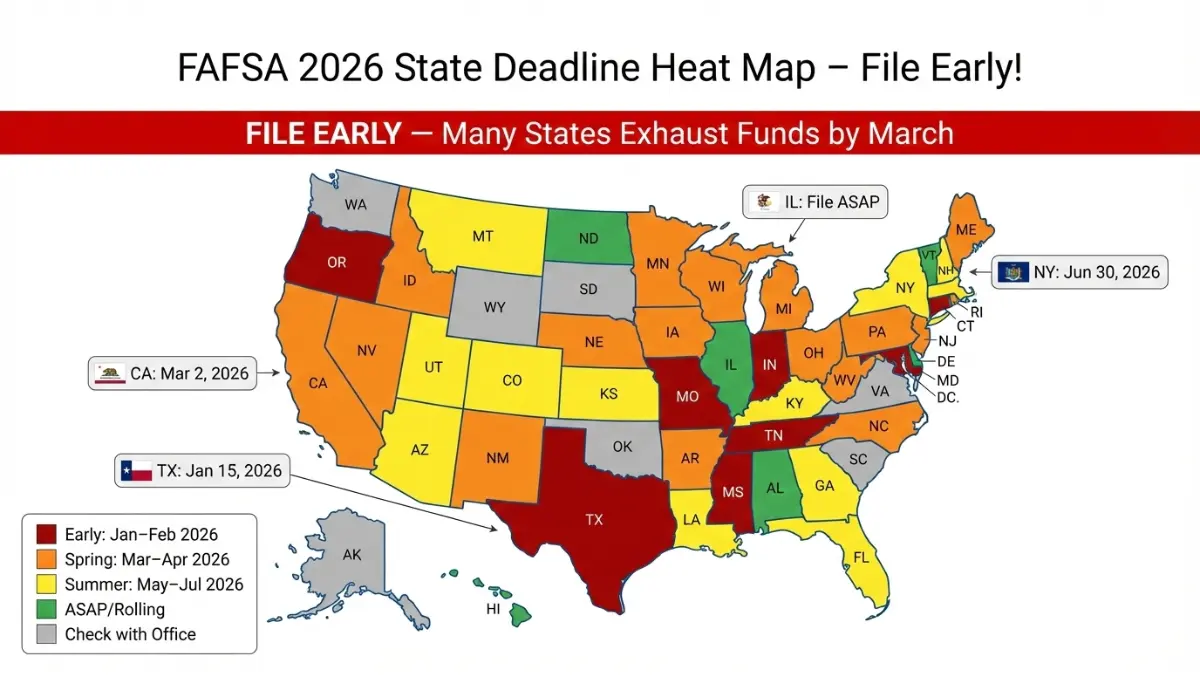
| State | Priority Deadline | State | Priority Deadline |
|---|---|---|---|
| Alabama | Check with financial aid office | Montana | Check with financial aid office |
| Alaska | June 30, 2026 | Nebraska | Check with financial aid office |
| Arizona | April 1, 2026 | Nevada | Check with financial aid office |
| Arkansas | July 1, 2026 | New Hampshire | Check with financial aid office |
| California | March 2, 2026 | New Jersey | As soon as possible after Oct 1 |
| Colorado | Check with financial aid office | New Mexico | Check with financial aid office |
| Connecticut | Feb 15, 2026 | New York | As soon as possible after Oct 1 |
| Delaware | April 15, 2026 | North Carolina | March 15, 2026 |
| Florida | As soon as possible | North Dakota | As soon as possible |
| Georgia | Check with financial aid office | Ohio | Oct 1, 2026 |
| Hawaii | Check with financial aid office | Oklahoma | As soon as possible |
| Idaho | March 1, 2026 | Oregon | As soon as possible |
| Illinois | As soon as possible after Oct 1 | Pennsylvania | May 1, 2026 |
| Indiana | April 15, 2026 | Rhode Island | March 1, 2026 |
| Iowa | As soon as possible | South Carolina | As soon as possible |
| Kansas | April 1, 2026 | South Dakota | As soon as possible |
| Kentucky | As soon as possible | Tennessee | As soon as possible |
| Louisiana | July 1, 2026 | Texas | Jan 15, 2026 |
| Maine | May 1, 2026 | Utah | Check with financial aid office |
| Maryland | March 1, 2026 | Vermont | As soon as possible after Oct 1 |
| Massachusetts | May 1, 2026 | Virginia | As soon as possible after Oct 1 |
| Michigan | March 1, 2026 | Washington | As soon as possible after Oct 1 |
| Minnesota | As soon as possible | West Virginia | April 15, 2026 |
| Mississippi | March 31, 2026 | Wisconsin | Check with financial aid office |
| Missouri | April 1, 2026 | Wyoming | Check with financial aid office |
States listing “as soon as possible” don’t specify exact deadlines but award grants until funds run out. File immediately after October 1 in these states to ensure maximum aid eligibility.
For detailed state deadline information, visit the official Federal Student Aid state deadlines page.
College Priority Deadlines
Individual colleges set their own FAFSA deadlines for institutional aid, often much earlier than state or federal deadlines. These priority deadlines typically align with admission application deadlines:
- Early Decision/Early Action: November-December 2025
- Regular Decision: January-February 2026
- Transfer Students: March-May 2026
Check each college’s financial aid website for specific deadlines. Missing a college’s priority deadline doesn’t disqualify you from admission, but it may significantly reduce available grant aid.
How to Maximize Your Financial Aid (2026 Strategies)
Common FAFSA Mistakes to Avoid
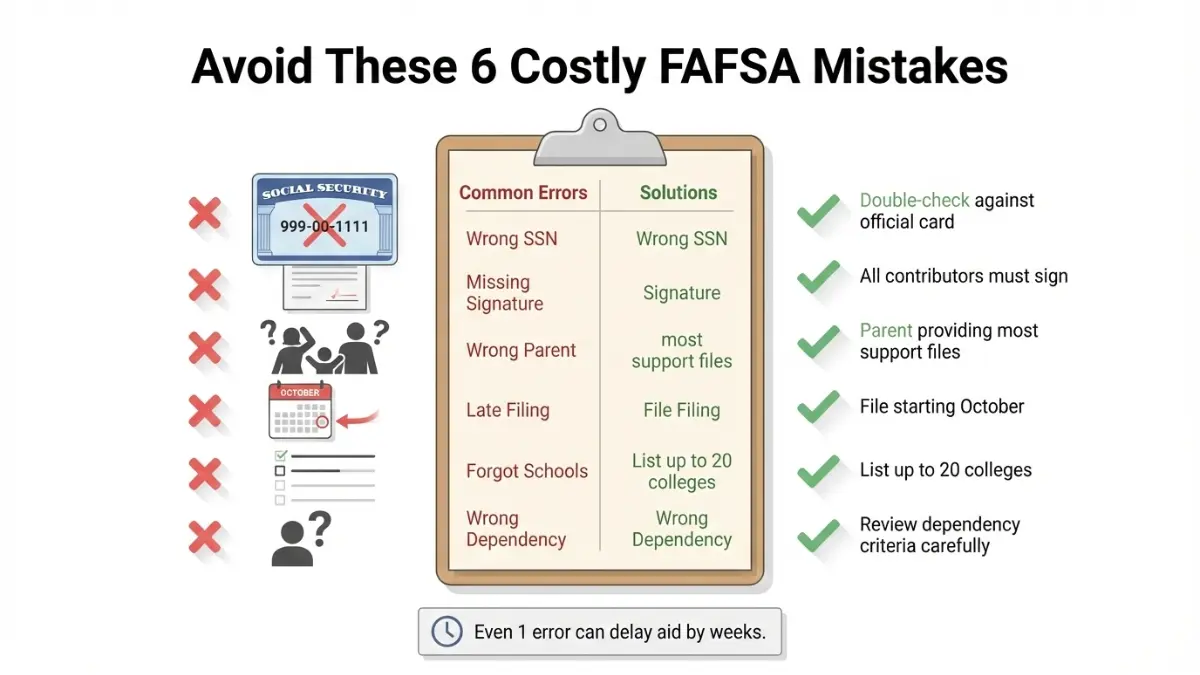
Even minor errors can delay your FAFSA processing by weeks or trigger time-consuming verification processes. The most frequent mistakes include:
Social Security number errors: Double-check SSNs for yourself and contributors against Social Security cards. One incorrect digit triggers rejection.
Missing signatures: Both student and all contributors must sign with their FSA IDs. Unsigned applications cannot be processed.
Wrong parent for divorced families: Report the parent who provided the most financial support during the past 12 months, not necessarily the custodial parent.
Procrastination: Waiting until spring to file costs thousands in first-come aid. File within weeks of the October opening.
Forgetting to list all schools: You can include up to 20 colleges. Listing fewer limits your aid comparison options.
Incorrect dependency status: Students under 24 are usually dependent unless they’re married, veterans, have children, or meet other specific criteria.
If you’re managing multiple financial obligations like debt consolidation strategies, plan your FAFSA filing timeline carefully to ensure accuracy without missing deadlines.
Special Circumstances Appeals
Your 2024 tax information may not reflect your current financial reality. Significant life changes since filing taxes can qualify you for a professional judgment review through your college’s financial aid office.
Common special circumstances include:
- Job loss or significant income reduction
- Divorce or separation
- Death of a parent or spouse
- Large unreimbursed medical expenses
- Natural disaster impact
- Disability or extended illness
How to appeal for special circumstances:
- Complete and submit your FAFSA using 2024 tax data
- Contact the financial aid office at colleges where you’re admitted
- Explain your changed circumstances in writing
- Provide documentation (termination letters, medical bills, divorce decrees)
- Request a professional judgment review
Financial aid officers have authority to adjust your SAI based on current circumstances, potentially increasing your aid package by thousands of dollars. Each college evaluates appeals independently, so file with all schools where you’re considering enrollment.
Divorced/Separated Parents: Who Files?
The 2026-27 FAFSA clarified rules for divorced, separated, or never-married parents. The parent who provided the most financial support during the past 12 months completes the parent section, regardless of custody arrangements.
How to determine which parent files:
- Calculate total financial support each parent provided (housing, food, medical care, education expenses)
- The parent providing 51% or more is the “contributor parent”
- If support was exactly equal, use the parent with higher income/assets
- Stepparent information must be included if the contributor parent remarried
Real scenario: Maria’s parents divorced in 2023. She lives with her mother but her father pays her private school tuition and provides higher monthly support. Her father completes the FAFSA parent section, along with his new spouse if remarried.
This rule differs from tax dependency. Your FAFSA parent may not be the parent who claims you as a tax dependent.
Independent vs Dependent Status
Most students under 24 are considered dependent for FAFSA purposes, requiring parent information regardless of whether parents actually provide support. You’re automatically independent if you meet any of these criteria:
- Age 24 or older by January 1, 2026
- Married or separated (not divorced)
- Working toward a graduate or professional degree
- Currently serving in the U.S. Armed Forces
- Veteran of the U.S. Armed Forces
- Have children who receive more than half their support from you
- Have dependents other than children or spouse living with you
- Both parents deceased or you’re a ward of the court
- Emancipated minor as determined by a court
- In legal guardianship as determined by a court
- Unaccompanied homeless youth
If none of these apply but you have exceptional circumstances (abusive parents, incarceration, abandonment), contact college financial aid offices about dependency override requests. These require extensive documentation and occur on a case-by-case basis.
Professional Judgment Reviews
Colleges have limited authority to override your calculated SAI through professional judgment when documented circumstances warrant adjustment. Unlike special circumstances appeals (which address changed financial situations), professional judgment can address:
Asset adjustments:
- Exclusion of one-time asset transfers from inheritance
- Adjustments for high medical debt not reflected in tax returns
- Corrections for unusual asset liquidation circumstances
Income adjustments:
- Projected income for the aid year (not just 2024)
- Exclusion of one-time income events (home sale, retirement distribution)
- Adjustments for loss of employment benefits
Each college evaluates professional judgment independently. Approval at one school doesn’t guarantee approval elsewhere. Provide detailed documentation and maintain respectful communication with financial aid offices throughout the process.
What to Do If You Made an Error
Discovering a FAFSA error after submission is common and correctable. Log into your FAFSA account and make corrections before college deadlines.
How to correct your FAFSA:
- Log in at FAFSA.gov using your FSA ID
- Select “Make FAFSA Corrections”
- Update incorrect information
- Re-sign with your FSA ID
- Submit corrections
Corrections typically process within 3-5 days. Some errors (like incorrect Social Security numbers) may require contacting Federal Student Aid at 1-800-433-3243 for manual resolution.
If your college already created a financial aid offer based on incorrect FAFSA data, notify their financial aid office about your corrections. They’ll recalculate your aid package using updated information.
FAFSA 2026 FAQs
1. When does FAFSA 2026-27 open?
The 2026-27 FAFSA opened September 24, 2025. You can file anytime between this date and the June 30, 2027 federal deadline, but filing early maximizes aid eligibility.
2. What is the FAFSA deadline for 2026-27?
The federal deadline is June 30, 2027. However, state and college deadlines occur much earlier—some as soon as January 2026. Check your specific state and college deadlines to avoid missing aid opportunities.
3. How long does FAFSA take to process?
Online FAFSA applications typically process within 1-3 days. You’ll receive your FAFSA Submission Summary via email once processing completes, showing your SAI and any required corrections.
4. Can I file FAFSA without my parents?
Dependent students under 24 must include parent information unless they meet specific independence criteria (marriage, military service, having dependents, graduate student status). Independent students file without parent information.
5. What income is used for FAFSA 2026-27?
The 2026-27 FAFSA uses 2024 federal tax return information—the “prior-prior year” method. This allows most families to file FAFSA immediately when it opens rather than waiting for tax season.
6. Do I need to file FAFSA every year?
Yes. FAFSA must be filed annually for each academic year you need financial aid. Renewal FAFSA applications are slightly simpler, pre-populating information from your previous year’s submission.
7. Can I update my FAFSA after submitting?
Yes. Log into your FAFSA account to make corrections or add colleges anytime before the deadline. Some updates require re-signing with your FSA ID, while others process automatically.
8. What if I don’t have a Social Security number?
U.S. citizens and eligible noncitizens without Social Security numbers should contact Federal Student Aid at 1-800-433-3243. Contributors without SSNs can still create FSA IDs and complete their FAFSA sections using alternative identification.
9. How do I know if I’m eligible for a Pell Grant?
Your FAFSA Submission Summary shows your SAI. An SAI of zero or below typically qualifies you for the maximum $7,395 Pell Grant. SAI values between 1-6,000 may qualify for partial Pell Grants depending on your college’s cost of attendance.
10. Can I list more than 10 colleges on FAFSA?
Yes. The 2026-27 FAFSA allows up to 20 colleges per application. If you need to add schools later or exceed 20, you can update your FAFSA after initial submission to add different colleges.
11. Is there a fee to file FAFSA?
No. FAFSA is completely free—the first “F” stands for “Free.” Never pay anyone to help you file FAFSA. Free assistance is available from high school counselors, college financial aid offices, and Federal Student Aid at 1-800-433-3243.
Disclaimer
This article is for educational purposes and does not constitute financial advice. FAFSA policies, deadlines, and aid amounts are subject to change by the U.S. Department of Education. For personalized guidance on your financial aid situation, consult your college’s financial aid office or a licensed financial advisor.
Federal student aid programs have specific eligibility requirements. Not all students qualify for all aid types. Your actual financial aid offer depends on your college’s cost of attendance, available funding, and your individual circumstances.
FAFSA is a registered trademark of the U.S. Department of Education. This article is not affiliated with or endorsed by the Department of Education. For official information, visit StudentAid.gov.
Informational disclaimer
The content on Finance Authority Hub is provided for general informational and educational purposes only and should not be considered personalized financial, investment, tax, legal, or professional advice. Financial decisions depend on your individual goals, income, risk tolerance, location, and regulatory situation. Before acting on any information, strategy, estimate, or calculator result, consult a qualified licensed professional who can evaluate your specific circumstances.