The first step to a Trump account for kids and the $1,000
Trump accounts for kids are open, and the $1,000 is real — but the free money creates no basis, so every dollar of it is taxed as ordinary income later.
In This Article
The $1,000 is real, the accounts opened on July 4, 2026, and it costs nothing to open one. If you have not filed yet, you have not missed it.
A Trump account is a new type of individual retirement account for a child under 18. A parent or guardian opens it and manages it. The child owns it.
Three paths through this page, depending on where you are:
- Your child was born in 2025 or later. The one-time $1,000 from the U.S. Treasury is probably yours to claim. Start with the eligibility check, then the steps.
- Your child was born before 2025. No federal $1,000, but an account is still allowed, and some children qualify for charitable deposits instead.
- You already filed and nothing has appeared. Skip to the activation section. A delay is common and is not a rejection.
One thing worth knowing before you start: opening the account and funding the account are two separate decisions, and only the first one involves free money.
ℹ️ Financial Disclaimer: This article is educational and is not personalized investment, tax, or retirement advice. Trump accounts involve investment activity and tax consequences that depend on your income, your other gifts, and your family’s circumstances. Before contributing, converting, or withdrawing, consult a fee-only fiduciary financial advisor for investment questions, a CPA or enrolled agent for tax questions, and a qualified attorney for guardianship or estate questions.
Does your child qualify for the $1,000?
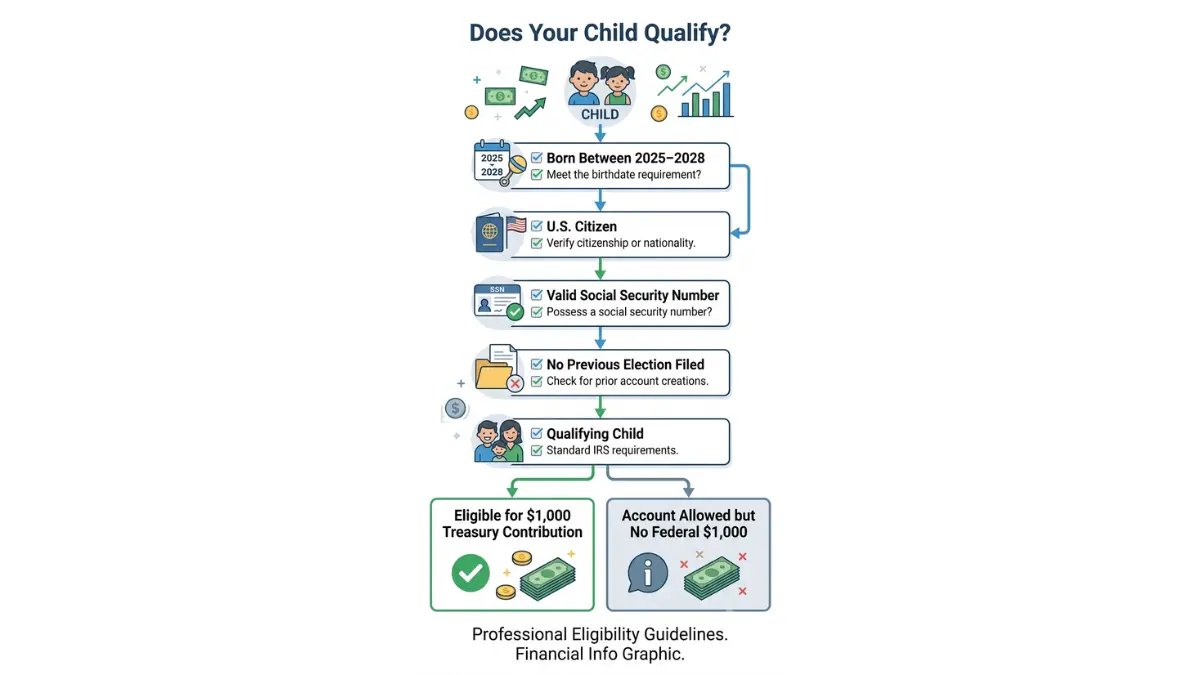
A child qualifies for the pilot program contribution of $1,000 if all five of these are true:
- The child is anticipated to be the qualifying child of the person making the election.
- The child was born after December 31, 2024, and before January 1, 2029.
- No prior pilot contribution election has been processed for that child.
- The child is a U.S. citizen.
- The child has a valid Social Security number.
Those five conditions are one gate. A separate, wider gate decides who can have an account at all: the child must not have turned 18 before the end of the year the election is made, must have an SSN issued before the election, and must not already have an election on file. For an election made in 2026, that means a child born after December 31, 2008.
If your child was born before 2025
The federal $1,000 window is fixed by statute, so a child born in 2024 or earlier does not receive it. An account is still permitted. Several charitable programs have pledged one-time deposits aimed at children who miss the federal cohort, and eligibility differs by program — check the official government program site, TrumpAccounts.gov, rather than a news summary.
What your child’s birth year actually means
🔍 How It Works: The lock-up is calculated by calendar year, not by birthday. The growth period runs from the day the account is established until December 31 of the year before your child turns 18. On January 1 of the year they turn 18, most special rules fall away. A child born in October 2025 turns 18 in October 2043, so their growth period ends December 31, 2042.
| Birth year | $1,000 from Treasury | Growth period ends | Becomes a regular IRA | Key detail |
|---|---|---|---|---|
| 2025 | Yes | Dec 31, 2042 | Jan 1, 2043 | Matches the IRS’s own worked example |
| 2026 | Yes | Dec 31, 2043 | Jan 1, 2044 | Roughly 18 years locked from today |
| 2027 | Yes | Dec 31, 2044 | Jan 1, 2045 | Elect any time after the SSN is issued |
| 2028 | Yes | Dec 31, 2045 | Jan 1, 2046 | Final birth year in the pilot |
| 2009–2024 | No | Dec 31 of the year before age 18 | Jan 1 of the year they turn 18 | Account allowed; charitable deposits may apply |
Dates computed by the FinanceAuthorityHub Editorial Team from the growth-period rule in the IRS Instructions for Form 4547.
How to open a Trump account, step by step
To open a Trump account for kids, you submit IRS Form 4547 — online through your IRS account, with your tax return, or on paper. The online route is the fastest.
Before you start, have ready:
- An ID.me account, or the time to create one.
- Your child’s Social Security number.
- Your child’s date of birth and address.
The online route:
- Sign in to your IRS individual account with ID.me, or create one.
- Complete and submit Form 4547 to elect your child.
- Check the status of the submitted election in the same account.
The IRS puts this at five to ten minutes. The identity-verification step is where people stall, not the form itself.
If you are not claiming the $1,000, the person making the election must be the child’s legal guardian, parent, adult sibling, or grandparent, in that order of priority. If you are claiming the $1,000, you must be someone who expects to claim that child as a qualifying child for the tax year. Either way, you sign under penalties of perjury.
You can open a Trump account through the IRS sign-in page at any time, including alongside your return. Opening a regular retirement account for yourself is a different process — opening a regular IRA for yourself works differently and involves a brokerage rather than the Treasury.
⚠️ Costly Mistake: If you file Form 4547 on paper, the signature must be handwritten — typed, digital, and electronic signatures are not valid on a paper form and the election will not process. Do not attach Form 4547 to Form 1040-X, and do not amend a return just to add it.
How much can go in, and who gets taxed on it
Contributions to a Trump account are capped at $5,000 a year during the growth period, with cost-of-living adjustments after 2027. Several categories sit outside that cap entirely.
| Contribution type | Annual cap | Counts toward $5,000? | Creates basis? | Key detail |
|---|---|---|---|---|
| Treasury pilot | $1,000, one time | No | No | Fully taxable as ordinary income later |
| Family, friends, the child | $5,000 combined | Yes | Yes | Never deductible during the growth period |
| Employer, under section 128 | $2,500 | Yes | No | Sits inside the $5,000, not on top of it |
| Government or 501(c)(3) | Set by the program | No | No | Must go to a defined class of children |
| Rollover from another Trump account | No cap | No | Basis carries over | Entire balance, trustee to trustee |
Source: IRS Instructions for Form 4547, verified July 23, 2026.
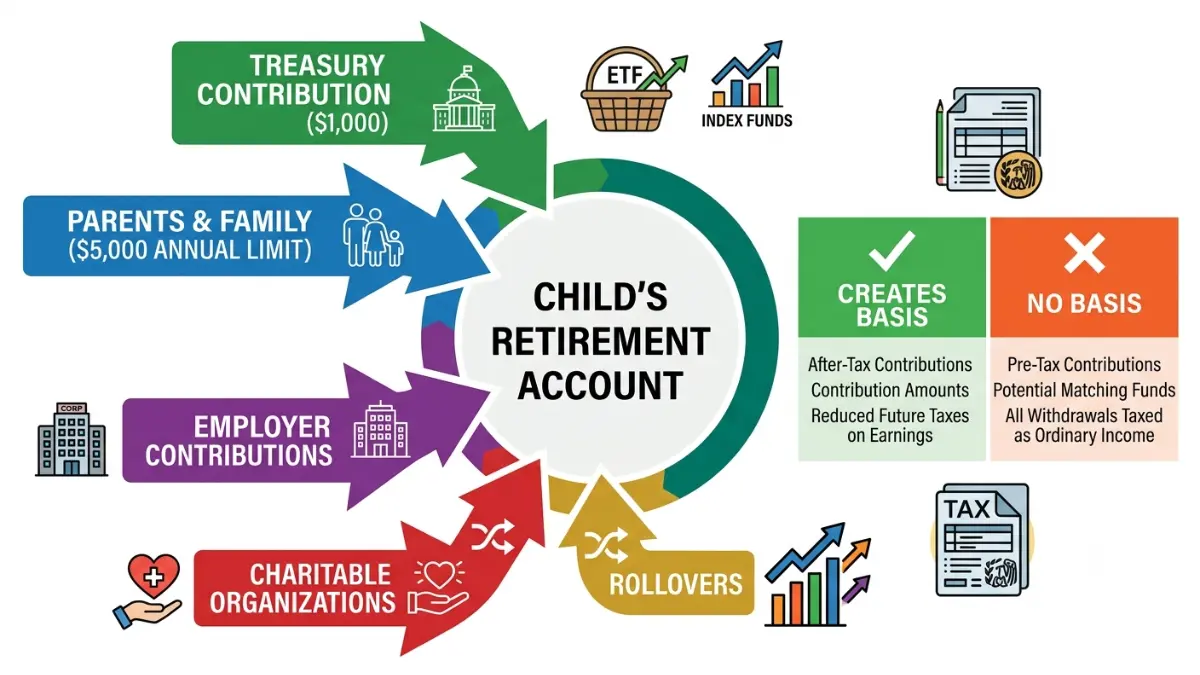
🔍 How It Works: Basis is the money already taxed on the way in, and it is not taxed again on the way out. Dollars your family contributes create basis. The $1,000, employer dollars, and charitable deposits create none — so every one of those dollars, plus everything they earn, is taxed as ordinary income when withdrawn. That is the difference between how long-term capital gains are taxed instead in a plain brokerage account.
During the growth period the money can only sit in a mutual fund or ETF tracking an index of primarily U.S. companies. Individual stocks, bond funds, sector funds, money market funds, and foreign-weighted indexes are all excluded, though how index funds and mutual funds differ still matters for what you pick among the eligible options.
Contributions may also count as gifts. IRS guidance issued in June 2026 created a safe harbor so most individual donors do not have to file a gift tax return solely because they contributed.
✅ Action Step: Before contributing, ask a CPA or enrolled agent one specific question: “Given my income and my total gifts to this child this year, does a Trump account contribution create any filing obligation for me?”
You filed and the $1,000 hasn’t arrived. What now?
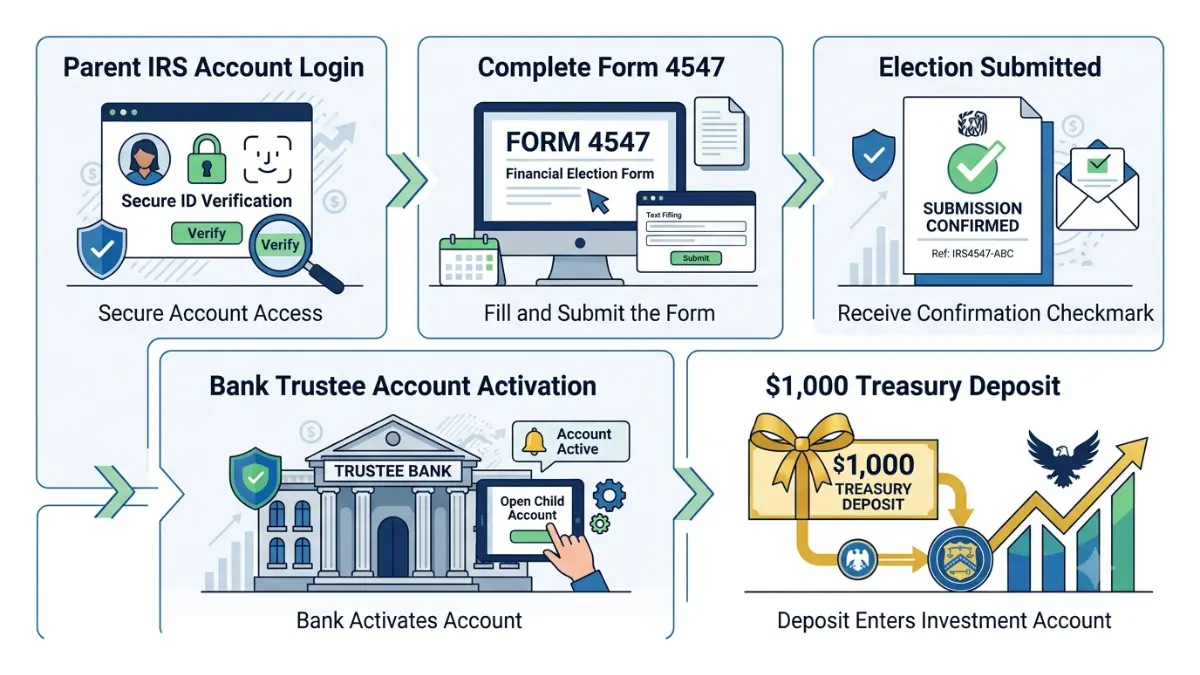
There are five links in the chain between filing and funding, and a stall at any one of them looks identical from the outside.
- Your election is filed on Form 4547.
- The Treasury, or its agent, sends you information to activate the account.
- You complete an identity authentication step.
- A trustee — a bank, or a nonbank trustee approved by the IRS — opens the account.
- The Treasury deposits the $1,000, once it can confirm with the trustee that the account is open.
The Treasury began sending activation information in May 2026, in phases. No pilot deposit could be made before July 4, 2026, regardless of when you filed.
Waits are real. The Associated Press and Fortune both reported on July 22, 2026 that some parents were still waiting, including one who was told to expect the deposit in about ten days and was later told up to four weeks. A delay is not a rejection, and nobody should pay a third party to speed up a free federal process.
✅ Action Step: Sign in to your IRS individual account and check the status of your submitted election before assuming anything went wrong. If the status looks stalled, use the program’s own support channel rather than a search result.
Trump account, 529, or custodial Roth: which does what
During the growth period, the only withdrawals allowed are four narrow ones: a rollover to another Trump account, a rollover to the child’s ABLE account at 17, a return of excess contributions, and a distribution on the child’s death. Ordinary traditional IRA rules take over from January 1 of the year the child turns 18 — a timing rule that is still unsettled and may shift to the birthday itself.
| Account | Built for | Earned income needed? | Tax on withdrawal | Best for |
|---|---|---|---|---|
| Trump account | Long-term, retirement-shaped saving | No | Ordinary income | A child eligible for free federal or employer money |
| 529 plan | Education | No | Tax-free for qualified education costs | A defined education goal |
| Custodial Roth IRA | Retirement | Yes | Tax-free in retirement | A teenager with actual earnings |
| Taxable brokerage | Anything | No | Long-term capital gains | Flexibility, with no lock-up |
Structural comparison only. Sources: IRS Instructions for Form 4547 and the SEC’s investor education page on Trump Accounts.
💡 Expert Note: Tax-advantaged here means deferred, not forgiven. Adam Michel of the Cato Institute argued in June 2026 that ordinary-income treatment at withdrawal can leave a family worse off than a taxable brokerage account taxed at capital gains rates. Madeline Brown of the Urban Institute has separately questioned how much the account does for lower-income households once the $1,000 is spent.
Once the account becomes a traditional IRA, the 10% early withdrawal penalty applies unless an exception does, and the difference between Roth and traditional tax treatment starts to matter. For the full picture of how these accounts relate, see how the main IRA types actually differ, or run the numbers on an 18-year horizon yourself.
Five things that surprise parents later
Your child controls the money at 18. Not you. On January 1 of the year they turn 18 they take ownership, and what happens next is their decision.
One account per child. Once an election has been filed for a child, another cannot be made, so the first filing is the one that counts.
There is no hardship exit. During the growth period, the four narrow exceptions are the only way money leaves the account. A change in your circumstances is not one of them.
⚠️ Costly Mistake: Treating this as a college fund. It is retirement-shaped, taxed as ordinary income, and locked until 18 — which is why the exceptions that let you withdraw without the penalty matter so much once it converts.
The big projections rest on one assumption. Figures in the hundreds of thousands assume a long-run average annual return above 10%, sustained for decades.
✅ Action Step: Ask a fee-only fiduciary advisor: “If my child controls this account as an adult, how should that change what I put in it versus what I hold in my own name for them?”
Trump accounts for kids: common questions
1. Is it too late to open a Trump account?
No. The election can be made at any time, as long as your child has not turned 18 before the end of the calendar year you file. For a 2026 election, that covers children born after December 31, 2008. The July 4 launch was a funding date, not an enrollment deadline.
2. Does my child get $1,000 if they were born before 2025?
No. The $1,000 pilot contribution is limited to children born after December 31, 2024 and before January 1, 2029. A Trump account can still be opened for an older child, and some charitable programs have pledged one-time deposits aimed at exactly that group.
3. How long does the $1,000 take to arrive?
The Treasury deposits it once it can confirm with the trustee that the account is open, and never before July 4, 2026. Reporting from the Associated Press and Fortune on July 22, 2026 described waits stretching past the ten days some parents were initially quoted.
4. Do I have to file a gift tax return if I contribute?
Usually not. IRS guidance issued in June 2026 created a safe harbor treating qualifying contributions as ordinary present-interest gifts, removing the filing requirement for most individual donors. The conditions are specific, so confirm your own position with a CPA before you rely on it.
5. Can I take the money out early?
No, apart from four narrow exceptions during the growth period: a rollover to another Trump account, an ABLE rollover at 17, a return of excess contributions, and a distribution on the child’s death. Hardship is not among them. Ask a fiduciary advisor before committing money you may need.
6. Is a Trump account better than a 529?
They solve different problems. A 529 is built for education and pays out tax-free for qualified costs; a Trump account is retirement-shaped and taxed as ordinary income. You can estimate what a college savings target actually requires, then discuss the split with a CPA.
7. Can grandparents open or fund one?
A grandparent can make the election when no legal guardian, parent, or adult sibling does — they sit fourth in the priority order. Anyone can contribute afterward, but every non-exempt contribution from every source shares the same $5,000 annual cap for that child.
8. What is the money invested in?
During the growth period, only a mutual fund or ETF tracking an index of primarily U.S. companies, with annual fees and expenses no higher than 0.1% and no leverage. Individual stocks, bond funds, sector funds, money market funds, and foreign-weighted indexes are excluded by law.
9. What happens when my child turns 18?
On January 1 of that year the growth period ends and ordinary traditional IRA rules take over, including the 10% additional tax on early distributions unless an exception applies. Far later, required minimum distributions eventually apply. This timing rule is not yet fully settled.
10. Is the $1,000 taxed?
Not when it arrives, but yes on the way out. The pilot contribution creates no basis, so the full $1,000 and everything it earns is taxed as ordinary income when withdrawn. A CPA can tell you what that means against your child’s likely future bracket.
11. What’s the catch?
Three, honestly stated: the money is locked until the year your child turns 18, growth on the free money is taxed as ordinary income rather than at capital gains rates, and your child — not you — controls the account from that point on. None of that makes the $1,000 not worth claiming.
What to do this week
If your child was born in 2025 or later, file the election. It is free, it takes minutes once your identity is verified, and $1,000 is waiting on the other side of it.
If your child was born earlier, the decision is smaller and slower: an account is allowed, no federal money comes with it, and it is worth opening mainly if an employer or charitable deposit is genuinely available to you.
If you have already filed, check your election status before worrying. The chain has five links and most stalls sit in the middle of it.
Then decide separately whether to fund it. Where a monthly contribution actually fits is a different question from whether to claim what is already yours.
Informational disclaimer
The content on Finance Authority Hub is provided for general informational and educational purposes only and should not be considered personalized financial, investment, tax, legal, or professional advice. Financial decisions depend on your individual goals, income, risk tolerance, location, and regulatory situation. Before acting on any information, strategy, estimate, or calculator result, consult a qualified licensed professional who can evaluate your specific circumstances.