Fixing a missed inherited IRA RMD, in the right order
Missed inherited IRA RMD? Most coverage collapses two very different failures into one — and only one of them carries an automatic IRS waiver.
In This Article
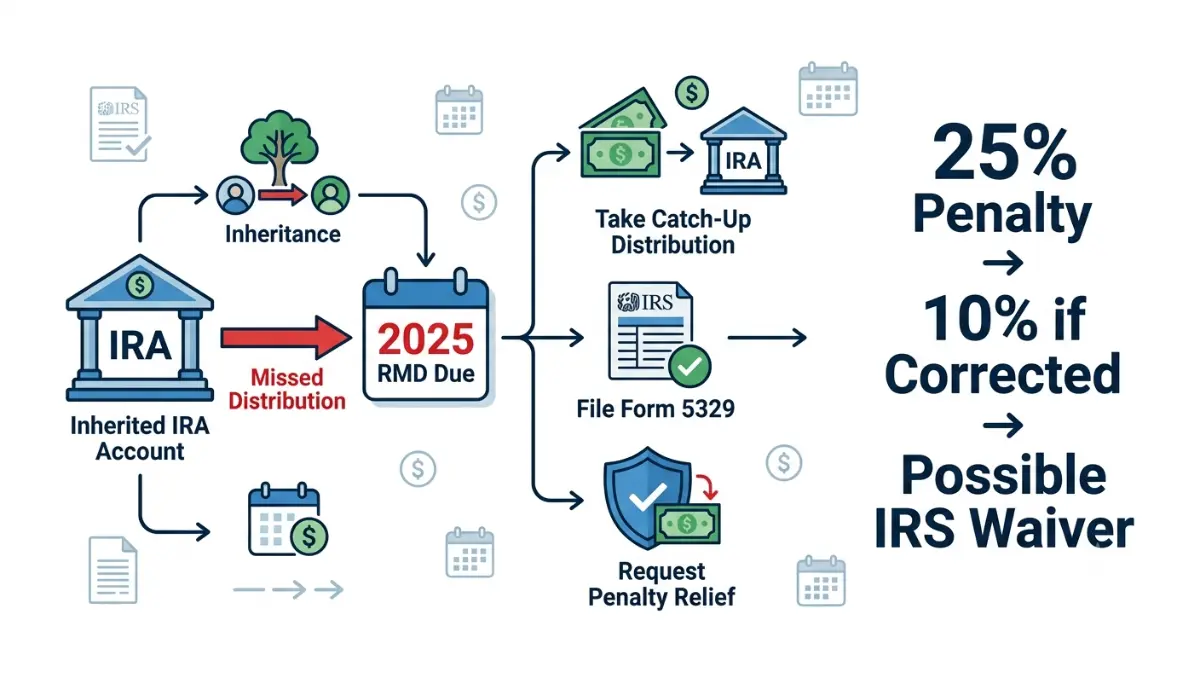
If you have just learned that a distribution was due from an inherited IRA for 2025 and it never came out, this is fixable. The 25% excise tax on the amount you should have withdrawn drops to 10% when you correct it properly, and the IRS can waive it entirely for a reasonable error.
Where you go next depends on which situation is yours.
- You’re not sure a 2025 distribution was required at all. Start with the next section. A large share of beneficiaries owed nothing.
- Your relative died without taking their own final distribution. Skip to the two-failures section. That one carries an automatic waiver and no form.
- You owed an annual distribution as the beneficiary and missed it. The cost, the deadline, and the filing steps are below.
Two dates now shape your paperwork: the 2025 distribution deadline passed on December 31, 2025, and the ordinary filing deadline passed in April 2026. Being late twice changes how you file, not whether you can fix it. If you are not certain what kind of account you inherited, our breakdown of how the five IRA types differ sorts that out first.
ℹ️ Financial Disclaimer: This article is educational and is not personalized investment, tax, lending, credit, insurance, or debt-relief advice. Tax rules for inherited retirement accounts turn on facts specific to you — the original owner’s date of birth and date of death, the account type, and your relationship to them. Before acting on anything here, consult a CPA, an enrolled agent, or a tax attorney about your own accounts, and a fiduciary advisor before changing how the money is invested or withdrawn.
First, check whether you owed a 2025 RMD at all
Not every beneficiary was required to take a required minimum distribution for 2025, and the fastest way to end this problem is to find out you never had one. Three questions settle it.
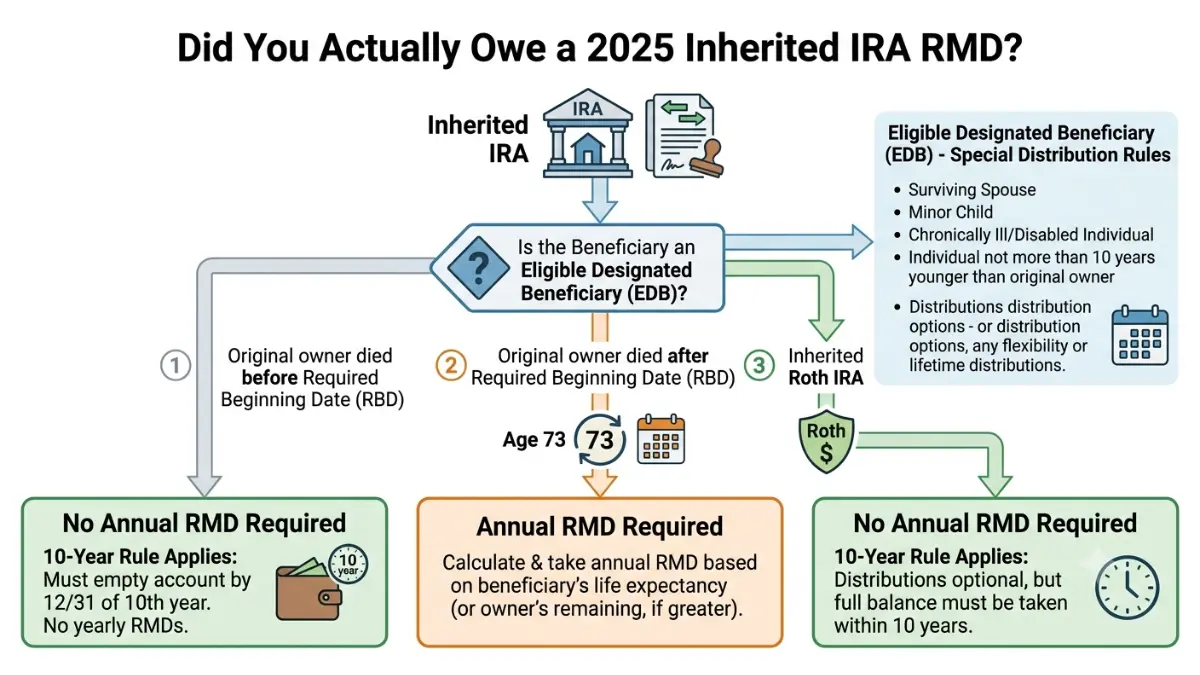
Did the original owner reach their required beginning date?
Annual distributions inside the 10-year window are required only when the original owner died on or after their required beginning date. That date is April 1 of the year following the year they reached age 73, per the IRS instructions for Form 5329. An owner who died before it leaves you with the 10-year emptying deadline and nothing due in between.
🔍 How It Works: The rule is about whether the money was already in motion. Once distributions have started, the IRS treats them as continuing to the beneficiary rather than pausing for a decade. If they had never started, there is nothing to continue.
Our guide to how the required beginning date is set walks through the age thresholds in detail, and the full eligibility framework sits in our explainer on whether annual RMDs apply inside your 10-year window.
Is it an inherited Roth IRA?
No annual distribution is required from an inherited Roth IRA. A Roth owner never has lifetime required distributions, so the owner is always treated as having died before their required beginning date — which means no yearly amount inside the window, only the year-10 deadline. Taxability is a separate question, and the decedent’s five-year clock decides whether the earnings come out tax-free.
Are you an eligible designated beneficiary?
A surviving spouse, the owner’s minor child, someone disabled or chronically ill, or a beneficiary not more than 10 years younger than the owner falls outside the standard 10-year rule entirely. The IRS overview of how beneficiary distributions are determined sets out the framework.
✅ Action Step: If you cannot answer the first question from memory, pull the death certificate and the decedent’s date of birth, then ask a CPA or enrolled agent one question: “Given this date of birth and this date of death, was I required to take an annual distribution for 2025?”
Two different missed RMDs, two completely different fixes
Most coverage of this topic collapses two separate failures into one, and they are not governed by the same rule. The distribution your relative failed to take before dying is treated very differently from the annual distribution you owed as beneficiary.
| Which miss? | Governing rule | Your deadline | Form | Penalty outcome |
|---|---|---|---|---|
| The decedent’s own final-year distribution, unpaid at death | 2024 final regulations, automatic waiver | Later of your filing deadline for the year of death, or the end of the following calendar year | None required for the waiver | Excise tax waived automatically if met |
| Your own annual distribution as beneficiary for 2025 | Internal Revenue Code section 4974 / Form 5329 Part IX | The correction window (see below) | Form 5329 for tax year 2025 | 25%, cut to 10% if corrected in the window, or waived for reasonable cause |
| No 2025 distribution was required | Not applicable | The year-10 emptying deadline still stands | None | No excise tax |
Sources: 2025 Instructions for Form 5329, Part IX; Treasury final regulations under section 401(a)(9) published July 19, 2024. Verified July 2026.
The year-of-death distribution is the forgiving one. The 2024 regulations extended the deadline for taking it and granting the automatic waiver, which for most beneficiaries lands on December 31 of the year after the death. Meet it and the excise tax disappears without a filing.
Your own annual distribution has no such mechanism. Nothing is automatic, and nothing happens unless you act.
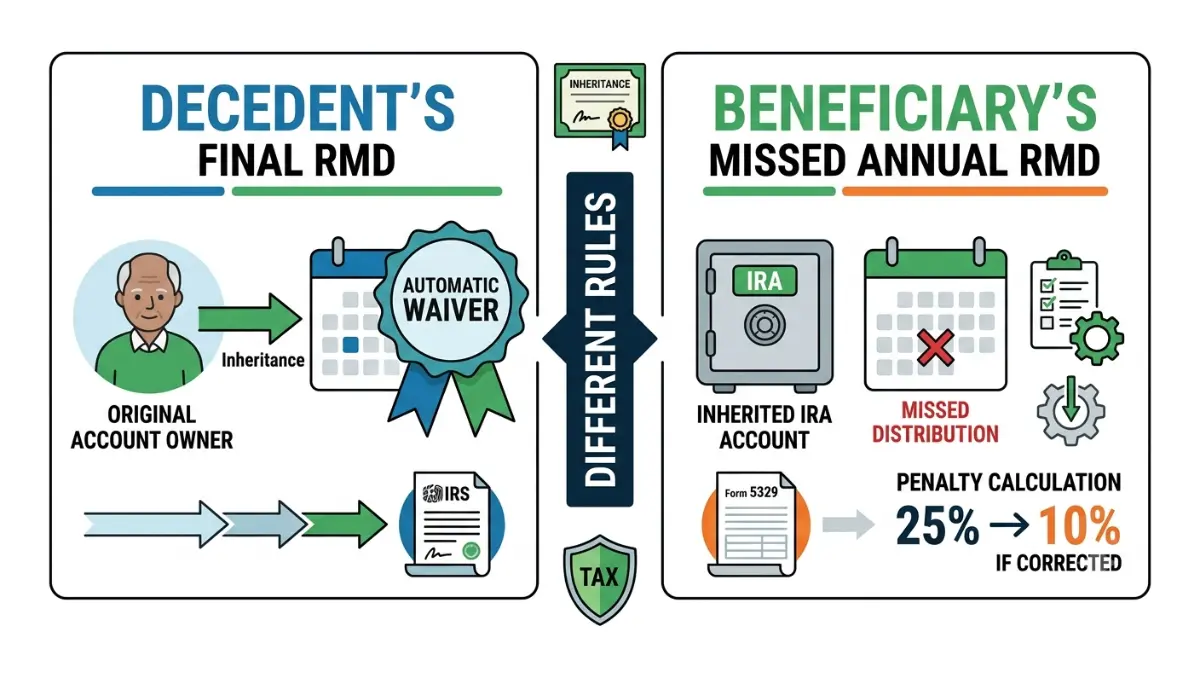
⚠️ Costly Mistake: Assuming one fix covers both. A beneficiary who inherited from a parent who died mid-year may owe two separate corrections — the parent’s unpaid final distribution and their own annual amount for a later year. They travel on different deadlines and only one of them needs a form.
What the penalty costs, and the date your discount expires
The excise tax applies to the shortfall — the difference between what was required and what actually came out — not to the whole account.
📊 Data Point: The tax on a missed required minimum distribution is 25% of the shortfall, reduced to 10% when the distribution is timely corrected within two years. Source: IRS, Retirement Plan and IRA Required Minimum Distributions FAQs, verified July 2026.
How the correction window drops it to 10%
Two things must both happen during the correction window, per the Form 5329 instructions. You must take a distribution of the amount that created the shortfall from the account that caused it, and you must submit a return reflecting the tax. Doing one without the other leaves you at 25%.
The date, and what closes it early
🔍 How It Works: The IRS defines the window as ending on the earliest of three events: the date a deficiency notice is mailed to you, the date the tax is assessed, or the last day of the second taxable year beginning after the year the tax was imposed. A 2025 shortfall imposes the tax in 2025. The first taxable year beginning afterward is 2026 and the second is 2027 — so that third test lands on December 31, 2027.
That gives most people roughly seventeen months from today, provided the IRS has not already mailed a notice or assessed the tax. Either of those closes the window immediately.
| Shortfall | At 25% | At 10% | Key detail |
|---|---|---|---|
| $10,490 | $2,622.50 | $1,049.00 | The $1,573.50 gap is the entire value of correcting properly |
Illustration using a chosen figure, calculated by our editorial team. Rates per the 2025 Instructions for Form 5329.
You can run the 25% and 10% figures against your own shortfall, and the same mechanism for account owners is covered in our piece on the correction window and the reduced rate.
How to fix it: five steps, in order
The correction process runs through Part IX of Form 5329, and the order matters — the IRS will not consider relief before the money has actually come out.
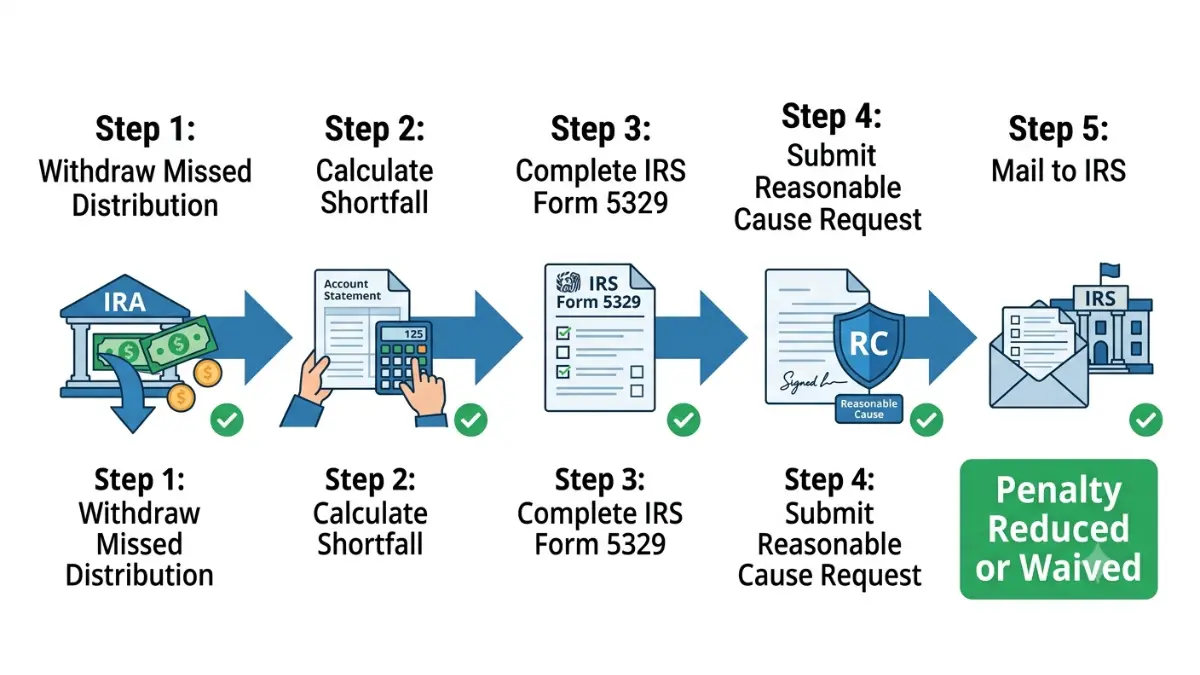
- Take the distribution now. Withdraw the full 2025 shortfall from the inherited account. There is no benefit to waiting, and the 10% early-distribution tax does not apply to a beneficiary’s withdrawal — death is a listed exception on Form 5329, so readers under 59½ are not facing a second penalty on top of this one.
- Figure the shortfall. Required amount minus what actually came out in 2025.
- Complete Part IX. Lines 52a and 52b carry the required amount, 53a and 53b the amount distributed, 54a and 54b the excess accumulation at 10% and 25%, and line 55 the total that flows to Schedule 2 of Form 1040.
- Request the waiver. Enter “RC” and the amount you want waived, in parentheses, on the dotted line next to line 54a or 54b, subtract it, and attach a signed statement explaining the error and what you have done about it.
- File it in the right place. Use the 2025 version of the form for a 2025 shortfall.
⚠️ Costly Mistake: Entering the catch-up distribution on lines 53a or 53b. The instructions are explicit that amounts received after the deadline or during the correction window do not belong there — putting them in reports no shortfall at all and defeats the filing.
Both the instructions for Part IX of Form 5329 and the 2025 version of the form itself are on the IRS site. A standalone Form 5329 cannot be filed electronically; it needs your address on page 1 and your signature and date on page 3.
Step 5 is where readers in July get stuck. The instructions describe filing the form by itself for someone who has not previously filed a return for that year, and filing it with Form 1040-X for someone with other changes — neither of which cleanly describes a person who already filed a 2025 return and now has only this to add. Practice among preparers diverges on that point.
✅ Action Step: Ask a CPA or enrolled agent this exact question before mailing anything: “My 2025 return is already filed and this is my only change — should this Form 5329 go in standalone by mail, or attached to a Form 1040-X?”
How to figure the 2025 amount you should have taken
Start with the shortcut: the Form 5329 instructions permit you to rely on the figure your custodian provides. Most will supply it on request, and that ends the exercise.
🔍 How It Works: Doing it manually takes two inputs. Divide the account’s December 31, 2024 balance by a life expectancy factor from Table I in Appendix B of Publication 590-B. You look that factor up once — for your age in the year after the owner’s death — then subtract one for each year since, rather than returning to the table.
A beneficiary who turned 55 in 2022, the year after the owner’s death, started at 31.6. By 2025, the fourth distribution year, the factor is 28.6. Against a December 31, 2024 balance of $300,000, that produces a 2025 amount of roughly $10,490 — the figure used in the comparison above.
Factors come from Table I in Appendix B of Publication 590-B.
⚠️ Costly Mistake: Covering the shortfall from the wrong account. Only distributions from IRAs inherited from the same decedent can be combined to satisfy this requirement, and money from your own IRA does not count at all. Inherited workplace plans are stricter still and are figured and satisfied separately.
Five mistakes that make a missed RMD worse
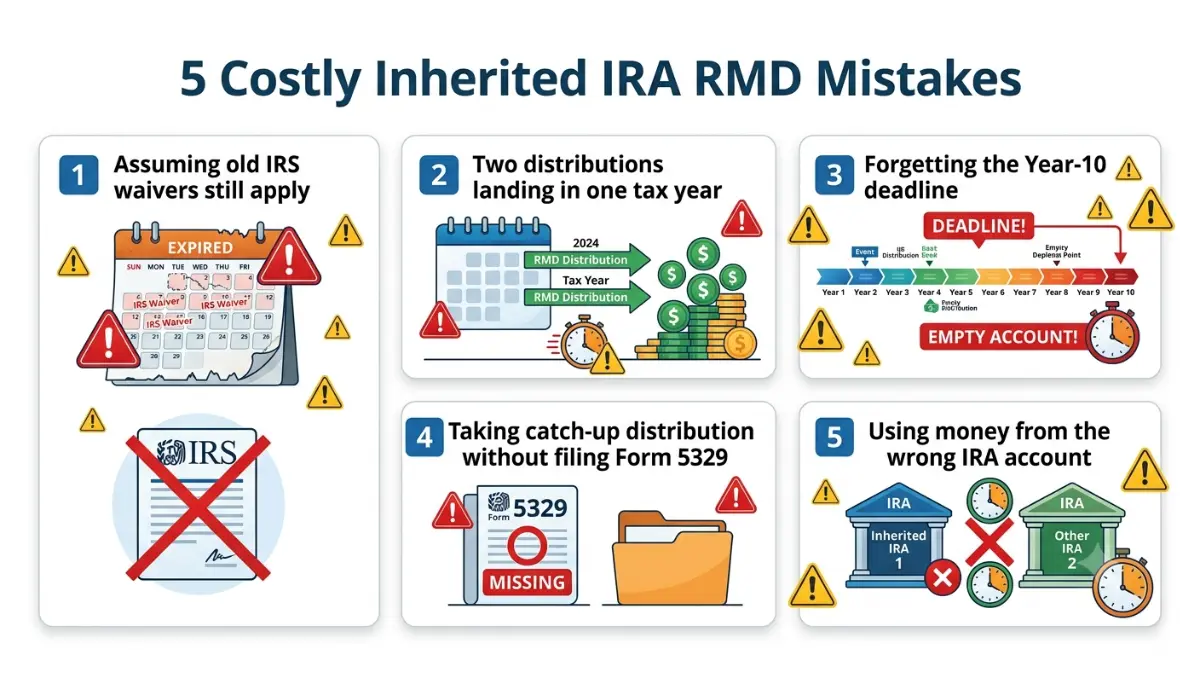
Assuming the old IRS waivers still cover you
Notices 2022-53, 2023-54, and 2024-35 waived this excise tax for 2021 through 2024 while the rules were unsettled. None of them reach 2025. A beneficiary who skipped those four years owes nothing for them and still owed an amount for 2025.
Letting two distributions land in the same tax year
A distribution counts as income in the year you actually receive it. Correcting a 2025 shortfall in 2026 means that money and your 2026 amount both land in this tax year, which can lift your total income more than either would alone. You can estimate what two distributions in one year do to your federal tax against this year’s brackets and standard deduction.
Forgetting the year-10 deadline is unchanged
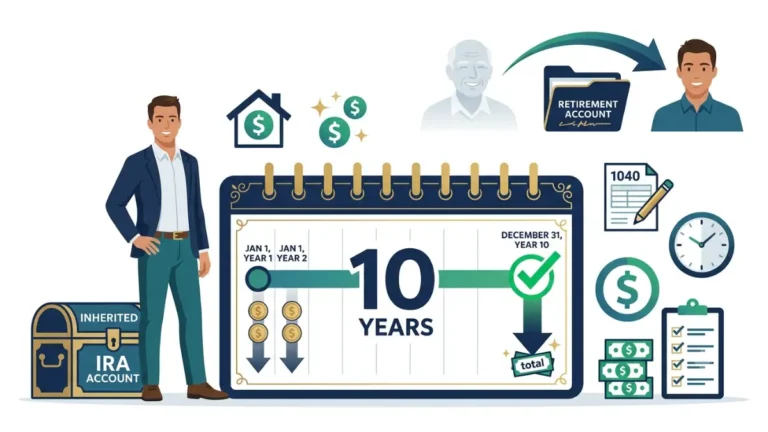
Skipping a year never buys you an extra one. The missed years still count toward the window, and the account must be empty by the end of year 10 regardless.
Two more worth naming: taking the money without filing anything leaves you at 25% rather than 10%, and pulling the correction from your own IRA satisfies nothing.
✅ Action Step: Ask a CPA or enrolled agent: “Both my 2025 catch-up and my 2026 distribution land in 2026 — does that change the timing of anything else in my year?”
Missed inherited IRA RMD: common questions
1. Did I actually owe an inherited IRA RMD for 2025?
Only if the original owner died on or after their required beginning date — April 1 of the year following the year they turned 73 — and the account is not a Roth. Eligible designated beneficiaries follow different rules, and surviving spouses have a separate set of options. Confirm your answer with a CPA before filing anything.
2. What is the penalty for a missed inherited IRA RMD?
The excise tax is 25% of the shortfall — the difference between the required amount and what you actually withdrew — not a percentage of the account. On a $10,490 shortfall, that is $2,622.50. It can drop to 10% or be waived entirely. A CPA can confirm the shortfall figure before you report it.
3. How do I get the 25% penalty reduced to 10%?
Two conditions must both be met inside the correction window: take a distribution of the amount that created the shortfall from the account that caused it, and submit a return reflecting the tax. Taking the money alone does not qualify. For a 2025 shortfall, that window generally runs to December 31, 2027. Confirm your dates with a tax professional.
4. Can the IRS waive the penalty entirely?
Yes. The IRS can waive part or all of the tax where the shortfall resulted from a reasonable error and you are taking reasonable steps to remedy it. You request it by entering “RC” and the amount on Form 5329 and attaching a statement of explanation. The IRS notifies you if it declines. An enrolled agent can review the statement first.
5. What counts as reasonable cause for a missed RMD?
The IRS does not publish a list of accepted reasons, so treat any article offering one with caution. The standard in the instructions is reasonable error plus reasonable steps to remedy the shortfall. A clear, dated account of what happened, when you found it, and what you did carries the request. Ask a CPA to review yours before mailing.
6. My 2025 return is already filed — where does Form 5329 go now?
The instructions describe two routes: the form filed by itself, and the form attached to Form 1040-X. Neither cleanly covers someone who already filed and has only this to add, and preparer practice diverges. Ask a CPA or enrolled agent which route fits your return before you mail anything.
7. Can I use a distribution from my own IRA to cover it?
No. Only distributions from IRAs inherited from the same decedent can be combined to satisfy the requirement for those inherited accounts. Money from your own IRA does not count toward an inherited IRA shortfall, and inherited workplace plans are figured separately again. A CPA can confirm which of your accounts can be combined.
8. Which year is the catch-up distribution taxable in?
The year you actually receive it. A 2025 shortfall withdrawn in 2026 is 2026 income, landing alongside your 2026 required amount in the same year. That is a real cost of correcting late, though a smaller one than the excise tax. Ask a CPA how the stacked income affects your year.
9. Do the 2021–2024 IRS waivers still protect me?
No. Notices 2022-53, 2023-54, and 2024-35 waived the tax for those four years only, while the rules were being finalized. Annual distributions inside the 10-year window became enforceable for 2025 under the final regulations. Nothing waives a 2025 shortfall.
10. Does missing a year extend my 10-year deadline?
No. Years in which you took nothing still count toward the window, and the account must be fully distributed by the end of the tenth year after the original owner’s death. Missing an annual amount creates a penalty problem, not extra time. A CPA can confirm your year-10 date.
11. How do I figure the 2025 amount I should have taken?
Ask your custodian first — the instructions permit relying on the figure they supply. Manually, divide the December 31, 2024 balance by your Table I factor, which you look up once for the year after the death and then reduce by one per year. Have a CPA verify the factor before filing.
What to do this week
Withdraw the 2025 shortfall from the inherited account, get the figure from your custodian if you do not have it, and put the Form 5329 question to a CPA or enrolled agent before you mail anything.
Two dates now sit in front of you: December 31, 2027, when the reduced rate stops being available, and December 31, 2026, when this year’s distribution is due. Setting the second one up now is what stops this repeating.
This is a common error with a defined fix, and most people who correct it properly pay 10% or nothing at all.
Informational disclaimer
The content on Finance Authority Hub is provided for general informational and educational purposes only and should not be considered personalized financial, investment, tax, legal, or professional advice. Financial decisions depend on your individual goals, income, risk tolerance, location, and regulatory situation. Before acting on any information, strategy, estimate, or calculator result, consult a qualified licensed professional who can evaluate your specific circumstances.