
Annuity vs. Life Insurance — Which One Fits You?
Annuity vs. life insurance isn’t either/or — U.S. annuity sales hit a record $464.1B in 2025, while ~100 million adults remain underinsured.

In This Article
Annuity vs. life insurance: which one do you actually need?
If an advisor or an ad has put both products in front of you, here’s the short version: an annuity vs life insurance decision is a choice between two opposite protections. Life insurance protects the people who depend on you if you die too soon. An annuity protects you from the opposite risk — outliving your savings; if that product is new to you, start with what an annuity is and how it works.
So route yourself. If a partner, kids, or debts lean on your income, the life insurance sections are for you; if you’re near or in retirement and worried your savings won’t last, start with the annuity sections. If both describe you, you may need both — and that’s common.
We don’t sell either product, and every figure here is tied to the IRS, the Federal Reserve, FINRA, or LIMRA by name.
ℹ️ Financial Disclaimer: This article is general educational information, not personalized investment, tax, insurance, or legal advice. Annuities and life insurance are regulated products whose features, fees, and tax treatment depend on your situation, your state, and the issuing company, and rates change frequently. Before buying, surrendering, or exchanging any policy, consult a licensed fiduciary financial advisor and a CPA or tax professional.
What’s the real difference between an annuity and life insurance?
The difference is purpose: life insurance pays a death benefit to your beneficiaries when you die, while an annuity pays income to you while you’re alive. Both are insurance-company contracts, and both grow tax-deferred — but they solve opposite problems.
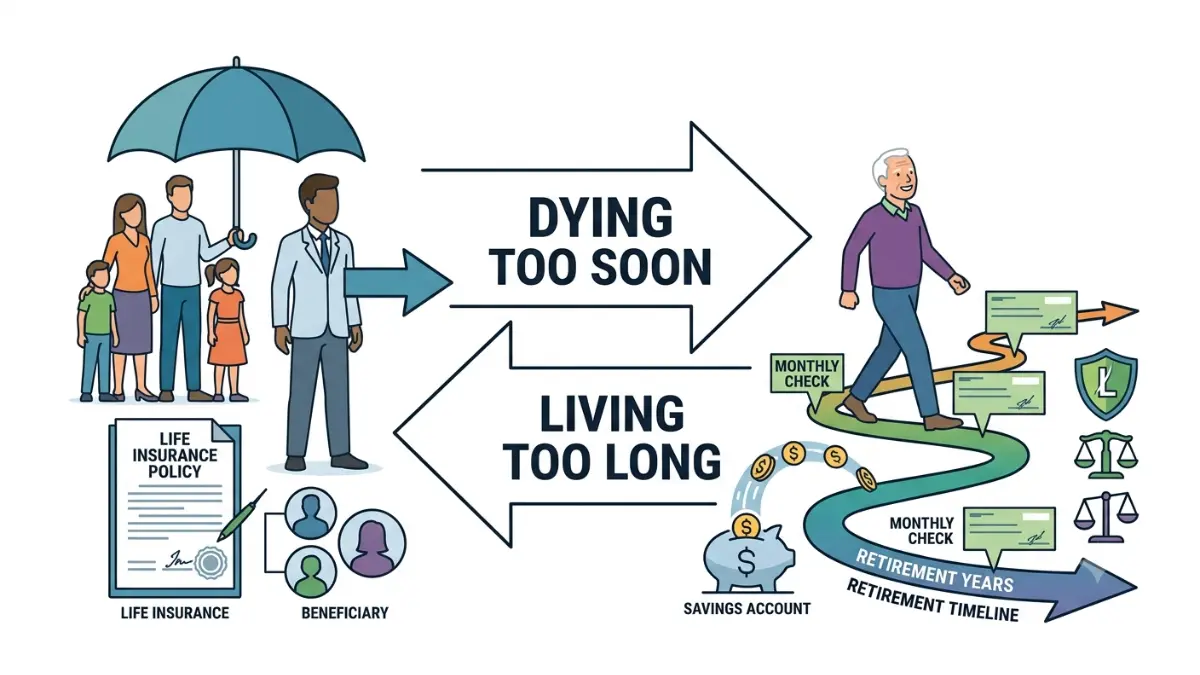
🔍 How It Works: Dying too soon leaves dependents without your income, and life insurance covers that. Living longer than your money lasts is the opposite risk, and an annuity covers it by turning savings into a paycheck you can’t outlive.
Life insurance: protection for the people who depend on you
Life insurance comes in two families. Term life covers a set period — often 10, 20, or 30 years — and pays only if you die during that term; it’s cheaper and fits most families’ working years. Permanent life (including whole life) lasts your whole life and builds cash value, but costs far more.
Compare how term life insurance works with what whole life insurance actually costs.
Annuities: income you can’t outlive
Annuities split by when they pay and how they grow. An immediate annuity starts income within about a year; a deferred annuity grows first and pays later. By growth type, a fixed annuity pays a set rate, a variable annuity rises and falls with invested subaccounts (and can lose value), and indexed products — fixed indexed and RILAs — track a market index with caps.
See the main types of annuities, and note the SEC’s reminder that variable annuities and RILAs are securities that can lose money in the SEC’s investor guide to annuities.
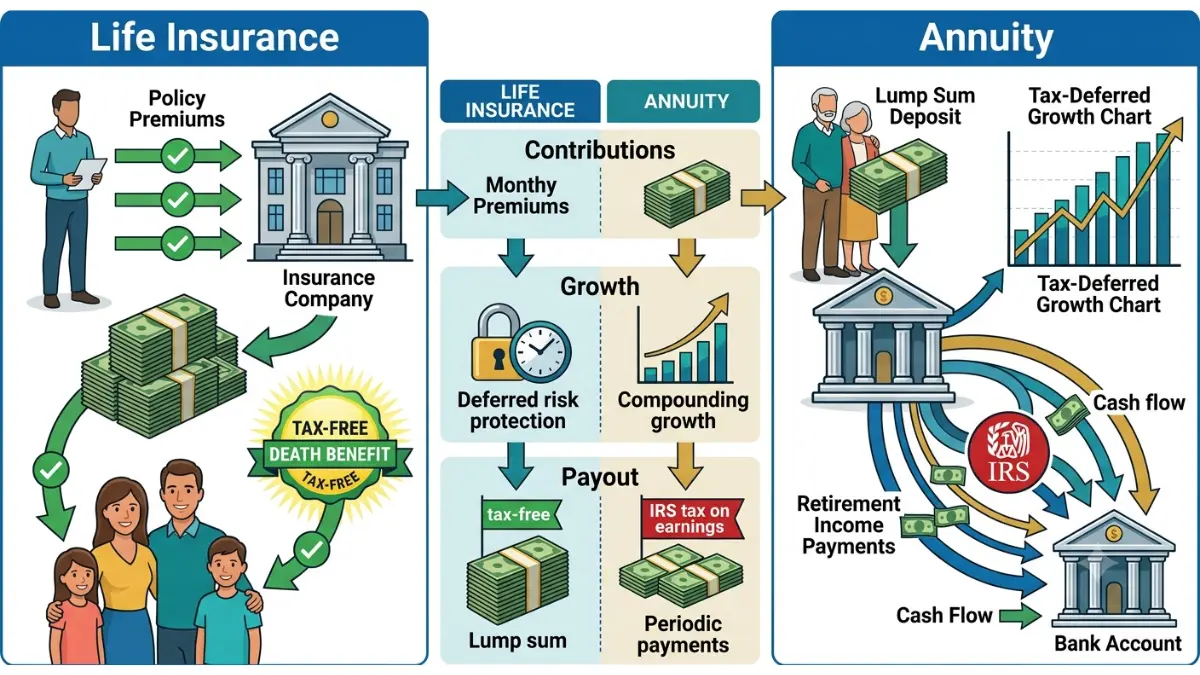
What do annuities and life insurance cost — and how is each taxed?
Here’s the contrast that matters most: a life insurance death benefit is generally income-tax-free to your beneficiaries, while annuity earnings are taxed as ordinary income when you withdraw them — and withdrawals before age 59½ usually add a 10% penalty.
What you pay in: premiums vs. a lump sum
You fund life insurance with ongoing premiums, and an annuity with a lump sum or a series of payments. Annuity payouts lean on interest rates, which sit near multi-decade highs. With the Federal Reserve’s benchmark held at 3.50% to 3.75% in June 2026, rate trackers recently showed top fixed annuity rates from A-rated insurers around 5.00% to 5.75% for multi-year contracts — about one to two points above comparable CDs, though they change daily.
📊 Data Point: The Federal Reserve held its federal funds target range at 3.50%–3.75% on June 17, 2026 — a fourth straight hold. — Source: Federal Reserve, the Federal Reserve’s most recent rate decision.
How each is taxed: the difference that matters most
The IRS taxes annuity earnings as ordinary income, and taking money before age 59½ generally adds a 10% penalty on the taxable portion, with exceptions for death, disability, and substantially-equal payments. Life insurance is the opposite: under Internal Revenue Code Section 101, a death benefit paid because of your death is generally excluded from your beneficiaries’ income.
🔍 How It Works: With a non-qualified annuity, earnings come out first and are taxed; once you annuitize, each payment splits into a taxable earnings piece and a tax-free return of principal, using an IRS “exclusion ratio.” A compound interest calculator shows how that tax-deferred growth compounds.
| Tax question | Annuity | Life insurance (death benefit) | Key detail |
|---|---|---|---|
| Taxed while it grows? | No (tax-deferred) | No (tax-deferred) | Both defer tax on growth |
| Taxed at payout? | Yes — ordinary income on earnings | Generally no income tax | IRC §101 excludes death benefits |
| Penalty before age 59½? | Usually 10% on earnings | Not applicable | Exceptions: death, disability, 72(t) |
| Counted in your estate? | Possibly | Possibly | 2026 federal exemption: $15M per person |
Sources: IRS (Publication 575; early-distribution exceptions), Internal Revenue Code §101, and the One Big Beautiful Bill Act / IRS Revenue Procedure 2025-32. Verified June 2026. Compare how annuities are taxed versus an IRA.
Most households never reach the estate-tax threshold — the 2026 federal exemption is $15 million per person — though 18 states levy their own estate or inheritance tax. The full carve-outs sit at the IRS’s list of exceptions to the early-withdrawal penalty.
✅ Action Step: Before you withdraw from or exchange an annuity, ask a CPA: “Given my age, whether this annuity is qualified or non-qualified, and my bracket, how will this withdrawal be taxed, and does the 10% penalty apply?”

How to decide: which one fits your situation?
Neither product is universally better — the right call depends on which risk you face. If people depend on your income, you’re solving for protection (life insurance). If you need income that lasts through a long retirement, that points to an annuity.
You likely need life insurance if…
- A spouse, children, or aging parents rely on your paycheck.
- You carry a mortgage or co-signed loans that wouldn’t disappear at your death.
- Your savings couldn’t yet replace your income.
💡 Expert Note: Cost is the most common reason people skip coverage — usually a misjudgment. LIMRA’s 2025 research found adults under 30 overestimate the price of a $250,000, 20-year term policy by about 10 to 12 times.
A life insurance needs calculator turns your income, debts, and years-to-cover into a coverage target.
You likely need an annuity if…
- You’re near or in retirement and afraid of running out of money.
- You’ve maxed accounts like a 401(k) and IRA and want more tax-deferred growth.
- You want a predictable income floor on top of Social Security.
A retirement income calculator shows whether your savings and Social Security cover essentials or leave a gap an annuity could fill.
When the answer is both — or neither yet
Two illustrations (general examples, not advice). A 40-year-old with kids and a mortgage needs life insurance first; an annuity can wait. A 62-year-old with savings but no pension or dependents may skip coverage and look at an annuity for lifetime income. Many people need both over time.
✅ Action Step: Before buying either, ask a fiduciary advisor: “Based on my dependents, debts, and retirement timeline, do I need protection, income, both, or neither — and what would you not sell me?”
What the numbers say: who’s buying what, and why
The market is sending two signals at once: strong demand for guaranteed income, and a stubborn shortage of protection.
Annuity demand just hit a record
📊 Data Point: U.S. annuity sales rose 7% to a record $464.1 billion in 2025 — a fourth straight record year. — Source: LIMRA (U.S. Individual Annuity Sales Survey, full-year 2025).
The driver is demographic: more than 4 million Americans turn 65 each year, and many lack a traditional pension. Indexed products — fixed indexed and RILAs — made up about 45% of 2025 sales.
The other side: a wide protection gap
At the same time, the life insurance coverage gap stays wide even as annuity buying breaks records. Just over half of U.S. adults own any life insurance at all.
📊 Data Point: The life insurance coverage need-gap was about 40% in 2025 (down from 42%), leaving roughly 100 million adults uninsured or underinsured. — Source: LIMRA / Life Happens (2025 Insurance Barometer Study).
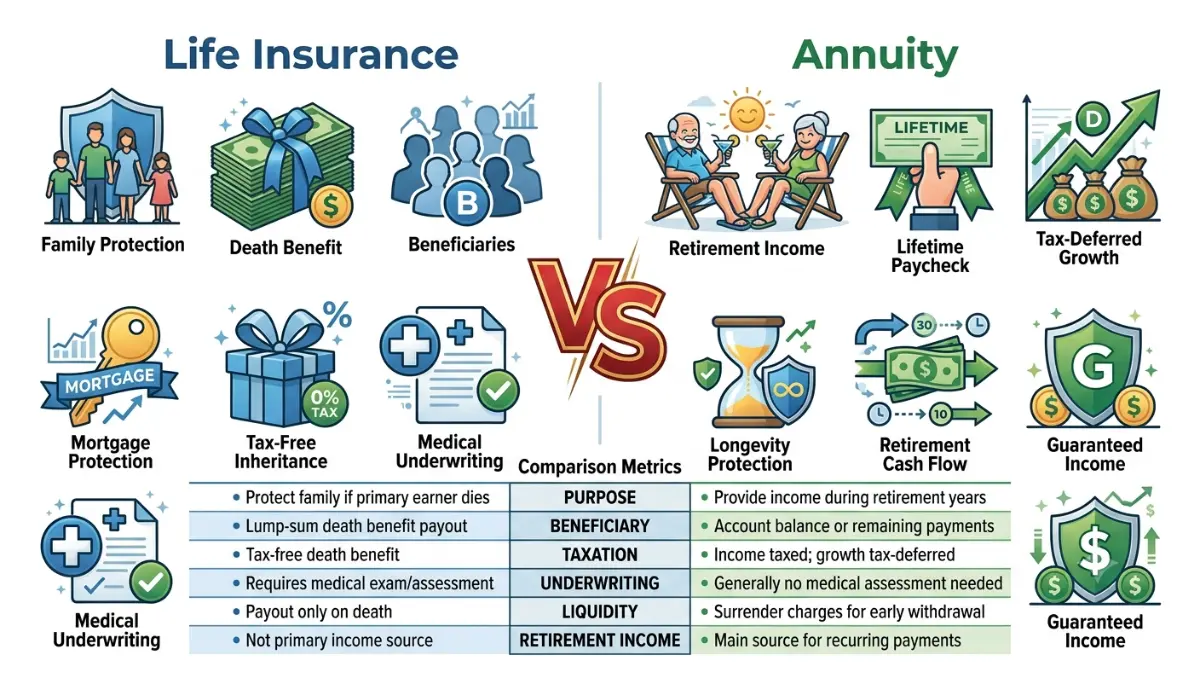
Annuity vs. life insurance: a side-by-side comparison
At a glance, the two products mirror each other — same insurer structure, opposite jobs.
| Feature | Annuity | Life insurance | Best for |
|---|---|---|---|
| Core purpose | Income while you’re alive | Payout when you die | Annuity: longevity; life: dependents |
| Who’s protected | You, the owner | Your beneficiaries | — |
| Growth tax | Tax-deferred | Tax-deferred cash value | — |
| Payout tax | Ordinary income on earnings | Generally income-tax-free | Life insurance for tax-free transfer |
| Underwriting | Usually none (age-based) | Usually a medical review | Annuity if you have health issues |
| Backed by | Insurer’s claims-paying ability | Insurer’s claims-paying ability | Neither is FDIC-insured |
Sources: IRS, SEC Investor.gov, and FINRA. Not FDIC-insured; guarantees depend on the issuing insurer. Verified June 2026.
The fine print buyers miss: fees and who backs the guarantee
Both products carry costs beyond the headline rate. FINRA notes annuities can include surrender charges, mortality and expense charges, administrative fees, and high commissions; many deferred annuities allow about 10% a year penalty-free, but pulling more during the surrender period (often several years) triggers a charge. And the guarantee is only as strong as the insurer — these aren’t bank deposits and aren’t FDIC-insured, though state guaranty associations give limited backup.
⚠️ Costly Mistake: Chasing the highest advertised rate from a lower-rated insurer raises the risk that matters most here — the company’s ability to pay claims decades from now. Check the carrier’s financial-strength rating before the rate.
For a full cost breakdown, see annuity fees and surrender charges, or read FINRA’s overview of annuity fees and surrender charges.
Common mistakes when choosing between an annuity and life insurance
Most expensive errors here come from buying the right product for the wrong reason — or believing a myth at the point of sale.
Buying the wrong product for the goal
Buying an annuity to protect your family, or whole life mainly as an investment, often means paying for features you don’t need. Match the product to the risk: protection for dependents, income for longevity.
Surrender traps and the “death benefit is taxed” myth
Two myths cost real money. Many people assume a life insurance death benefit is taxed — it generally isn’t, under IRC Section 101. And people forget that moving between contracts isn’t always a free reset.
🔍 How It Works: A 1035 exchange lets you swap one contract for a similar one without triggering tax — for example, life insurance into an annuity. It does not work in reverse: you cannot 1035 an annuity into life insurance, and FINRA warns an exchange can restart surrender charges and the early-withdrawal clock.
✅ Action Step: Before any switch, ask a CPA or fiduciary advisor: “Does this move trigger a surrender charge or a taxable event, and is a 1035 exchange the cleaner path?”
Annuity vs. life insurance: frequently asked questions
1. What is the difference between an annuity and life insurance?
In the annuity vs life insurance comparison, the difference is direction. An annuity pays income to you while you’re alive, guarding against outliving your savings. Life insurance pays a death benefit to your beneficiaries after you die. Both are insurance-company contracts that grow tax-deferred.
2. Which is better, an annuity or life insurance?
Neither is universally better — it depends on the risk you’re solving. Choose life insurance if dependents rely on your income; choose an annuity if you’re near retirement and fear running out of money. A fiduciary advisor can confirm which fits you.
3. How are annuities taxed?
Annuities grow tax-deferred, but earnings are taxed as ordinary income when withdrawn. Taking money before age 59½ usually adds a 10% IRS penalty on the taxable portion, with exceptions for death, disability, and 72(t) payments. Confirm specifics with a CPA.
4. Is a life insurance death benefit taxable?
Usually not. Under Internal Revenue Code Section 101, a life insurance death benefit paid because of your death is generally excluded from your beneficiaries’ income. Exceptions exist, and very large estates may owe estate tax. A CPA can review your case.
5. Can you have both life insurance and an annuity?
Yes, and it’s common. The two solve opposite problems, so owning both can protect your family while you’re working and provide income you can’t outlive in retirement. A fiduciary advisor can help you sequence them.
6. What are the disadvantages of an annuity?
Annuities can carry surrender charges during a multi-year period, ongoing fees such as mortality and expense charges, and ordinary-income tax on withdrawals. They’re also not FDIC-insured, and liquidity is limited. Ask a fiduciary advisor whether the trade-offs fit your goals.
7. At what age should you buy an annuity?
There’s no single right age. People most often buy income annuities near or in retirement, frequently in their late 50s to 60s, when the goal shifts from growing money to producing reliable income. A fiduciary advisor can help with timing.
8. Are annuities FDIC-insured?
No. Annuities aren’t FDIC-insured because they’re insurance products, not bank deposits. The guarantee depends on the insurer’s claims-paying ability, with limited backup from your state’s guaranty association, and limits vary by state. A licensed professional can explain your state’s limits.
9. How much does life insurance actually cost?
Less than most people think. Term life insurance — the cheapest type — covers a set period. LIMRA found adults under 30 overestimate the cost of a $250,000, 20-year term policy by about 10 to 12 times; your real price depends on age, health, and coverage amount. See life insurance costs and types.
10. Can you convert life insurance into an annuity?
Yes — a 1035 exchange lets you move a life insurance policy’s value into an annuity without immediate tax. It does not work in reverse: you cannot exchange an annuity into life insurance. Confirm the costs with a CPA first.
11. What happens to an annuity when you die?
It depends on your payout choice. With a death-benefit rider or a contract still accumulating, your beneficiary typically receives the remaining value; some lifetime-only payouts stop at death. Any gains are taxed as ordinary income. A CPA can clarify your contract.
The bottom line: protection, income, or both
The choice comes down to one question: are you protecting the people who depend on you, or protecting yourself from outliving your money? If dependents rely on your income, life insurance comes first. If a long retirement is the worry, an annuity earns its place — and for many people, the honest answer is both, in that order, over time.
Write down your situation before any sales meeting, and take it to a fiduciary advisor and a CPA who earn nothing from selling you a product. If you’re weighing the income side, our full guide to how annuities work is the next step.
Informational disclaimer
The content on Finance Authority Hub is provided for general informational and educational purposes only and should not be considered personalized financial, investment, tax, legal, or professional advice. Financial decisions depend on your individual goals, income, risk tolerance, location, and regulatory situation. Before acting on any information, strategy, estimate, or calculator result, consult a qualified licensed professional who can evaluate your specific circumstances.