Facing a Missed RMD Penalty? Start Here to Lower It
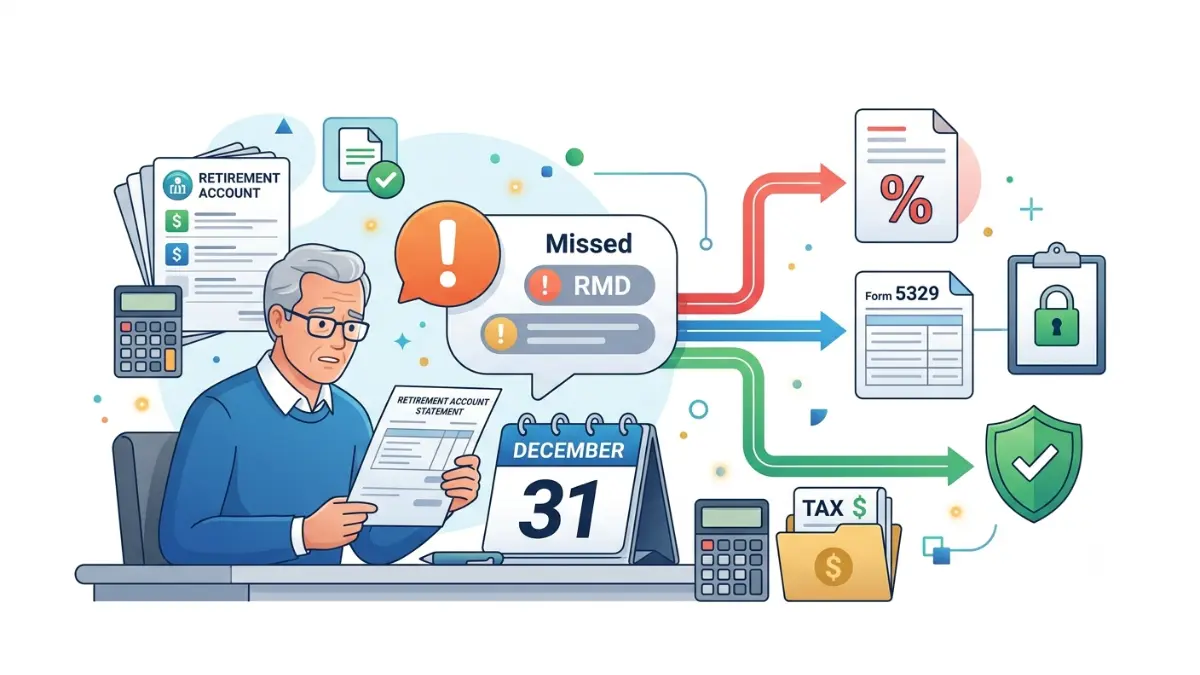
Missed an RMD? The 25% penalty drops to 10%—sometimes to nothing—if you take the distribution and file Form 5329 before your correction window closes.
In This Article
If you just found out you missed a required minimum distribution, the “25% penalty” you’ve read about sounds catastrophic — but it’s rarely as bad as it looks. The tax applies only to the amount you missed, not your whole account, and you can usually cut it to 10% or have it waived entirely. This guide routes you to the fix based on where you are:
- Just realized you missed this year’s RMD? Start with what the penalty actually is, then the step-by-step fix.
- Missed a prior year’s RMD? The correction-window section shows your exact deadline to still qualify for the lower rate.
- Managing an inherited IRA? The prevention section covers the beneficiary rules that trip people up.
- Want to make sure it never happens again? Skip ahead to prevention and pitfalls.
Take a breath: the fix is a single form and a short letter, and the IRS grants relief more often than most people expect.
ℹ️ Financial Disclaimer: This article is for general educational purposes only and is not personalized investment, tax, retirement, or legal advice. RMD corrections, penalty waivers, and withdrawal timing depend on your specific accounts and circumstances. Before acting, consult a CPA, an enrolled agent, or a fiduciary financial advisor — and a tax attorney if the IRS has already contacted you about the shortfall.
What the missed RMD penalty actually is
The missed RMD penalty is a 25% excise tax on the amount you were required to withdraw but didn’t — what the IRS calls the “excess accumulation,” not your entire balance. Before 2023 this penalty was a punishing 50%; the SECURE 2.0 Act cut it to 25%, with a further reduction to 10% for those who correct the mistake in time, under Internal Revenue Code Section 4974. That change is why a missed distribution, though serious, is far more fixable than it used to be.
How the 25% is calculated (it’s only the shortfall)
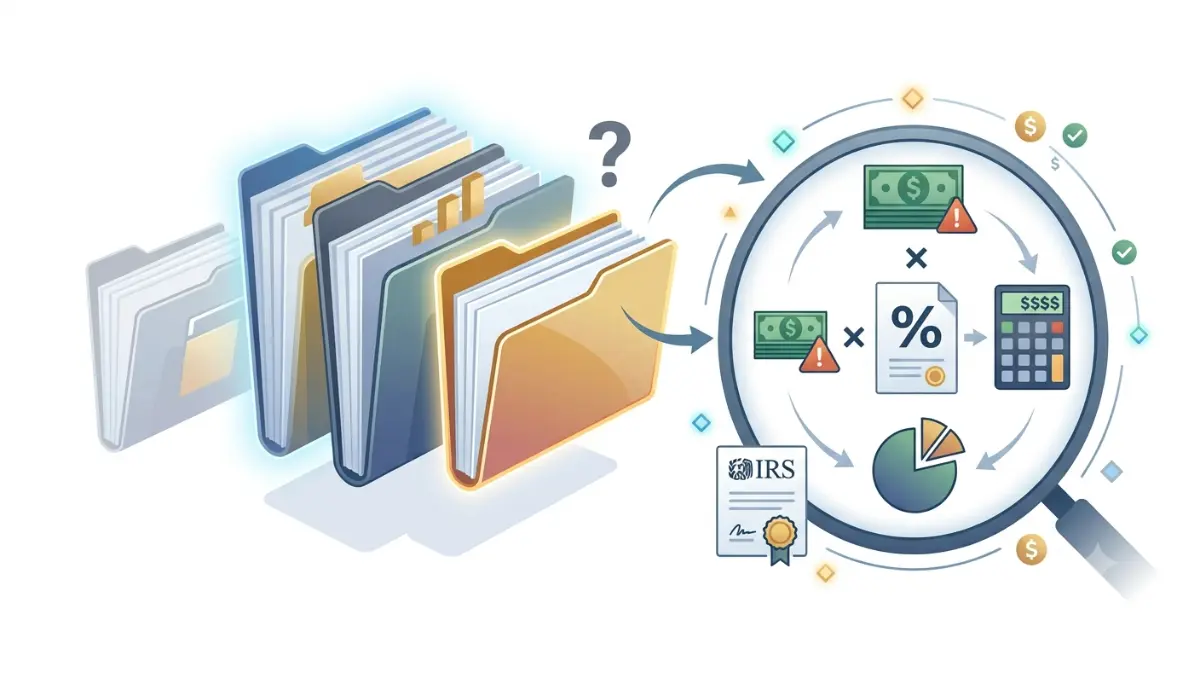
🔍 How It Works: The excise tax applies to the shortfall alone. If you were required to take $20,000 and withdrew nothing, the 25% applies to that $20,000 — a $5,000 penalty — not to your $500,000 account, and not to any earnings the money produced while it stayed invested.
Take the total you should have withdrawn, subtract what you actually took, and the difference is the amount the penalty hits. For the full age and deadline rules behind it, see the RMD age and 25% penalty basics.
Who owes it — and who’s exempt
This penalty applies to traditional IRAs, SEP and SIMPLE IRAs, 401(k)s, 403(b)s, and inherited IRAs that require annual distributions — and 401(k) accounts follow their own RMD age rules. Roth IRA owners are exempt, because there are no required minimum distributions during the original owner’s lifetime. Since 2024, designated Roth accounts inside a 401(k) or 403(b) are also exempt, so a missed-RMD penalty cannot apply to them — one of several differences among the five IRA account types.
How to cut the penalty to 10%: the correction window
To qualify for the reduced 10% rate, you must fix the shortfall during what the IRS calls the correction window — and it ends on the earliest of three dates:
- The date the IRS mails you a deficiency notice about the penalty
- The date the IRS assesses the tax
- The last day of the second tax year that begins after the year the RMD was due
If no IRS notice arrives first, you generally have until the end of the second year after the miss.
The exact correction-window deadline (with dates)
| Year you missed the RMD | Latest date to still correct at the 10% rate* |
|---|---|
| 2024 | December 31, 2026 |
| 2025 | December 31, 2027 |
| 2026 | December 31, 2028 |
*Assumes the IRS has not already mailed a deficiency notice or assessed the tax — either of which closes the window sooner. Source: derived from the correction-window rule in the IRS Instructions for Form 5329.
To actually earn the 10% rate, the IRS requires two things during that window: take the make-up distribution, and file a return that reports the tax.
Reduce to 10% vs. request a full waiver — they’re not the same
These are two different paths, and the distinction matters. The reduced 10% rate applies when you correct in time and file. A full waiver is separate: if the miss was a reasonable error and you’ve fixed it, the IRS can waive the penalty entirely — potentially down to $0.
⚠️ Costly Mistake: Taking the make-up distribution alone does not get you the 10% rate. The reduced rate also requires filing a return that reports the tax — skip that step and you can be stuck at 25% even though you withdrew the money.
✅ Action Step: Match the date you took (or will take) your make-up withdrawal against the table above, then ask a CPA or enrolled agent one question: “Based on this date, am I inside the correction window, and should I claim the 10% rate, request a full waiver, or both?”
How to fix it: Form 5329, step by step
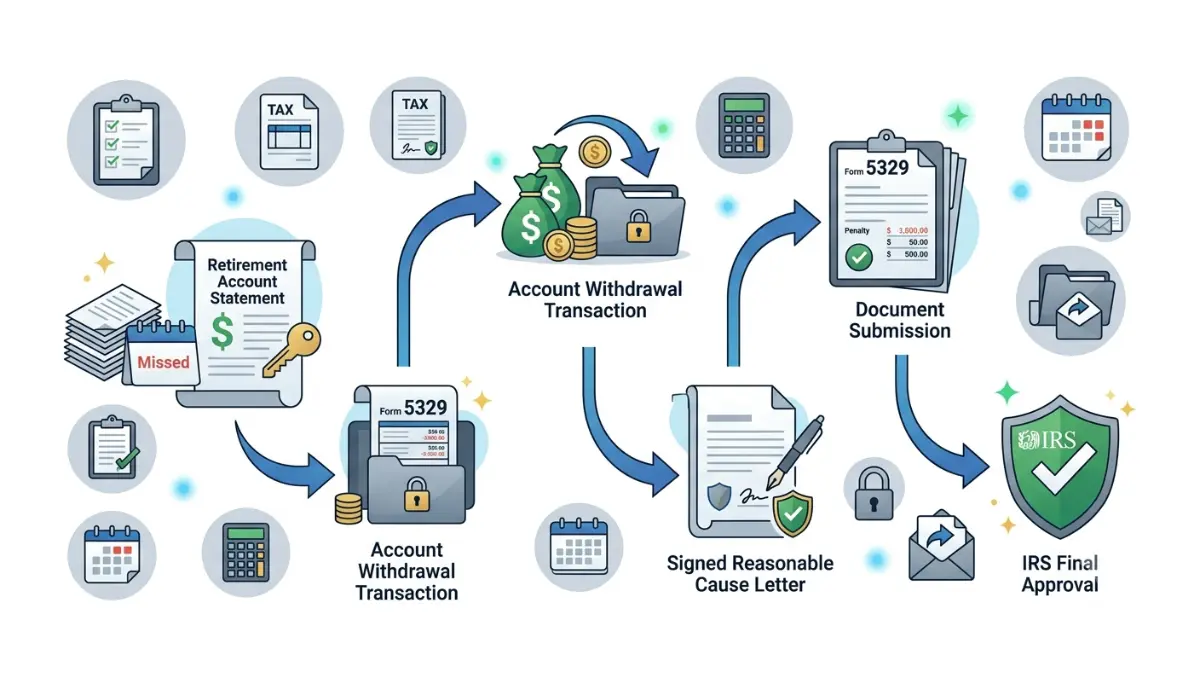
You fix a missed RMD by completing Form 5329, Part IX. It comes down to six steps:
- Take the missed distribution now. Withdraw the full shortfall as soon as possible, ideally as a separate transaction so your records clearly show the make-up amount and date.
- Figure your shortfall. Subtract what you actually withdrew from what you were required to take; the difference is the excess accumulation.
- Complete Part IX. Enter the required amount and the amount distributed on the lines provided, then the shortfall — Part IX is where the excise tax is calculated.
- Request a waiver with “RC.” To ask for relief, write “RC” (reasonable cause) and the amount you want waived in parentheses next to the tax line, subtract it, and enter the result — often $0.
- Attach a reasonable-cause statement. A short signed letter explaining what happened and that you’ve fixed it (structure below).
- File it. Attach Form 5329 to the return for the year you missed; if you already filed, use an amended return. Any tax still owed carries to Schedule 2 of Form 1040.
Because the IRS occasionally renumbers Part IX, confirm the exact line numbers against the current-year form and the IRS Instructions for Form 5329 before you file.
Steps 1–3: Take the distribution and figure your shortfall
Withdraw the shortfall first — the sooner the money is out, the stronger your waiver request looks — and take it as a standalone distribution so the amount and date are unmistakable on your statement. Because the make-up distribution is taxable in the year you take it, estimate the tax on your distribution before you file.
Steps 4–6: The “RC” notation and the reasonable-cause letter
💡 Expert Note: The “RC” notation is the key mechanic. You are effectively self-reporting a reduced or $0 penalty and asking the IRS to agree, based on the letter you attach. The IRS grants these waivers routinely when the miss was an honest mistake that you’ve already corrected — but approval is never guaranteed.
Your reasonable-cause statement should include, in a few short sentences:
- Your name, address, and the tax year you missed
- The reason for the shortfall — illness, a custodian error, an overlooked account, or bad advice
- The date you corrected it and the amount you withdrew
- The steps you’ve taken so it won’t happen again
The real dollar math: 25%, 10%, or $0
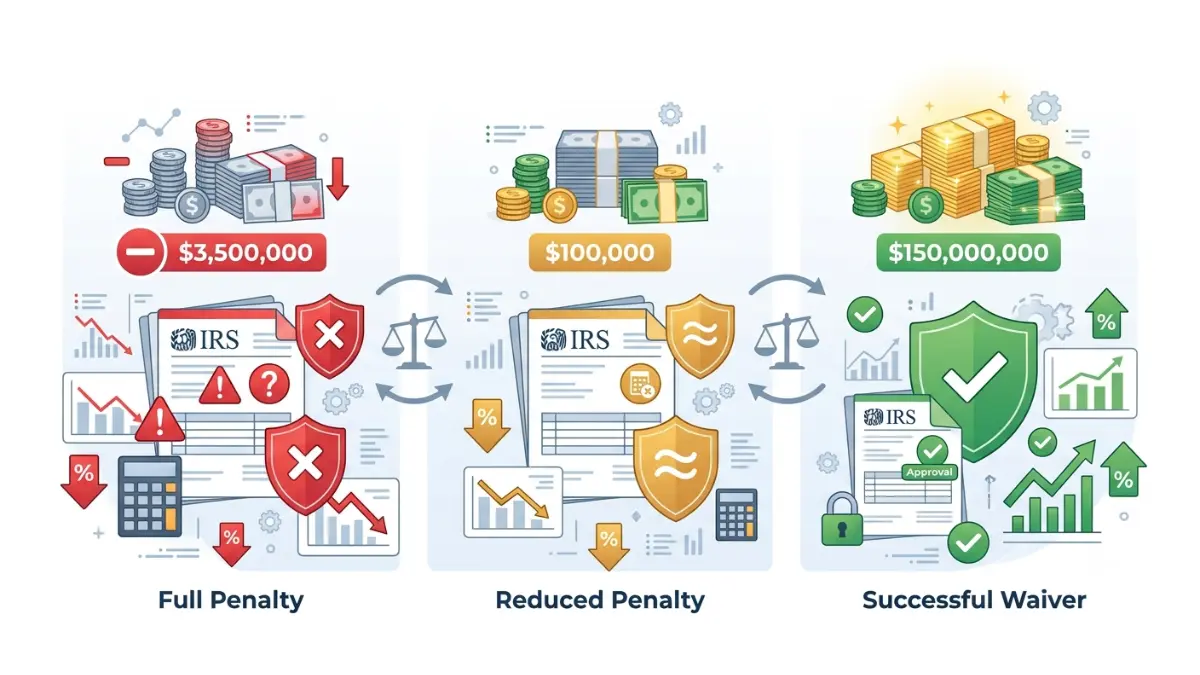
Nothing shows why the correction window matters like the dollars. Here is the same missed RMD under all three outcomes.
Calculating the shortfall from your December 31 balance
Your RMD equals your prior-year December 31 balance divided by a life-expectancy factor from the IRS Uniform Lifetime Table. At age 73 that factor is 26.5, so a $1,000,000 traditional IRA produces a required withdrawal of about $37,736. You can estimate your own retirement withdrawals or model a 401(k) over time to find your number.
📊 Data Point: The age-73 distribution period is 26.5 — Source: IRS Publication 590-B, Table III (Uniform Lifetime). A $1,000,000 balance ÷ 26.5 = a $37,736 RMD.
Three outcomes on the same missed RMD
Say you missed that $37,736 distribution entirely. Here is what it costs under each path:
| Outcome | Penalty rate | You owe |
|---|---|---|
| Missed, not corrected in time | 25% | $9,434 |
| Corrected within the window, then filed | 10% | $3,774 |
| Full reasonable-cause waiver granted | 0% | $0 |
Source: penalty rates from the IRS Instructions for Form 5329; RMD figured from the IRS Publication 590-B factor above.
The gap between the top two rows — $5,660 — is what acting in time is worth on this one distribution.
Don’t get hit twice: preventing the next missed RMD
Most missed RMDs come from a few predictable traps, and each has a simple guardrail.

Why RMDs get missed (the multi-account trap)
You can total the RMDs for your traditional IRAs and take the combined amount from any one of them — but 401(k)s and 403(b)s cannot be aggregated, so each plan needs its own withdrawal. Someone with six 401(k)s and one IRA has to take seven separate distributions, and the more accounts you juggle, the easier one is to miss. Consolidating old accounts is the single most effective fix.
The first-year April 1 rule and inherited-IRA RMDs
Your first RMD isn’t due until April 1 of the year after you turn 73 — but delaying it means two RMDs land in the same calendar year, which can push you into a higher bracket, raise Medicare premiums, and affect how much of your Social Security is taxed. Inherited accounts carry their own trap: many beneficiaries now owe annual distributions during the inherited-account 10-year rule window, which the IRS began enforcing in 2025. A qualified charitable distribution can satisfy your RMD tax-free, and a QLAC can reduce future RMDs altogether. The full deadlines appear in the IRS required minimum distribution rules.
✅ Action Step: Ask your IRA custodian to set up automatic RMD withdrawals, and if you hold an inherited IRA, ask a CPA one question: “Do I owe an annual RMD during my 10-year window, and how much?”
Five mistakes that turn a fixable miss into a costly one
A missed RMD is usually cheap to fix — unless one of these errors gets in the way.
Confusing “reduce to 10%” with a full waiver, and other filing traps
The biggest error is assuming the make-up withdrawal alone earns the 10% rate. It doesn’t — you must also file the return reporting the tax. Two more: letting the correction window close entirely, which locks in 25%, and failing to keep the custodian statement that proves the date and amount of your make-up distribution.
The two different 10%s
Don’t confuse the reduced 10% RMD rate with the separate 10% early-withdrawal penalty — they are different rules at opposite ends of retirement, calculated in different parts of Form 5329, and worth understanding on their own through the separate 10% early-withdrawal penalty and penalty-free ways to withdraw from an IRA. And the individual reasonable-cause waiver on Form 5329 is not the same as the plan-sponsor correction programs some articles cite, which are for employers, not IRA owners.
✅ Action Step: If you have multiple plans, an inherited IRA, or the IRS has already sent a notice, hand the correction to a CPA or a tax attorney rather than filing solo — and ask them to review your Form 5329 and reasonable-cause letter before you submit.
Missed RMD penalty: frequently asked questions
1. What is the penalty for not taking an RMD?
The missed RMD penalty is a 25% excise tax on the amount you failed to withdraw — the shortfall, not your full balance. Down from 50% before 2023, it can drop to 10% or be waived entirely if you correct the miss promptly. Confirm the specifics with a CPA.
2. Can the missed RMD penalty be waived?
Yes. If the miss was a reasonable error and you’ve corrected it, the IRS can waive the penalty entirely. You request this by filing Form 5329 with a signed statement explaining what happened. A tax professional can help you make the case.
3. How long is the RMD correction window?
It ends on the earliest of three dates: when the IRS mails a deficiency notice, when the tax is assessed, or the last day of the second tax year after the year the RMD was due. Missing that window locks in the higher 25% rate.
4. Is the 25% penalty on my whole account or just the shortfall?
Only the shortfall — the amount you were required to withdraw but didn’t. It never applies to your full balance or to earnings the money produced. So a $20,000 shortfall means a $5,000 penalty at 25%, not a percentage of your entire account.
5. What is Form 5329 used for?
Form 5329 reports additional taxes on IRAs and retirement plans. Part IX is where you report a missed RMD, calculate the excise tax, and — using the “RC” notation plus a letter — request a penalty waiver. It’s filed with your federal tax return.
6. Do I pay the penalty before the IRS decides my waiver?
If you request a full waiver, you enter the reduced amount, often $0, and pay only what’s left, if anything. The IRS then reviews your explanation and notifies you whether it believes you still owe. Ask a CPA if unsure.
7. Can I cover multiple IRAs with one withdrawal?
Yes for traditional IRAs — total the required amounts and take them from any one or more. But each 401(k) or 403(b) must be handled separately, because those can’t be aggregated. Mixing this up is a leading cause of a missed RMD penalty.
8. What if I missed my first RMD at 73?
Your first RMD is due by April 1 of the following year, not December 31. If you delay it, you take two RMDs in one calendar year, which can raise your tax bracket and Medicare premiums. A CPA can help you time it.
9. Do inherited IRAs have RMD penalties too?
Yes. Inherited IRAs that require annual distributions carry the same 25% — or reduced 10% — penalty, and the rules are complex. Many beneficiaries now owe annual distributions during the 10-year window. Ask a CPA whether, and how much, applies to you.
10. How do I calculate the RMD I missed?
Divide your account balance on December 31 of the prior year by your age-based factor from the IRS Uniform Lifetime Table in Publication 590-B. At age 73 the factor is 26.5. The result is the minimum you were required to withdraw for the year.
11. Does a Roth IRA have RMDs?
Not during the original owner’s lifetime, so a missed RMD penalty can’t apply to your own Roth IRA. Since 2024, designated Roth accounts in a 401(k) or 403(b) are also exempt. Inherited Roth accounts, however, do carry distribution requirements.
Your next step
If you’ve missed an RMD, the path forward is short: take the make-up distribution now, complete Form 5329 with a brief reasonable-cause letter, and file it before your correction window closes. Do those three things and you move from a 25% penalty toward 10% — or, with a granted waiver, nothing at all. The IRS is genuinely lenient with people who fix honest mistakes quickly, so the worst move is to wait. If you’re managing several accounts, an inherited IRA, or a notice from the IRS, have a CPA review your paperwork before you file.

Informational disclaimer
The content on Finance Authority Hub is provided for general informational and educational purposes only and should not be considered personalized financial, investment, tax, legal, or professional advice. Financial decisions depend on your individual goals, income, risk tolerance, location, and regulatory situation. Before acting on any information, strategy, estimate, or calculator result, consult a qualified licensed professional who can evaluate your specific circumstances.