What the Medicare Part D late enrollment penalty costs you
Medicare Part D’s late enrollment penalty is calculated on a national benchmark that rose to $41.33 for 2027 — not on the plan you actually bought.

In This Article
The Medicare Part D late enrollment penalty is a permanent monthly surcharge, not a one-time fee. Medicare adds it to your drug plan premium for as long as you keep Medicare drug coverage, even if you later switch plans.
Two readers usually land here.
If a penalty letter just arrived: Sections 2 and 3 show exactly how that number was built, and Section 6 covers the 60-day appeal window that is already running.
If you are approaching 65: Sections 4 and 7 cover what protects you, and what quietly does not.
Medicare’s costs arrive as several separate bills rather than one premium. This penalty attaches to one of them only — the drug plan bill.
ℹ️ Financial Disclaimer: This article is educational and is not personalized investment, tax, lending, credit, insurance, or debt-relief advice. FinanceAuthorityHub is not affiliated with or endorsed by Medicare, the Centers for Medicare & Medicaid Services, or any government agency, and does not sell or recommend insurance plans. Before acting on anything here, consult a fiduciary advisor, a CPA, or a qualified attorney as your situation requires.
How the Part D late enrollment penalty is calculated
Medicare multiplies 1% of the national base beneficiary premium by the number of full months you went without drug coverage, rounds to the nearest $0.10, and adds the result to your premium.
For 2026, that base figure is $38.99.

The formula, in three steps
- Count the full months you had neither Part D nor creditable drug coverage.
- Multiply that count by 1% of $38.99.
- Round to the nearest $0.10.
Medicare’s published example uses 14 uncovered months: 14% of $38.99 is $5.46, which rounds to $5.50 per month. You can check that arithmetic on Medicare’s own late enrollment penalty page.
Why a cheaper plan won’t shrink your penalty
🔍 How It Works: The base beneficiary premium is a national benchmark that CMS publishes each summer. Your penalty is a percentage of that benchmark, never a percentage of the plan you actually bought. Moving to a $0-premium drug plan changes your premium but leaves the penalty exactly where it was.
What the penalty actually costs over 10 and 20 years
Because the benchmark rises most years, the same gap costs more each January. A 24-month gap — a 24% penalty — priced across five coverage years:
| Coverage year | Base beneficiary premium | Monthly penalty on a 24-month gap | Key detail |
|---|---|---|---|
| 2023 | $32.74 | $7.90 | Before the IRA cap took effect |
| 2024 | $34.70 | $8.30 | First year of the 6% cap |
| 2025 | $36.78 | $8.80 | Capped at 6% again |
| 2026 | $38.99 | $9.40 | Current year |
| 2027 | $41.33 | $9.90 | Announced July 28, 2026 |
Base beneficiary premiums: Centers for Medicare & Medicaid Services annual Part D bid announcements, 2023–2027. Monthly penalty figures calculated by FinanceAuthorityHub by applying 24% to each year’s published benchmark and rounding to the nearest $0.10.
📊 Data Point: The 2027 Part D base beneficiary premium is $41.33, up from $38.99 — Source: CMS Part D 2027 bid announcement, July 2026. CMS notes the Inflation Reduction Act caps the annual increase at 6% through 2029.
Your penalty is going up in 2027

At $9.90 a month, a 24-month gap costs about $119 in 2027. Held at that rate, twenty years runs near $2,380 — a projection that assumes no further increase, which has not happened in any year since 2023. This sits alongside what Medicare costs per year overall.
What counts as creditable drug coverage
Creditable prescription drug coverage is coverage expected to pay, on average, at least as much as standard Part D. It is an actuarial test applied to a specific plan — not a property of a coverage category.
The 63-day rule
The penalty starts accruing once you go 63 days or more in a row without creditable coverage after you first become eligible.

Coverage that usually counts
Employer or union drug coverage, Department of Veterans Affairs benefits, and Indian Health Service coverage are all listed among creditable sources — when the specific plan meets the test.
⚠️ Costly Mistake: Assuming a category protects you. Two employers can offer drug coverage where one is creditable and one is not. CMS requires plan sponsors to tell Medicare-eligible members in writing, before October 15 each year, which one theirs is. That letter is the proof that wins an appeal years later — most people throw it away.
Who never has to pay the penalty
Two groups generally escape it entirely.
If you have creditable coverage
Months covered by creditable drug coverage are not uncovered months. They never enter the calculation.
If you qualify for Extra Help
Extra Help, the Part D Low-Income Subsidy, is administered by the Social Security Administration. Medicare generally does not charge the late enrollment penalty to people who qualify.
People routinely assume they earn too much and never apply. Applying is free and costs nothing but time.
✅ Action Step: Check current eligibility on Medicare’s Extra Help page, then contact your State Health Insurance Assistance Program counselor — free and non-commercial — and ask: “Based on my income and resources, should I apply for Extra Help, and would it remove my late enrollment penalty?”
How to appeal a Part D late enrollment penalty
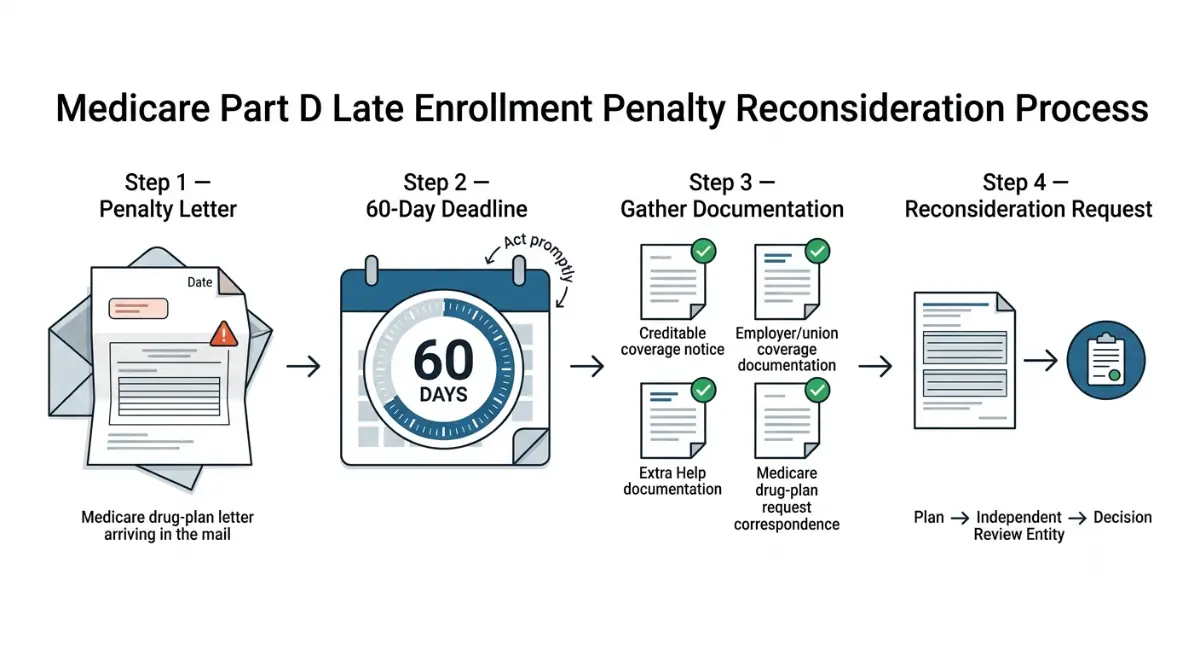
You have 60 days from the date on your penalty letter to file a reconsideration request. Your plan sends the form with the letter.
Grounds that can win
- Medicare missed creditable coverage you actually had.
- You had drug coverage but never received a notice stating whether it was creditable.
- You receive or previously received Extra Help.
- A serious medical emergency prevented you from enrolling.
An Independent Review Entity under contract to CMS decides the case. Full grounds appear on CMS’s late enrollment penalty appeals page.
Not knowing the requirement existed is not among the grounds. Late filings may still be accepted if you show good cause.
✅ Action Step: Before filing, ask a SHIP counselor: “Can you review my creditable coverage documentation and confirm I’ll meet the 60-day deadline?” Mail the form to the address printed on your own letter. Medicare’s appeal routes differ by bill — the IRMAA appeal uses Form SSA-44 instead.
Two mistakes that create a lifetime penalty
Assuming no prescriptions means no plan needed
Pre-retirees who take nothing skip Part D and start the clock. Medicare itself suggests considering a low-premium plan for exactly this reason. A plan also carries Part D’s annual out-of-pocket cap, which no coverage gap provides.
Confusing Part B and Part D deadlines
They calculate differently. Part B adds 10% for each full 12-month delay; the Part B penalty runs on its own clock and its own base figure.
Common questions about the Part D late enrollment penalty
1. How much is the Part D late enrollment penalty in 2026?
It’s 1% of $38.99 for each full uncovered month, rounded to the nearest $0.10 and added to your monthly premium.
2. Does the Part D late enrollment penalty ever go away?
Generally no. It stays on your premium for as long as you keep Medicare drug coverage, even after switching plans.
3. Is the penalty based on my plan’s premium or a national figure?
A national figure. The calculation always uses the base beneficiary premium, never your own plan’s monthly cost.
4. What counts as creditable prescription drug coverage?
Coverage similar in value to Part D, such as qualifying employer, union, VA, or Indian Health Service drug coverage.
5. Can I avoid the penalty if I take no medications?
No. The penalty counts uncovered months, not prescriptions filled, so months without a plan still accrue. Ask a SHIP counselor about your specific coverage before deciding.
6. Does VA drug coverage prevent the Part D penalty?
It can. VA benefits appear among creditable sources, but confirm your own coverage’s creditable status in writing.
7. How long do I have to appeal a Part D late enrollment penalty?
Sixty days from the date on your penalty letter. Later filings may be accepted if you show good cause.
8. Does Extra Help remove the Part D late enrollment penalty?
Yes. Medicare generally does not charge the penalty to people who qualify for Extra Help. Contact Social Security to confirm your eligibility.
9. Will my Part D penalty change in 2027?
Yes. The base beneficiary premium rises to $41.33, so the same uncovered months will cost slightly more.
10. Does the penalty apply to Medicare Advantage plans with drug coverage?
Yes. That is Medicare drug coverage, and the penalty follows you into it. A SHIP counselor can confirm how it applies to your plan.
10. Is the Part D penalty the same as the Part B late enrollment penalty?
No. Part B adds 10% for each full 12-month delay; Part D adds 1% for each uncovered month.
Two things are worth doing today. If a penalty letter arrived, find its date and count sixty days forward — that deadline governs everything else. If you are approaching 65, ask your plan administrator for your creditable coverage status in writing and file it somewhere you will find it in five years.
Informational disclaimer
The content on Finance Authority Hub is provided for general informational and educational purposes only and should not be considered personalized financial, investment, tax, legal, or professional advice. Financial decisions depend on your individual goals, income, risk tolerance, location, and regulatory situation. Before acting on any information, strategy, estimate, or calculator result, consult a qualified licensed professional who can evaluate your specific circumstances.