Contributing to a 401(k) and an IRA in the same year
With a 401(k) and an IRA in the same year, an employer match alone counts as coverage for the year, while a 457(b) by itself does not.
In This Article
Rates and limits checked on October 26, 2026.
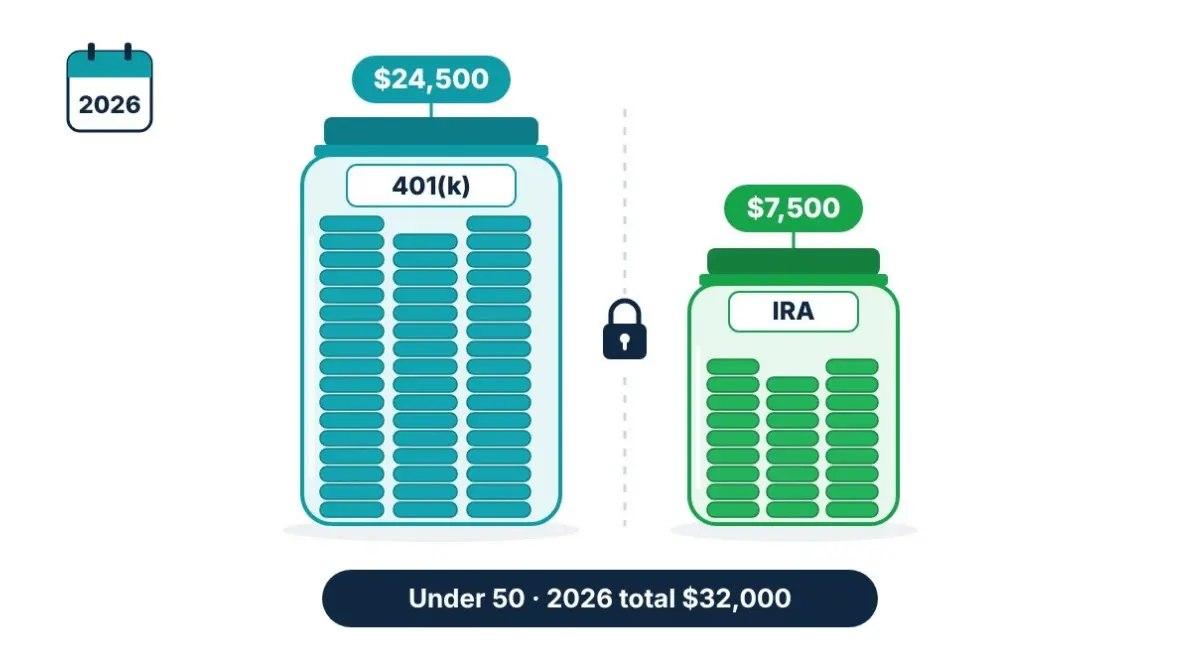
Yes. For tax year 2026 you can defer up to $24,500 into a 401(k) and also contribute $7,500 to an IRA, and neither limit reduces the other. A workplace plan can affect only whether a traditional IRA contribution is tax-deductible; it has no say over whether you may contribute, and it plays no part in Roth IRA eligibility.
Whether that deduction survives turns on two facts from your own return: whether you count as covered by a plan at work, and where your modified adjusted gross income (MAGI) lands.
$24,500 plus $7,500: the two limits never overlap
A worker under 50 can move $32,000 into retirement accounts for 2026, the full 401(k) deferral plus the full IRA amount. From age 50, catch-up contributions raise both ceilings, and the 401(k) side has a larger catch-up for ages 60 to 63.
| Age reached by the end of 2026 | 401(k) deferral | IRA contribution | Combined |
|---|---|---|---|
| Under 50 | $24,500 | $7,500 | $32,000 |
| 50 to 59, or 64 and older | $32,500 | $8,600 | $41,100 |
| 60 to 63 | $35,750 | $8,600 | $44,350 |
Tax year 2026 figures from the IRS announcement of 2026 retirement limits. The 401(k) catch-up amounts apply only if your plan permits catch-up contributions.
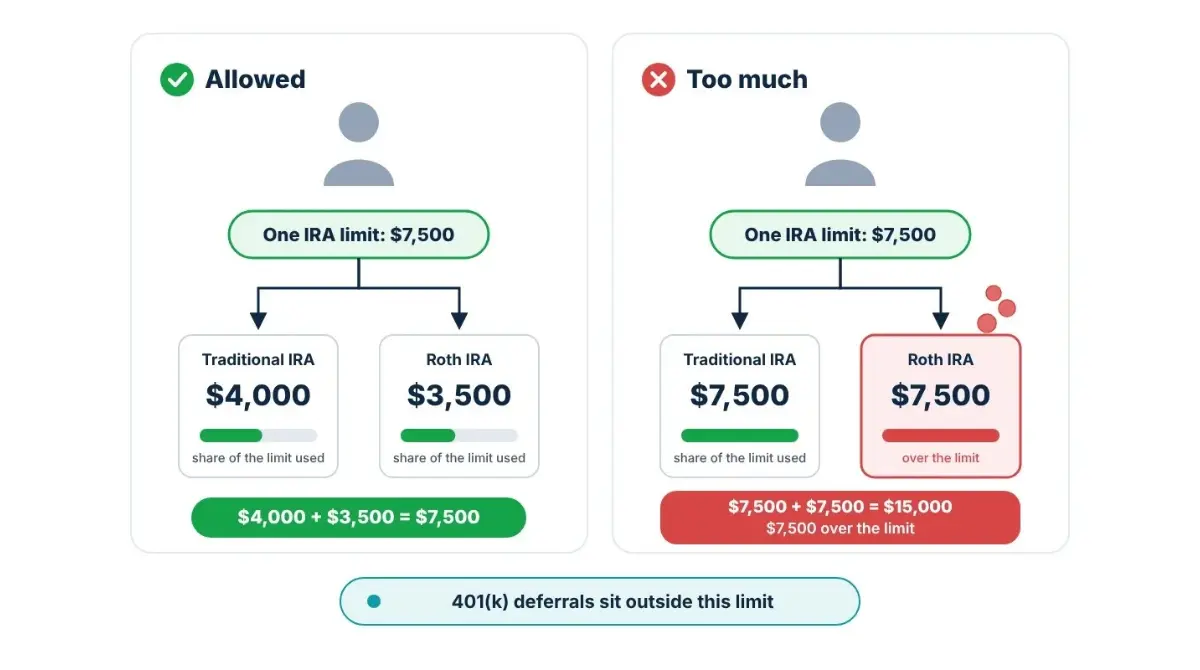
The IRA figure applies per person across every IRA you own. A traditional IRA and a Roth IRA share one $7,500 limit, and your total can’t exceed your taxable compensation for the year (Publication 590-A). Someone who earned $4,000 can put in $4,000.
The wider rules for each account type are in the page on how each IRA type and its income limits work.
Who counts as covered by a plan at work
The IRS tests coverage by plan type, and none of the tests ask whether you chose to save.
| Plan your employer runs | You count as covered for the year if |
|---|---|
| 401(k), 403(b), profit-sharing or another defined contribution plan | Any contribution or forfeiture was allocated to your account for the plan year |
| SEP or SIMPLE IRA | Any amount was contributed to your account for the plan year |
| Pension (defined benefit plan) | You were eligible to participate, even if you declined |
Source: IRS, are you covered by an employer’s retirement plan.
Covered without putting in a dollar
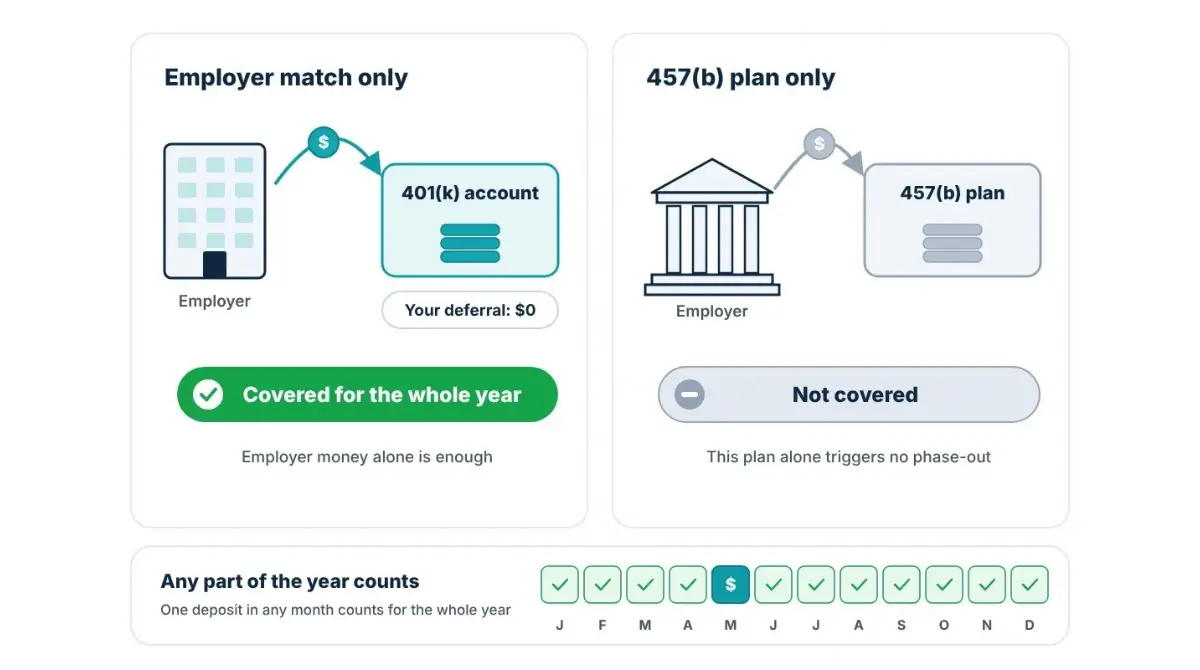
An employer match or a profit-sharing deposit is enough by itself. Someone who never enrolled can still be covered for 2026 if the employer added money to the account, and coverage for any part of the year counts for the whole year (Publication 590-A).
Box 13 of Form W-2 has a “Retirement plan” checkbox. The IRS tells employers to check it for anyone who was an active participant at any point in the year (IRS Form W-2 guidance for retirement plans).
If the box and your account history disagree, take both to a CPA or enrolled agent. Ask: “My W-2 shows this box blank, but my plan statement shows employer deposits in 2026. Which one decides my IRA deduction?”
A 457(b), a spouse’s plan or a pension
A 457(b) deferred compensation plan doesn’t count. That same IRS guidance tells employers to leave the Box 13 checkbox empty when the only plan is a 457(b), so a worker whose only workplace plan is a 457(b) faces no coverage-based phase-out.
A spouse’s plan works differently. If your spouse is covered and you aren’t, your own deduction phases out only at a much higher joint income, shown in the next table.
With a pension, eligibility is the test. Declining to join doesn’t take you out of it.
Coverage shrinks the IRA deduction as income rises
Once you count as covered, the deduction fades out across a band of MAGI, and your filing status sets the band.
| Your situation for 2026 | Partial deduction when MAGI is between | No deduction at or above |
|---|---|---|
| Single or head of household, covered | $81,000 and $91,000 | $91,000 |
| Married filing jointly, you’re covered | $129,000 and $149,000 | $149,000 |
| Married filing jointly, only your spouse is covered | $242,000 and $252,000 | $252,000 |
| Married filing separately, covered | $0 and $10,000 | $10,000 |
Tax year 2026 ranges from the IRS announcement of 2026 retirement limits.
Below the band you deduct the full contribution. If neither spouse is covered, there is no income test at all.
A lost deduction never blocks the deposit. Money you can’t deduct can still go in as a nondeductible contribution, reported on Form 8606, so that part isn’t taxed a second time when you withdraw it. The worksheet for every filing status is on the page covering traditional IRA deduction income limits.
Where the Roth IRA fits
Workplace coverage has no effect on Roth eligibility. For 2026, direct Roth contributions phase out between $153,000 and $168,000 of MAGI for single filers and between $242,000 and $252,000 for joint filers. The 2026 Roth IRA income limits show the reduced amount inside each band.
Does a bigger pre-tax deferral bring the deduction back?
Example: a single filer under 50, covered at work, earns $100,000 in wages and has no other income or adjustments. Their MAGI equals the wages left in Box 1 of the W-2.
Pre-tax 401(k) deferrals stay out of Box 1 (IRS retirement plan contribution FAQ). The IRA deduction itself is added back when MAGI is figured for this test (Publication 590-A). In this household, that makes the pre-tax deferral the one number that moves MAGI.
| Tax year 2026 | Deferring $6,000 | Deferring $16,000 |
|---|---|---|
| Box 1 wages and MAGI | $94,000 | $84,000 |
| Where MAGI sits in the $81,000 to $91,000 band | Above the top | $3,000 into it |
| Deductible part of a $7,500 IRA contribution | $0 | $5,250 |
| Nondeductible part, reported on Form 8606 | $7,500 | $2,250 |
At $84,000, the worksheet takes $91,000 minus $84,000, which is $7,000. Divided by the $10,000 band, that gives 0.7. Times $7,500, that’s $5,250 deductible, and the other $2,250 goes on Form 8606.
Send the extra $10,000 to a Roth 401(k) instead and the picture flips back. Roth deferrals are taxed as wages, Box 1 stays at $94,000, and the deduction stays at zero.
Two worksheet rules matter at the edges. The result rounds up to the next $10, and any result above zero but under $200 becomes $200. At $90,800 of MAGI the formula produces $150, so this filer could deduct $200.
The table shows how the worksheet responds; whether a larger deferral fits your budget is your call. The 401(k) calculator lets you enter your salary and a new deferral amount, so you can check the change against the $24,500 cap before you ask payroll for it. A CPA or enrolled agent can run the worksheet on your own figures. Ask: “At my expected 2026 MAGI, how much of a $7,500 traditional IRA contribution is deductible, and what goes on Form 8606?”
Check Box 13 before your last 2026 paycheck
Payroll is the clock that runs out first.
Deadline: a 401(k) deferral for tax year 2026 can come only out of pay you receive by December 31, 2026. IRA contributions for 2026 are due by April 15, 2027, and a filing extension doesn’t move that date (Publication 590-A).
- Ask HR, or check your plan statement, whether any money went into your plan account in 2026. Box 13 on the W-2 you receive early in 2027 should match.
- Estimate your 2026 MAGI and place it in the band for your filing status.
- If you plan to change your deferral, give payroll the new amount before its year-end cutoff.
- When you contribute to the IRA, tell the custodian the deposit is for tax year 2026, and report any nondeductible part on Form 8606.
Putting $7,500 into a traditional IRA and another $7,500 into a Roth IRA for the same year creates an excess contribution. Correcting an excess IRA contribution runs on its own deadline.
Informational disclaimer
The content on Finance Authority Hub is provided for general informational and educational purposes only and should not be considered personalized financial, investment, tax, legal, or professional advice. Financial decisions depend on your individual goals, income, risk tolerance, location, and regulatory situation. Before acting on any information, strategy, estimate, or calculator result, consult a qualified licensed professional who can evaluate your specific circumstances.