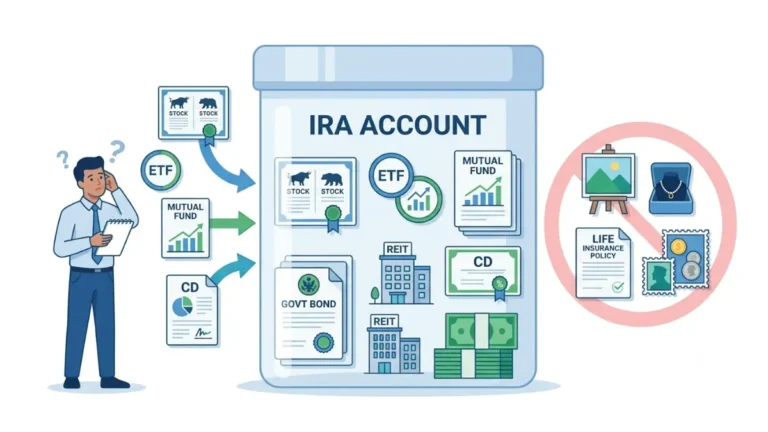
The Self-Directed IRA Risks Most Savers Overlook
Self-directed IRA risks go past bad deals. Business or debt-financed income inside the account can be taxed at 37% above $16,000 in 2026.
In This Article
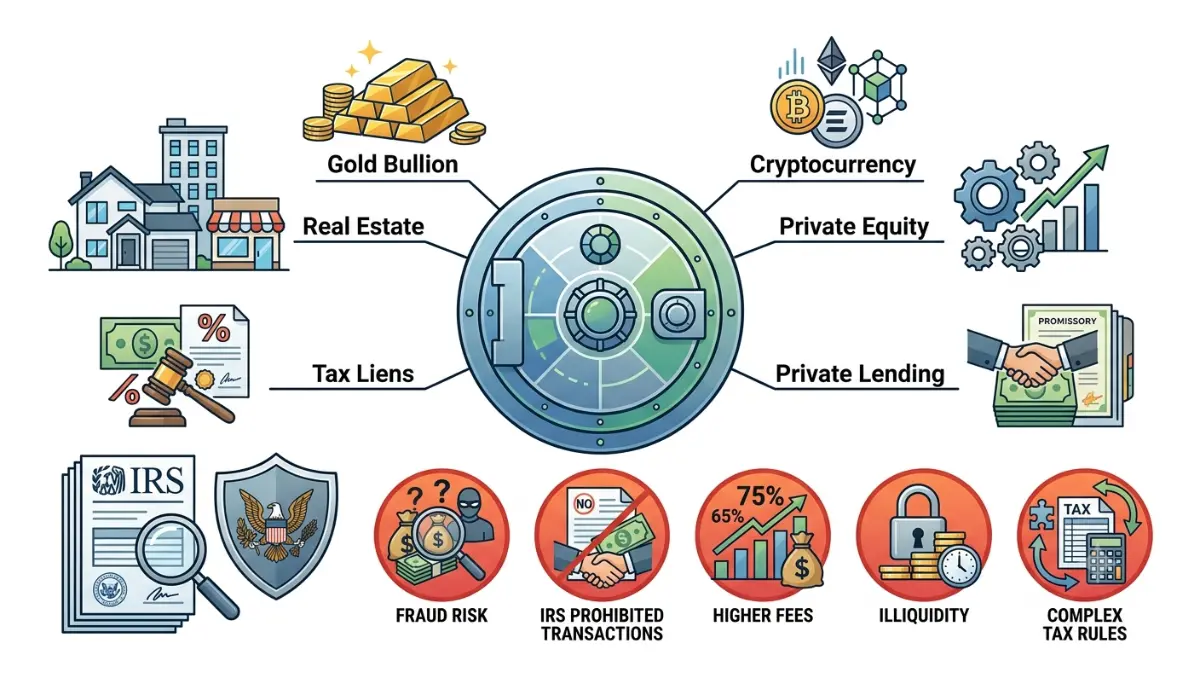
A self-directed IRA is not a sixth type of retirement account. It is a traditional, Roth, SEP, or SIMPLE IRA held at a custodian willing to hold assets most providers refuse — real estate, private notes, precious metals, crypto assets, tax liens.
The risks split into two families that have nothing to do with each other. The SEC, NASAA, and FINRA warn about who is selling you the asset. The IRS cares what you do with it afterwards, and its penalty reaches the whole account rather than the bad investment.
So read by situation. Considering one — start with what your custodian will and will not check. Already own one — go to the prohibited transaction rules below.
Being pitched one this week — the six verification checks will test the offer faster than anything else here. Self-employed savers should know a SEP IRA can be self-directed too, and the wrapper still determines which type of IRA fits your income.
This page sells nothing and links to no products.
ℹ️ Financial Disclaimer: This article is educational and is not personalized investment, tax, lending, insurance, or debt-relief advice. Self-directed IRA rules carry investment risk, tax consequences, and legal exposure that depend entirely on your own facts. Before acting, consult a fiduciary advisor, a CPA, or a qualified tax attorney.
Your custodian is not checking anything
The risks of a self-directed IRA fall into five categories, and only two concern the investment itself:
- No review — the custodian does not evaluate the asset or the person selling it
- Promoter risk — the person pitching you may not be licensed or regulated
- Illiquidity — private assets can be hard to sell when you need the money
- Complex tax rules — rules that never touch a mainstream IRA apply here
- Higher fees — account, annual, administrative, and asset-specific charges stack
What a custodian actually does
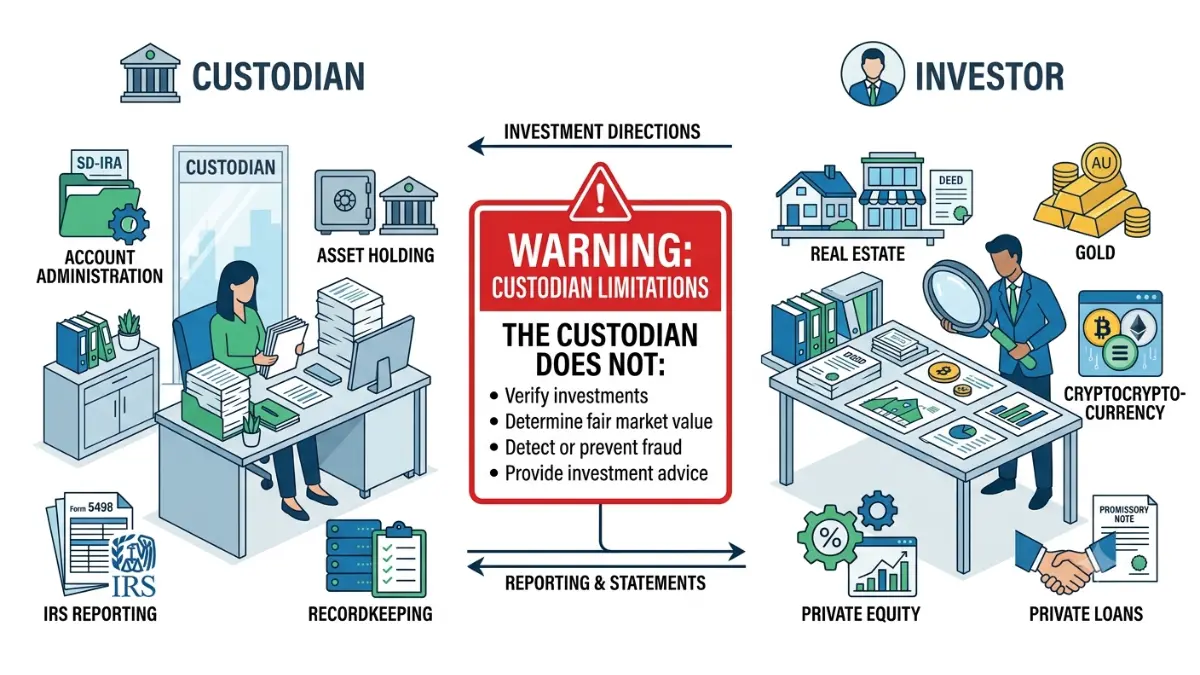
The joint alert from the SEC’s Office of Investor Education and Advocacy, NASAA, and FINRA is unusually blunt. Self-directed IRA custodians do not sell investments or give advice, do not judge whether an investment or its promoter is legitimate, and do not verify the financial information handed to them.
Their job is holding and administering assets. Most custodial agreements state plainly that the custodian carries no responsibility for performance.
Why “held at a real custodian” proves nothing
⚠️ Costly Mistake: Reading a legitimate custodian as a seal of approval. Regulators state directly that using a legitimate custodian does not make an investment legitimate — and some promoters misrepresent custodial duties to imply the asset was vetted when nobody looked at it.
Promoters solicit money for these investments. They may not be licensed, and they may sit outside the oversight rules covering the securities industry. Account fees here can also run well above mainstream providers, which is worth measuring against what ordinary IRA providers charge and what exits cost.
The full SEC, NASAA and FINRA joint investor alert is worth twenty minutes before you sign anything.
One prohibited transaction can end the whole account
If you or your beneficiary engage in a prohibited transaction at any point during a year, the account stops being an IRA as of the first day of that year. Everything in it is then treated as distributed to you at fair market value on that date.
That retroactivity is the part almost everyone misses. The penalty does not land on the offending asset. It lands on the account.
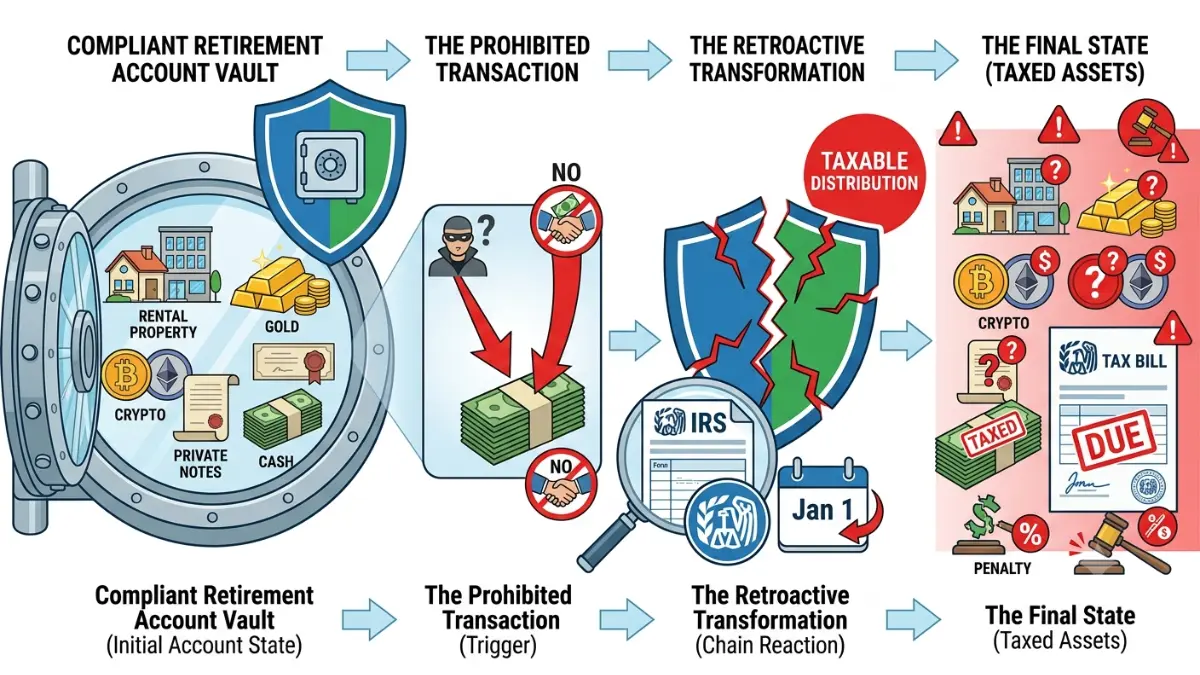
🔍 How It Works: Say the transaction happens in November on a $12,000 note, inside a $300,000 IRA. The IRS does not tax $12,000 in November. It treats the full $300,000 as distributed on January 1 — taxable as ordinary income, with the 10% early withdrawal penalty stacked on top if you are under 59½.
Who counts as a disqualified person
The IRS lists your fiduciary and your family — spouse, ancestors, lineal descendants, and the spouses of lineal descendants. Siblings, cousins, and friends are not on that list.
That absence is not a green light. Fiduciary self-dealing and indirect-benefit rules still apply, and this is precisely where readers talk themselves into trouble.
What it costs
| Misstep | Rule that applies | Who pays | Key detail |
|---|---|---|---|
| You or family use an IRA-owned property | Prohibited transaction, §4975 | Account owner | Account stops being an IRA as of January 1 |
| Your IRA lends money to your child | Prohibited transaction | Account owner | Same retroactive disqualification |
| A business you control deals with your IRA | Prohibited transaction | Other disqualified persons | 15% excise tax on the amount involved, rising to 100% if uncorrected |
| Your IRA buys art, antiques, or wine | Collectible acquisition, §408(m) | Account owner | Distribution equal to cost, in the year acquired |
Sources: IRS, Retirement topics — Prohibited transactions; 26 U.S.C. §4975. Verified July 2026.
A disqualified Roth account also disturbs the two Roth five-year clocks. You can estimate what a deemed distribution would add to your taxable income before it becomes theoretical.
✅ Action Step: Before any transaction touching a family member, a business you control, or personal use of an IRA asset, ask a CPA or tax attorney one question: “Would this give me or a family member any direct or indirect benefit from an IRA asset?”
Full detail sits in the IRS prohibited transaction rules.
When a tax-free account gets a tax bill
An IRA with $1,000 or more of gross income from an unrelated business must file Form 990-T and may owe tax — inside the account, in the same year. The custodian files it; the liability belongs to the IRA.
This surprises people because the account is supposed to be tax-deferred. Two things break that: operating a business, and borrowing.
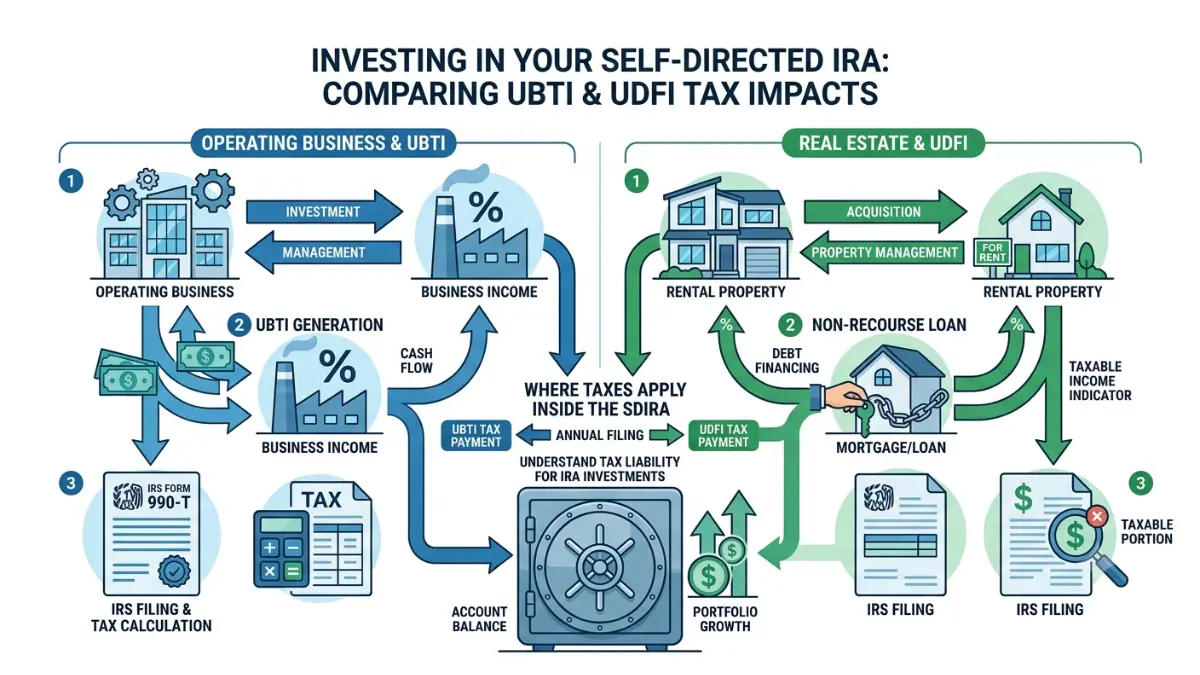
Why a mortgage inside an IRA creates taxable income
🔍 How It Works: Unrelated business taxable income comes from running a trade or business. Unrelated debt-financed income comes from leverage — if your IRA buys a rental with a non-recourse loan, the share of income attributable to the borrowed money becomes taxable. Ordinary rent, interest, and capital gains in an unleveraged IRA are not affected.
What the 2026 rates cost
| 2026 taxable income inside the IRA | Federal rate | Key detail |
|---|---|---|
| Up to $3,300 | 10% | Brackets are compressed, not generous |
| $3,300 to $11,700 | 24% | — |
| $11,700 to $16,000 | 35% | — |
| Above $16,000 | 37% | A single filer does not reach 37% until roughly $640,600 |
Source: IRS Revenue Procedure 2025-32. Verified July 2026.
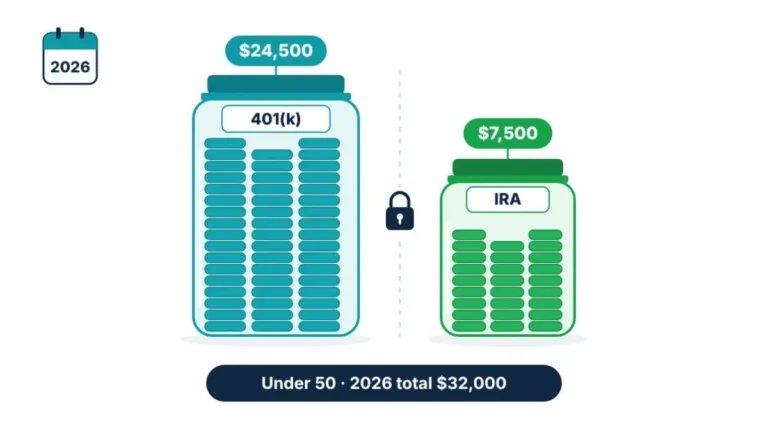
So $20,000 of debt-financed rental income is taxed at 37% on the slice above $16,000 — a rate that would take a single filer more than half a million dollars of income to reach. For scale, the 2026 IRA contribution limit is $7,500.
Illiquid assets also complicate the year required minimum distributions begin at 73. It is worth seeing what that tax drag costs over twenty years.
✅ Action Step: Before your IRA borrows or buys an operating business interest, ask a CPA: “Will this generate UBTI or UDFI, and who prepares the 990-T?”
See the IRS unrelated business income rules for the filing threshold.
Gold, crypto, and the home-storage myth
No. You cannot keep IRA-owned metals at home, and titling them to an LLC your IRA owns does not change that.
An IRA acquiring a collectible is treated as taking a distribution equal to the cost, in the year of purchase. Certain gold, silver, platinum, and palladium bullion is carved out — but only when a bank or an IRS-approved nonbank trustee holds physical possession of it.
What it cost in court
📊 Data Point: In McNulty v. Commissioner, 157 T.C. No. 10 (November 18, 2021), American Eagle coins bought through an IRA-owned LLC and kept in a home safe were held to be taxable distributions of $374,000 for 2015 and $37,380 for 2016. Accuracy-related penalties were upheld. — Source: United States Tax Court.
The taxpayer relied on a vendor website claiming home storage was fine. That is the exact pattern regulators warn about.
The ruling turned on physical possession, not on the LLC structure itself — a distinction worth keeping straight. The same logic raises an unsettled question about self-custodied crypto keys, which no authority has resolved.
✅ Action Step: Before taking possession of any IRA-owned tangible asset or private key, ask a tax attorney: “Who holds legal physical possession, and is that entity a bank or an IRS-approved nonbank trustee?”
The IRS treatment of collectibles in self-directed accounts sets out both the rule and the exception.
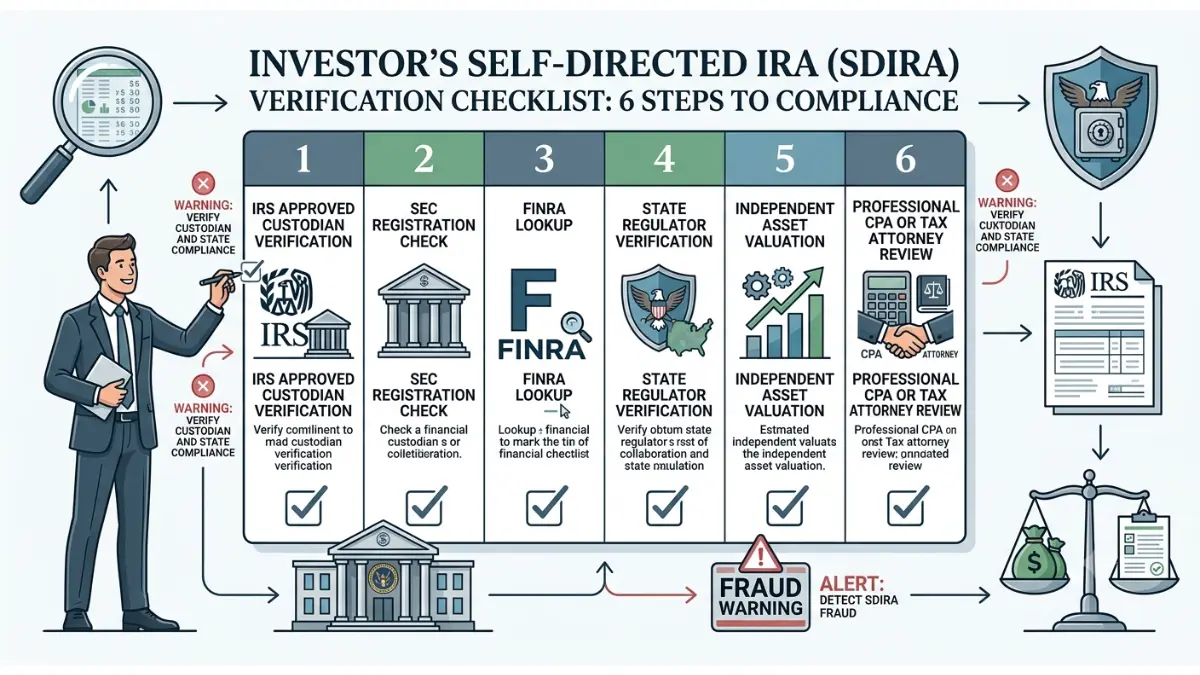
Six checks before you sign anything
Every check below uses a free, official source. None requires a professional, though the last one is worth paying for.
- Confirm the custodian appears on the IRS list of approved nonbank trustees. If it is absent, research further — the list is not complete, and absence alone proves nothing either way.
- Ask whether the person offering the investment is registered, and whether the investment itself is registered.
- Verify those answers independently with the SEC, FINRA, or your state securities regulator.
- Treat guaranteed, risk-free, or absolutely-safe language as a fraud marker rather than a selling point.
- Check your account statement values independently. Custodians often carry the original purchase price or a figure the promoter supplied.
- Get a second opinion from a licensed, unbiased professional before funding.
Unsolicited pitches often arrive as an invitation to move a 401(k) into an IRA first. That first step is where the money leaves supervision.
✅ Action Step: Run check one now — the IRS list of approved nonbank trustees and custodians takes two minutes.
Who decides what your asset is worth
Since 2015, custodians have had to report the fair market value of hard-to-value IRA assets each year on Form 5498, using codes covering private stock, non-traded debt, LLC interests, real estate, partnership interests, and assets with no readily available value.
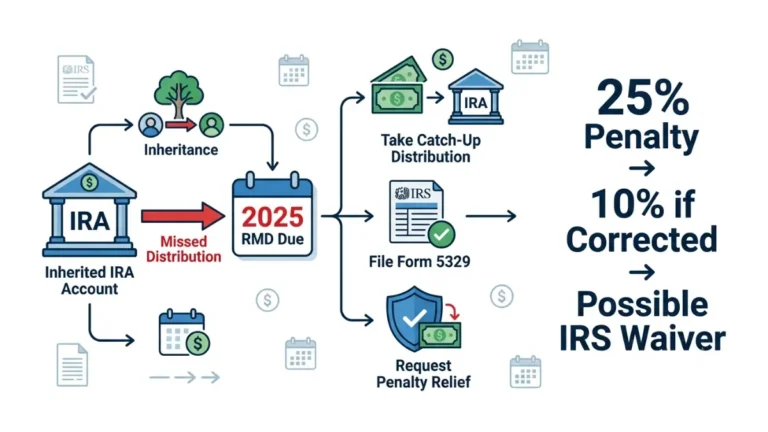
The IRS notes that accounts holding closely held investments the owner effectively controls carry a greater potential for a prohibited transaction. Valuation is often the owner’s problem in practice, and a stale figure can cascade — an illiquid asset is also the most common reason people later need to correct a missed RMD.
What the 2026 rule changes actually cover
💡 Expert Note: Executive Order 14330 and the Department of Labor’s March 2026 proposed rule address fiduciary duties for investment options inside 401(k) plans. As of July 2026 the rule was still proposed. It does not amend the prohibited transaction rules, the unrelated business income rules, or the collectibles rule, and it does not apply to self-directed IRAs. Nothing on this page changed.
Self-directed IRA questions people actually ask
1. What is a self-directed IRA, exactly?
It is a traditional, Roth, SEP, or SIMPLE IRA held at a custodian that permits a wider set of assets than most providers allow, including real estate, private notes, precious metals, and crypto. The tax wrapper is identical to any other IRA. What changes is the asset menu and who bears responsibility for evaluating it.
2. Are self-directed IRAs legal?
Yes. They are permitted retirement accounts, and the custodians holding them can be IRS-approved. Legality is not the risk — the risks are fraud exposure, illiquidity, higher fees, and tax rules that do not apply to mainstream IRAs. Consult a CPA before opening one to confirm the structure suits your situation.
3. Who counts as a disqualified person?
The IRS names your fiduciary and your family: spouse, ancestors, lineal descendants, and spouses of lineal descendants. Siblings, cousins, and friends are not listed. That does not make transactions with them safe, because fiduciary self-dealing and indirect-benefit rules still apply to anything that benefits you personally.
4. Can I live in or work on a property my IRA owns?
No. Buying property for present or future personal use is a prohibited transaction, and so is furnishing services to the account. Repairing the property yourself falls into the same territory. Ask a tax attorney before you touch an IRA-owned asset in any way.
5. What happens if my IRA commits a prohibited transaction?
The account stops being an IRA as of the first day of that year, and all assets are treated as distributed to you at fair market value on that date. Under 59½, the 10% early withdrawal penalty applies as well. Other disqualified persons face a separate 15% excise tax.
6. Does a self-directed IRA ever owe income tax?
Yes. With $1,000 or more of gross unrelated business income, the account files Form 990-T and may owe tax at trust rates, which reach 37% above $16,000 in 2026. Ordinary interest, rent, and gains in an unleveraged account are unaffected. Confirm your position with a CPA.
7. What is UDFI, and does a mortgage inside an IRA trigger it?
Unrelated debt-financed income arises when an IRA uses borrowed money. If your IRA buys a rental with a non-recourse loan, the portion of income attributable to that debt becomes taxable inside the account. The same 37% compression applies above $16,000. A CPA should model this before you borrow.
8. Can I hold IRA gold or crypto keys myself?
No for metals. The bullion exception applies only when a bank or IRS-approved nonbank trustee has physical possession, and a home safe cost one taxpayer $374,000 in deemed distributions. Self-custodied crypto keys raise the same unresolved question. Ask a tax attorney before taking possession of anything.
9. How do I check out a self-directed IRA custodian?
Start with the IRS list of approved nonbank trustees, then confirm the custodian’s registration with the SEC, FINRA, or your state securities regulator. The IRS list is not complete, so absence is a prompt to research further rather than proof of a problem.
10. Who values a private asset in my IRA each year?
Custodians report hard-to-value assets on Form 5498 but often carry the original purchase price or a promoter-supplied figure. In practice the owner supplies or arranges the valuation, which is why an independent appraisal matters for anything that would need to survive an audit.
11. Did the 2026 alternative-asset rules change self-directed IRAs?
No. Executive Order 14330 and the Department of Labor’s March 2026 proposal concern fiduciary duties for 401(k) investment options, and the rule was still proposed as of July 2026. Prohibited transaction, unrelated business income, and collectibles rules are unchanged. Verify current status with a CPA.
What to do before any money moves
If you are still considering one, the honest outcome of reading this may be that a self-directed IRA is not for you. That is a legitimate conclusion, not a failure of nerve.
If you already hold an alternative asset in an IRA and have never had the structure reviewed, that review is the next step — not next quarter.
And if someone is pitching you this week, run the six checks first. Nothing in the offer expires faster than your ability to verify it.
It helps to see what losing an account would cost you at 67 before deciding the risk is small.
Informational disclaimer
The content on Finance Authority Hub is provided for general informational and educational purposes only and should not be considered personalized financial, investment, tax, legal, or professional advice. Financial decisions depend on your individual goals, income, risk tolerance, location, and regulatory situation. Before acting on any information, strategy, estimate, or calculator result, consult a qualified licensed professional who can evaluate your specific circumstances.