How the Pro-Rata Rule Turns a Backdoor Roth Taxable
Pro-rata rule blindsided your backdoor Roth? The tax hinges on your Dec 31 pre-tax IRA balance — here’s the math, the traps, and the clean-conversion fix.
In This Article
You did everything by the book. As a high earner you couldn’t contribute to a Roth IRA directly, so you put after-tax money into a traditional IRA, ran the two-step backdoor Roth process, and expected to owe nothing. Then your backdoor Roth conversion showed up as taxable income on your return.
You’re not alone, and you probably didn’t make the mistake you think you did. The tax almost always traces back to one rule most guides mention only in passing: the pro-rata rule.
This guide is for three situations: if you already got taxed, the math is below; if you’re self-employed with a SEP or SIMPLE IRA, one section is written for you; and if you’re weighing whether to continue, which IRA fits your income and the decision section help. You’ll finish knowing what triggered the tax, what you can and can’t fix, and how to convert cleanly next year.
ℹ️ Financial Disclaimer: This article is for educational purposes only and is not personalized investment, tax, or retirement advice. Roth conversions, the pro-rata rule, and IRA rollovers carry consequences that depend on your individual circumstances. Consult a CPA, a tax attorney, or a fiduciary financial advisor before making any conversion, rollover, or contribution decision.
What the pro-rata rule actually is
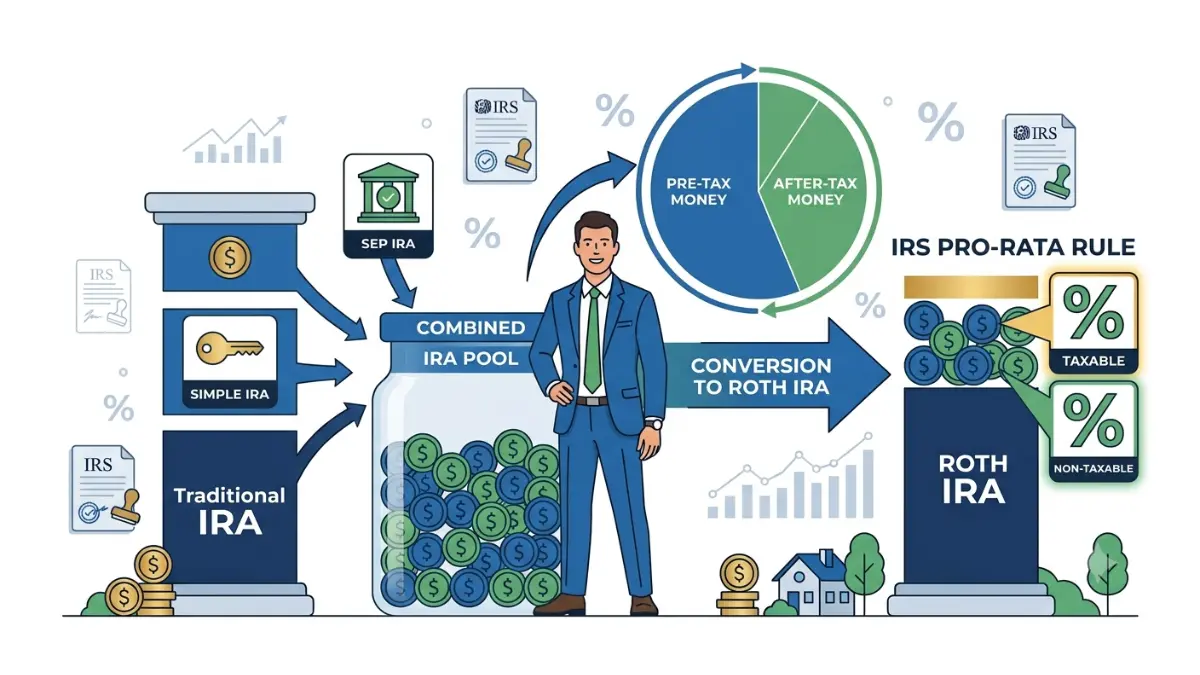
The pro-rata rule is an IRS formula that determines how much of a Roth conversion is taxable. It treats every dollar across all your traditional, SEP, and SIMPLE IRAs as one combined pool, then taxes your conversion in proportion to the pre-tax share of that pool — measured on December 31 of the conversion year.
Why high earners use the backdoor in the first place
Roth IRAs have income ceilings. For 2026, the ability to contribute directly phases out between $153,000 and $168,000 of modified adjusted gross income if you’re single, and between $242,000 and $252,000 if you’re married filing jointly, per the IRS’s 2026 contribution and income limits. Above those numbers, direct Roth contributions aren’t allowed.
The backdoor exists because there’s no income limit on converting a traditional IRA to a Roth. So high earners contribute after-tax dollars to a traditional IRA and then convert, and you can see every threshold in the full Roth IRA income limits.
Why you can’t just convert the after-tax part
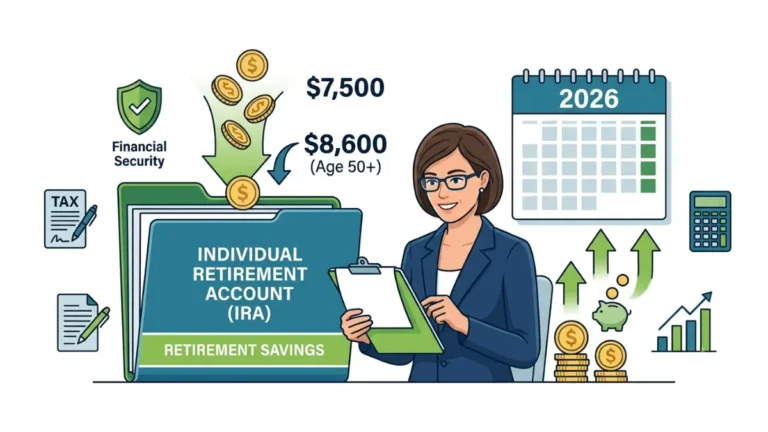
Here’s the catch: you might assume you’re converting only the after-tax money you just deposited, but the IRS doesn’t see it that way. The annual IRA contribution limit is $7,500 for 2026 ($8,600 if you’re 50 or older) — see the full contribution limit details — yet the pro-rata rule looks at your entire IRA balance, not just this year’s contribution.
🔍 How It Works: Picture stirring cream into coffee. Once it’s mixed, you can’t pour out only the cream — the IRS blends all your non-Roth IRA money, pre-tax and after-tax, into one cup, and any conversion scoops out a proportional mix of both.
Why your conversion got taxed: the math
The tax isn’t a penalty or an error in your paperwork. It’s the pro-rata formula doing exactly what it’s designed to do.
The formula the IRS uses
The IRS uses one calculation to find the tax-free share of your conversion:
Non-taxable percentage = after-tax basis ÷ total year-end value of all non-Roth IRAs
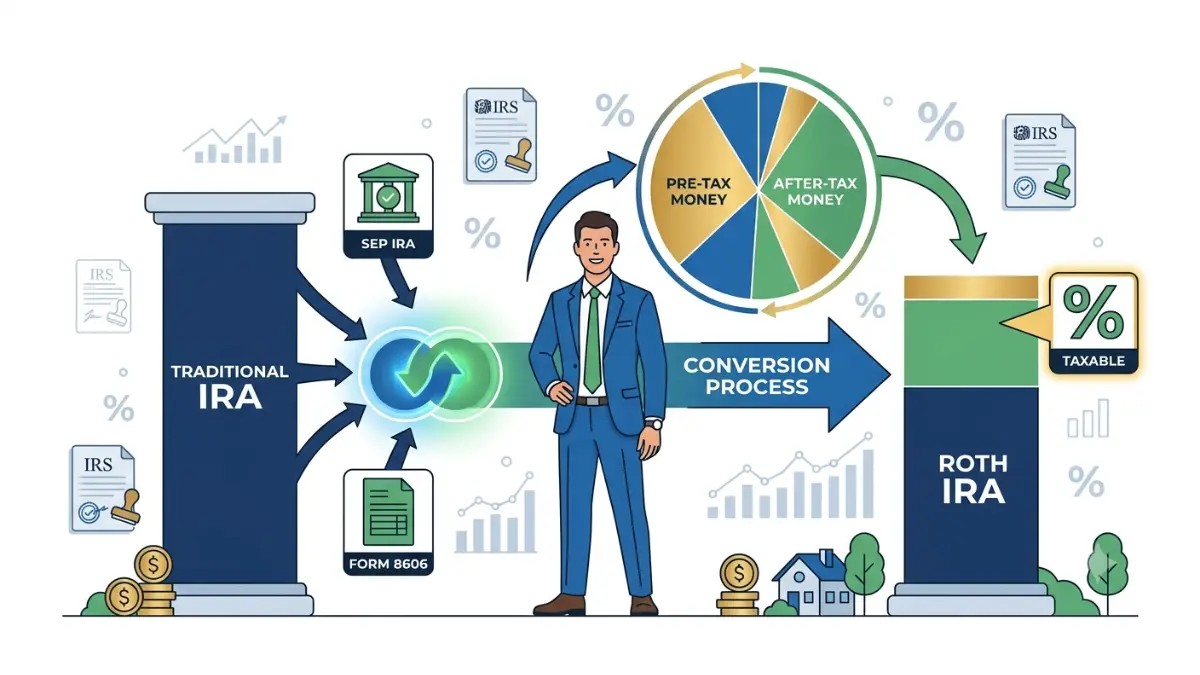
Whatever percentage is left over is taxed as ordinary income. Your after-tax basis — the nondeductible money you contributed — is tracked on IRS Form 8606, which also calculates the taxable portion of every conversion.
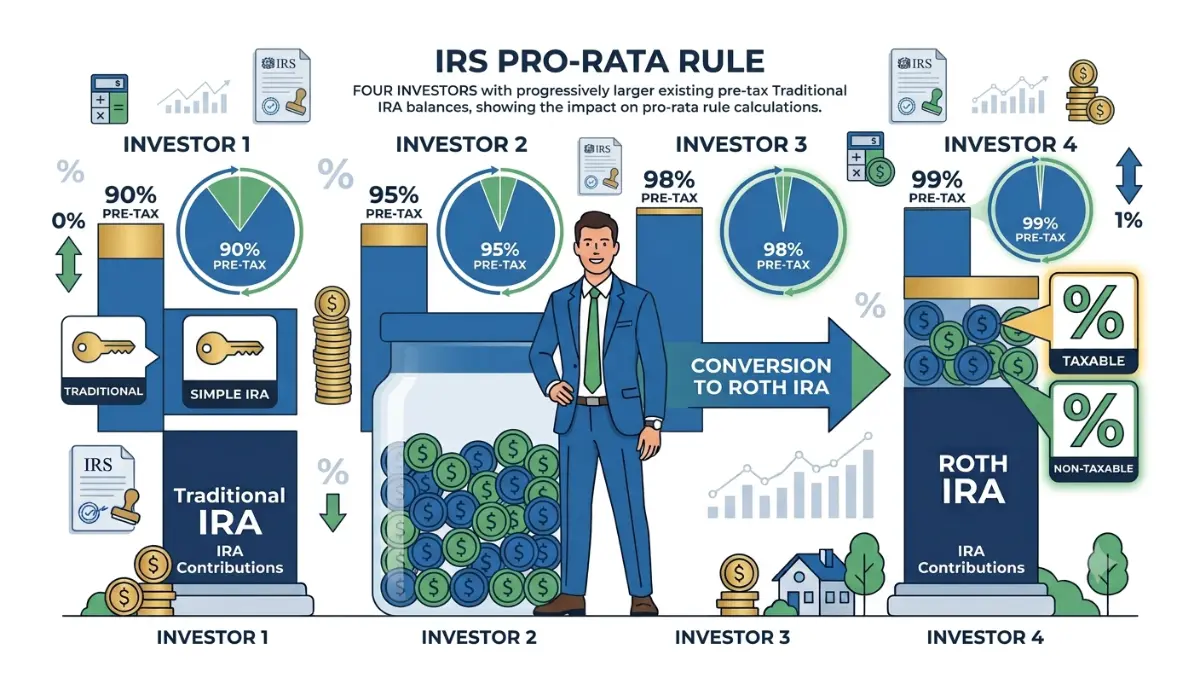
🔍 How It Works: The formula runs on your total non-Roth IRA balance as of December 31, not the balance the day you converted. If pre-tax money is sitting in any traditional, SEP, or SIMPLE IRA at year-end, it dilutes your after-tax share and pushes the taxable amount up.
Same $7,500, four very different tax outcomes
Say you make a $7,500 nondeductible contribution and convert it. Here’s how the identical conversion is taxed against four different year-end pre-tax balances.
| Pre-tax IRA balance (Dec 31) | After-tax basis | Total non-Roth IRA value | Non-taxable % | Taxable on your $7,500 conversion |
|---|---|---|---|---|
| $0 | $7,500 | $7,500 | 100% | $0 |
| $30,000 | $7,500 | $37,500 | 20% | $6,000 |
| $60,000 | $7,500 | $67,500 | 11% | $6,667 |
| $93,000 | $7,500 | $100,500 | 7.5% | $6,940 |
Illustrative figures. The contribution amount reflects the 2026 IRS limit; the pre-tax balances are examples. Your actual result depends on your own year-end balances.
The driver is the size of your pre-tax balance, not the size of your contribution. A single old rollover IRA can turn a supposedly tax-free move into a mostly taxable one. Once you know your marginal rate, you can estimate the tax on the taxable portion.
✅ Action Step: Before you rely on any of these numbers for your own return, confirm your total year-end IRA basis and balance with a CPA, or work through Form 8606 line by line. One account you forgot to count changes the entire result.
The traps that trigger the tax (and the Dec-31 catch)
Most people who get blindsided by this hit one of three specific traps.
The Dec-31 balance trap (why timing fooled you)
The calculation uses your total non-Roth IRA balance on December 31 of the year you convert — not the balance the day you clicked “convert.” You might convert in January when your traditional IRA is nearly empty, then roll an old 401(k) into an IRA in November, and that year-end balance still counts.
⚠️ Costly Mistake: Converting early in the year does not dodge the rule. If any pre-tax IRA money lands in your accounts by December 31 — a rollover, a SEP contribution, a transfer — it gets blended into the calculation retroactively.
SEP and SIMPLE IRAs count too
Your traditional IRA isn’t the only account in the pool: SEP IRAs and SIMPLE IRAs are counted too, a common blind spot for the self-employed. A SEP holding pre-tax business contributions dilutes every backdoor conversion you make. Whether this year’s contribution was even deductible is covered in whether your traditional IRA contribution was deductible.
What does NOT count: your 401(k), Roth, and inherited IRAs
Three things stay out of your personal pro-rata calculation: your workplace 401(k) or 403(b), your existing Roth IRAs, and inherited IRAs (unless you’re a spouse who elected to treat one as your own). Money inside an employer plan is invisible to this formula — which is exactly what makes the fix in the next section work. Inherited-IRA and SIMPLE timing situations have their own wrinkles, so confirm those with a CPA.
How to clear the pro-rata trap for next year
The tax you already owe is settled (more on that next), but you can set up a clean conversion for next year. You can clear the pro-rata trap in four ways:
- Roll pre-tax IRA money into your 401(k). Most employer plans accept incoming rollovers of pre-tax IRA funds; move that money into the plan and it leaves the pro-rata pool entirely.
- Convert everything and pay the tax. If your pre-tax balance is small, converting all of it may cost less than years of partial taxation.
- Spread conversions across years to manage which tax bracket the taxable portion lands in.
- Pause the backdoor until your year-end IRA balance is zero.
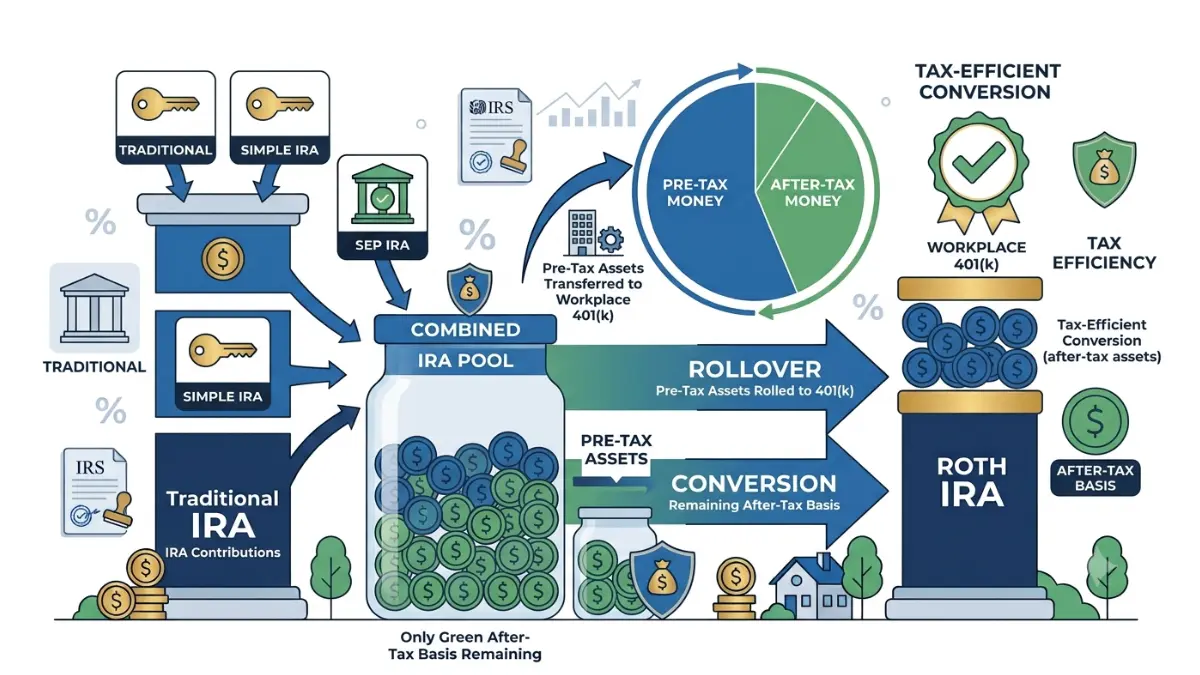
The escape hatch: roll pre-tax IRA money into your 401(k)
The roll-in is the cleanest fix, because a workplace 401(k) isn’t counted in your pro-rata calculation — moving pre-tax dollars there isolates your after-tax basis. Two conditions apply: your plan must accept roll-ins, and only pre-tax money can go in, so your basis stays in the IRA to be converted. If you’re self-employed without a plan, you can open a solo 401(k) to receive the rollover, and the IRS rollover rules explain how the transfer works.
Other options: convert everything, spread it out, or pause
Options two through four are fallbacks when a roll-in isn’t available: convert everything when the balance is modest, spread conversions to control your bracket, or pause to buy time to fix the setup.
Get your December 31 balance to zero
Every option points at the same target: a $0 balance across all your traditional, SEP, and SIMPLE IRAs on December 31 of your conversion year — hit zero, and your next backdoor conversion is fully tax-free. The roll-in has to complete before year-end to count, so don’t leave it to late December; you can model the roll-in in our 401(k) calculator to see how it changes your retirement picture.
✅ Action Step: Before moving anything, ask your 401(k) plan administrator two questions — “Does the plan accept incoming IRA rollovers?” and “Can the roll-in complete before December 31?” Then confirm with a CPA that only pre-tax dollars are being moved.
Is the backdoor Roth still worth it after this?
Getting taxed once doesn’t mean the strategy failed. It means your setup and the strategy weren’t aligned, and whether to continue comes down to a few honest questions about your own situation.
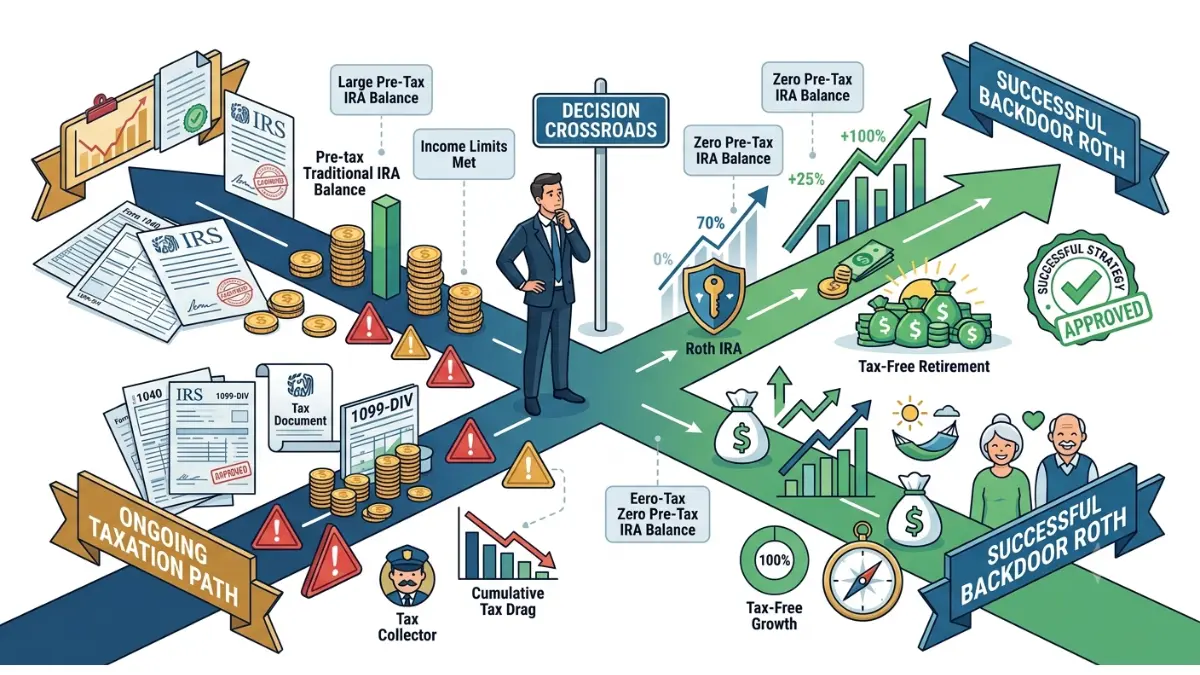
When it still makes sense
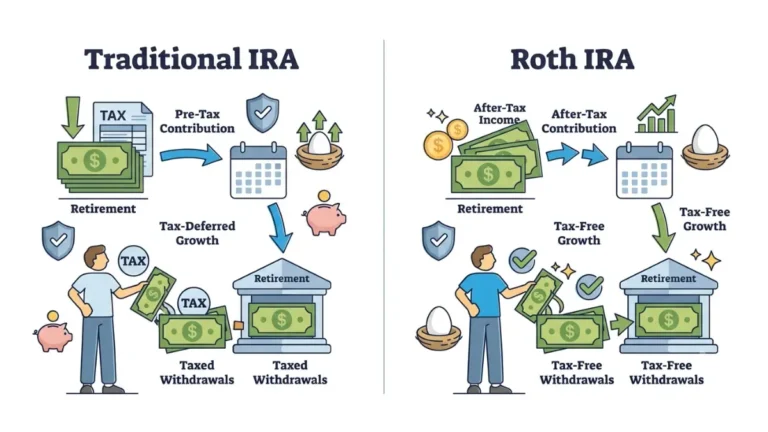
The backdoor Roth still works cleanly if you can reach a zero year-end IRA balance — usually by rolling pre-tax money into a 401(k) — and you expect a similar or higher tax bracket in retirement. If you’re already maxing your workplace plan and want more tax-free growth, converting after-tax dollars is a legitimate next step, and which account to max first walks through the funding order.
When to pause or rethink
It may not be worth the friction if you hold a large pre-tax IRA you can’t move — no 401(k) that accepts roll-ins, or self-employed without a solo plan — and the annual taxable bite outweighs the benefit. Some savers are simply better served choosing between a Roth versus traditional IRA on the merits. The right answer depends on your full tax picture, which is worth reviewing with a fiduciary advisor or CPA.
What to do about the tax you already owe
Let’s answer the question that’s probably bothering you most: can you undo it?
What’s not recoverable
No — since January 1, 2018, the Tax Cuts and Jobs Act permanently eliminated the ability to recharacterize (reverse) a Roth conversion, per the IRS’s guidance on recharacterizations. Once the conversion processes, the tax for that year is locked in, with no do-over even if the market drops right afterward.
What you don’t lose
Here’s the part most articles skip: your after-tax basis isn’t lost. The nondeductible contribution is recorded on Form 8606 and carries forward year after year. It reduces the taxable portion of future conversions and distributions, so money you already paid tax on won’t be taxed again — the bill this year is real, but it isn’t wasted, and next year’s conversion can be clean.
✅ Action Step: Confirm your carried-forward basis is recorded correctly on Form 8606 for every year you made a nondeductible contribution. If a prior year’s form is missing, ask a CPA about filing it — that basis is what protects you from being taxed twice.
Pro-rata rule and backdoor Roth: FAQs
1. Why was my backdoor Roth conversion taxed if I used after-tax money?
Because the pro-rata rule blends all your traditional, SEP, and SIMPLE IRA money into one pool, taxing even after-tax contributions in proportion to the pre-tax dollars, measured on December 31. If you hold any pre-tax IRA balance, part of every conversion is taxable, so confirm your figures with a CPA.
2. Does the pro-rata rule include my 401(k)?
No — money in a workplace 401(k) or 403(b) is not counted in your personal pro-rata calculation; only traditional, SEP, and SIMPLE IRAs are. That exclusion is exactly why rolling pre-tax IRA funds into a 401(k) can remove them from the calculation and clear the way for a tax-free backdoor conversion.
3. Does the pro-rata rule include my SEP or SIMPLE IRA?
Yes — SEP IRAs and SIMPLE IRAs are counted alongside traditional IRAs in the pro-rata rule pool, a frequent surprise for the self-employed. Pre-tax balances here dilute your after-tax share and raise the taxable portion of a conversion, and a SIMPLE IRA also carries a two-year rule before it can be rolled elsewhere.
4. What IRA balance date does the pro-rata rule use?
December 31 of the year you convert. The formula uses the total value of all your non-Roth IRAs on the last day of the year, not the balance on your conversion date, so converting early doesn’t help if pre-tax money lands in an IRA by December 31.
5. Can I undo the tax I already paid on my conversion?
No — since January 1, 2018, Roth conversions can’t be recharacterized, so the tax for that year is permanent. Your after-tax basis isn’t lost, though: it’s tracked on Form 8606 and reduces the taxable portion of future conversions, so ask a CPA to confirm it’s recorded correctly.
6. Do my spouse’s IRAs count in my pro-rata calculation?
No — IRAs are individual, so only the IRAs you own are included in your own pro-rata rule calculation; your spouse’s are separate. That means one spouse can run a clean backdoor Roth even if the other holds a large pre-tax IRA balance.
7. Does an inherited IRA count toward pro-rata?
Generally no — an inherited IRA is kept separate and isn’t factored into your personal calculation. The exception is a spouse who elects to treat an inherited IRA as their own, which puts it in the pool; because these situations vary, confirm the details with a CPA.
8. What is Form 8606 and do I have to file it?
Form 8606 is the IRS form that reports nondeductible IRA contributions and calculates the taxable portion of your conversions. You file it for any year you make an after-tax contribution or a conversion, and it tracks your cumulative basis, which protects that money from being taxed a second time.
9. Can I roll my traditional IRA into my 401(k) to avoid pro-rata?
Often, yes — if your employer’s plan accepts incoming rollovers, moving pre-tax IRA funds into the 401(k) removes them from the pool, since employer plans aren’t counted. Only pre-tax money can be rolled in (your after-tax basis stays in the IRA to convert), so confirm plan rules and timing with a CPA.
10. Is the backdoor Roth still worth it if I get taxed?
It depends on whether you can reach a zero year-end IRA balance. If you can roll pre-tax money into a 401(k) the backdoor stays tax-efficient; if you hold a large pre-tax IRA you can’t move, the annual tax may outweigh the benefit, so review your full picture with a fiduciary advisor.
11. How much can I contribute to a backdoor Roth in 2026?
The contribution follows the standard IRA limit: $7,500 for 2026, or $8,600 if you’re 50 or older. A backdoor Roth isn’t a separate account type — it’s a nondeductible traditional IRA contribution followed by a conversion, so the same annual limit applies to what you put in.
Your next step
The pro-rata rule caught you because the IRS treats all your non-Roth IRAs as one pool and measures it on December 31 — so a pre-tax balance you may have forgotten made your “tax-free” conversion partly taxable. The tax this year stands, but your basis carries forward and your setup is fixable.
Your one next step: check whether you hold any pre-tax balance in a traditional, SEP, or SIMPLE IRA. If you do, rolling it into a 401(k) is usually the cleanest path to a zero year-end balance — then project your Roth IRA growth and confirm your plan with a CPA before you act.

Informational disclaimer
The content on Finance Authority Hub is provided for general informational and educational purposes only and should not be considered personalized financial, investment, tax, legal, or professional advice. Financial decisions depend on your individual goals, income, risk tolerance, location, and regulatory situation. Before acting on any information, strategy, estimate, or calculator result, consult a qualified licensed professional who can evaluate your specific circumstances.