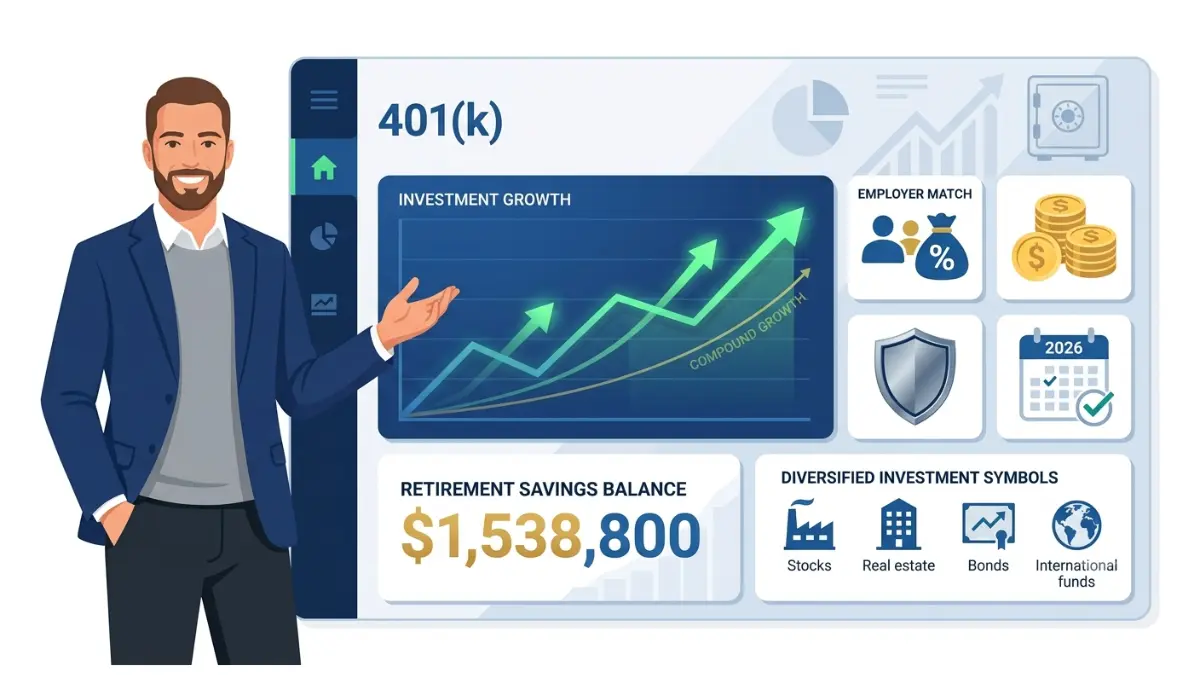
401(k) Contribution Limits, Match, and Payouts for 2026
contribution limits rose to $24,500 for 2026—but the bigger story is the new $150,000 Roth catch-up rule that many high earners will miss.
In This Article
Your 401(k) in 2026: start here
Your 401(k) plan is probably the largest pile of money you will ever build — and for 2026, three of its rules changed at once. The contribution ceiling went up, one catch-up amount stayed surprisingly flat, and a brand-new rule now forces some savers’ catch-up money into a Roth account. Where you land in those changes depends entirely on your situation, so start by finding yourself below.
Find your situation below
- If you just got access to a 401(k) and have no idea how much to put in, start with the basics in the next two sections, then jump to how much to contribute.
- If you’re already contributing but aren’t sure you’re capturing every dollar your employer offers, the match and vesting sections are written for you.
- If you earned more than $150,000 last year and want to max out, the new high-earner Roth catch-up rule changes how your 2026 catch-up dollars are taxed — read that section closely.
- If you’re between 60 and 63, there’s a larger catch-up window most savers never hear about, and it did not shrink for 2026.
- If you’re within a few years of retirement, the payout sections cover when you can take money out, the Rule of 55, and the required withdrawals that begin at 73.
- If you’re leaving a job or need cash before 59½, read the withdrawal and rollover sections before you touch the account — one wrong move there is expensive.
No single reader needs every section. Use the list above to go straight to the decision in front of you.
What changed for 401(k)s in 2026
Three things are genuinely new this year, and all three are confirmed in the IRS’s official 2026 limit announcement.
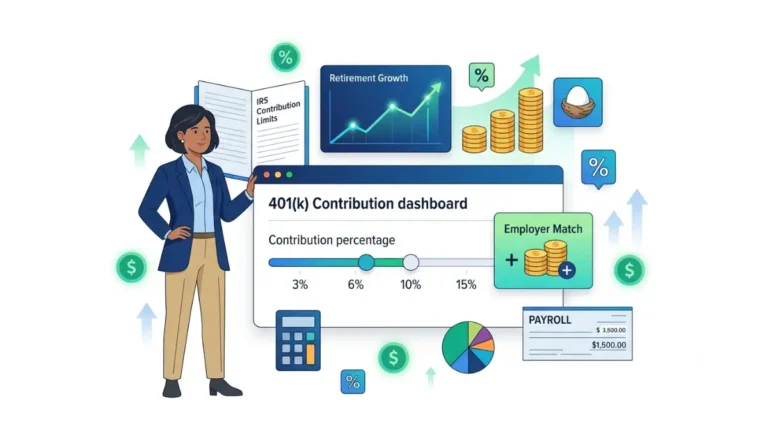
First, the amount you can contribute from your own paycheck rose to $24,500, up from $23,500 in 2025. Second, the larger “super catch-up” for people aged 60 to 63 stayed exactly the same at $11,250 — it did not rise with the other limits, which trips up a lot of the coverage you’ll read elsewhere. Third, starting in 2026, higher earners must make their catch-up contributions as Roth (after-tax) dollars rather than pre-tax ones.
Each of those gets its own section, with the exact numbers and what they mean for your paycheck.
A 401(k) rewards two simple habits more than any clever strategy: contributing enough to capture your full employer match, and leaving the money invested long enough to compound. Most of the costly mistakes in this guide come from missing one of those two things — not from picking the wrong fund.
This article covers the full picture in three parts: the 2026 contribution limits, how the employer match and vesting actually work, and the payout rules for getting your money back out. Everything here is general education, verified against primary sources, and dated so you know how current it is.
ℹ️ Financial Disclaimer: The contribution limits, tax rules, penalty figures, and product comparisons in this article reflect current data from the IRS, SEC, FINRA, and the Bureau of Labor Statistics, and are provided for general educational purposes only — not personalized investment, tax, or legal advice. Whether a specific contribution rate, a pre-tax-versus-Roth choice, an early withdrawal, a mega backdoor Roth, or a particular withdrawal sequence is right for you depends on your income, tax bracket, plan rules, and goals. Before acting on anything here, consult a fiduciary financial advisor, a CPA, or a qualified tax attorney about your specific situation.
What is a 401(k) and how does it actually work?
A 401(k) is an employer-sponsored retirement account that lets you save part of your paycheck for retirement, usually with tax advantages and often with matching money from your employer. You choose how much to contribute, the money is invested in funds your plan offers, and it grows until you withdraw it in retirement.
401(k) definition in plain English
The name comes from a section of the U.S. tax code, but the idea is simple. You agree to send a percentage of each paycheck into the account before it ever reaches your bank, and that money is yours, invested on your behalf, for retirement.
The account is “defined contribution,” which means your eventual balance depends on what goes in and how the investments perform — not on a fixed pension formula. That’s the key shift from the pensions an earlier generation relied on: the saving, and the investment risk, now sit with you.
How money goes in: payroll deferrals and the match
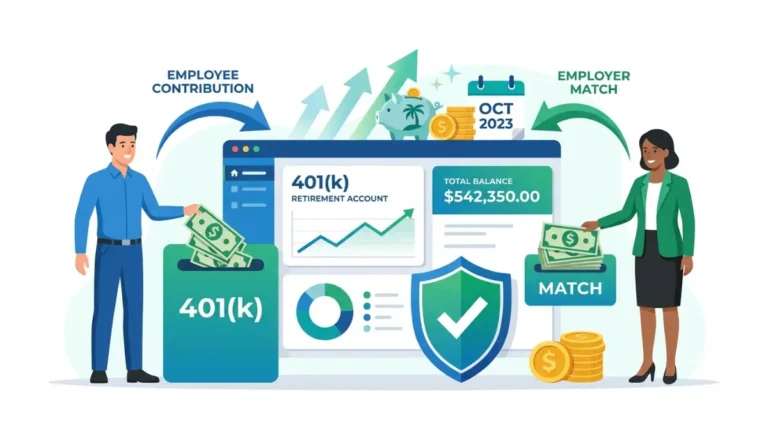
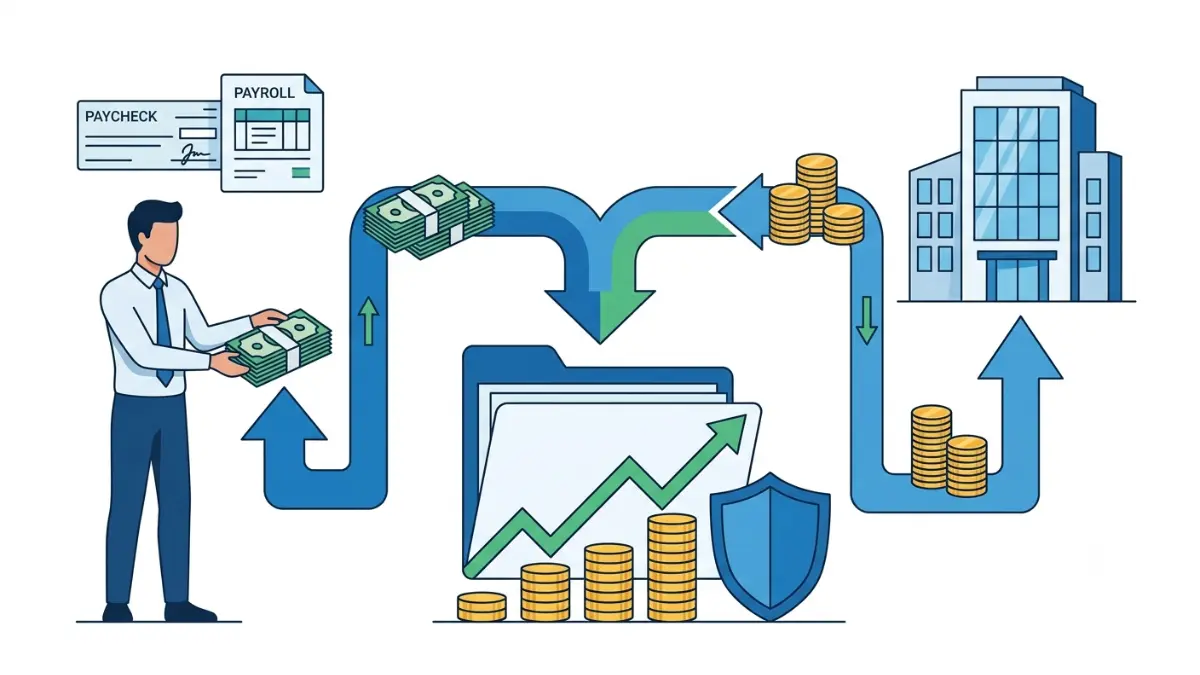
Money enters a 401(k) two ways. The first is your own salary deferral — the slice of each paycheck you choose to contribute. The second is your employer’s contribution, most often a match tied to how much you put in.
🔍 How It Works: A traditional 401(k) deferral comes out of your pay before income tax is calculated. If you earn $5,000 in a paycheck and defer $500, you’re taxed as if you earned $4,500 that period — so a $500 contribution lowers your taxable income by $500 right now. You pay the tax later, when you withdraw the money in retirement.
Your own contributions are always 100% yours from the moment they land. Employer money is different — it often becomes fully yours only after you’ve worked there a set number of years, a process called vesting that the match section covers in detail.
How money grows: it’s invested, and you choose how
A 401(k) is not a savings account, and this is the single most common misunderstanding about it. The cash you contribute is invested in the funds your plan offers — typically a menu of mutual funds or index funds, often including target-date funds built around your expected retirement year.
That’s why the balance can rise and fall: it’s tied to markets, not a fixed interest rate. Over long periods that market exposure is the engine of growth, but it also means the value moves, and you can lose money in any given year. The SEC’s investor education resources explain how the funds inside a workplace plan work and what fees to watch for.
How money comes out: the basics of withdrawals
Getting money out follows age rules, and the payout sections cover them fully — here’s the short version. The standard age for penalty-free withdrawals is 59½. Take money out before then and you generally owe income tax plus a 10% early-withdrawal penalty, with some exceptions.
At the other end, the IRS eventually requires you to start withdrawing: required minimum distributions begin at age 73 for traditional balances. Between those ages, what you do with the account when you change jobs — roll it over, leave it, or cash out — has real tax consequences covered later.
Traditional vs. Roth 401(k) at a glance
Many plans let you choose between two tax treatments, and you can often split between them. A traditional 401(k) takes contributions pre-tax and taxes withdrawals in retirement; a Roth 401(k) takes contributions after-tax and, if rules are met, makes qualified withdrawals tax-free.
The right choice turns on whether you expect your tax rate to be higher now or in retirement — a decision the traditional-versus-Roth section unpacks with examples. For now, the key point is that both live inside the same 401(k), under the same contribution limit.
With the mechanics clear, the question everyone arrives with is how much you’re actually allowed to put in for 2026.
How much can you put in a 401(k) in 2026?
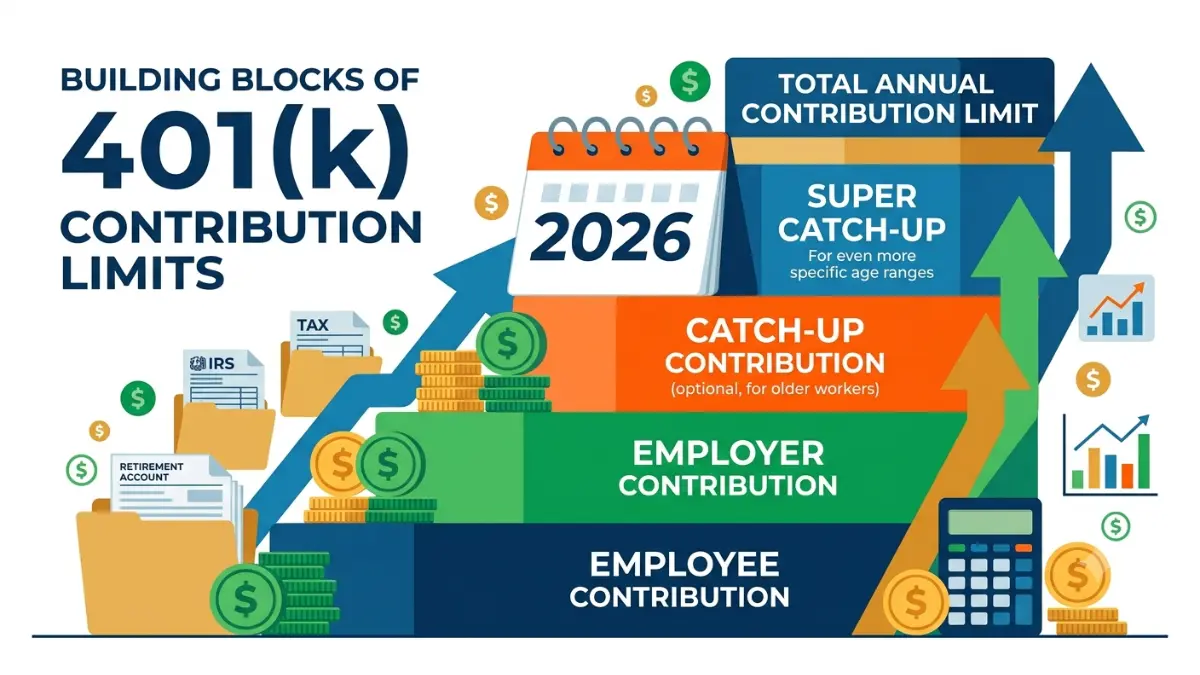
For 2026, you can contribute up to $24,500 of your own pay to a 401(k) — the employee salary-deferral limit set by the IRS, up from $23,500 in 2025. If you’re 50 or older, you can add more through catch-up contributions, covered in the next section. Here is how the 2026 limits compare with 2025.
| Limit (per person) | 2025 | 2026 | Key detail |
|---|---|---|---|
| Employee deferral (under 50) | $23,500 | $24,500 | Your own pre-tax or Roth contributions |
| Total with 50+ catch-up | $31,000 | $32,500 | Adds the $8,000 catch-up |
| Total with 60–63 catch-up | $34,750 | $35,750 | Adds the $11,250 super catch-up |
| Combined employee + employer | $70,000 | $72,000 | All sources together (Section 415(c)) |
| Compensation cap | $350,000 | $360,000 | Max pay counted for contributions |
Source: IRS, Notice 2025-67 (2026 cost-of-living adjustments). Limits are per person across all your 401(k) plans, not per plan.
The 2026 employee contribution limit
The $24,500 figure is the most important number in this article, because it’s the one almost every saver bumps against first. It’s the maximum you can defer from your own wages in 2026, whether you contribute pre-tax, Roth, or a mix.
It applies per person, not per plan. If you have two jobs with two 401(k)s, your combined deferrals across both still can’t exceed $24,500 (plus any catch-up).
🔍 How It Works: The deferral limit caps only the money you put in from your paycheck. It does not include your employer’s match, which sits under a separate, higher ceiling explained below. That’s why someone can have far more than $24,500 land in their account in a single year.
2025 vs. 2026: what changed
The employee limit rose by $1,000, from $23,500 to $24,500. The combined employee-and-employer ceiling rose by $2,000, from $70,000 to $72,000. The amount of pay an employer can count toward contributions rose to $360,000.
These are inflation adjustments the IRS makes most years. The notable exception for 2026 is the 60–63 super catch-up, which did not change — more on that next.
Employee limit vs. total limit (don’t confuse them)
This is where readers most often go wrong, so it’s worth slowing down. There are two separate limits, and they answer different questions.
The employee deferral limit ($24,500) is the most you can contribute from your paycheck. The total annual additions limit ($72,000) is the most that can land in your account from all sources combined — your deferrals, your employer’s match, and any after-tax contributions.
Most people never approach $72,000, because it requires a generous employer contribution or large after-tax contributions on top of a maxed-out deferral. But the distinction matters for high savers, and it’s the foundation of the mega backdoor Roth covered later.
What counts toward your limit (and what doesn’t)
Your pre-tax and Roth deferrals both count toward the $24,500 employee limit — choosing Roth doesn’t give you extra room. Catch-up contributions sit on top of that limit, for those eligible.
Your employer’s match does not count toward your $24,500 deferral limit, but it does count toward the $72,000 total. The cap on the pay an employer can use to calculate your contributions is $360,000 for 2026, which mainly affects very high earners.
What happens if you contribute too much
If you defer more than $24,500 — which can happen if you switch jobs mid-year and both plans accept contributions — the excess is treated as taxable income in the year you made it. If it isn’t corrected by the plan’s deadline, you can be taxed on that money twice: once when contributed and again when withdrawn.
⚠️ Costly Mistake: Changing jobs mid-year is the classic way to over-contribute, because your new plan doesn’t know what you already deferred at the old one. If you switch employers in 2026, add up your year-to-date deferrals from both W-2s and tell your new plan administrator before December 31 — most plans can stop you before you cross $24,500, but only if they know.
You can model your own 2026 contribution and see how it fits each paycheck in our 401(k) calculator. The IRS publishes the full set of 2026 retirement plan limits in its official cost-of-living announcement.
If you’re 50 or older, you can go well beyond $24,500 — and for one age group, by more than most people realize.
Catch-up contributions: the 50+ and 60–63 rules
If you’re 50 or older at the end of 2026, you can add an extra $8,000 in catch-up contributions on top of the $24,500 employee limit — bringing your total to $32,500. If you’re aged 60 to 63, the catch-up is larger still at $11,250, for a total of $35,750. Here’s how the totals stack up by age.
| Your age in 2026 | Base limit | Catch-up | Total you can defer |
|---|---|---|---|
| Under 50 | $24,500 | — | $24,500 |
| 50–59 | $24,500 | $8,000 | $32,500 |
| 60–63 | $24,500 | $11,250 | $35,750 |
| 64 and older | $24,500 | $8,000 | $32,500 |
Source: IRS, Notice 2025-67. The 60–63 “super catch-up” applies only if your plan permits it.
The 50+ catch-up for 2026
The standard catch-up rose to $8,000 for 2026, up from $7,500 in 2025. It’s available to anyone who turns 50 or older by the end of the calendar year, even on December 31.
You don’t have to be “behind” on saving to use it — eligibility is purely about age. The catch-up is separate from, and on top of, the $24,500 base limit.
The 60–63 super catch-up (and why it didn’t go up)
This is the rule most coverage gets wrong, so read carefully. For people who are 60, 61, 62, or 63 by year-end, the catch-up is $11,250 instead of $8,000 — a provision created by the SECURE 2.0 Act and first available in 2025.
For 2026, that $11,250 figure stayed exactly the same. The base limit and the regular catch-up both rose with inflation, but the super catch-up did not — so anyone telling you it increased for 2026 is mistaken.
💡 Expert Note: The super catch-up is a narrow, four-year window. At 64, you revert to the standard $8,000 catch-up — the larger amount applies only in the calendar years you are 60 through 63. Plans are permitted, but not required, to offer it, so confirm yours does before counting on it.
Your total possible contribution by age
Putting it together: under 50 you can defer $24,500; from 50 through 59 (and again at 64 and older) you can defer $32,500; and in the 60-to-63 window you can defer $35,750. Those figures are your own contributions only — employer money lands on top, within the $72,000 combined ceiling.
Who’s eligible and when the age clock starts
Eligibility runs on the calendar year, not your birthday. If you turn 50 at any point in 2026, you can make the full $8,000 catch-up for the whole year; the same logic applies to the 60–63 window.
There’s one important catch for higher earners that changes how these catch-up dollars are taxed starting in 2026 — not how much, but whether they must go into a Roth account. That’s the next section, and it affects more people than you might expect.
The new 2026 Roth catch-up rule for high earners
Starting in 2026, if your wages from your employer exceeded $150,000 in 2025, your 401(k) catch-up contributions must be made as Roth (after-tax) dollars rather than pre-tax. Your base $24,500 deferral isn’t affected — only the catch-up portion, and only for higher earners. This is a new requirement under the SECURE 2.0 Act, and it takes effect for the 2026 tax year.
What the rule says
The rule is narrow but important. If you’re catch-up eligible (age 50 or older) and you earned above the wage threshold last year, you can still make catch-up contributions — but they have to go into a Roth account, where you pay tax on them now instead of in retirement.
The dollar amounts don’t change: a 55-year-old can still add $8,000, and a 62-year-old can still add $11,250. What changes is the tax treatment of those specific dollars for affected earners.
🔍 How It Works: A pre-tax catch-up lowers your taxable income today and is taxed when you withdraw it. A Roth catch-up gives you no deduction today, but qualified withdrawals later are tax-free. The new rule forces the Roth version for higher earners’ catch-up money — so an affected saver loses the upfront deduction on that portion.
The $150,000 threshold — and why it isn’t $145,000
Here’s a detail much of the coverage online still gets wrong. The SECURE 2.0 law wrote the threshold as $145,000, and many articles repeat that figure — but $145,000 is the base amount, which is indexed for inflation.
For 2026, the IRS set the actual threshold at $150,000, based on your 2025 wages. That’s the number that determines whether your 2026 catch-up must be Roth, and it comes straight from the IRS’s official 2026 limit guidance. The base figure rises over time, so expect the threshold to keep climbing in future years.
So the test for 2026 is simple: did your relevant 2025 wages exceed $150,000? If no, you can still choose pre-tax or Roth for your catch-up. If yes, your catch-up must be Roth.
Which “wages” actually count (Box 3 nuance)
The threshold is measured against your FICA wages — specifically Social Security wages — from the employer sponsoring your plan, not your total income or your taxable income. On your W-2, that’s the Social Security wages figure, and the IRS’s final regulations point to it directly.
This matters because FICA wages can differ from your salary. Pre-tax health premiums and similar benefits are excluded from FICA wages, while equity compensation that vests during the year is generally included. If you’re near the line, the box-by-box guide to your W-2 shows exactly where Social Security wages appear.
⚠️ Costly Mistake: Assuming your salary equals your FICA wages can put you on the wrong side of the threshold. There’s also a genuine technical wrinkle for very high earners — Social Security wages are capped at the annual wage base — which is why the precise measurement for top earners is a question worth confirming with your plan administrator or a CPA rather than guessing.
What if your plan has no Roth option
This is the part that catches people off guard. If your 401(k) plan does not offer a Roth feature and you’re over the wage threshold, you simply cannot make catch-up contributions in 2026 — the law doesn’t let affected high earners make pre-tax catch-ups, and there’s no Roth bucket to use instead.
Plans aren’t required to add a Roth option, though many are doing so in response to this rule. If you’re affected and your plan lacks Roth, ask your administrator whether one is being added.
What this means for your 2026 paycheck
If you’re affected, the practical effect is that your catch-up money no longer reduces this year’s taxable income. For someone in a high bracket adding the full catch-up, that’s a real difference in the current-year tax bill — offset by tax-free growth on those dollars later.
Whether that tradeoff helps or hurts you depends on your bracket now versus in retirement, which is exactly the kind of question to take to a professional.
✅ Action Step: Before your first 2026 catch-up contribution, check Box 3 (Social Security wages) on your 2025 W-2. If it’s near or above $150,000, ask a CPA or fiduciary advisor one specific question: “Based on my 2025 FICA wages, are my 2026 catch-up contributions required to be Roth, and does my plan support Roth catch-ups?”
The IRS lays out the catch-up and Roth rules in its retirement plan contribution guidance.
Catch-ups aside, there’s a much higher ceiling on total contributions — and a strategy built on top of it that high savers should understand.
The $72,000 limit and the mega backdoor Roth
The total amount that can land in your 401(k) from all sources in 2026 — your own contributions plus your employer’s — is $72,000. With catch-up contributions included, that combined ceiling rises to $80,000 for those 50 and older, and $83,250 in the 60-to-63 window.
| Combined limit (all sources) | 2026 amount |
|---|---|
| Under 50 | $72,000 |
| 50–59 and 64+ (with catch-up) | $80,000 |
| 60–63 (with super catch-up) | $83,250 |
Source: IRS, Notice 2025-67. This is the annual additions limit under Internal Revenue Code Section 415(c), or 100% of your compensation if lower.
The total 2026 limit: $72,000 (and higher with catch-up)
This ceiling covers everything that enters your account in a year: your pre-tax and Roth deferrals, your employer’s match and any other employer contributions, and after-tax contributions if your plan allows them. It’s capped at $72,000 or 100% of your pay, whichever is less.
Most savers never reach it. To get there, you’d typically need a maxed-out deferral plus a large employer contribution, or the ability to make sizable after-tax contributions on top.
How after-tax contributions fit
Some plans allow a third contribution type beyond pre-tax and Roth: regular after-tax contributions. These are different from Roth contributions, and they’re what make the space between your deferrals-plus-match and the $72,000 ceiling usable.
🔍 How It Works: Picture a saver under 50 who defers the full $24,500 and receives a $10,000 employer match — that’s $34,500 of the $72,000 ceiling used. The remaining $37,500 of “room” can, in plans that allow it, be filled with after-tax contributions. Those after-tax dollars are what a mega backdoor Roth then converts.
What the mega backdoor Roth is
The mega backdoor Roth is a strategy that turns large after-tax 401(k) contributions into Roth money, either by converting them inside the plan or rolling them into a Roth IRA. Done correctly, it can move far more into tax-free Roth space in a year than the standard Roth IRA limit allows.
It’s powerful for high earners who have already maxed their regular contributions and want more tax-free growth. But it’s entirely dependent on your specific plan’s features, and it’s a high-stakes tax maneuver — the kind of thing to execute with professional guidance, not from a general article.
Who can actually use it (plan rules matter)
The strategy only works if your plan allows two things: after-tax contributions above the regular limit, and either in-plan Roth conversions or in-service withdrawals to a Roth IRA. Many plans allow neither, which is why the mega backdoor Roth is unavailable to most workers regardless of income.
There are also coordination issues — timing, the pro-rata rule, and how conversions are taxed — that make errors costly. This is education, not a recommendation to act.
✅ Action Step: If you’ve maxed your 401(k) and want to know whether a mega backdoor Roth is even possible for you, ask your plan administrator one question: “Does this plan allow after-tax contributions beyond the standard limit, and does it permit in-plan Roth conversions or in-service rollovers?” If yes, take the tax details to a CPA or fiduciary advisor before contributing.
Limits set the ceiling, but the part of a 401(k) that’s closest to free money is the employer match — and most of its value is won or lost in how you handle it.
How does a 401(k) employer match work?
An employer match is money your company adds to your 401(k) based on what you contribute — most commonly 50 cents for every dollar you put in, up to 6% of your pay. Match formulas vary, but the average employer contribution runs around 4% to 5% of salary. It’s the closest thing to free money most workers will ever get.
What an employer match is
A match is the employer’s piece of your 401(k), and it’s tied to your own contributions. Put in nothing, and most match formulas give you nothing; put in enough to earn the full match, and your employer adds a set amount on top.
That structure is deliberate. The match exists to encourage you to save, which is why “contributing enough to get the full match” is the first move in almost every sound 401(k) plan.
📊 Data Point: In March 2025, 72% of private-industry workers had access to retirement benefits, and 70% had access to a defined contribution plan like a 401(k), according to the Bureau of Labor Statistics’ employee benefits data. Among large employers with 500 or more workers, access reached 90%.
The most common match formulas
There’s no single match formula, but a few patterns dominate. The most common is 50 cents per dollar on the first 6% of pay — so if you contribute 6%, your employer adds 3%.
Another widespread formula is a full dollar-for-dollar match on the first 3% of pay, then 50 cents per dollar on the next 2% — which means contributing 5% earns you a 4% match. Both reward contributing at least up to the cap; contributing less leaves match money unclaimed.
| Common match formula | You contribute | Employer adds | Best for |
|---|---|---|---|
| 50% of the first 6% | 6% | 3% | The most common single-tier formula |
| 100% of first 3%, then 50% of next 2% | 5% | 4% | Plans that reward slightly higher saving |
| Dollar-for-dollar up to 5% | 5% | 5% | A generous, less common match |
Source: Vanguard, How America Saves; Fidelity. Match formulas vary by employer — confirm yours in your plan’s summary description.
The average match in 2026
Across employers, the average match lands around 4% to 5% of pay. Vanguard’s plan data puts the typical employer contribution near 4.6% of salary, on top of what the employee saves.
📊 Data Point: For a worker earning $75,000, an average employer match of roughly 4.6% of pay adds about $3,450 a year to their 401(k) — before any investment growth, and on top of their own contributions (Vanguard, How America Saves). More than 85% of plans Fidelity administers offer some employer contribution.
The match is real, recurring money. Skipping it is one of the most expensive things a saver can do, and it’s far more common than you’d expect.
⚠️ Costly Mistake: Roughly one in five eligible employees doesn’t contribute enough to capture the full employer match, according to FINRA — leaving guaranteed money on the table every year. If you’re contributing below your match cap, raising your contribution to hit it is the highest-return move available to you, because no investment offers a guaranteed 50% to 100% return on day one. The full picture on why leaving the match unclaimed is so costly is worth a read if you’re not yet at your cap.
How to calculate your own match
You can work out your match in one line: multiply your salary by your contribution percentage (up to the cap), then by the match rate.
🔍 How It Works: Take an $85,000 salary with a 50%-of-first-6% match. Contribute 6% ($5,100), and your employer adds 50% of that — $2,550 — for the year. Contribute only 3%, and the match drops to $1,275; the other $1,275 is forfeited because you didn’t reach the 6% cap.
The lesson is simple: find your plan’s cap, and contribute at least that much. Anything less is a voluntary pay cut.
Why the match doesn’t count toward your $24,500 limit
A common worry is that the employer match eats into your own contribution room. It doesn’t. The match counts toward the separate $72,000 combined ceiling, not your $24,500 employee deferral limit.
So a worker can defer the full $24,500 and receive thousands in match on top — the two limits operate independently. One wrinkle for very high earners: a $360,000 cap applies to the pay an employer can use to calculate the match, and a separate “highly compensated employee” status (a $160,000 pay threshold for 2026) can affect how much they’re allowed to contribute under plan testing rules.
The match is money you’ve earned by contributing — but in many plans, it isn’t fully yours to keep right away. That’s vesting, and it’s next.
401(k) vesting: when the match is really yours
Vesting is the process by which your employer’s matching contributions become fully yours, usually after you’ve worked there a set number of years. Some plans vest the match immediately; others require three to six years. Your own contributions, though, are always 100% yours from day one.
What vesting means
Vesting answers a simple question: if you left tomorrow, how much of your employer’s match could you take with you? The money is in your account, but a vesting schedule determines how much you actually own.
Employers use vesting to encourage people to stay. It’s a retention tool, which is why the match often becomes fully yours only after a few years on the job.
Immediate, cliff, and graded vesting
There are three common vesting structures, and the difference between them can be worth thousands of dollars.
- Immediate vesting: you own 100% of the match the moment it’s deposited. Nearly half of plans use this, according to retirement-plan industry data.
- Cliff vesting: you own 0% until you hit a set milestone — often three years — at which point you become 100% vested all at once.
- Graded vesting: you gain ownership gradually, commonly 20% per year until you’re fully vested after several years.
🔍 How It Works: Under a typical graded schedule, you might own 20% of the match after two years, 40% after three, and so on until you reach 100%. Leave at year three, and you forfeit the unvested 60% — even though it’s listed on your account statement.
Federal law caps how long these schedules can run — generally a maximum of three years for cliff vesting and six years for graded vesting of employer matching contributions — though plans can be more generous. Confirm the exact schedule in your plan’s summary description before relying on it.
What you keep if you leave early
This is where job changes get expensive. If you leave before you’re fully vested, you keep only the vested portion of the match; the rest is forfeited back to the plan.
⚠️ Costly Mistake: Around one in four plans uses a five- or six-year graded vesting schedule, according to Vanguard’s plan data — so leaving a few months before a vesting milestone can cost you a meaningful slice of your employer match. If you’re job-hunting and close to a vesting date, check your schedule before you give notice; waiting even a short time can mean keeping thousands more.
Your own contributions are always 100% yours
Here’s the reassuring part. Vesting applies only to employer money. Every dollar you contribute from your own paycheck — plus its investment growth — is yours immediately and permanently, no matter when you leave.
One detail to carry forward: even in a Roth 401(k), employer matching contributions are generally deposited pre-tax into a separate account, so the match and its earnings are taxed when you withdraw them, even though your own Roth contributions come out tax-free. That distinction matters when you choose between traditional and Roth — but first, the most practical question of all: how much should you actually contribute?
How much should you contribute to your 401(k)?
Start by contributing at least enough to capture your full employer match, then work toward saving 12% to 15% of your income — including the match — over time. If you can’t get there yet, that’s fine; the key is to capture every match dollar first and increase from there. This is a general framework, not personalized advice.
Step 1: always capture the full match
If you do nothing else, contribute enough to get your entire employer match. It’s the one move in retirement saving that earns a guaranteed, immediate return — your employer is effectively adding 50 cents or a full dollar to each of your dollars, up to the cap.
Skipping it means leaving guaranteed money behind. Find your plan’s match cap, set your contribution to at least that percentage, and you’ve already done the highest-value thing available to you.
Step 2: build toward 12–15%
Once you’re capturing the full match, the widely cited target is to save 12% to 15% of your income for retirement, counting both your contributions and your employer’s.
📊 Data Point: Vanguard suggests a total contribution rate of 12% to 15% of income, including the employer match, as a target for staying on track — and in 2025, about 51% of its plan participants met that target or hit the maximum. Fidelity offers a similar 15% guideline. Roughly half of savers are still below it.
You don’t have to jump there overnight. Raising your contribution by one percentage point a year — many plans automate this — moves you toward the target without a painful hit to your paycheck.
✅ Action Step: Check whether your plan offers automatic annual increases (sometimes called auto-escalation). Turning it on once, set to raise your contribution 1% each year, builds your savings rate steadily without requiring another decision — just confirm it stops at a rate you’re comfortable with.
Where the next dollar goes after the match
Once you’ve captured the match, the next dollar doesn’t automatically belong in your 401(k). Depending on your situation, an IRA or a health savings account may offer advantages worth weighing.
After the match, many savers compare maxing the 401(k) against funding a Roth or traditional IRA first, which can offer broader investment choices and sometimes lower fees. A health savings account is another option some overlook — how an HSA’s tax treatment can beat a 401(k) for certain dollars is worth understanding before you decide. The right order depends on your plan’s fees, your tax situation, and your goals.
How to fit it into your budget
If contributing 12% to 15% feels out of reach, the issue is usually cash flow, not willpower. Mapping where your money actually goes often reveals room you didn’t know you had.
A simple budgeting framework can help you find the space to contribute — a basic monthly budget calculator lets you see your income against your spending and spot where a contribution increase can fit. Start with capturing the match, then raise your rate as your budget allows.
💡 Expert Note: Maxing out a 401(k) isn’t realistic or necessary for most people — only about 14% of participants contribute the full annual limit, according to Vanguard’s plan data. The far more important habits are capturing the full match and increasing your rate steadily over time. Because how much to save and where to direct it depend on your full financial picture, a fiduciary advisor can help you set a rate and account mix that fit your income, debts, and goals.
With a contribution rate in mind, it helps to see exactly how these numbers land on a real 2026 paycheck.
2026 example: your paycheck, match, and catch-up
To max out the $24,500 employee limit in 2026, you’d contribute about $1,020.83 per paycheck if you’re paid twice a month ($24,500 ÷ 24). But most people don’t max out, and the right number depends on your age, your match, and your income. Here are three worked examples using the actual 2026 limits.
Example 1: a 35-year-old earning $80,000
Maria is 35, earns $80,000, and her employer matches 50% of the first 6% she contributes. Her first priority is capturing that full match.
To get it, she contributes 6% of her pay — $4,800 for the year, or $200 per semi-monthly paycheck. Her employer adds 50% of that, or $2,400, bringing her annual total to $7,200 without her saving a dollar more than the 6%.
🔍 How It Works: Maria’s $4,800 contribution is well under the $24,500 limit, so she has room to save more if her budget allows. If she later raised her contribution to 10% ($8,000), she’d add $3,200 of her own money on top — but her $2,400 match wouldn’t change, because the match caps at 6% no matter how much more she contributes.
If Maria wants to see how that $7,200 a year grows over three decades, the result is striking — decades of compounding do most of the work. She can model it with a compound interest calculator and compare her balance against typical retirement savings benchmarks by age.
Example 2: a 58-year-old maxing out with catch-up
David is 58 and wants to contribute the maximum his age allows. Because he’s over 50, his limit is the $24,500 base plus the $8,000 catch-up — $32,500 for 2026.
Spread across 24 semi-monthly paychecks, that’s about $1,354 per paycheck ($32,500 ÷ 24). If his employer adds a match on top, it lands within the separate $80,000 combined ceiling for savers 50 and older, so the match doesn’t reduce his $32,500.
David earns $130,000, which is below the $150,000 high-earner threshold, so he can still choose whether his $8,000 catch-up goes in pre-tax or Roth. He opts for pre-tax, lowering this year’s taxable income by the full $32,500.
Example 3: a 62-year-old high earner (Roth catch-up applies)
Susan is 62 and earned $200,000 in FICA wages in 2025. Because she’s in the 60-to-63 window, her catch-up is the larger $11,250 — so her total limit is $35,750 for 2026.
But there’s a catch tied to her income. Since her 2025 wages topped $150,000, the new rule requires her $11,250 catch-up to be made as Roth (after-tax) dollars, not pre-tax.
🔍 How It Works: Susan can still contribute the full $35,750. Her base $24,500 can go in pre-tax if she chooses, but the $11,250 catch-up must be Roth — so she gets no deduction on that portion and pays tax on it now. In exchange, that $11,250 and its growth can later come out tax-free if Roth rules are met. For someone in a high bracket, that’s a real change to this year’s tax bill, which is why it’s worth confirming the details with a CPA.
What each example means for take-home pay
The headline numbers — $24,500, $32,500, $35,750 — are annual ceilings, not paycheck requirements. What actually leaves each paycheck depends on how you spread contributions across the year and whether they’re pre-tax or Roth.
Pre-tax contributions reduce your take-home pay by less than the contribution amount, because they also lower the income tax withheld. A $200 pre-tax contribution reduces your take-home pay by about $156 if you’re in the 22% federal bracket — the other $44 is federal tax you would have paid anyway (state taxes, Social Security, and Medicare still apply to the full amount).
💡 Expert Note: This is why pre-tax contributions can feel more affordable than they look: part of the cost is offset by lower current income taxes. Roth contributions don’t get that upfront break — your full contribution reduces take-home pay now — but qualified withdrawals later are tax-free. Which one leaves you better off depends on your tax rate today versus in retirement.
These examples assume one more decision we haven’t settled: whether to contribute pre-tax or Roth in the first place.
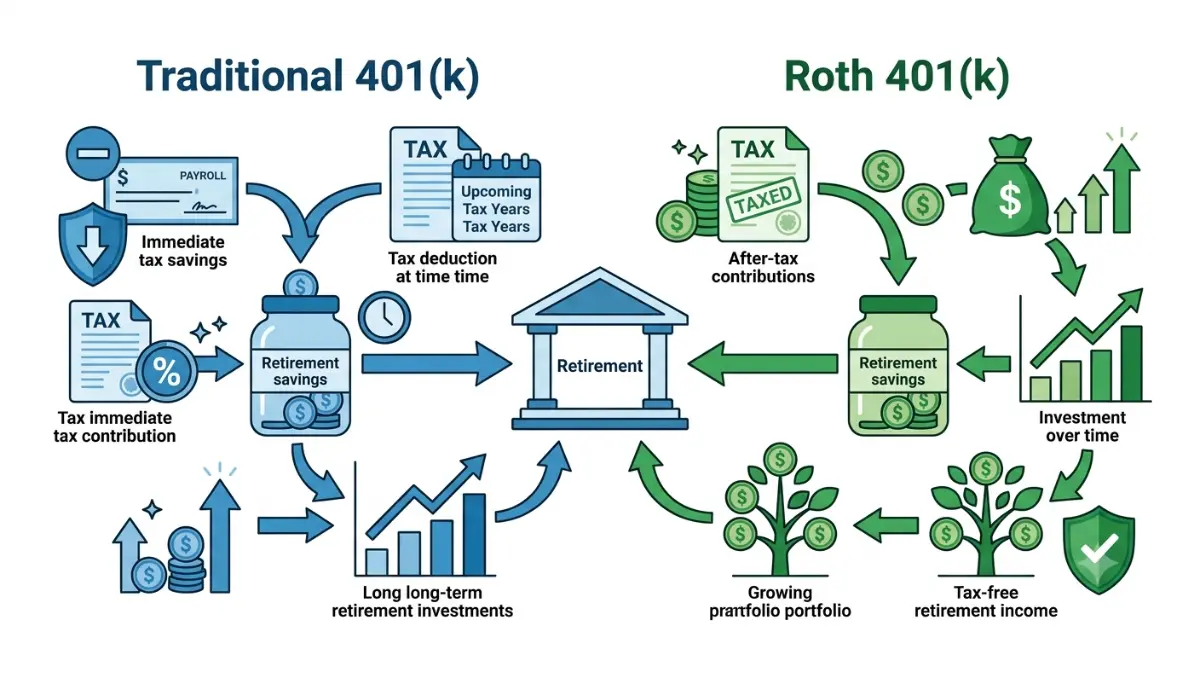
Traditional vs. Roth 401(k): which is better?
The choice comes down to timing: a traditional 401(k) gives you a tax break now and taxes your withdrawals in retirement, while a Roth 401(k) takes after-tax dollars now and lets qualified withdrawals come out tax-free later. Traditional tends to favor those who expect a lower tax rate in retirement; Roth tends to favor those who expect the same or higher. Many plans let you split between both.
The core difference: pay tax now or later
Both accounts live inside the same 401(k) and share the same $24,500 contribution limit. The only difference is when you pay income tax on the money.
A traditional contribution is pre-tax: it lowers your taxable income today, grows tax-deferred, and is taxed as ordinary income when you withdraw it. A Roth contribution is after-tax: no deduction today, but qualified withdrawals — including all the growth — are tax-free in retirement.
🔍 How It Works: Imagine contributing $10,000. In a traditional 401(k), you deduct it now and pay tax on whatever it grows to when you withdraw it. In a Roth 401(k), you pay tax on the $10,000 now, and if it grows to $40,000 by retirement, you withdraw the full $40,000 tax-free. The bet is whether your tax rate is higher now or later.
When traditional tends to make sense
A traditional 401(k) generally favors you if you expect to be in a lower tax bracket in retirement than you are today. The upfront deduction is worth more when your current rate is high, and you pay tax later at what you expect to be a lower rate.
It’s also the default many high earners lean toward during peak earning years, when cutting current taxable income is most valuable. Knowing your 2026 tax bracket is the starting point for thinking this through.
When Roth tends to make sense
A Roth 401(k) generally favors you if you expect your tax rate to be the same or higher in retirement — often the case for younger savers early in their careers, who have decades of tax-free growth ahead and relatively low current rates.
Roth money also offers flexibility later: qualified withdrawals don’t add to your taxable income in retirement, and Roth 401(k) balances are no longer subject to required minimum distributions during the owner’s lifetime. For savers who want a pool of tax-free money in retirement, a Roth IRA is another way to build that alongside a Roth 401(k).
You can often split between both
This isn’t always all-or-nothing. Many plans let you direct part of your contribution to traditional and part to Roth, which spreads your tax exposure across both now and later.
Splitting can be a reasonable middle path when you’re genuinely unsure where your future tax rate will land. It gives you both a current deduction on part of your contribution and a growing pool of tax-free money.
How the employer match is taxed
One point catches many Roth savers off guard. Even if you contribute to a Roth 401(k), your employer’s match is generally deposited pre-tax into a separate account.
That means the match and its earnings are taxed as ordinary income when you withdraw them, even though your own Roth contributions come out tax-free. So a “Roth 401(k)” usually holds a pre-tax match alongside your after-tax contributions.
✅ Action Step: Before locking in pre-tax or Roth, ask a CPA or fiduciary advisor one question: “Given my current tax bracket and what I expect in retirement, should I contribute pre-tax, Roth, or a mix?” The answer depends on your specific situation, and it’s one of the few 401(k) decisions where getting it wrong is hard to undo.
Whichever you choose, the money has rules about when it can come back out — the payout side of a 401(k).
401(k) payouts: when can you take the money out?
You can take penalty-free withdrawals from a 401(k) starting at age 59½. Leave your job in or after the year you turn 55, and the Rule of 55 may let you tap that employer’s plan even earlier without penalty. At the other end, required withdrawals begin at 73 — so a 401(k) has three key age gates: 55, 59½, and 73.
The main age gate: 59½
The standard age for penalty-free 401(k) withdrawals is 59½. Once you reach it, you can withdraw as much as you like, owing ordinary income tax on traditional balances but no early-withdrawal penalty.
There’s no requirement to start at 59½ — it’s simply the age the 10% penalty disappears. Many people leave their 401(k) untouched well into their 60s to let it keep growing.
🔍 How It Works: “Penalty-free” doesn’t mean tax-free. When you withdraw from a traditional 401(k), the amount is added to your taxable income for the year and taxed at your ordinary rate. Only qualified withdrawals from a Roth 401(k) come out entirely tax-free.
The Rule of 55 (an early exit)
The Rule of 55 is one of the most useful — and most misunderstood — early-access rules. If you leave your job (by quitting, being laid off, or retiring) in or after the calendar year you turn 55, you can take penalty-free withdrawals from that employer’s 401(k).
It applies only to the plan at the employer you just left, not to old 401(k)s or IRAs. Qualified public safety workers — police, firefighters, EMTs — may qualify as early as age 50.
⚠️ Costly Mistake: Rolling your 401(k) into an IRA before using the Rule of 55 destroys this option — IRAs don’t offer it. If you’re between 55 and 59½ and might need early access, leaving the money in your former employer’s 401(k) rather than rolling it over can preserve penalty-free withdrawals you’d otherwise lose. Not all plans permit it, so check your summary plan description first.
In-service withdrawals while still working
Can you take money out while still employed? Often not before 59½, but it depends entirely on your plan.
Some plans allow in-service withdrawals or hardship distributions for an immediate and heavy financial need, but these typically still carry taxes and, before 59½, the 10% penalty unless an exception applies. The next section covers the real cost and the exceptions in detail.
How to actually request a distribution
When you’re eligible and want to take money out, the process runs through your plan administrator or its online portal. You’ll choose your distribution type — a standard withdrawal, a hardship withdrawal, or a required minimum distribution once you’re 73.
🔍 How It Works: Most plans apply a default 20% federal withholding on distributions, which you can adjust using Form W-4P. The money typically arrives by check or direct deposit within several business days. Withholding is a prepayment of tax, not the final bill — your actual tax depends on your total income for the year.
Keep in mind that 20% withholding may not cover what you ultimately owe, especially if a large withdrawal pushes you into a higher bracket. Planning the timing and size of withdrawals can soften the tax hit.
How payouts are taxed
For traditional 401(k) balances, every dollar you withdraw is taxed as ordinary income in the year you take it. There’s no special capital-gains rate — it’s treated like a paycheck.
Roth 401(k) withdrawals work differently: qualified distributions of your contributions and earnings come out tax-free, because you already paid tax going in. The employer match, even in a Roth account, is pre-tax money and is taxed on withdrawal.
✅ Action Step: Before taking any sizable 401(k) distribution, ask a CPA one specific question: “How will this withdrawal affect my taxable income and bracket this year, and is there a way to time or split it to reduce the tax?” A withdrawal that looks affordable can cost more than expected once it’s added to your other income.
Take money out before 59½ without an exception, though, and the cost jumps — here’s exactly how much an early withdrawal really runs.
Early 401(k) withdrawals and the 10% penalty
Withdrawing from a 401(k) before age 59½ generally costs you a 10% penalty plus ordinary income tax on the amount you take out — and possibly state tax too. On a large withdrawal, that combination can erase a third or more of the money. There are exceptions, and there are usually better alternatives.
The 10% penalty plus income tax
An early withdrawal is almost always the most expensive way to access your 401(k). Before 59½, the IRS generally adds a 10% penalty on top of the regular income tax you’d owe, and that penalty applies even in genuine financial hardship unless an exception fits.
The tax isn’t optional either. The withdrawal is added to your taxable income for the year, which can also push you into a higher bracket.
A real cost example
Numbers make the cost concrete. Suppose you withdraw $25,000 early while in the 22% federal bracket.
🔍 How It Works: On a $25,000 early withdrawal, you’d owe roughly $5,500 in federal income tax (22%) plus a $2,500 penalty (10%) — about $8,000 gone before any state tax, leaving you closer to $17,000. That same $25,000 left invested for 20 years at a 7% average return could grow to nearly $97,000, which is the true cost of cashing out early.
That gap — between what you keep now and what the money could have become — is why early withdrawals are a last resort.
Penalty exceptions (hardship, disability, and more)
The IRS waives the 10% penalty in specific situations, though income tax usually still applies. Common penalty exceptions include:
- Separation from your employer in or after the year you turn 55 (the Rule of 55), or age 50 for qualified public safety workers
- Total and permanent disability
- Unreimbursed medical expenses above 7.5% of your adjusted gross income
- A qualified domestic relations order in a divorce
- Birth or adoption of a child, up to $5,000 per child
- Emergency personal expenses, up to $1,000 per year under the SECURE 2.0 Act
- An IRS levy on the account
A hardship withdrawal, by contrast, lets you access money for an immediate and heavy need — but it generally still owes both income tax and the 10% penalty unless one of the exceptions above also applies.
401(k) loans vs. withdrawals
If you need cash and your plan allows it, a loan is often far cheaper than a withdrawal. You’re borrowing your own money and paying it back with interest, with no tax or penalty as long as you repay on schedule.
🔍 How It Works: A 401(k) loan generally lets you borrow up to 50% of your vested balance, capped at $50,000, repaid within five years (longer if it’s for a primary residence). The catch: if you leave your job, the loan often becomes due quickly, and an unpaid balance is treated as a taxable distribution — with the 10% penalty if you’re under 59½.
Substantially equal payments (Rule 72(t))
For early retirees, there’s a way to tap a 401(k) before 59½ without the penalty: a series of substantially equal periodic payments, sometimes called a 72(t) arrangement.
Once you start, the payments must continue for the longer of five years or until you reach 59½, and the schedule generally can’t be changed — breaking it can trigger retroactive penalties on everything you’ve withdrawn. It’s a rigid commitment, which is why it’s not something to set up without professional guidance.
✅ Action Step: Before any early withdrawal, ask a CPA or fiduciary advisor one specific question: “After federal and state tax and the 10% penalty, how much of this withdrawal will I actually keep, and would a 401(k) loan or another source cost me less?” Seeing the after-tax, after-penalty number often changes the decision.
At the other end of life, the IRS eventually requires you to start taking money out — whether you need it or not.
401(k) RMDs: what you must withdraw after 73
Starting at age 73, the IRS requires you to withdraw a minimum amount from your traditional 401(k) each year — a required minimum distribution, or RMD. The starting age rises to 75 in 2033. Roth 401(k) balances are exempt during your lifetime.
What an RMD is and when it starts (age 73)
An RMD is the smallest amount you must take out of your retirement account each year once you reach the required age. For most people retiring now, that age is 73, raised from 72 by the SECURE 2.0 Act.
You can always withdraw more than the minimum. If you’re still working at 73 and don’t own more than 5% of the company, you can generally delay RMDs from that employer’s plan until you retire — though this doesn’t apply to old 401(k)s or IRAs.
🔍 How It Works: Your first RMD has a special deadline. You can take it by April 1 of the year after you turn 73, but every RMD after that is due by December 31. Delaying the first one to April means taking two RMDs in the same year, which can spike that year’s taxable income.
How RMDs are calculated
The math is straightforward. You divide your account balance as of December 31 of the prior year by a life-expectancy factor from the IRS’s Uniform Lifetime Table.
🔍 How It Works: At age 73, the Uniform Lifetime Table factor is 26.5. So a $600,000 balance produces a first RMD of about $22,642 ($600,000 ÷ 26.5). As you age, the factor shrinks, so the required percentage of your balance rises each year.
The IRS spells out the rules and tables in its required minimum distribution guidance, and most plans calculate the amount for you.
The penalty for missing one
Missing an RMD used to carry a brutal 50% penalty, but the SECURE 2.0 Act reduced it. Today, failing to take a required distribution triggers a 25% excise tax on the amount you should have withdrawn.
That penalty drops to 10% if you correct the shortfall within two years. Either way, it’s an expensive mistake — and an avoidable one, since the deadline is predictable.
Roth 401(k)s and RMDs
Here’s a meaningful change for Roth savers. Roth 401(k) accounts are no longer subject to required minimum distributions during the owner’s lifetime, matching the long-standing treatment of Roth IRAs.
That means Roth 401(k) money can keep growing untouched for as long as you live, with no forced withdrawals. It’s one more reason some savers value Roth balances in retirement.
Strategies to manage RMDs
Because RMDs add to your taxable income, large required withdrawals can have ripple effects — pushing up your tax bracket or the taxation of your Social Security. You can estimate your Social Security benefit to see how it fits alongside RMDs in your retirement income.
Some retirees manage the tax hit by drawing down traditional balances earlier, converting to Roth before 73, or using qualified charitable distributions from an IRA. Each has tradeoffs, and the right approach depends on your full tax picture.
✅ Action Step: As you approach 73, ask a CPA or fiduciary advisor one specific question: “When does my first RMD apply, and how should I sequence withdrawals across my accounts to keep my lifetime tax bill as low as possible?” Coordinating RMDs with your other income is where a professional earns their fee.
RMDs assume your money is still in the plan — but most people change jobs several times, so what happens to a 401(k) when you leave matters just as much.
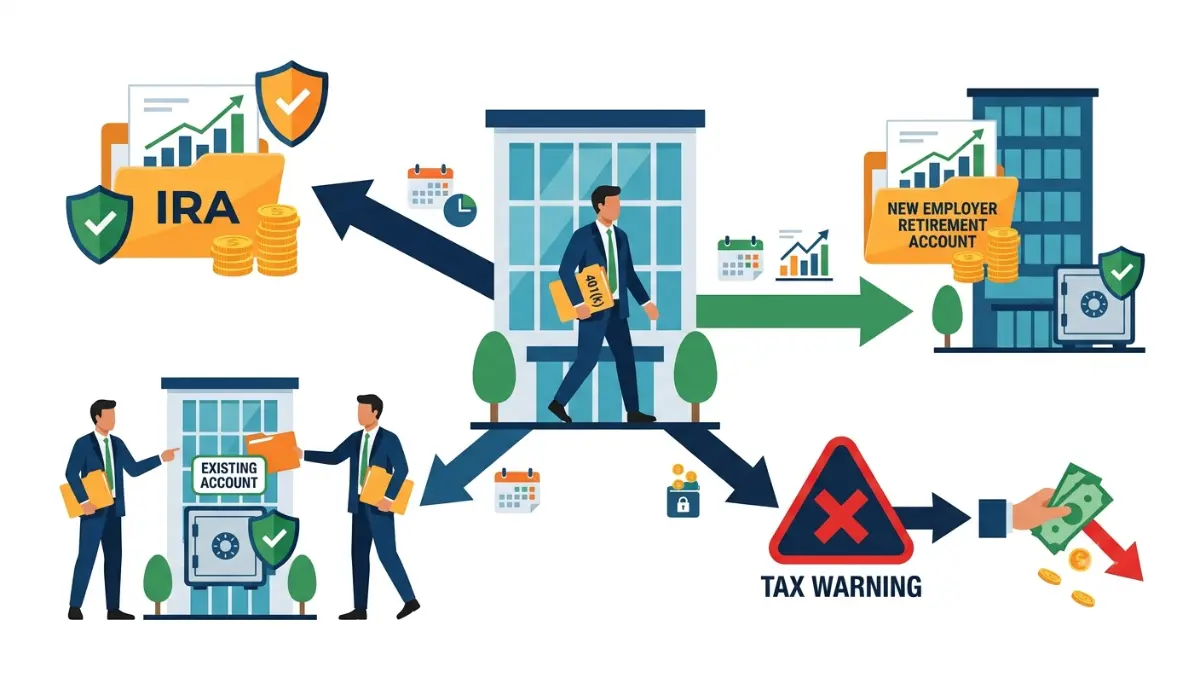
What happens to your 401(k) when you leave a job
When you leave a job, your 401(k) doesn’t disappear — you have four choices: roll it over into a new employer’s plan, roll it into an IRA, leave it in your former employer’s plan, or cash it out. The first three keep your money growing tax-deferred; cashing out usually triggers taxes and penalties.
Your four options
Your vested 401(k) balance is yours, and you decide what happens to it when you go. Each path has different tradeoffs for fees, investment choices, and access.
| Option | Best for | Key detail |
|---|---|---|
| Roll into new employer’s 401(k) | Consolidating accounts | Keeps the loan option; preserves Rule of 55 for the new plan |
| Roll into an IRA | More investment choices | Often lower fees and broader options; ends Rule of 55 eligibility |
| Leave it in the old plan | Strong, low-cost plans | You can’t keep contributing, but it stays invested |
| Cash out | Rarely the best choice | Income tax plus a 10% penalty if under 59½ |
Source: IRS, 401(k) distribution rules. Confirm your specific plan’s options with the administrator.
Roll into an IRA or a new 401(k)
A rollover moves your money into another tax-advantaged account without triggering tax — if done correctly. A direct rollover, where the money goes straight from one plan to the other, is the cleanest way.
🔍 How It Works: With an indirect rollover, the plan sends you a check, withholds 20% for taxes, and you have 60 days to deposit the full amount into a new account — including replacing that withheld 20% from your own pocket — or the shortfall is taxed as a distribution. A direct rollover avoids this trap entirely.
Leave it where it is
If your former employer’s plan has strong investment options and low fees, leaving your money there can be a fine choice. You can’t make new contributions, but the balance stays invested and tax-deferred.
The downside is that managing several old 401(k)s across jobs gets unwieldy, and it’s easy to lose track of accounts. Many people eventually consolidate for simplicity.
Cash out (and why it usually hurts)
Cashing out is the option that does the most damage. You’ll owe income tax on the full amount and, if you’re under 59½, the 10% early-withdrawal penalty — plus you lose decades of potential growth.
⚠️ Costly Mistake: Under SECURE 2.0, small balances can be moved automatically when you leave — plans can distribute balances under $1,000 and must roll balances between $1,000 and $7,000 into a safe-harbor IRA if you don’t make a choice. Don’t let a default decision be made for you; if you have a balance, choose a rollover actively so your money lands somewhere you control. For retirees weighing guaranteed income later, it helps to understand how a 401(k) compares with an annuity before moving large sums.
Don’t lose the Rule of 55
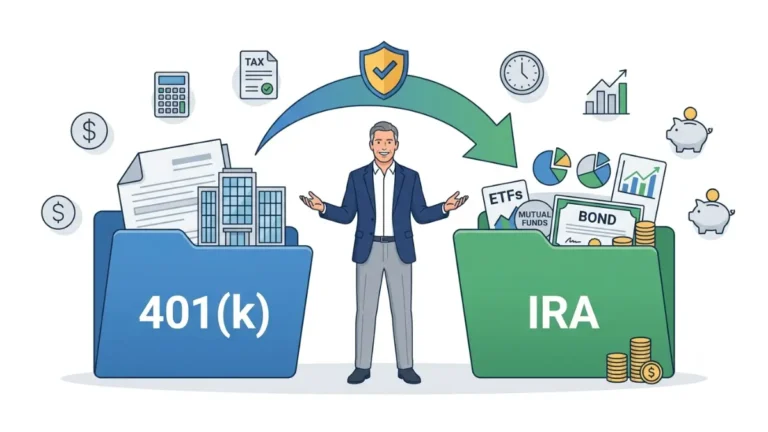
One rollover decision deserves special care if you’re in your mid-50s. Rolling a 401(k) into an IRA permanently gives up the Rule of 55, which only applies to employer plans.
If you might retire or need penalty-free access between 55 and 59½, keeping the money in your former employer’s 401(k) — or your new one — preserves that option. Roll to an IRA, and it’s gone.
With the full lifecycle covered, a handful of mistakes account for most of the money savers lose.
The most common 401(k) mistakes to avoid
The costliest 401(k) mistakes are rarely about picking the wrong investment — they’re about leaving the employer match unclaimed, cashing out at job changes, ignoring vesting, missing the new 2026 Roth catch-up rule, and forgetting the first required withdrawal. Each one is avoidable once you know it exists.
Not contributing enough to get the full match
This is the single most expensive mistake, and the most common. Contributing below your match cap leaves guaranteed money behind every year — roughly one in five eligible workers does exactly this.
The fix takes minutes: find your match cap and set your contribution to at least that percentage. No other move offers a guaranteed return that large.
Cashing out at every job change
Cashing out a 401(k) when you leave a job feels harmless when the balance is small, but it’s a slow-motion disaster. You pay income tax plus a 10% penalty if under 59½, and you lose decades of compounding on money that’s hard to replace.
Rolling the balance into an IRA or your new plan keeps it growing tax-deferred. A small balance left to compound for 30 years is worth far more than the cash in hand today.
Ignoring vesting before you quit
Leaving a job a few months before a vesting milestone can forfeit a meaningful chunk of your employer match. Since some plans use five- or six-year graded schedules, the timing of your exit matters.
If you’re close to a vesting date, it’s worth knowing exactly where you stand before giving notice. Your own contributions are always safe; it’s the match that’s at risk.
Missing the 2026 Roth catch-up rule
For 2026, higher earners — those with more than $150,000 in 2025 wages — must make catch-up contributions as Roth. If your plan offers no Roth option and you’re over the threshold, you may be unable to make catch-up contributions at all.
Affected savers who assume nothing changed could find their catch-up rejected or miscategorized. Checking your 2025 W-2 against the threshold before contributing avoids the surprise.
Forgetting your first RMD
The first required minimum distribution at 73 has an easy-to-miss deadline, and the penalty for skipping it is a 25% excise tax (10% if corrected within two years). The first one can be delayed to April 1 of the following year, but that’s also a common trap, since it stacks two RMDs into one tax year.
Mark the deadline, or let your plan calculate and distribute it automatically. It’s one of the most avoidable penalties in the entire system.
401(k) questions people ask most
A quick reference to the questions savers ask most about 401(k) plans in 2026, with answers drawn from the figures and rules above.
1. What’s the 2026 401(k) contribution limit?
For 2026, you can contribute up to $24,500 of your own pay to a 401(k), up from $23,500 in 2025. If you’re 50 or older, you can add an $8,000 catch-up for a total of $32,500; those aged 60 to 63 can add $11,250 for a total of $35,750. These are IRS limits and apply per person across all your 401(k) plans.
2. What’s the catch-up contribution for 2026?
Savers 50 and older can contribute an extra $8,000 in catch-up contributions in 2026, on top of the $24,500 base limit — a total of $32,500. The catch-up rose from $7,500 in 2025. Eligibility depends only on reaching age 50 by year-end, not on how much you’ve saved before.
3. What’s the super catch-up for ages 60 to 63?
If you’re 60, 61, 62, or 63 by the end of 2026, your catch-up is a larger $11,250 instead of $8,000 — a total contribution of $35,750. This “super catch-up” stayed flat from 2025. At 64, you revert to the standard $8,000 catch-up. Your plan must permit the higher amount for you to use it.
4. What’s the total 401(k) limit with employer match?
The combined limit for all contributions — yours plus your employer’s — is $72,000 for 2026, rising to $80,000 with the 50+ catch-up and $83,250 in the 60-to-63 window. Your own deferrals are capped separately at $24,500, so the employer match doesn’t reduce how much you can personally contribute.
5. Do high earners have to use Roth for catch-up in 2026?
Yes. Starting in 2026, if your FICA wages from your employer exceeded $150,000 in 2025, your catch-up contributions must be made as Roth (after-tax) dollars rather than pre-tax. Your base $24,500 deferral is unaffected. If your plan offers no Roth option and you’re over the threshold, you may be unable to make catch-up contributions — confirm your situation with a CPA.
6. What’s the average employer 401(k) match?
The most common match formula is 50 cents per dollar on the first 6% of pay, which works out to a 3% employer contribution. Across employers, the average match runs around 4% to 5% of salary, near 4.6% in Vanguard’s plan data. Formulas vary widely, so check your plan’s summary description for your specific match.
7. How does 401(k) vesting work?
Vesting determines how much of your employer’s match you own based on how long you’ve worked there. Some plans vest immediately; others use cliff vesting (often 100% after three years) or graded vesting (gaining ownership gradually). Your own contributions are always 100% vested. Leave before you’re fully vested, and you forfeit the unvested employer match.
8. How much should I contribute to my 401(k)?
At a minimum, contribute enough to capture your full employer match — it’s a guaranteed return. From there, a common target is saving 12% to 15% of your income, including the match, building up by about one percentage point a year. The right rate depends on your income, debts, and goals, so consider speaking with a fiduciary advisor.
9. When can I withdraw from my 401(k) without penalty?
The standard penalty-free age is 59½. You may also qualify earlier under the Rule of 55 if you leave your job in or after the year you turn 55. Before those ages, withdrawals generally face a 10% penalty plus income tax. Roth 401(k) qualified withdrawals are tax-free, while traditional withdrawals are taxed as ordinary income.
10. What’s the Rule of 55?
The Rule of 55 lets you take penalty-free withdrawals from your current employer’s 401(k) if you leave that job in or after the calendar year you turn 55 (age 50 for qualified public safety workers). It applies only to that employer’s plan, not to old 401(k)s or IRAs — and rolling the money to an IRA eliminates the option.
11. At what age are 401(k) RMDs required?
Required minimum distributions from a traditional 401(k) begin at age 73, rising to 75 in 2033 under the SECURE 2.0 Act. Your first RMD can be delayed to April 1 of the following year; later ones are due by December 31. Roth 401(k) balances have no required distributions during the owner’s lifetime.
12. What’s the penalty for early 401(k) withdrawal?
Withdrawing before age 59½ generally costs a 10% penalty plus ordinary income tax, and possibly state tax — together often a third or more of the amount. Exceptions exist for disability, certain medical expenses, the Rule of 55, birth or adoption, and others. A 401(k) loan is frequently a cheaper alternative, and it’s worth consulting a CPA first.
13. Can I take a loan from my 401(k)?
If your plan allows loans, you can generally borrow up to 50% of your vested balance, capped at $50,000, repaid within five years (longer for a primary-home purchase). Repaid on schedule, a loan avoids taxes and penalties. But if you leave your job, the balance often becomes due quickly, and an unpaid amount is taxed as a distribution.
14. Can I contribute to both a 401(k) and an IRA?
Yes. Contributing to a 401(k) doesn’t stop you from also funding an IRA, which has its own separate annual limit that’s lower than a 401(k)’s. Your income and whether you have a workplace plan can affect how much of a traditional IRA contribution is tax-deductible. Because the limits are independent, you can contribute to both in the same year.
15. What’s a highly compensated employee?
For 2026, the IRS defines a highly compensated employee as someone earning $160,000 or more, or who owns more than 5% of the company. Plans run annual nondiscrimination tests, and if a plan fails, highly compensated employees may have contributions limited or refunded. Safe-harbor plan designs let them contribute the full limit without that risk.
16. What happens to my 401(k) when I leave my job?
You have four options: roll it into your new employer’s plan, roll it into an IRA, leave it in the old plan, or cash it out. The first three keep the money growing tax-deferred. Cashing out triggers income tax plus a 10% penalty if you’re under 59½, so it’s rarely the best choice.
17. Is there a penalty for missing an RMD?
Yes. Failing to take a required minimum distribution triggers a 25% excise tax on the amount you should have withdrawn, reduced to 10% if you correct it within two years — down from the old 50% penalty under the SECURE 2.0 Act. The deadline is predictable, so the penalty is avoidable with a reminder or automatic distribution.
18. How much do most people have in their 401(k)?
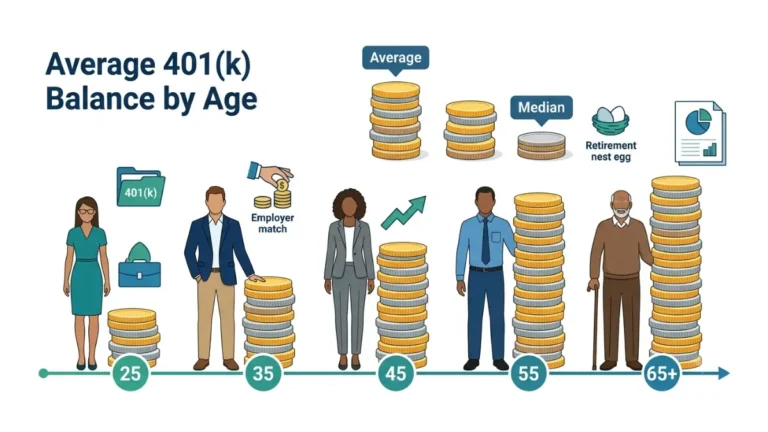
There’s no typical balance — it varies enormously by age, income, and how long someone has saved. One telling figure: only about 14% of participants contribute the annual maximum, and most save considerably less. Rather than comparing yourself to an average, focus on capturing your full match and building toward a 12% to 15% savings rate.
Your next move before your next paycheck
Understanding your 401(k) is the hard part, and you’ve done it — the limits, the match, the tax choices, and the payout rules that decide how much you actually keep. Whether you’re just starting out, trying to capture every match dollar, or sequencing withdrawals near retirement, the system rewards the same two habits: contribute enough to get the full match, and let the money compound.
The one thing to do this week
If you take one action, make it this: log in to your 401(k) and confirm you’re contributing at least enough to capture your full employer match. That single step is the highest-guaranteed-return move in personal finance, and most of the costly mistakes in this guide trace back to skipping it.
From there, raise your contribution by a percentage point when you can, and revisit the amount each year as the IRS limits change.
Where to go next
Once your match is secured, the natural next questions are where your additional dollars should go and whether you’re on track. It helps to compare whether to prioritize a 401(k) or an IRA, to check your balance against retirement savings benchmarks by age, and — as retirement nears — to weigh how a 401(k) compares with an annuity for steady income.
To put these numbers to work for your own situation, our free 2026 401(k) Match and Contribution Worksheet helps you map your paycheck, your match, and your target rate in a few minutes — download it to build your own plan.
✅ Action Step: Before your next money decision — a contribution change, a job move, or a withdrawal — have one conversation with a fiduciary financial advisor or a CPA, and ask the question that fits your situation: “Given my income, tax bracket, and goals, how much should I contribute, in pre-tax or Roth, and how should I handle this account when I change jobs or retire?”
Every figure in this guide is drawn from primary sources — the IRS’s 2026 limit announcement and final regulations, IRS distribution rules, and federal benefits data — and dated so you know how current it is. We don’t manufacture credentials or invent expertise; where a guide like this would benefit from a credentialed reviewer, we say so plainly. The most important step before your next paycheck is the simplest one: make sure you’re not leaving your employer’s match on the table.
Informational disclaimer
The content on Finance Authority Hub is provided for general informational and educational purposes only and should not be considered personalized financial, investment, tax, legal, or professional advice. Financial decisions depend on your individual goals, income, risk tolerance, location, and regulatory situation. Before acting on any information, strategy, estimate, or calculator result, consult a qualified licensed professional who can evaluate your specific circumstances.