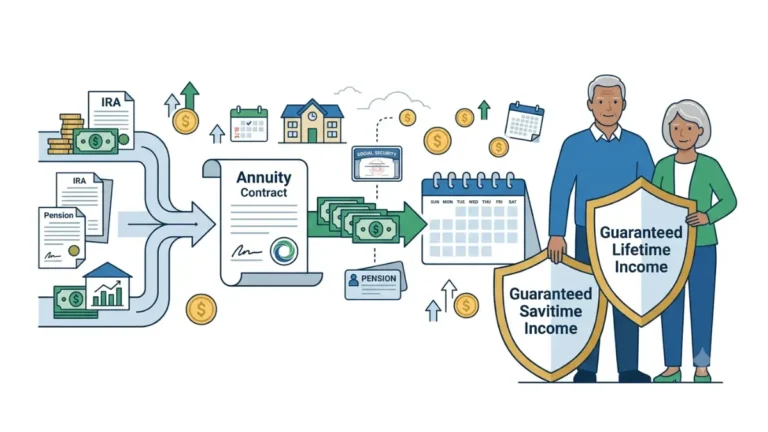
Choosing the Best Age to Buy an Annuity for Your Goals
The best age to buy an annuity is really a bet on how long you’ll live — waiting to 70 only wins if you pass ~84. Here’s the break-even, by age.
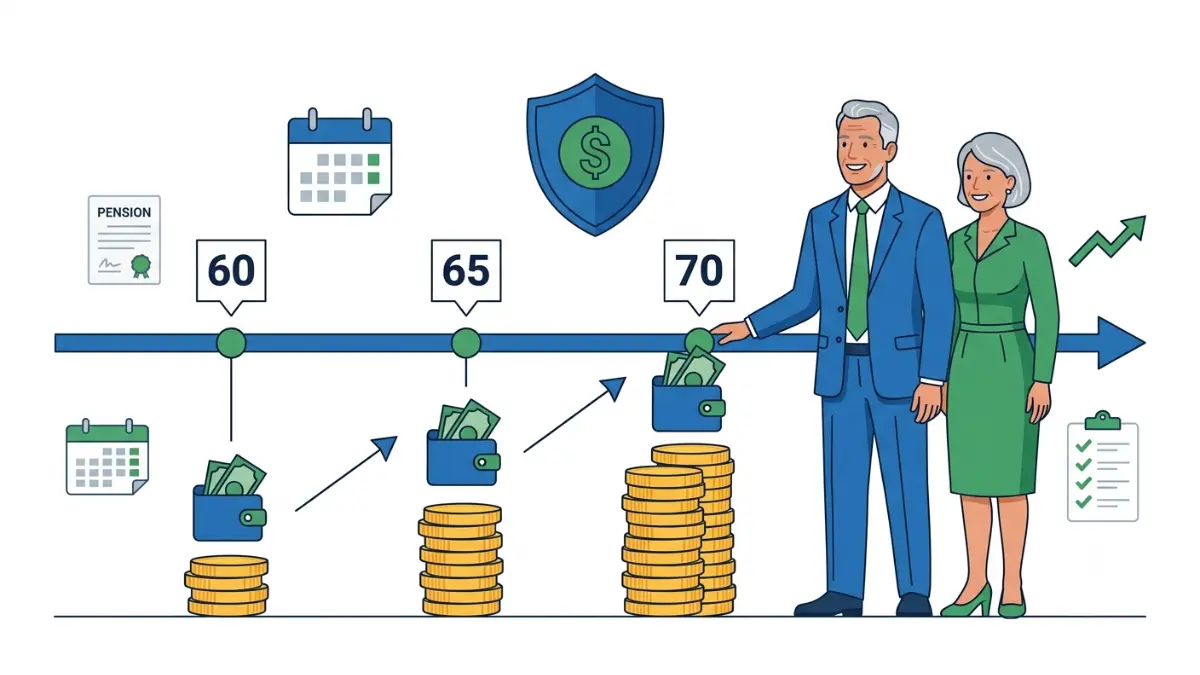
In This Article
There is no single best age to buy an annuity — but there is a best age for your situation, and it comes down to two things: when you need the income, and what kind of money you are using to buy it.
Start by placing yourself. If you need guaranteed income within the next year, you are shopping for an immediate annuity, and your age sets your payout today. If you can wait five or ten years, you have a different decision, because deferring can raise your eventual check. And if you are buying with pre-tax retirement money — a traditional IRA or 401(k) — an extra layer applies that after-tax buyers can ignore: required minimum distributions and the rules that let you defer them.
This guide walks all three paths. It shows what a $100,000 annuity actually pays at 60, 65, and 70 right now, and runs the break-even math on whether waiting truly pays more. For the product fundamentals behind the timing, start with our guide to how annuity income and rates actually work.
ℹ️ Financial Disclaimer: This article is general educational information, not investment, tax, or insurance advice. Annuities are insurance products; payout rates are quotes that change and vary by carrier, state, age, gender, and health. Tax outcomes depend on your specific situation. Consult a fiduciary financial advisor and a CPA or tax professional before buying or timing an annuity.
Why your age changes what an annuity pays
Older buyers get larger monthly checks for one reason: the insurer expects to pay them for fewer years. This is the mechanism behind every number in this article, and it is why a 70-year-old’s payout beats a 65-year-old’s on the same deposit.
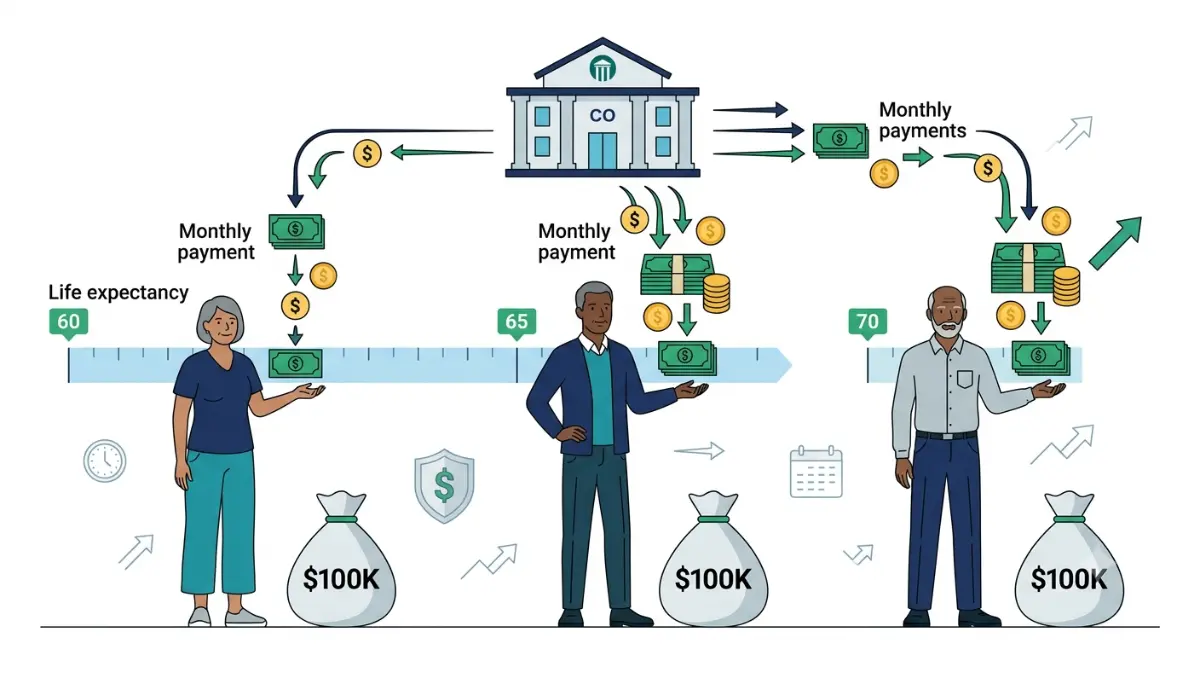
🔍 How It Works: When you buy a lifetime income annuity, the insurer pools money from many buyers. Some die early, some live long, and the payments of those who die early help fund the ones who outlive expectations — a “mortality credit.” The shorter your expected payout period, the bigger your share of that credit, so each monthly payment is higher.
Life expectancy is the input that drives the whole calculation. A 65-year-old man has, on average, roughly 17 more years ahead of him, and a 65-year-old woman closer to 20.
📊 Data Point: About 50% of 65-year-old men reach age 84, about 50% of 65-year-old women reach 87, and roughly 1 in 4 people who reach 65 live past 90 — Source: SSA Period Life Table, 2023 (used in the 2026 Trustees Report).
One distinction saves buyers from a common error: a payout rate is not an interest rate. A 7% payout rate on $100,000 means $7,000 a year, but most of that is your own principal coming back to you, not 7% interest earned. Judge an annuity by the income it guarantees, not by a percentage that looks like a yield.
What a $100,000 annuity pays at 60, 65, and 70 right now
Here is what a single life-only $100,000 annuity pays per month at each age, based on current mid-2026 quotes. These are live quotes, not fixed rates — they move with bond yields and differ by carrier, state, and gender.
| Age at purchase | Est. monthly income ($100,000, life-only) | Key detail |
|---|---|---|
| 60 | ~$530–$590 | Lowest payout shown; many buyers defer instead |
| 65 | ~$575–$670 | Most common buying age (women lower, men higher) |
| 70 | ~$700–$760 | Highest shown — roughly $130+/month above age 65 |
Source: composite of current immediate-annuity quotes, mid-2026 (Annuity.org, Ogletree Financial). Single life, life-only. Verify live before purchasing — quotes change frequently and vary by carrier, state, gender, and health.
Your real quote will differ from any table. Choosing a joint-life option that covers a spouse lowers the monthly amount by roughly 12–16%, and adding a guarantee period (so payments continue to heirs for a set number of years) also trims the check. Rates today sit well above the low-rate stretch of the 2010s, helped by a federal funds target the Federal Reserve held at 3.50%–3.75% in June 2026, which lets insurers fund larger payments.
⚠️ Costly Mistake: Treating a quote range as a promise. The only number that counts is the figure on a signed contract for your exact age, state, and option — so collect several quotes the same week before deciding.
For a deeper breakdown of these figures, see our guides to immediate annuity (SPIA) payouts and what a $100,000 annuity pays by age.
Is it better to buy at 65 or wait until 70? The break-even
Waiting from 65 to 70 buys you a bigger monthly check — but you give up five years of payments to get it. Whether that trade pays off depends entirely on how long you live.
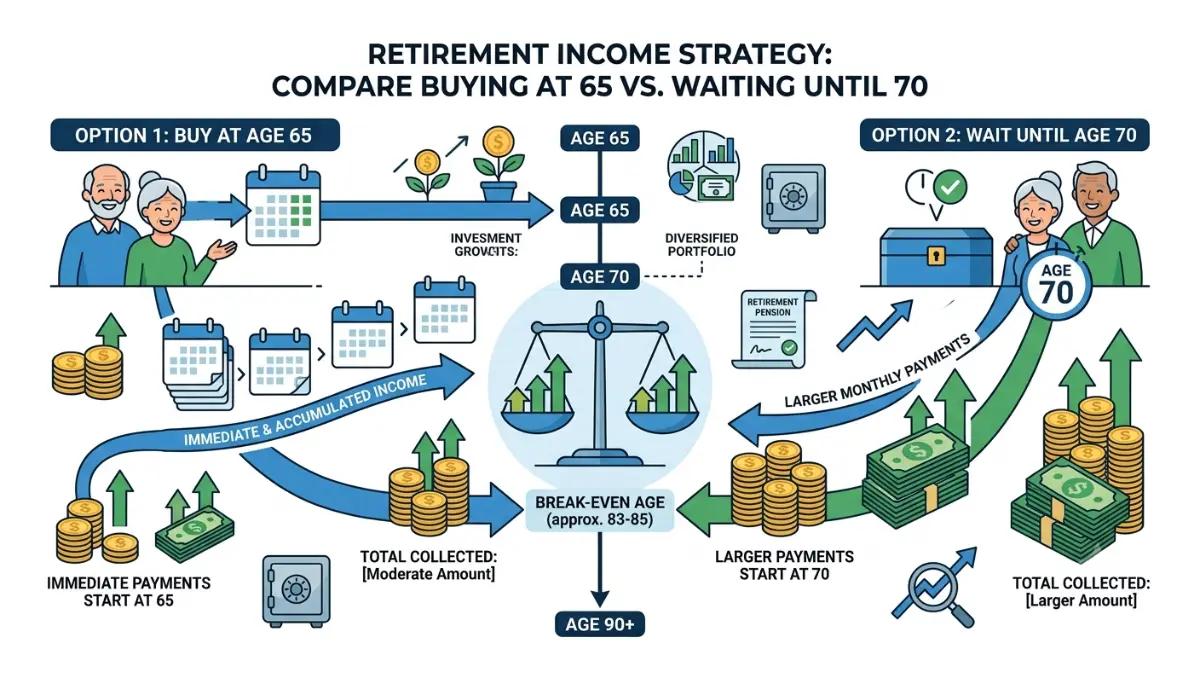
🔍 How It Works (the break-even): Buying at 65 starts the income five years sooner. Buying at 70 raises the monthly amount but forfeits 60 months of payments first. To find the crossover, weigh those missed payments against the higher check, then see at what age the bigger check has repaid the income you skipped.
Run it with the table above. At 65, roughly $620/month for five years is about $37,200 collected before a 70-year-old buyer receives a dollar. The 70-year-old’s check might be $130 higher per month — but recovering $37,200 at $130/month takes years, which pushes the break-even age to somewhere around 83 to 85, depending on the exact quotes.
Now place that against the longevity data: the break-even sits almost exactly at the median lifespan for a 65-year-old man.
📊 Data Point: A 65-year-old man has about a 50% chance of reaching 84 — Source: SSA Period Life Table, 2023. In plain terms, waiting until 70 is close to a coin flip on your own longevity, with better odds for women and people in strong health.
This is general math, not a recommendation to wait or not wait — your health, family history, and other income should drive the call.
✅ Action Step: Before deciding, request quotes for your exact age at 65 and at 70 from at least three insurers, then run the numbers in a break-even calculator and model what you’d earn investing the money while you wait.
Best age by goal: SPIA, MYGA, indexed, and deferred income
The best age genuinely changes by product, because each annuity type rewards a different goal. The table below shows the general patterns, not a recommendation for your situation.
| Annuity type | Typical age window | Best for |
|---|---|---|
| Immediate (SPIA) | ~65–72 | Income needed now; highest immediate payout |
| MYGA (fixed-rate) | ~55–70 | A guaranteed rate with no market risk; the rate does not depend on age |
| Fixed indexed (income rider) | ~55–62 | Years to let an income base grow before turning income on |
| Deferred income / QLAC | Buy earlier, start later | Locking in future income; deferring RMDs on IRA money |
Source: general product-suitability patterns across current industry guidance. Not personalized advice.
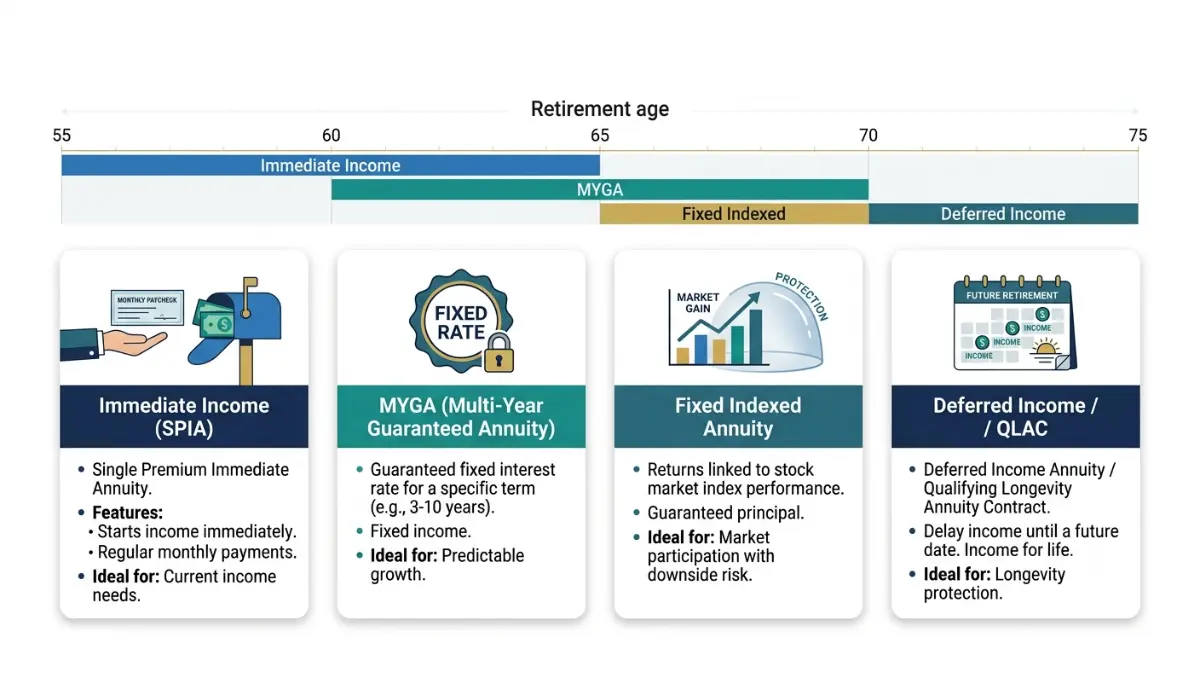
A fixed-rate MYGA is the outlier: because it carries no mortality component, its rate is the same at 55 or 75, so “best age” there is simply whenever you have money you can lock up for the term. Income annuities are the opposite — the older you start, the higher the payout, which is the kernel of truth behind the so-called “age 75 rule.” Deferred products reward starting early so the income base has years to build; our guide to the deferred income annuity covers that trade-off.
💡 Expert Note: A common point of confusion is assuming one product fits every age. The SEC’s investor education materials stress that annuities are complex and vary widely by type and contract, which is why matching the product to the goal matters more than chasing the highest headline number. See the SEC’s investor guide to annuities for a neutral overview.
✅ Action Step: Ask a fiduciary financial advisor one specific question before buying: “Given my income timeline, tax situation, and how much I can afford to lock up, which annuity type fits — and what is every fee and surrender charge in the contract you’re recommending?”
Using IRA money? RMDs and QLACs change the timing
If you are buying with a traditional IRA or 401(k), the timing decision gains a layer that after-tax buyers never face — and it is the part most “best age” guides skip entirely.
The first piece is required minimum distributions. Under current rules, RMDs from traditional retirement accounts begin at age 73 (rising to 75 in 2033), and that applies even to many annuities held inside an IRA. Every dollar of a qualified annuity’s income is taxable as ordinary income, while an after-tax annuity returns part of each payment tax-free under the IRS exclusion ratio. See the IRS rules on required minimum distributions for the specifics.
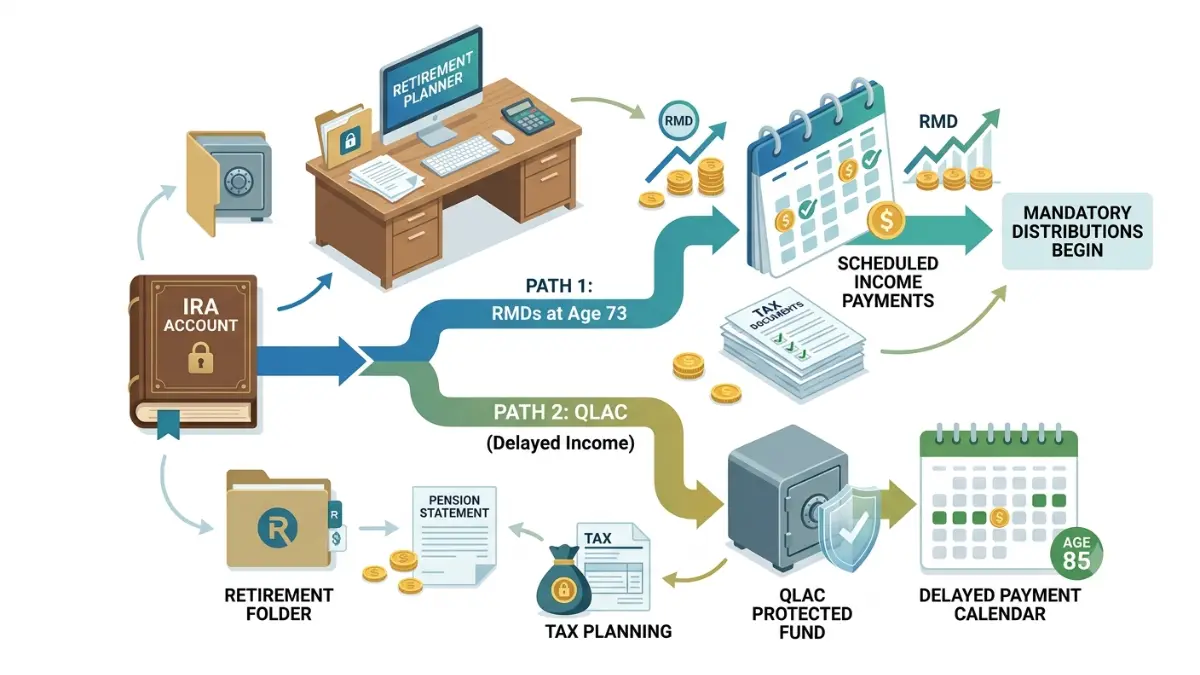
The second piece is a tool that can push income — and the tax on it — years later.
🔍 How It Works (QLAC): A Qualifying Longevity Annuity Contract lets you move a slice of IRA or 401(k) money into a deferred annuity that is excluded from your RMD calculation until income begins, which can be deferred as late as age 85. It works as longevity insurance that also trims the next decade of forced, taxable withdrawals.
📊 Data Point: The 2026 QLAC premium limit is $210,000 per person, and income can be deferred to as late as age 85 — Source: IRS, Notice 2025-67 (limit set under SECURE 2.0).
Deferring RMD income can also help some higher-income retirees stay under the thresholds that trigger Medicare premium surcharges — but those interactions are individual, and this is general education, not a tax strategy. Our guides to qualified vs. non-qualified annuity money and how a QLAC can reduce RMDs go deeper, and you can estimate your future RMDs first.
✅ Action Step: If you hold a large traditional IRA, ask a CPA: “Run my projected RMDs with and without a QLAC — does the carve-out lower my tax and Medicare costs enough to justify locking up that money, or would Roth conversions serve me better first?”
The timing mistakes that cost retirees money
The wrong age is rarely the real error — these four mistakes do more damage, and each one ties back to the mechanics above.
The first is locking up money you may need. Annuities are illiquid, and pulling money out early can trigger surrender charges plus, before age 59½, a 10% tax penalty. Money for emergencies or near-term spending does not belong in one.
The second is chasing a bigger check when your own situation says buy now. If your health is poor or longevity is not in your family, waiting for the age-70 payout can mean you never reach the break-even — the bigger check is worthless if you do not collect it long enough.
⚠️ Costly Mistake: Putting too much with one insurer. State guaranty associations commonly protect about $250,000 per person, per insurer, but the limit varies by state. Concentrating $400,000 with a single carrier can leave money beyond that line unprotected if the insurer fails.
The third is ignoring inflation, since a fixed payment buys less each year. The fourth is skipping the ladder — buying in tranches at different ages and rates spreads timing risk and can lift your blended income. Our guide to annuity red flags and pressure tactics covers the sales traps that surround these decisions.
✅ Action Step: Before signing, check that your emergency cushion is funded so you are not annuitizing money you might need, and confirm your total deposit with any one insurer stays within your state’s guaranty limit.
Best age to buy an annuity: frequently asked questions
1. What is the best age to buy an annuity?
There is no single best age. For income annuities, the efficient window is roughly your early 60s to early 70s, because payouts rise with age. The right age depends on whether you need income now and whether you are using pre-tax or after-tax money. Consider a fiduciary advisor for your specific situation.
2. Why do older buyers get higher annuity payments?
Insurers expect to make payments over a shorter remaining life expectancy, so each check is larger — the “mortality credit.” A 65-year-old man has about 17 years of life expectancy on average, which is why a 70-year-old’s payout exceeds a 65-year-old’s on the same deposit.
3. How much does a $100,000 annuity pay per month at 65?
As of mid-2026, a life-only $100,000 annuity for a 65-year-old runs roughly $575–$670 a month, with men toward the higher end and women lower. These are live quotes that vary by carrier, state, and option, so get several quotes before deciding.
4. Is it better to buy an annuity at 65 or wait until 70?
Waiting raises the monthly check but forfeits about five years of payments. The break-even lands around age 83–85 — close to the median lifespan for a 65-year-old man. If you are healthy or female, the odds of clearing break-even improve. A fiduciary can run it on your real quotes.
5. What is the annuity “age 75 rule”?
It is shorthand, not a law: insurers pay higher monthly income at older ages because life expectancy is shorter, so payouts are notably richer around 75. You do not have to wait until 75 — many buyers act earlier when they need income or want to lock in a rate.
6. Can you buy an annuity at 70 or older?
Yes. There is no federal maximum age, though carriers set their own limits, often between 75 and 90 depending on the product. Buying at 70+ produces a higher immediate payout; whether it fits depends on your health, other income, and goals.
7. Do annuities have required minimum distributions?
If the annuity is held in a traditional IRA or 401(k), yes — RMDs begin at age 73 (rising to 75 in 2033). After-tax (non-qualified) annuities have no RMDs. Because RMD interaction with annuity timing is individual, confirm it with a CPA.
8. What is a QLAC and how late can income start?
A Qualifying Longevity Annuity Contract lets you move up to $210,000 (the 2026 limit) of IRA or 401(k) money out of your RMD calculation and defer income as late as age 85. It is a longevity hedge with a tax benefit; model it with a tax professional before buying.
9. Is 60 too young to buy an annuity?
Not necessarily. At 60, a life-only $100,000 annuity pays less per month (roughly $530–$590 in mid-2026) than it would later, so many people at 60 use deferred or growth-oriented annuities and turn on income later. It depends on your income timeline.
10. Should I buy one annuity or ladder several?
Laddering — buying in tranches at different ages and rates — spreads both timing and interest-rate risk and can raise your blended income over time. It also splits money across insurers, which helps with guaranty-association limits. A fiduciary can structure the ladder to your needs.
11. Are annuity payments taxed differently by age?
Age does not change the tax rule; the funding source does. Pre-tax (IRA/401(k)) annuity income is fully taxable as ordinary income. After-tax annuity income is partly tax-free under the IRS exclusion ratio until you recover your principal. Confirm your situation with a tax professional.
So, what’s the right age for you?
The answer fits on one line. If you need income now, your 60s are the window; if you want the biggest possible check and expect a long life, waiting toward 70 can pay off past your early 80s; and if you are using IRA money, factor in RMDs and a possible QLAC before you commit.
What matters more than the calendar is matching the product to your goal, keeping money you might need out of an illiquid contract, and getting real quotes for your exact age and state. When you are ready to compare offers, our guide to how to buy an annuity the right way walks the steps. Then take the numbers to a fiduciary advisor and ask them to show the fees, the surrender schedule, and the break-even on your own quotes before you sign.
Informational disclaimer
The content on Finance Authority Hub is provided for general informational and educational purposes only and should not be considered personalized financial, investment, tax, legal, or professional advice. Financial decisions depend on your individual goals, income, risk tolerance, location, and regulatory situation. Before acting on any information, strategy, estimate, or calculator result, consult a qualified licensed professional who can evaluate your specific circumstances.