
What Happens to Your Annuity When You Die, Made Clear
When you die, your annuity may leave your family everything—or nothing. The payout you chose decides, and heirs owe ordinary income tax on the gains.
In This Article
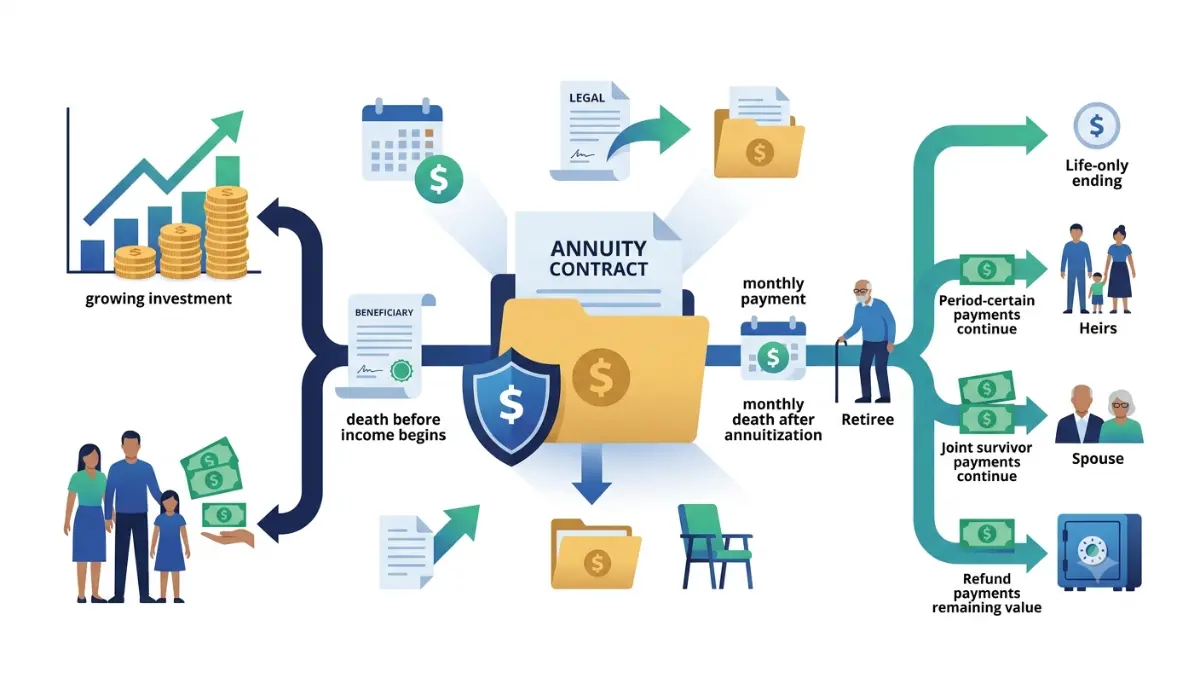
What happens to your annuity when you die depends on two things: the type of annuity you own and whether income payments have already started. If you die during the growth phase, a death benefit usually passes to your named beneficiary. If you die after annuitizing — turning the contract into an income stream — whether anything remains depends entirely on the payout option you chose.
This guide is for two readers. If you own an annuity and are planning ahead, the next three sections show how to make sure your family isn’t left with nothing. If you’ve just inherited one, skip ahead to how inherited annuities are taxed and the distribution deadlines that apply — that’s where the real money decisions sit.
Either way, you’ll leave knowing whether anything is left, who receives it, how it’s taxed, and by when it must be paid out.
ℹ️ Financial Disclaimer: This article is general educational information only — not personalized investment, tax, insurance, or estate-planning advice. Annuity contracts, tax rules, and distribution deadlines vary by product and by your circumstances. Before electing a payout, taking a distribution, or making any irreversible decision, consult a fiduciary financial advisor, a CPA or tax attorney, or a licensed estate-planning attorney about your specific situation.
The two scenarios that decide everything
Whether your annuity leaves money to anyone hinges on one fork: did you die before or after income payments began? The answer flows from how an annuity works as a contract — specifically, which phase it’s in.
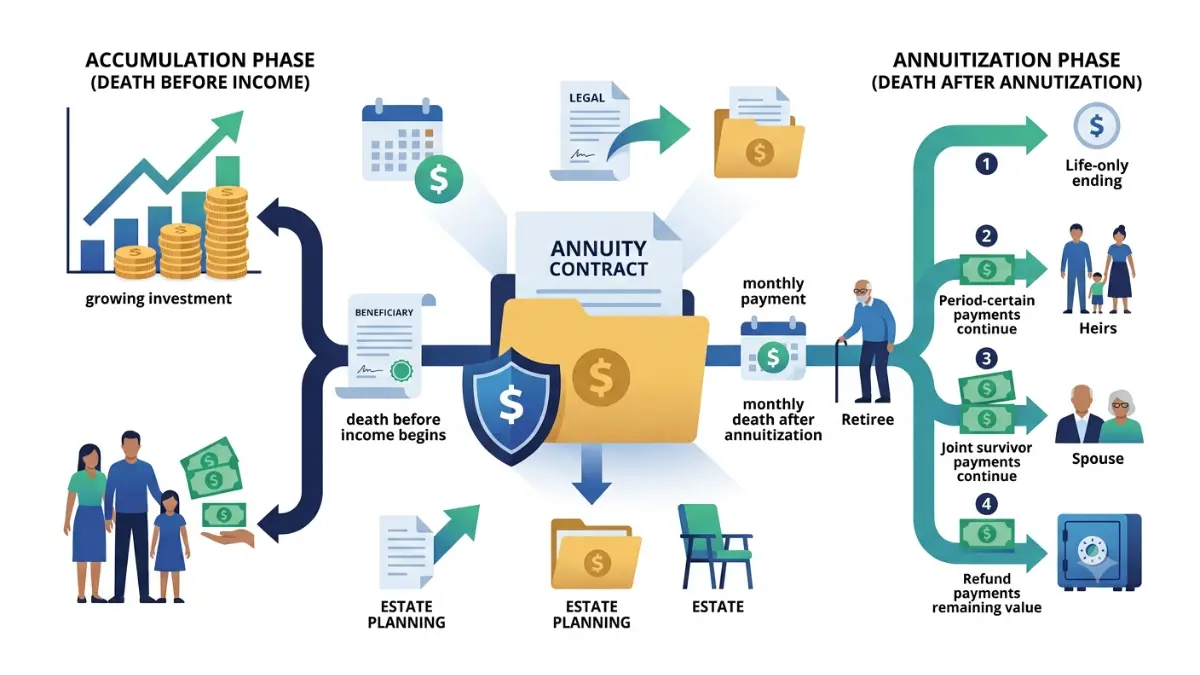
Dying during the growth (accumulation) phase
A deferred annuity spends years growing before it pays income — the accumulation phase. Die during it and the contract still holds a value, so a death benefit generally passes to your beneficiary. That benefit is typically the greater of the current contract value or the total premiums paid, and your beneficiary can usually take it as a lump sum or as installments.
Annuities come in fixed, variable, and indexed forms, and the death-benefit structure can differ across them — variable annuities, for instance, often include a guaranteed death benefit, while a bare deferred annuity may not.
Dying after annuitization
Once you annuitize, the contract converts from an account into an income stream, and what remains for heirs depends entirely on the payout option you selected. As FINRA notes in its guidance on annuity risks, whether payments continue to anyone after death depends on the annuity’s type and provisions — some options leave a great deal, others nothing at all.
🔍 How It Works: An annuity has two lives. In the accumulation phase it behaves like an account with a balance, so there’s something to inherit. After annuitization it behaves like a pension — the insurer pays income on a schedule, and only specific payout options promise a beneficiary anything once you’re gone.
What each payout option leaves your beneficiary
Whether your beneficiary receives anything — and how much — comes down to the payout option you elect at annuitization. This table shows what each common option leaves behind.
| Payout Option | What Your Beneficiary Receives | Tax on the Earnings | Best For |
|---|---|---|---|
| Life only | Nothing — payments stop at your death | No payout passes to heirs | Maximizing your own income with no heirs to provide for |
| Period certain only | The remaining guaranteed payments | Ordinary income to the beneficiary | A fixed income window with a backstop for family |
| Life with period certain | Lifetime income to you, plus remaining guaranteed payments to heirs if you die within the period | Ordinary income to the beneficiary | Lifetime income and a minimum guarantee for family |
| Joint and survivor | Continued payments for the surviving spouse’s lifetime | Ordinary income to the survivor | Couples who rely on the income together |
| Cash or installment refund | The difference between premiums paid and payments already received | Ordinary income to the beneficiary | Guaranteeing your principal isn’t lost if you die early |
Source: Payout mechanics per FINRA and state insurance regulators; earnings taxed as ordinary income per IRS Publication 575.

Life-only vs. period-certain vs. joint
The single most surprising line above is the first one. A life-only payout buys you the highest monthly check, but if you die early — even a month in — your family gets nothing, and any remaining value stays with the insurer. The payout option you lock in at annuitization is usually irreversible, so it’s worth understanding before you sign.
A worked illustration
Consider two retirees with identical premiums (an illustration). David elects life-only to maximize income; when he dies, payments stop and nothing passes on. Susan chooses life with a 20-year period certain through an immediate income annuity, dies in year eight, and her beneficiary collects the remaining 12 years of payments.
⚠️ Costly Mistake: Choosing life-only purely to get the biggest check can quietly disinherit your family. For the same premium, a life-with-period-certain option pays slightly less each month but guarantees payments to your beneficiary if you die inside the guarantee window.
Who inherits it: beneficiaries, spouses, and probate
How the money actually reaches a person comes down to one document — the beneficiary designation on the contract — plus a special option reserved for spouses.
Why your beneficiary form beats your will
The person named on your annuity receives the death benefit directly, and a named, living beneficiary usually means the money skips probate entirely. That’s faster and cheaper for your family, and it happens regardless of what your will says.
The spousal continuation option
A surviving spouse has a choice no one else gets: spousal continuation. Rather than cashing out, a spouse can usually keep the contract in their own name and preserve its tax deferral. For a qualified annuity held inside an IRA, the IRS’s beneficiary rules let a surviving spouse roll it into their own IRA and treat it as theirs.
What happens with no named beneficiary
Name no beneficiary and the annuity typically falls into your estate and passes through probate under your will — adding delay, cost, and public exposure. Naming both a primary and a contingent beneficiary avoids that.
💡 Expert Note: A common point of confusion is that your will controls your annuity. It doesn’t — the beneficiary named on the contract does, even if your will says something different. Keeping that designation current is what actually directs the money.
✅ Action Step: Request a beneficiary verification letter from your insurer and confirm both your primary and contingent beneficiaries are named and current — especially after a marriage, divorce, birth, or death in the family.
How an inherited annuity is taxed
Yes, beneficiaries owe tax on an inherited annuity — but only on part of it. The earnings are taxed as ordinary income to the beneficiary; the original premiums return tax-free; and unlike inherited stock, annuities receive no step-up in basis.
Earnings are ordinary income; principal isn’t
With a non-qualified annuity (bought with after-tax dollars), only the growth above your cost basis is taxable, and it’s taxed at your regular income rate — confirmed in the IRS’s guidance that the taxable portion is treated as ordinary income. A qualified annuity funded with pre-tax money inside an IRA or 401(k) is different: the entire distribution is ordinary income. You can see how annuity earnings are taxed in more detail, or the full breakdown of inherited annuity taxes for beneficiary specifics.
Why there’s no step-up in basis
Inherited stock or real estate usually gets a “step-up” that erases built-in gains. Annuities don’t — they’re income-in-respect-of-a-decedent, so the beneficiary inherits the original basis and owes ordinary income tax on the earnings.
Income tax vs. estate tax — what people get backwards
Most people fear estate tax, but for typical heirs the real bill is income tax.
📊 Data Point: The 2026 federal estate-and-gift tax exemption is $15 million per individual ($30 million per married couple) — Source: One Big Beautiful Bill Act / IRS inflation adjustments for tax year 2026. Estates below that threshold owe no federal estate tax, though 18 states and jurisdictions impose their own estate or inheritance taxes at lower thresholds.
🔍 How It Works: With a non-qualified annuity, the IRS uses a last-in, first-out rule: the taxable earnings come out first, and only after they’re exhausted does your tax-free principal return. An early lump sum is therefore taxed most heavily. (The 10% early-withdrawal penalty that hits living owners under age 59½ is waived for death distributions.)
✅ Action Step: Before taking a distribution, ask a CPA: “Given my other income this year, how much of this will be taxable, and would spreading it across years keep me in a lower bracket?” You can also model how a reinvested lump sum could grow — but don’t elect a lump sum until you have the tax answer.
Distribution deadlines: the 5-year, 10-year, and stretch rules
The five-year rule requires a non-qualified inherited annuity to be fully distributed within five years of the owner’s death — you can withdraw any amount, at any time, as long as it’s empty by year five. But that’s only one of several deadlines, and which applies depends on one fact: is the annuity qualified or non-qualified?

Non-qualified annuities: lump sum, five-year, or lifetime
If the annuity was bought with after-tax money, the beneficiary generally chooses among:
- A lump sum, taxed in the year received;
- The five-year rule, spreading withdrawals across up to five years;
- A lifetime “stretch,” annuitizing payments over the beneficiary’s life expectancy (beginning within about a year of death); or
- Spousal continuation, if the beneficiary is the surviving spouse.
Qualified annuities: the SECURE Act 10-year rule
A non-qualified annuity follows those rules; a qualified annuity inside an IRA or 401(k) follows the SECURE Act instead. For deaths after December 31, 2019, most non-spouse beneficiaries must empty the account by December 31 of the 10th year after death. If the original owner had already reached their required beginning date (April 1 after age 73), the beneficiary also owes annual required minimum distributions in years one through nine.
Who’s exempt: eligible designated beneficiaries
Five “eligible designated beneficiaries” can still stretch over their lifetimes: a surviving spouse; a minor child of the owner (until age 21, then the 10-year rule); a disabled individual; a chronically ill individual; and anyone not more than 10 years younger than the owner. Confirming whether your annuity is qualified or non-qualified and how annuity and IRA tax rules compare is the first step.
✅ Action Step: Ask your insurer and a CPA two questions: “Is this annuity qualified or non-qualified?” and “Do I owe annual required minimum distributions during the window, or only a final deadline?” Those answers set your entire timeline.
Five mistakes that cost families the inheritance
The knowledge above only helps if it changes what you do next. These are the avoidable errors that quietly cost families the money.
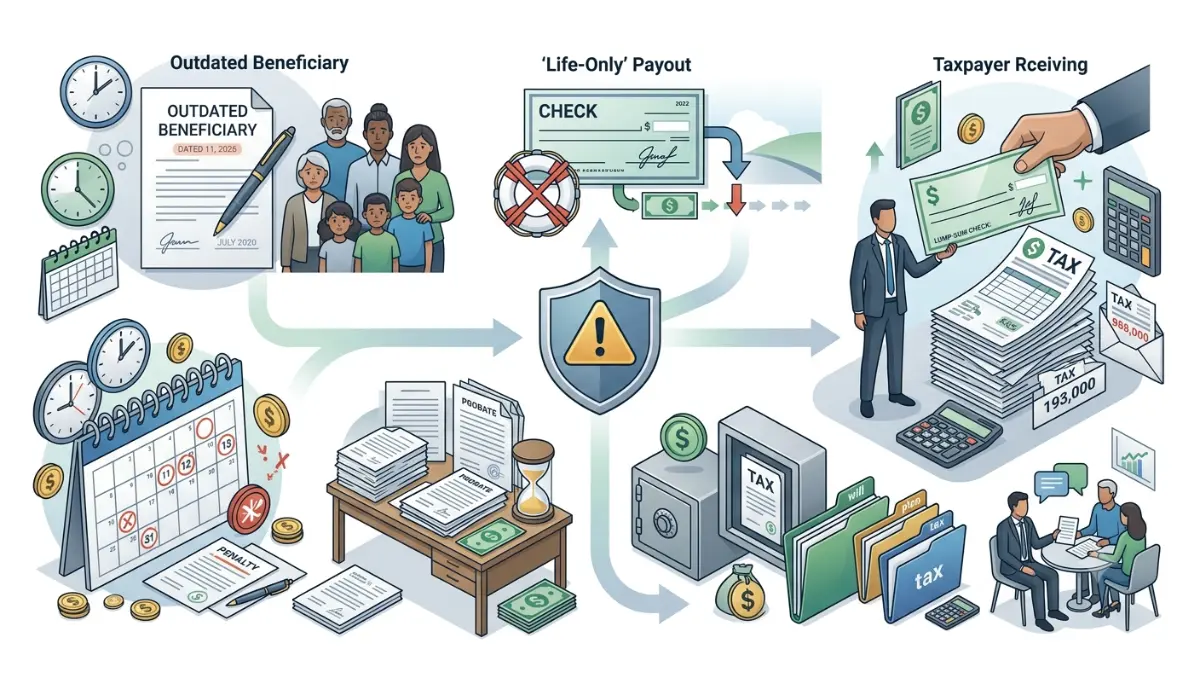
Mistakes that leave heirs with nothing
The first two are about structure. Electing a life-only payout for the biggest check leaves your family nothing if you die early. Naming no beneficiary — or never updating an old one after a divorce or death — sends the annuity into probate instead of straight to the person you intended.
Mistakes that trigger an avoidable tax bill
The next three are about taxes. Taking the whole thing as a lump sum without checking the year’s tax hit can spike your bracket. Assuming an annuity gets a step-up like inherited stock leads to a surprise bill. And not knowing whether the contract is qualified or non-qualified can mean missing a distribution deadline entirely. (For broader warning signs, here are other annuity red flags to watch for.)
⚠️ Costly Mistake: Taking an inherited annuity as one lump sum stacks all the taxable earnings into a single year and can push you into a higher bracket. Spreading the distribution — where the contract and the rules allow — often keeps more of the money in your pocket; a CPA can model both before you choose.
✅ Action Step: Before signing anything, get four answers from your insurer and a CPA: Is it qualified or non-qualified? What’s the deadline? How much of a distribution is taxable this year? Is spousal continuation available? Those four prevent the most expensive mistakes.
Frequently asked questions
1. What happens to an annuity when you die?
It depends on the annuity type and whether income payments have started. In the accumulation phase, a death benefit usually passes to your beneficiary; after annuitization, whether anything remains depends on the payout option you chose — from a full continuation to nothing at all.
2. Do you pay income tax on an inherited annuity?
Yes. The earnings are taxed as ordinary income to the beneficiary; the original premiums return tax-free, and there’s no step-up in basis. How much you owe in a given year depends on the payout you take, so confirm the numbers with a CPA.
3. What are the payout options for an annuity beneficiary?
Commonly a lump sum, periodic payments, a five-year payout, or a lifetime stretch — and a surviving spouse can often continue the contract. Which options apply depends on the contract terms and whether the annuity is qualified or non-qualified.
4. Can a surviving spouse take over an annuity?
Usually yes. Spousal continuation lets a surviving spouse keep the contract in their own name and preserve its tax deferral — an option non-spouse beneficiaries generally don’t have, which is why it’s often the most tax-efficient path for couples.
5. What is the five-year rule on an inherited annuity?
For non-qualified annuities, the five-year rule requires the full contract to be distributed within five years of the owner’s death. You can withdraw any amount at any time during that window, as long as nothing remains after year five.
6. Does the SECURE Act 10-year rule apply to annuities?
It applies to qualified annuities held in an IRA or 401(k) for deaths after December 31, 2019, generally requiring full distribution within 10 years. Non-qualified annuities follow the separate Internal Revenue Code rules instead. Confirm your status with a tax professional.
7. Does an annuity avoid probate?
Usually, if you’ve named a living beneficiary — the death benefit passes directly to them. With no named beneficiary, the annuity typically becomes part of your estate and goes through probate under your will, adding delay and cost.
8. What happens to an annuity with no named beneficiary?
It generally becomes part of the owner’s estate and is distributed through probate under the will. That process can be slow and costly, which is why naming and regularly updating a beneficiary is the simplest way to protect your family.
9. Is an inherited annuity taxed as capital gains or ordinary income?
Ordinary income. Unlike inherited stock, annuity earnings don’t get capital-gains treatment or a step-up in basis, so the gain is taxed at your regular income rate when distributed. A CPA can help you time withdrawals to manage the rate.
10. Do inherited annuities get a step-up in basis?
No. Annuities are income-in-respect-of-a-decedent assets, so they receive no step-up. The beneficiary inherits the original cost basis and owes ordinary income tax on the earnings above it when the money is paid out.
11. What happens to a life-only annuity when you die?
Payments stop at your death and nothing passes to beneficiaries — any remaining value stays with the insurer. Life-only maximizes your own income but leaves no death benefit, which surprises many families who expected something to remain.
Your next step
If you own an annuity, two checks protect your family: confirm the payout option you chose actually leaves something behind, and verify your beneficiary designation is current. If a life-only payout doesn’t match your wishes, ask your insurer what changing it would cost.
If you’ve just inherited an annuity, start by finding out whether it’s qualified or non-qualified — that one fact sets both your tax treatment and your deadline. Bring those details to a CPA before you elect a distribution, and see how the money fits into your retirement plan once the dust settles.
The worst outcomes here come from rushing an irreversible choice. A little time and one professional conversation usually pay for themselves.
Informational disclaimer
The content on Finance Authority Hub is provided for general informational and educational purposes only and should not be considered personalized financial, investment, tax, legal, or professional advice. Financial decisions depend on your individual goals, income, risk tolerance, location, and regulatory situation. Before acting on any information, strategy, estimate, or calculator result, consult a qualified licensed professional who can evaluate your specific circumstances.