How to Decide If an Annuity Is Right for You
Is an annuity right for you? It can pay income you can’t outlive—but a 10% penalty hits withdrawals before 59½. Here’s how to tell if one fits you.

In This Article
If someone has pitched you an annuity, or you lie awake wondering whether your savings will outlast you, you’re asking the right question. An annuity is one of the few products that can pay you guaranteed income for life — and one of the easiest to buy for the wrong reasons.
This guide is built for three readers. If you’re nearing retirement and weighing guaranteed income, the decision framework below is for you. If a salesperson is in front of you right now, skip to the costs and the questions to ask. And if you’re comparing an annuity to CDs, staying invested, or simply delaying Social Security, the alternatives section names the trade-offs.
Here’s our bias, stated plainly: we don’t sell annuities. Every cost, tax rule, and protection below is sourced to the SEC, FINRA, the IRS, or the CFPB — not to a sales desk. The aim isn’t to talk you into one or out of one, but to give you a clear framework and the questions to take to a fiduciary before you sign.
ℹ️ Financial Disclaimer: This article is general educational information, not personalized investment, tax, insurance, or debt advice. Annuity products, fees, and consumer protections vary by state and insurer, and tax rules change over time. Before acting on anything here, consult a fiduciary financial advisor and a CPA or tax attorney about your specific situation.
What an annuity actually is (and what it isn’t)
An annuity is a contract with an insurance company: you hand over money, and the insurer promises to pay it back as income, either soon or years later. According to FINRA, money inside an annuity grows on a tax-deferred basis, meaning you owe no tax on the growth until you take it out.
The core trade is simple to state and easy to underestimate. You give up access to and control of a chunk of savings in exchange for income you can’t outlive — protection against what the industry calls longevity risk.

🔍 How It Works: Turning your savings into a stream of payments is called annuitization. Think of it as converting a lump sum into a personal paycheck — one the insurer guarantees for a set number of years or for the rest of your life.
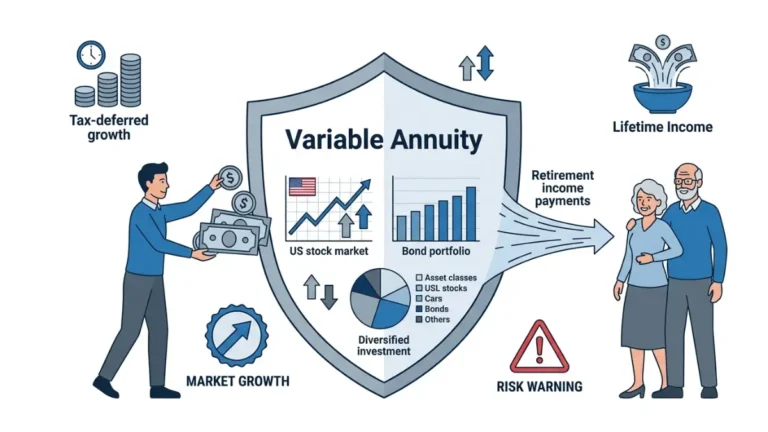
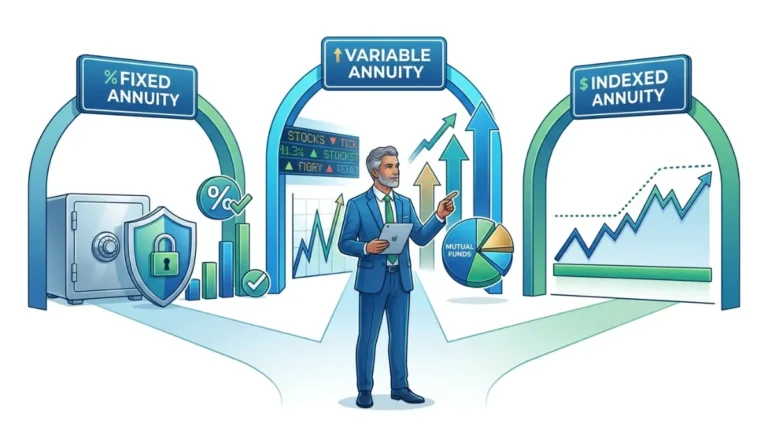
There are three main types, and they sit at very different risk levels. A fixed annuity has the insurer guarantee both the interest rate and the payout. A variable annuity lets you choose investments, and the SEC warns you can lose money, including your original investment. An indexed annuity sits between the two, with returns tied to a market index.
Annuities are also either immediate (income starts within about a year) or deferred (the money grows first). All annuities are regulated by state insurance commissioners, while variable annuities and registered index-linked annuities are also regulated by the SEC and FINRA. For a side-by-side look at the two ends of the risk spectrum, see our guide to the differences between fixed and variable annuities, and the SEC’s investor guide to annuities covers each type in plain terms.
Who an annuity is right for — and who it isn’t
An annuity fits some situations well and works against others — and the honest version of this question has two sides, not one. Below are the general signals; your personal answer depends on the specifics of your finances.
Signs an annuity may fit:
- You’re worried about outliving your savings and want guaranteed income to cover essential expenses.
- You have a low risk tolerance and value certainty over the chance of higher returns.
- You’ve already captured any 401(k) employer match and used your tax-advantaged accounts.
- You expect a long life and have enough other liquid savings left after buying.
Signs it probably doesn’t fit:
- You might need the money before age 59½, or your time horizon is short.
- You haven’t yet captured your full 401(k) match or filled your IRA.
- Your essential expenses are already covered by Social Security and a pension.
- Leaving a large inheritance is your priority, or you’d be committing most of your savings.
That last point matters most. FINRA’s suitability rules require a seller to weigh your age, time horizon, liquidity needs, tax status, and risk tolerance — and note that deferred annuities are long-term products, typically unsuitable for short horizons. On how much, the general principle is to commit only a portion and keep an accessible reserve; there’s no universal percentage.
✅ Action Step: Before committing any savings, ask a fee-only fiduciary advisor this specific question: “Given my other guaranteed income and my liquidity needs, how much — if any — belongs in an annuity, and why?” To see whether you even have an income gap to fill, run your numbers through our retirement income calculator.
The real costs that decide whether it’s worth it
Whether an annuity is worth it usually comes down to cost, and annuities can carry several. Here is what each fee is and what it does to your money.
| Fee | What it is | What it costs you | Key detail |
|---|---|---|---|
| Surrender charge | Penalty for withdrawing early | A declining % of what you take out | A typical schedule starts near 7% and falls about a point a year (SEC) |
| Mortality & expense (M&E) | Insurer’s risk/profit charge | An ongoing annual % of your value | Most common on variable annuities |
| Administrative fee | Account upkeep | A flat fee or small annual % | Charged on top of M&E |
| Rider charges | Optional add-ons (income/death benefits) | An extra annual % per rider | Each rider you add raises your cost |
| Commission / fund fees | Seller pay + underlying investment costs | Reduces what works for you | Variable annuities also carry fund expenses |
Source: fee taxonomy per FINRA and the SEC Office of Investor Education; surrender-schedule example per SEC investor bulletins.
📊 Data Point: The SEC’s own illustration compares two annuities — one charging 1.25% and one charging 1.75% in total annual fees — and shows the cheaper contract pulling meaningfully ahead over a decade. Source: SEC, Updated Investor Bulletin: Variable Annuities.
🔍 How It Works: A surrender charge applies during a surrender period the SEC notes is usually six to eight years, and sometimes ten or longer. Withdraw during that window and the insurer keeps a slice; the slice shrinks each year until it disappears.
The tax rules are the other half of the cost. The SEC and IRS confirm that annuity earnings are taxed as ordinary income when withdrawn, not at lower capital-gains rates. And for an annuity you bought directly (a nonqualified contract), the IRS treats withdrawals as coming out of earnings first — the taxable part — before your original principal.
⚠️ Costly Mistake: Pull money out before age 59½ and you can face a surrender charge and a 10% penalty. Per IRS Topic 410, a 10% additional federal tax applies to early annuity distributions unless an exception applies — stacked on top of the surrender charge and the regular income tax.
Unlike a CD, which issues a 1099 and is taxed every year, an annuity defers that tax — though a CD is FDIC-insured and an annuity is not. To see how a CD’s guaranteed return would compare, our CD calculator runs the math, and our full breakdown of annuity fees walks through every line, with the SEC’s variable-annuity bulletin as the primary source.
Questions to ask before you sign
The right questions protect you more than any sales brochure. Split them into questions for yourself and questions for whoever is selling.
Ask yourself first:
- Do I actually have an income gap an annuity would fill?
- Will I still have accessible emergency savings after buying?
- Am I under 59½, where early withdrawals trigger the 10% penalty?
Ask the seller — and verify the answers:
- What are all the fees, including riders and surrender charges?
- How are you paid, and is there a commission on this sale?
- What’s the surrender period, and is there a free-look period to cancel for a refund?
- What’s the insurer’s financial strength rating?
That last question matters because, as FINRA explains, an annuity’s guarantees rest entirely on the insurer’s claims-paying ability — and annuities are not insured by the FDIC or SIPC, only by state guaranty associations up to limits. Most buyers look for strong AM Best financial-strength ratings before committing. A free-look window exists in every state, but its length varies (commonly around 10 to 30 days), so confirm yours in writing.
✅ Action Step: Before signing, look up the salesperson and their firm on FINRA’s free BrokerCheck database to see their license and any complaint history. The FINRA investor information on annuities explains how sellers are compensated and why suitability rules require them to match the product to your profile.
Annuity vs. the alternatives
An annuity isn’t the only route to retirement income, and naming the alternatives is the fairest way to judge it. The honest comparison includes income you may already have.
You could keep your savings invested and draw from them with a withdrawal strategy, which keeps you in control of the assets. CDs offer FDIC-insured, predictable returns but are taxed each year; Treasuries are backed by the U.S. government. Each route trades some certainty for more flexibility — or the reverse.
The most overlooked alternative is one you already own. Delaying Social Security buys you a larger, inflation-adjusted guaranteed income for life — often cheaper than purchasing the same income from an insurer.
📊 Data Point: Claiming Social Security before your full retirement age can reduce your monthly benefit by as much as 30%, while waiting increases it. Source: Consumer Financial Protection Bureau.
Before handing a lump sum to an insurer, it’s worth estimating that benefit and modeling what staying invested could do. Our Social Security benefit estimator and compound interest calculator let you compare, and our annuity vs. CD comparison covers the safe-money side. The CFPB’s Social Security claiming guide is the source on how timing changes your benefit. A fee-only advisor can model the personalized version — but the choice itself is yours to weigh.
Common annuity mistakes to avoid
A few errors account for most annuity regret, and each is avoidable. They cluster around two themes: putting in too much, and buying a benefit you don’t need.
Committing too large a share leaves you illiquid — and if you need it back early, the surrender charge plus the 10% penalty can erase years of growth. Keep a separate, accessible reserve no matter how appealing the guaranteed rate looks.
The second trap is paying for tax-deferred growth you already have. An IRA is itself tax-deferred, so wrapping a tax-deferred annuity inside one usually adds cost without adding a tax benefit.
⚠️ Costly Mistake: Buying an annuity inside an IRA for the tax deferral is often redundant — you’d pay annuity fees for a tax break the IRA already provides. Our guide to how annuity and IRA tax rules interact explains when it does and doesn’t make sense.
Finally, don’t skip shopping carriers, and be wary of pressure. FINRA reports that variable annuities are a leading source of investor complaints, driven by complexity and aggressive sales — a signal to slow down, not speed up.
Annuity decision: frequently asked questions
1. Is an annuity right for me?
Whether an annuity is right for you depends on whether you need guaranteed income you can’t outlive, have a long time horizon, and can give up access to a portion of savings. It fits low-risk-tolerance retirees with an income gap, and rarely fits those needing liquidity. Confirm your case with a fiduidiary advisor.
2. Who should not buy an annuity?
An annuity is generally a poor fit if you may need the money before age 59½, have a short time horizon, haven’t yet captured your 401(k) match or filled tax-advantaged accounts, already cover essentials with Social Security and a pension, or would commit most of your savings. Consult a fiduciary advisor first.
3. How much of my savings should go into an annuity?
There’s no universal percentage. The general principle is to commit only a portion and keep an accessible emergency reserve, since annuities are long-term and carry surrender charges for early withdrawal. The right amount depends on your other guaranteed income and liquidity needs — confirm it with a fee-only fiduciary advisor.
4. What fees do annuities charge?
Annuities can carry surrender charges for early withdrawal, mortality and expense (M&E) charges, administrative fees, charges for optional riders, sales commissions, and — in variable annuities — underlying fund fees, according to FINRA and the SEC. These costs reduce your return. Ask for every fee in writing before buying.
5. Are annuity withdrawals taxed, and is there a penalty?
Yes. The IRS taxes annuity earnings as ordinary income when withdrawn, and for a nonqualified annuity, withdrawals come from earnings first. Per IRS Topic 410, a 10% additional federal tax also applies before age 59½ unless an exception applies. Our guide to how annuities are taxed and the IRS rules on annuity payments cover the details; consult a CPA.
6. Can I lose money in an annuity?
It depends on the type. With a fixed annuity, the insurer guarantees your principal and rate, backed by its claims-paying ability. With a variable annuity, the SEC warns you can lose money, including your original investment, because your return follows the investments you choose. Consult a financial professional.
7. Are annuities FDIC-insured?
No. FINRA confirms annuities are not insured by the FDIC, SIPC, or any federal agency. Instead, they may be protected by your state’s guaranty association up to certain limits if the insurer fails. Because guarantees rest on the insurer, check its financial strength before buying, and consult a financial professional.
8. Can I get my money back after buying one?
Usually only for a short window. Every state requires a free-look period during which you can cancel for a refund, though the length varies. After that, taking money out generally triggers a surrender charge, and a 10% federal penalty may apply before age 59½. Confirm your free-look terms in writing.
9. Should I put an annuity inside my IRA?
Usually not for the tax benefit. An IRA is already tax-deferred, so holding a tax-deferred annuity inside one typically adds fees without adding a tax advantage. It may still make sense for an income guarantee, but weigh the cost carefully. Consult a CPA or fiduciary advisor about your situation.
10. Is now a good time to buy an annuity?
Fixed annuity payouts move with interest rates, which remain elevated relative to recent years. Whether timing favors you depends on your income needs, not just the rate environment. See current figures in our main annuity guide, and consult a fiduciary advisor before acting on a rate.
11. How do I know if the salesperson and insurer are trustworthy?
Check the salesperson and firm on FINRA’s free BrokerCheck for licensing and complaint history, and review the insurer’s financial-strength rating (such as AM Best), since guarantees depend on its claims-paying ability. Also ask how the seller is paid. Consult a fiduciary advisor before committing.
So, is an annuity right for you?
There’s no universal answer — an annuity is a tool that’s right for some situations and wrong for others. It can fit if you want guaranteed income, have a long horizon, and keep enough in reserve; it usually doesn’t if you need liquidity, haven’t filled your tax-advantaged accounts, or already cover essentials with other guaranteed income.
The next step isn’t a purchase. Take the questions above to a fee-only fiduciary, and read the full guide to how annuities work, including current income and rates before you decide anything.
Informational disclaimer
The content on Finance Authority Hub is provided for general informational and educational purposes only and should not be considered personalized financial, investment, tax, legal, or professional advice. Financial decisions depend on your individual goals, income, risk tolerance, location, and regulatory situation. Before acting on any information, strategy, estimate, or calculator result, consult a qualified licensed professional who can evaluate your specific circumstances.