A Clear Look at Today’s Annuity Rates and MYGA Yields
Annuity rates are near 15-year highs and top MYGAs now out-yield CDs — but the highest advertised rate isn’t always the best deal.

In This Article
A multi-year guaranteed annuity (MYGA) locks in a fixed interest rate for a set term, and right now those rates sit near their highest in more than a decade. The top fixed annuity rates reach roughly 6.50% from lower-rated carriers and about 5.00%–5.75% from the financially strongest insurers, depending on term and deposit.
If a bank CD just matured and you want a better yield without market risk, start with the rate table below. If you’re weighing a MYGA against a CD or a Treasury, the comparison section is built for that decision. And if you’ve been pitched an annuity and worry about being trapped or oversold, the costs and safety sections speak directly to that.
This guide shows current rates by term, the real costs, and how the guarantees are actually protected — every figure dated and sourced. For the bigger picture, see our pillar on how annuities work and what they really cost.
ℹ️ Financial Disclaimer: This article is general financial education, not personalized investment, tax, insurance, or debt advice. Annuity rates, contract terms, and state guaranty-association limits vary by carrier, state, and date and change frequently; annuities are not FDIC insured, and their guarantees depend on the issuing insurer’s claims-paying ability. Before buying, consult a fiduciary financial advisor and a CPA, and verify current rates and your state’s protections.
What a MYGA rate is — and why it’s this high right now
A MYGA is a fixed annuity that pays a guaranteed interest rate for a set term — usually two to ten years — with interest compounding tax-deferred until you withdraw it. It works much like a bank CD, except an insurance company issues it and the tax treatment differs.
🔍 How It Works: Insurers set MYGA rates from the yields on the bonds they buy with your premium — mainly Treasurys and high-grade corporates. When the general level of interest rates is higher, carriers can promise higher fixed annuity rates; when yields fall, new MYGA rates fall too.
Annuity rates therefore track the broader rate environment that the Federal Reserve heavily influences. The Fed’s benchmark range has sat at 3.50%–3.75% since December 2025, and policymakers have put further cuts “on ice” as inflation has stayed elevated near 4.2% — with a hold widely expected at the June 2026 meeting. That higher-for-longer stance is why fixed annuity yields remain near 15-year highs.
For the full product mechanics, see the detailed breakdown of how MYGAs work, or check the Federal Reserve’s current policy stance.
Today’s best MYGA rates by term
As of mid-June 2026, the single highest fixed annuity rate is about 6.50% on a seven-year MYGA from an A-minus-rated carrier, while the strongest A-rated insurers pay roughly 5.00%–5.75%. The top rate, 6.50%, came from a seven-year MYGA at an A-minus carrier; A-rated carriers generally run 5.00%–5.75%, with five-year contracts often highest. Treat the table as a dated snapshot and re-check before you buy.
| Term | Top advertised rate (June 2026) | Key detail |
|---|---|---|
| 2–3 years | ~5.0%–5.5% | Shortest lock; closest to top CD rates |
| 5 years | up to ~6.3% | The most popular MYGA term |
| 7 years | up to ~6.5% | Highest yields on the market now |
| 10 years | ~5.0%–6.0% | Longest guaranteed rate lock |
Rates as of June 2026 from independent annuity marketplaces (annuity.org, Blueprint Income, My Annuity Store, Ohio Insure Plan). Top advertised rates often come from A-minus carriers; the strongest A-rated insurers generally pay 5.00%–5.75%. Verify before purchase.

📊 Data Point: As of June 2026, no fixed annuity pays 7% or more — Source: AnnuityExpertAdvice rate tracker, June 2026.
The important nuance: that headline 6.50% often comes from an A-minus carrier, while an A-plus insurer might pay closer to 5.75%. A MYGA guarantee is only as strong as the company behind it, so the highest number isn’t automatically the best deal. To turn a rate into a real dollar figure, model how a guaranteed rate compounds over the term.
Some links on this page go to advertising partners, and we may earn a commission if you request a quote. That’s disclosure — not a recommendation to buy any specific product.
MYGA vs CD vs Treasury: which pays more right now?
A top MYGA currently out-yields a top CD by roughly one to two percentage points, but yield is only part of the decision. A best five-year MYGA has reached about 6.3% versus a best five-year CD around 4.2%, with today’s leading five-year CD rates near 4.0%–4.1%.
| Feature | MYGA | 5-yr CD | Treasury | Best for |
|---|---|---|---|---|
| Top rate (Jun 2026) | up to ~6.5% | ~4.0%–4.25% | Varies w/ market | Highest fixed yield → MYGA |
| Taxes | Deferred until withdrawal | Taxed yearly (1099) | Federal-taxed, state-exempt | Tax deferral → MYGA |
| Insurance | State guaranty association | FDIC up to $250k | U.S. government | Federal backing → CD/Treasury |
| Liquidity | Surrender charges early | Early-withdrawal penalty | Sell on the market | Easy access → Treasury |
Rates as of June 2026; verify before purchase. CD coverage per FDIC; MYGA coverage via state guaranty associations.
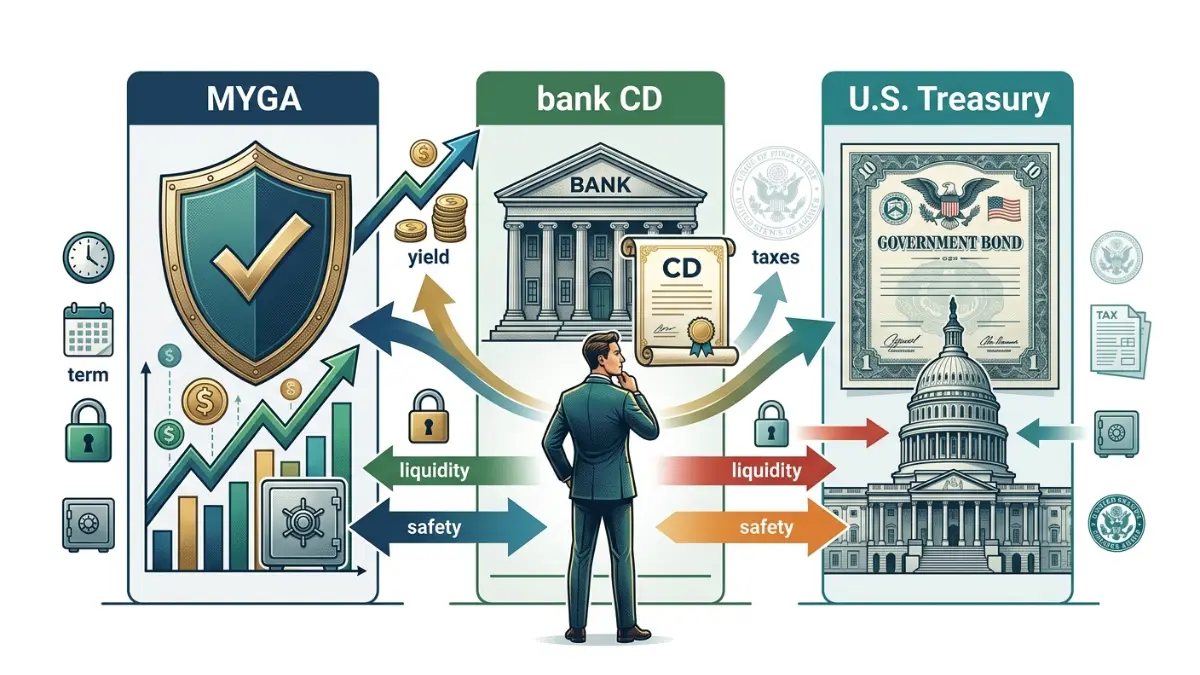
The MYGA wins on yield and tax deferral; the CD and Treasury win on liquidity and government-grade backing. CDs at FDIC-insured banks are federally insured up to $250,000 per depositor, per institution — a MYGA is not. Your tax bracket and your timeline decide it: tax deferral helps most if you’re in a higher bracket and won’t touch the money before 59½.
💡 Expert Note: A common point of confusion is assuming a MYGA’s tax deferral always beats a CD. It mainly helps if you’re in a higher tax bracket and can leave the money untouched — for cash you may need soon, the CD’s easier access can matter more.
⚠️ Costly Mistake: Chasing the headline MYGA rate while overlooking that a CD is federally insured and a MYGA is not. The MYGA backstop is real but works differently — covered in the safety section below.
Dig deeper with our full MYGA vs CD breakdown, run the same deposit as a CD, or see how Treasury bills stack up. For your exact numbers, a CPA can compare the after-tax result.
How to lock in the best rate without getting trapped
Locking in a good rate is less about the single highest number and more about matching the term to your timeline and the carrier to your need for safety. Two checks matter most before you sign.
First, the carrier’s financial strength. Most experts suggest considering only insurers rated A-minus or above by AM Best for a long-term annuity, because the guarantee rests entirely on the company’s ability to pay. A slightly lower rate from a stronger carrier is often the better trade.
🔍 How It Works — the renewal trap: When your MYGA term ends, it doesn’t simply cash out. Unless you act during the short window after maturity, it renews at the carrier’s then-current rate — which can be far lower, though never below the contract’s minimum guaranteed rate, often just 1.00%.
⚠️ Costly Mistake: Letting a MYGA auto-renew at a 1% floor because you missed the maturity window. Mark the date and decide in advance whether to withdraw, renew, or do a 1035 exchange.
✅ Action Step: Before buying, ask a fiduciary financial advisor: “Given my age, tax bracket, and when I’ll need this money, is this term and carrier appropriate — and exactly what happens at renewal?”
If you’re still mapping the accumulation phase, see how deferred annuities accumulate, and review what regulators say to check before buying an annuity.
The real costs: surrender charges, taxes, and early withdrawals
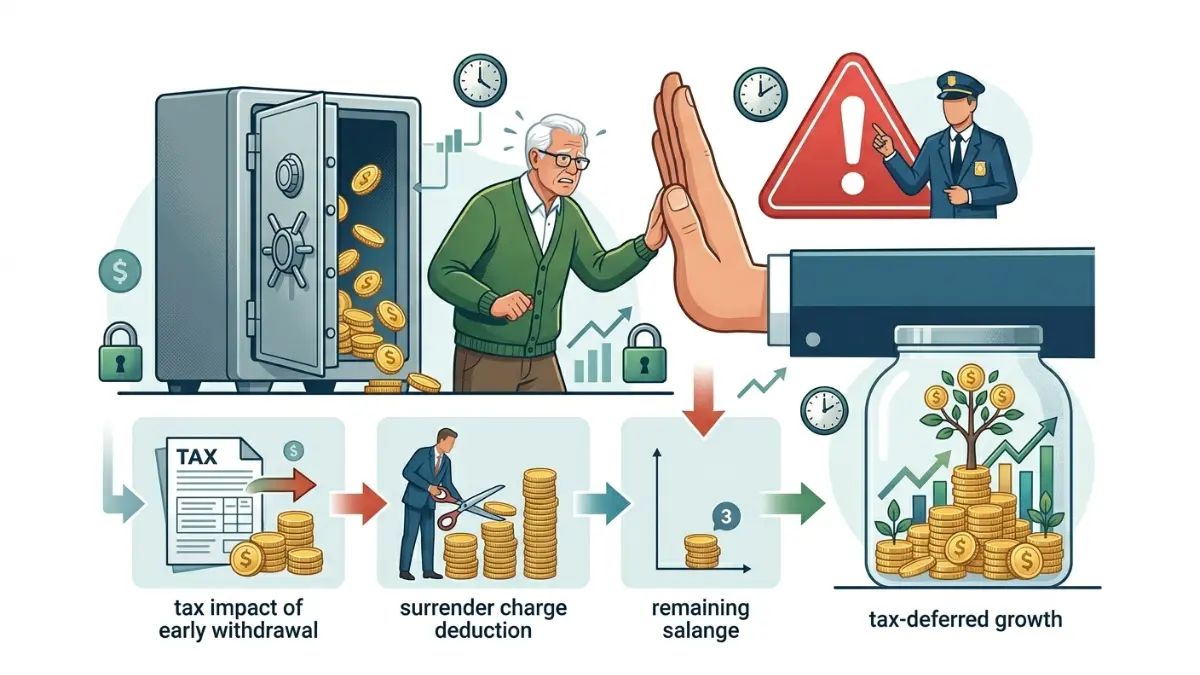
A MYGA is safe and predictable, but it isn’t money you can grab anytime — and knowing the costs up front prevents an expensive surprise. There are three to plan around.
Surrender charges apply if you withdraw more than the contract allows during the surrender period. Most MYGAs let you take out about 10% of the value penalty-free each year, with charges above that declining over the term.
Here’s how MYGA withdrawals are taxed:
- Growth is tax-deferred — no annual 1099, so interest compounds untaxed until you withdraw.
- Withdrawals are taxed as ordinary income, not at lower capital-gains rates; non-qualified contracts use last-in-first-out, so gains come out first.
- Before age 59½, the IRS adds a 10% penalty on the taxable portion, with exceptions for death, disability, and certain payment plans under Rule 72(t).
🔍 How It Works: A 1035 exchange lets you move a maturing MYGA into a new annuity without triggering tax — handy at renewal. Qualified (IRA-funded) contracts also face required minimum distributions starting at age 73.
✅ Action Step: Ask a CPA: “How will withdrawals from this annuity — and any 1035 exchange — affect my taxable income and the taxation of my Social Security?”
See how a QLAC can defer required minimum distributions, estimate how added income affects your Social Security taxes, or read the IRS rules on pension and annuity income.
Are fixed annuities safe? The mistakes to avoid
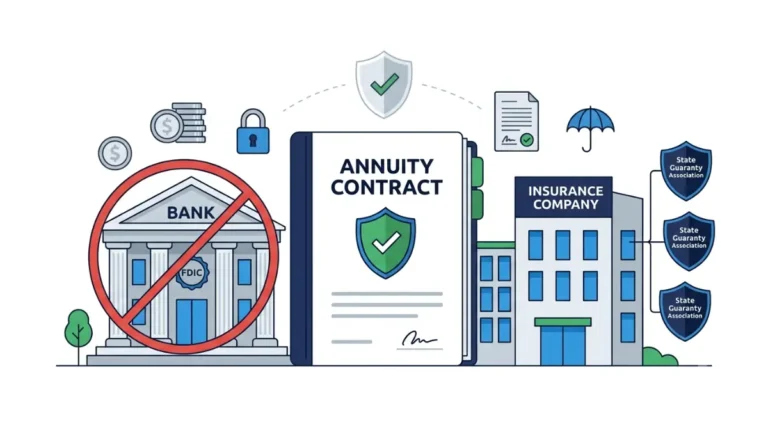
Fixed annuities are not FDIC insured — but they aren’t unprotected either. If the insurer fails, your state guaranty association steps in — the insurance-industry safety net that works like the FDIC for annuities, funded by assessments on licensed insurers and coordinated nationally by NOLHGA.
📊 Data Point: Every state covers at least $250,000 in present value of annuity benefits per owner, per insurer — Source: NAIC Life and Health Insurance Guaranty Association Model Act (#520); NOLHGA, 2026. Limits vary — Connecticut covers up to $500,000, while California covers 80% of an annuity up to $250,000.

Three mistakes to avoid:
- Buying on the headline rate alone and ignoring the carrier’s AM Best strength.
- Putting more than your state’s limit with one insurer — where limits are per-insurer, splitting across carriers raises your protected total.
- Forgetting the renewal date and getting reset to a roughly 1% floor.
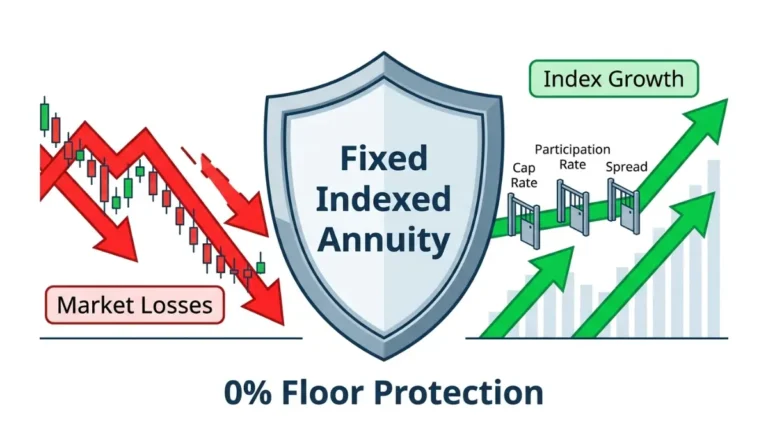
Before exceeding a limit, confirm your state’s exact figure with your state guaranty association. If a MYGA feels too rigid, compare fixed indexed annuities and their caps and floors.
Annuity rates FAQ
1. What is the best annuity rate today?
As of June 2026, the top annuity rate is about 6.50% on a seven-year MYGA from an A-minus carrier, while the strongest A-rated insurers pay roughly 5.00%–5.75%. Rates change daily and vary by term, deposit, and state, so confirm a live quote before buying. The highest rate isn’t always the best deal if the carrier is weaker.
2. What is a multi-year guaranteed annuity (MYGA)?
A MYGA is a fixed annuity that pays a guaranteed interest rate for a set term, usually two to ten years, with interest growing tax-deferred until withdrawal. It functions like a bank CD but is issued by an insurance company and taxed differently. The rate is locked for the full term you choose.
3. Are MYGA rates better than CD rates?
Often, yes — a top MYGA has recently yielded about 6.3% versus roughly 4.0%–4.2% on leading five-year CDs, plus tax deferral. But CDs are FDIC insured and more liquid, while MYGAs use state guaranty coverage and charge surrender fees for early access. Your bracket and timeline decide it; a CPA can run your numbers.
4. Why are annuity rates so high right now?
Annuity rates track the broader interest-rate environment, and the Federal Reserve’s benchmark has held at 3.50%–3.75% since December 2025 after policymakers paused rate cuts amid elevated inflation. Insurers fund MYGA rates from bond yields, so a higher-for-longer rate environment keeps fixed annuity yields near 15-year highs.
5. Are fixed annuities FDIC insured?
No. Annuities are not FDIC insured; guarantees depend on the issuing insurer’s claims-paying ability. If an insurer fails, your state guaranty association provides a backstop — at least $250,000 in present value of annuity benefits in every state, though limits vary. Confirm your state’s specific coverage before committing large sums, and consider carrier strength.
6. How much money do I need to buy a MYGA?
Minimums are set by each carrier and contract rather than by a single industry rule, and they vary widely. The practical step is to request quotes from several A-rated insurers, which shows the minimum deposit, the rate by term, and whether interest is compounding or simple. Compare strength ratings, not just the headline rate.
7. What happens when my MYGA term ends?
Unless you act during the short window after maturity, the contract typically renews at the carrier’s current rate, which can be much lower — though never below the minimum guaranteed rate, often about 1.00%. Your options at maturity are usually to withdraw, renew, or do a tax-free 1035 exchange into another annuity. Mark the date.
8. Can I lose money in a fixed annuity?
The rate itself is contractually guaranteed and carries no market risk, so you won’t lose principal to market swings. You can still lose money to surrender charges if you withdraw early, to the 10% IRS penalty before 59½, or if an insurer fails beyond your state’s guaranty limit. Carrier strength and liquidity planning are the real safeguards.
9. How are annuity withdrawals taxed?
Growth is tax-deferred, but withdrawals are taxed as ordinary income, not at capital-gains rates. Non-qualified contracts use last-in-first-out, so gains come out first; before age 59½ the IRS adds a 10% penalty on the taxable portion, with limited exceptions. Qualified contracts face required minimum distributions at 73. Confirm specifics with a CPA.
10. What is a surrender charge?
A surrender charge is a fee the insurer applies if you withdraw more than the contract’s penalty-free amount during the surrender period. Most MYGAs allow roughly 10% penalty-free each year, with the charge on larger withdrawals declining as the term progresses. Read the surrender schedule before buying so you know your true access to the money.
11. Should I buy a MYGA now or wait for higher rates?
No one can reliably predict rates, but annuity yields are near 15-year highs, and the Fed has paused its rate cuts — so the case for waiting is weaker than usual. Locking part of your cash now and keeping some liquid is a common middle path. Match the term to your timeline, and review the decision with a fiduciary advisor.
Your next steps
Annuity rates near multi-year highs make today a genuinely good moment to lock in a guaranteed yield — but the right move depends on your tax bracket, when you’ll need the money, and the strength of the carrier behind the guarantee. The highest advertised rate is rarely the whole story.
Three concrete next steps: model the rate with a compounding calculator to see your actual dollar growth, write down the questions to ask before signing, and review the numbers with a fiduciary advisor and a CPA. To see how guaranteed income fits the rest of your plan, map it against your retirement timeline.
Informational disclaimer
The content on Finance Authority Hub is provided for general informational and educational purposes only and should not be considered personalized financial, investment, tax, legal, or professional advice. Financial decisions depend on your individual goals, income, risk tolerance, location, and regulatory situation. Before acting on any information, strategy, estimate, or calculator result, consult a qualified licensed professional who can evaluate your specific circumstances.