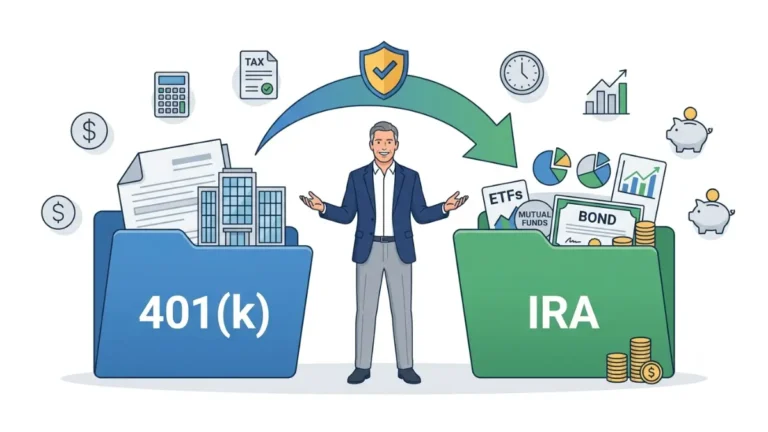
No 401(k) at Work? Smart State Auto-IRA Options
No 401(k)? A state auto-IRA can auto-start your retirement savings — but its Roth setup may block the 2027 Saver’s Match worth up to $1,000.
In This Article
Starting a job with no 401(k) — or realizing the one you’ve had for years never offered one — can feel like you’re already behind on retirement. You’re not, and you’re not out of options.
This guide is for three kinds of readers. If you work for a small business in one of the 15 states that now run automatic retirement programs, your state may enroll you in an account without you lifting a finger. If you’re self-employed, a gig worker, or a 1099 contractor, you can often open the same kind of account yourself — or one with a far higher limit. And if your state has no program yet, you can still start saving on your own today.
Whichever describes you, the account at the center of all this is an individual retirement account, or IRA — and it doesn’t need an employer to exist. Here’s how each path works, what you can put in for 2026, and one costly trap to sidestep.
ℹ️ Financial Disclaimer: This article is for general educational purposes only and is not personalized investment, tax, or retirement advice. Retirement accounts, contribution limits, Roth income rules, and state programs all change, and the right move depends on your income, tax situation, and goals. Before acting, consult a fiduciary financial advisor or a CPA — and a qualified tax attorney for any complex tax question.
What a state auto-IRA actually is
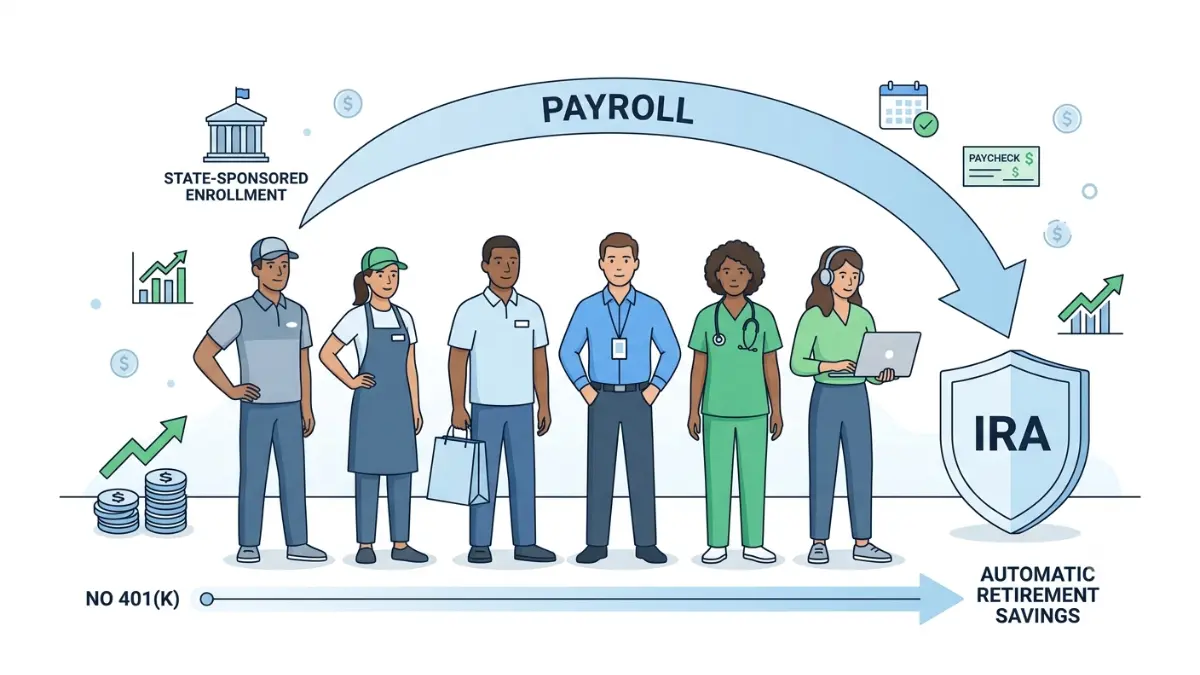
A state auto-IRA is a Roth IRA that your state automatically enrolls you in through payroll when your employer doesn’t offer a retirement plan. The account is yours, not the employer’s — you keep it if you change jobs or move.
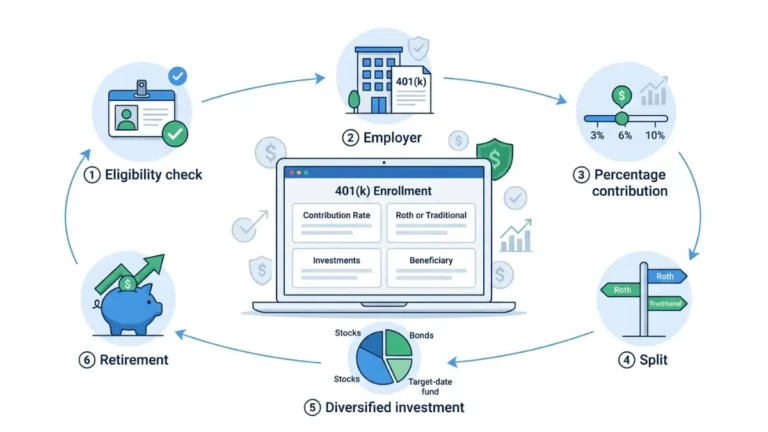
The setup is simple from your side. An employer with no plan registers with the state, and you get an enrollment notice. If you take no action, you’re enrolled after about 30 days, and a set percentage of each paycheck flows into an IRA in your name. You can change that rate or opt out whenever you want.
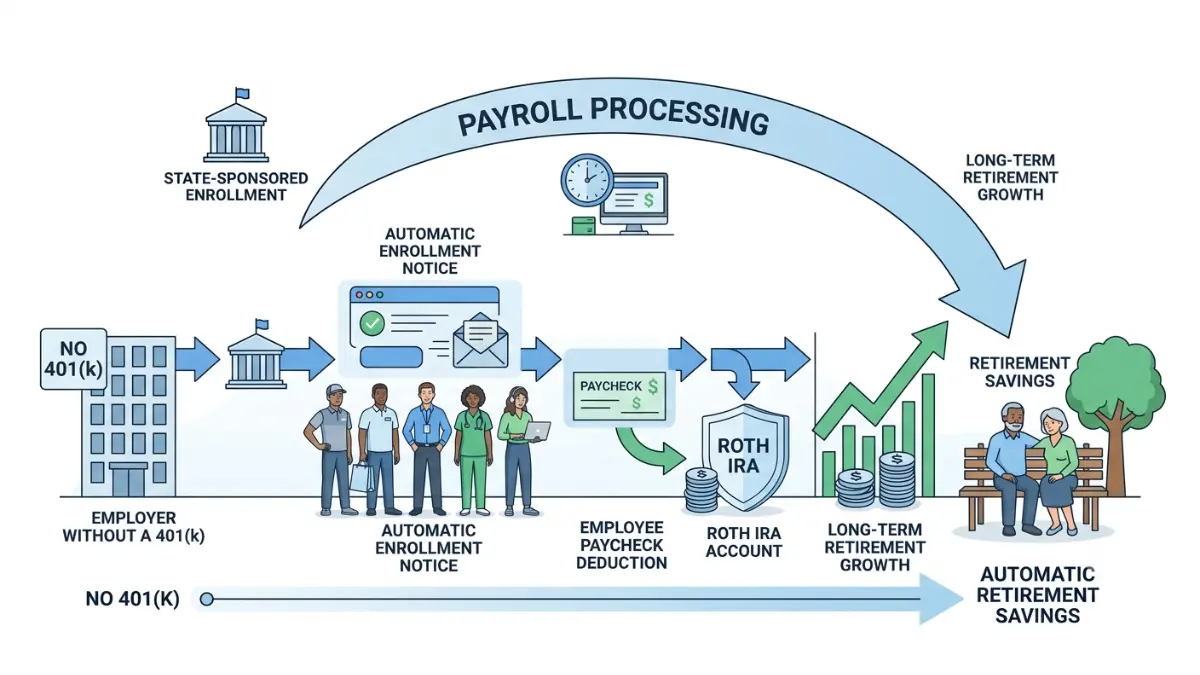
🔍 How It Works: A Roth IRA is funded with money you’ve already paid tax on. Nothing comes off your tax bill today, but once you’re 59½ and the account is at least five years old, qualified withdrawals — including everything your money earned — come out tax-free.
Most programs use Roth IRAs, though a few also offer a traditional option. These programs lean on automatic enrollment because it works: people save far more when saving is the default than when they have to sign up. If the account type is new to you, the SEC’s plain overview of how IRAs work is a good starting point.
Which states have auto-IRA programs — and are you covered?
As of 2026, 15 states run active auto-IRA programs: California, Colorado, Connecticut, Delaware, Illinois, Maine, Maryland, Minnesota, Nevada, New Jersey, New York, Oregon, Rhode Island, Vermont, and Virginia.
📊 Data Point: As of 2026, 15 states operate active auto-IRA programs, and more than 1.2 million workers have saved through state-run programs — Source: Georgetown University Center for Retirement Initiatives, 2026.
How to tell if you’re covered
In most states, employers above a size threshold — often five or more employees, though some states start at one — must either offer a plan or facilitate the state program. Employers that already offer a qualified plan, like a 401(k), are exempt. If your employer is covered and offers nothing else, you’ll receive an enrollment notice.
Self-employed? You may be able to self-enroll
Many programs let self-employed and gig workers sign up directly, even without a participating employer. This list also grows almost every year as more states roll out programs — so confirm your state’s status on its official program website. California’s program is CalSavers, Oregon’s is OregonSaves, and several others use a “Secure Choice” or “Saves” name.
How much you can contribute in 2026 — and what it costs your paycheck
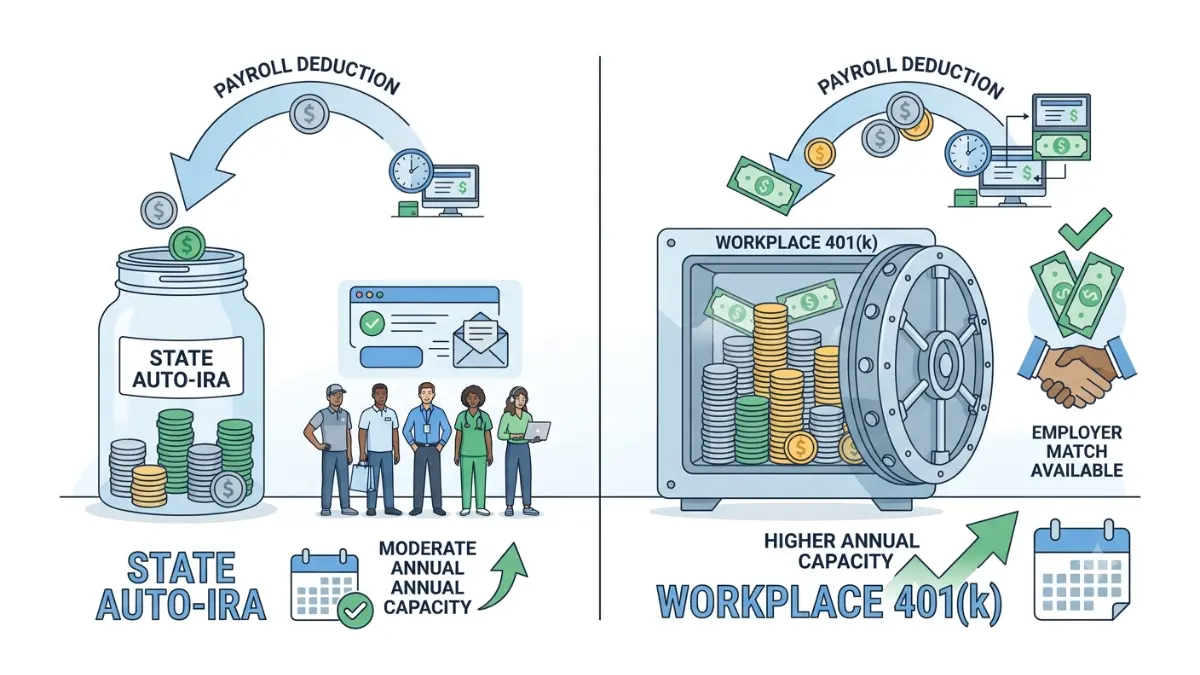
For 2026, you can contribute up to $7,500 to a state auto-IRA if you’re under 50, or $8,600 if you’re 50 or older. That cap comes from the IRS, because the state account is a Roth IRA — and the same limit applies across all the IRAs you own combined.
📊 Data Point: The 2026 IRA contribution limit is $7,500, rising to $8,600 at age 50 with the $1,100 catch-up — Source: IRS 2026 contribution limits, November 2025.
The default rate: 5%, rising 1% a year to 8%
When you’re enrolled, you start at a default rate set by the state, generally between 3% and 5% of pay. In California’s CalSavers, for example, the default is 5% of gross pay, and it rises 1% each year up to 8% unless you change it. You can set it as low as 1% or opt out entirely. Before you decide, it helps to see how a 5% payroll deduction affects your take-home pay and to estimate how a Roth IRA could grow at that rate.
🔍 How It Works: Auto-escalation nudges your savings rate up on its own — 5% becomes 6% next year, then 7%, capped at 8%. The increase only happens if you take no action; you can decline it or pick your own rate at any time.
How the state cap compares to a 401(k)
The state account is a floor, not a ceiling. A workplace plan lets you save far more, which is worth knowing if your situation changes.
| Account | 2026 Employee Limit (under 50) | Employer Match? | Best For |
|---|---|---|---|
| State auto-IRA (Roth) | $7,500 | No | Workers with no plan who want an automatic start |
| 401(k) | $24,500 | Often yes | Workers whose employer offers one — higher cap plus a match |
Source: IRS Notice 2025-67 (2026 limits). For the full picture on the workplace side, see our guide to the 2026 401(k) contribution limit of $24,500.
⚠️ Costly Mistake: The $7,500 cap is shared across every IRA you own. If you already contribute to a Roth or traditional IRA on your own, your state auto-IRA contributions count toward the same limit — not a separate one. Going over triggers a 6% IRS excise tax on the excess for each year it stays in the account.
Auto-IRA, your own IRA, or a self-employed plan — which fits you?
The state auto-IRA is a solid default, but it isn’t always your best option. Which account fits depends on your situation — what follows is general education, not a personal recommendation.
When the state auto-IRA is enough
If you’re a W-2 worker with no plan and you want automatic, low-effort saving, staying enrolled beats opting out. It’s a fine floor to build on, and you can raise your rate as your budget allows.
When to open your own IRA instead
Because the state account is a Roth, it comes with income limits. If you earn above them, you can’t contribute to a Roth directly and would need to opt out or recharacterize to a traditional IRA. If that’s a risk for you, it’s worth reading how to open your own Roth IRA and which account to fund first.
📊 Data Point: For 2026, Roth income limits phase out direct contributions between $153,000 and $168,000 of income for single filers, and between $242,000 and $252,000 for those married filing jointly — Source: IRS Notice 2025-67.
Self-employed? A SEP-IRA or Solo 401(k) may beat it
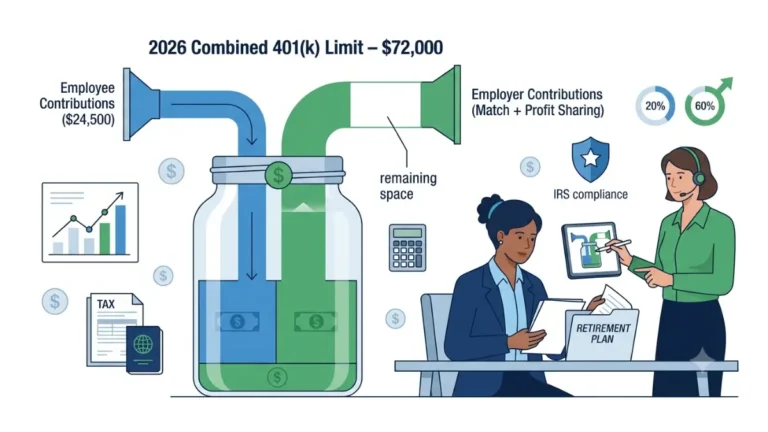
If you’re self-employed, you can shelter far more than the state Roth allows. A SEP-IRA or Solo 401(k) can accept up to $72,000 for 2026, versus $7,500 in the state account — a large gap if you have the income to save more. See our guide to a Solo 401(k) for the self-employed for how those work.
| Account | 2026 Contribution Limit | Tax Treatment | Best For |
|---|---|---|---|
| State auto-IRA | $7,500 (Roth) | After-tax; qualified withdrawals tax-free | No-plan workers wanting an automatic start |
| Your own IRA | $7,500 (Roth or traditional) | Roth after-tax, or traditional pre-tax | Anyone wanting to choose their provider and investments |
| SEP-IRA / Solo 401(k) | Up to $72,000 | Mostly pre-tax; Roth Solo options exist | Self-employed savers who can set aside more |
Source: IRS Notice 2025-67; IRS retirement-plan limits (2026).
✅ Action Step: Before you choose, ask a CPA or a fee-only fiduciary advisor one specific question: “Given my income and whether I’m self-employed, should I use the state auto-IRA, my own IRA, or a SEP or Solo 401(k) — and am I under the Roth income limit?”
The 2027 Saver’s Match — free money the Roth auto-IRA can accidentally block
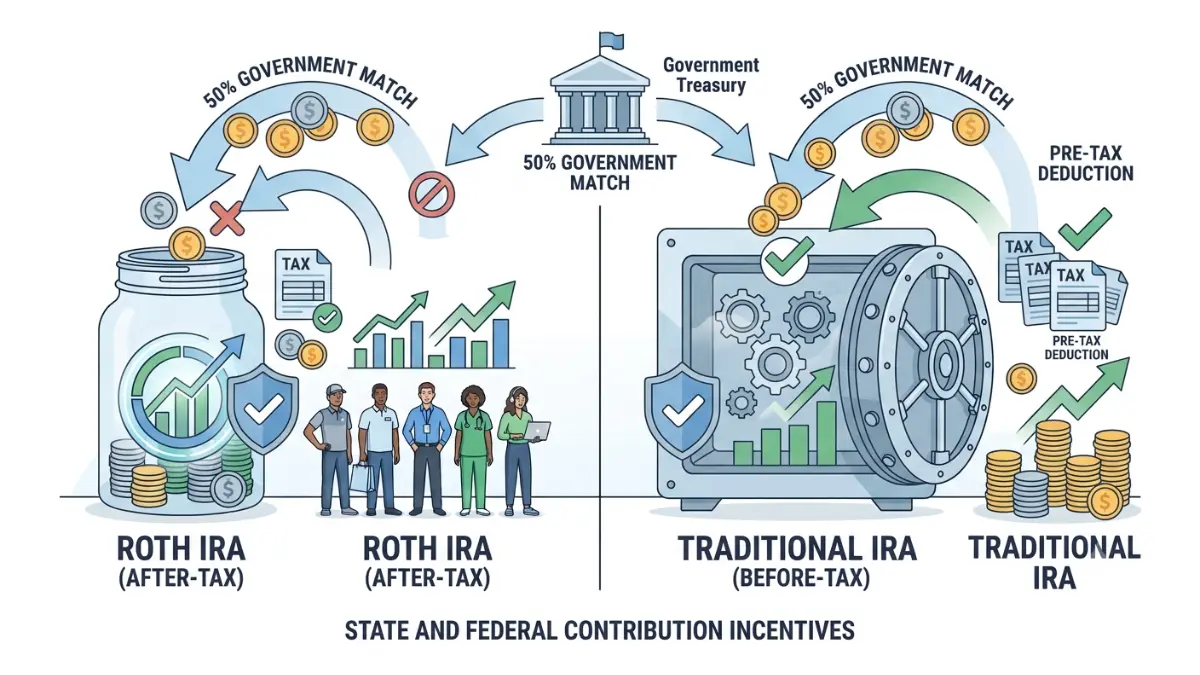
Starting in 2027, a federal program called the Saver’s Match will pay 50% of what lower- and moderate-income savers contribute — up to $1,000 a year, deposited straight into a retirement account. But there’s a catch that hits state auto-IRA savers specifically.
How the Saver’s Match works — and who qualifies
The match is 50% of up to $2,000 you contribute, so the most any one person can receive is $1,000 a year, or $2,000 for a couple. It’s refundable, meaning you get it even if you owe no federal income tax, and the Treasury deposits it after you claim it on your return — contributions made in 2027 arrive in early 2028. Eligibility runs to $35,500 for single filers, $53,250 for heads of household, and $71,000 for married couples filing jointly, with the full match below the bottom of each range. Our guide explains how the federal Saver’s Match works in more detail, and the current version — the IRS Saver’s Credit rules — becomes the Match in 2027.
📊 Data Point: The 2027 Saver’s Match pays 50% of up to $2,000 in contributions — a maximum of $1,000 per person — and is fully refundable — Source: SECURE 2.0 Act (Section 103); Congressional Research Service, 2026.
The Roth catch — and the fix
Here’s the trap: the match is structured as a pre-tax contribution, and it cannot be deposited into a Roth account. Because nearly every state auto-IRA is a Roth IRA, a saver whose only retirement account is that state Roth may have nowhere for the match to land. The fix, as general education, is to open a separate traditional IRA before 2027 so the match has a home — after confirming with a CPA that you qualify.
🔍 How It Works: The match counts as a pre-tax contribution, so it’s taxed as ordinary income when you eventually withdraw it — unlike your Roth contributions, which come out tax-free. That tax difference is why the government routes the match into a traditional account rather than a Roth.
⚠️ Costly Mistake: If your only retirement account is a Roth state auto-IRA and you qualify for the 2027 Saver’s Match, the match can’t be deposited there. Without a separate traditional IRA, an eligible saver could forfeit up to $1,000 a year in federal contributions.
What it looks like on $200 a month
Say you set aside $200 a month — $2,400 a year — in your state Roth auto-IRA, and you qualify for the full match. The federal government adds $1,000 into a traditional IRA on top of that. So $2,400 out of your pocket becomes $3,400 working for you in a single year, and both amounts keep compounding over time, though actual growth depends on your investments and is never guaranteed. You can see how those contributions compound and model your retirement savings with either scenario.
✅ Action Step: If your income is under roughly $35,500 (single) or $71,000 (married filing jointly), ask a CPA whether opening a traditional IRA before 2027 would let you capture the Saver’s Match your Roth auto-IRA can’t hold.
Five mistakes that quietly cost you
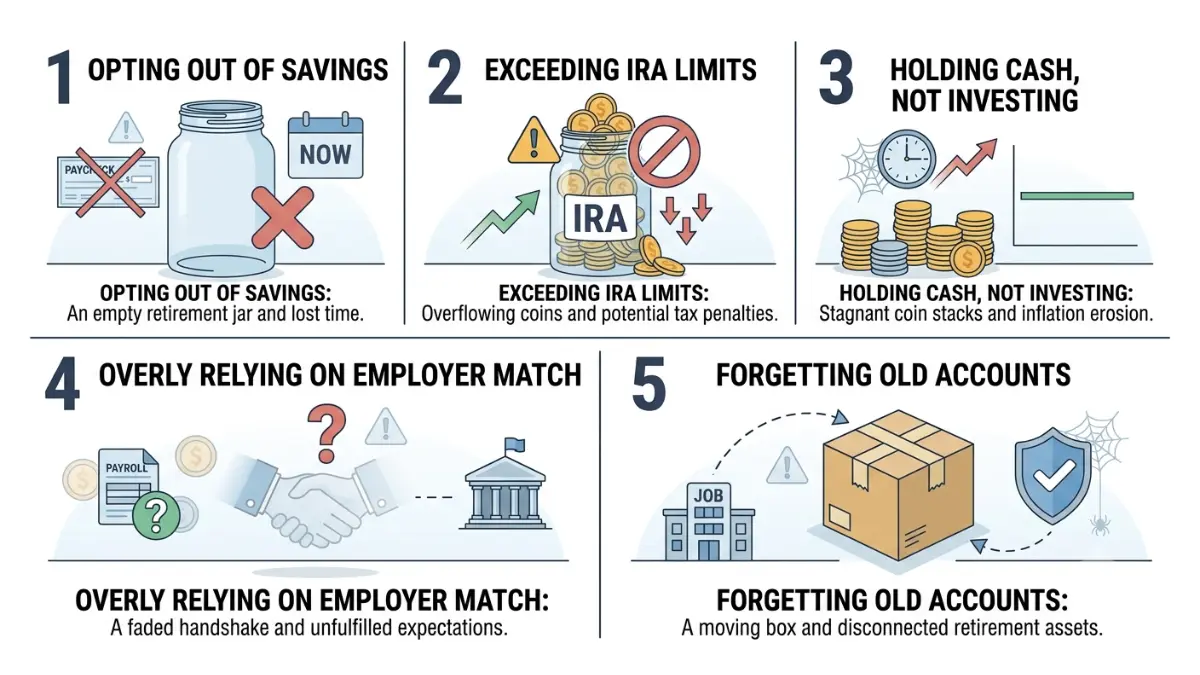
A few common missteps can drain most of the value out of a state auto-IRA. Here’s what to watch for.
- Opting out and saving nothing. You’re allowed to opt out, but that usually means saving $0 for retirement — the costliest outcome of all. Even 1% is better than nothing.
- Not realizing it’s a Roth. If your income climbs past the Roth limit, contributions can become excess and get taxed. If that’s you, opt out or recharacterize to a traditional IRA.
- Leaving your money in the default cash fund. Some programs park initial contributions in a money-market fund. That’s fine briefly, but it isn’t a long-term investment — check and set your investment choice.
- Assuming there’s an employer match. There isn’t one. No state auto-IRA includes employer contributions, so don’t plan around a match that won’t come.
- Forgetting the account when you switch jobs. The account is portable and stays yours — track it so it doesn’t get lost across job changes.
💡 Expert Note: Automatic enrollment works precisely because staying in is the easy default. Studies consistently find participation is far higher when workers must opt out rather than opt in — which is exactly why opting out quietly undoes the program’s biggest advantage.
No 401(k) at work: your questions answered
1. What is a state auto-IRA?
A state auto-IRA is a Roth IRA your state automatically enrolls you in through payroll when your employer offers no retirement plan. Fifteen states run one as of 2026. You’re enrolled at a default rate — often 5% — but you can change it or opt out at any time, and the account stays yours.
2. What happens if my job doesn’t offer a 401(k)?
If your job offers no 401(k), you can still save in an IRA on your own, and 15 states will automatically enroll you in a state auto-IRA through payroll. Self-employed workers can often sign up directly. The account is an individual retirement account that doesn’t need an employer to exist.
3. Which states have auto-IRA programs?
As of 2026, 15 states run active auto-IRA programs: California, Colorado, Connecticut, Delaware, Illinois, Maine, Maryland, Minnesota, Nevada, New Jersey, New York, Oregon, Rhode Island, Vermont, and Virginia. More states roll out programs each year, so confirm your state’s status on its official program website.
4. How much can I contribute to a state auto-IRA in 2026?
For 2026, you can contribute up to $7,500 to a state auto-IRA if you’re under 50, or $8,600 if you’re 50 or older. Because it’s a Roth IRA, that limit is shared across all your IRAs combined. Confirm your own limit with a tax professional, since Roth eligibility also depends on your income.
5. Is a state auto-IRA a Roth or a traditional IRA?
Most state auto-IRA programs use a Roth IRA, so contributions are made with after-tax dollars and qualified withdrawals in retirement are tax-free. Some states also offer a traditional option. Because it’s a Roth, high earners may exceed the income limit — a CPA can confirm whether you’re eligible.
6. Can I opt out of my state’s auto-IRA?
Yes. For employees, a state auto-IRA is voluntary — you can opt out at any time or lower your rate to as little as 1%. But opting out usually means saving nothing for retirement, which is the costliest choice of all. Even a small contribution keeps you moving forward.
7. Does my employer contribute to a state auto-IRA?
No. A state auto-IRA has no employer match — employers only facilitate the payroll deduction and cannot contribute to your account. If an employer match matters to you, a workplace 401(k) is the account that offers one. Don’t plan around matching contributions from a state program.
8. Can self-employed or gig workers use a state auto-IRA?
Often, yes. Many state auto-IRA programs let self-employed and gig workers self-enroll even without a participating employer. If you’re self-employed, a SEP-IRA or Solo 401(k) may let you save far more — up to $72,000 for 2026. A CPA can help you compare based on your income.
9. What happens to my auto-IRA if I change jobs or move states?
Your state auto-IRA is portable — the account belongs to you, not your employer, so you keep it if you change jobs or move to another state. You can leave the money invested, roll it into another IRA, or keep contributing on your own. Nothing is lost when you switch employers.
10. Can I have both a state auto-IRA and my own IRA?
Yes, but the $7,500 limit for 2026 is combined across all your IRAs. You can’t put $7,500 into a state auto-IRA and another $7,500 into a personal Roth — the total across every IRA you own can’t exceed the annual cap. Going over triggers a 6% IRS penalty until it’s corrected.
11. Will the 2027 Saver’s Match work with a Roth auto-IRA?
Partly. The 2027 Saver’s Match pays 50% of up to $2,000 in contributions, but it can’t be deposited into a Roth — and most state auto-IRAs are Roth. To capture up to $1,000 a year, an eligible saver may need a separate traditional IRA. Ask a CPA whether this applies to you.
Your next step, whatever your state does
You don’t need an employer’s plan to start building retirement savings — you need one small decision this week.
If you’re in one of the 15 auto-IRA states, check your enrollment notice and keep a contribution rate you can live with instead of opting out. If you’re self-employed or in a state without a program, open your own IRA — or a higher-limit account if you can save more. And if your income is modest, note the 2027 Saver’s Match and whether a traditional IRA would let you claim it.
Starting small beats not starting. To see where you stand, our guide to how your savings compare by age can help you set a target.

Informational disclaimer
The content on Finance Authority Hub is provided for general informational and educational purposes only and should not be considered personalized financial, investment, tax, legal, or professional advice. Financial decisions depend on your individual goals, income, risk tolerance, location, and regulatory situation. Before acting on any information, strategy, estimate, or calculator result, consult a qualified licensed professional who can evaluate your specific circumstances.