The parts of your Social Security statement worth checking
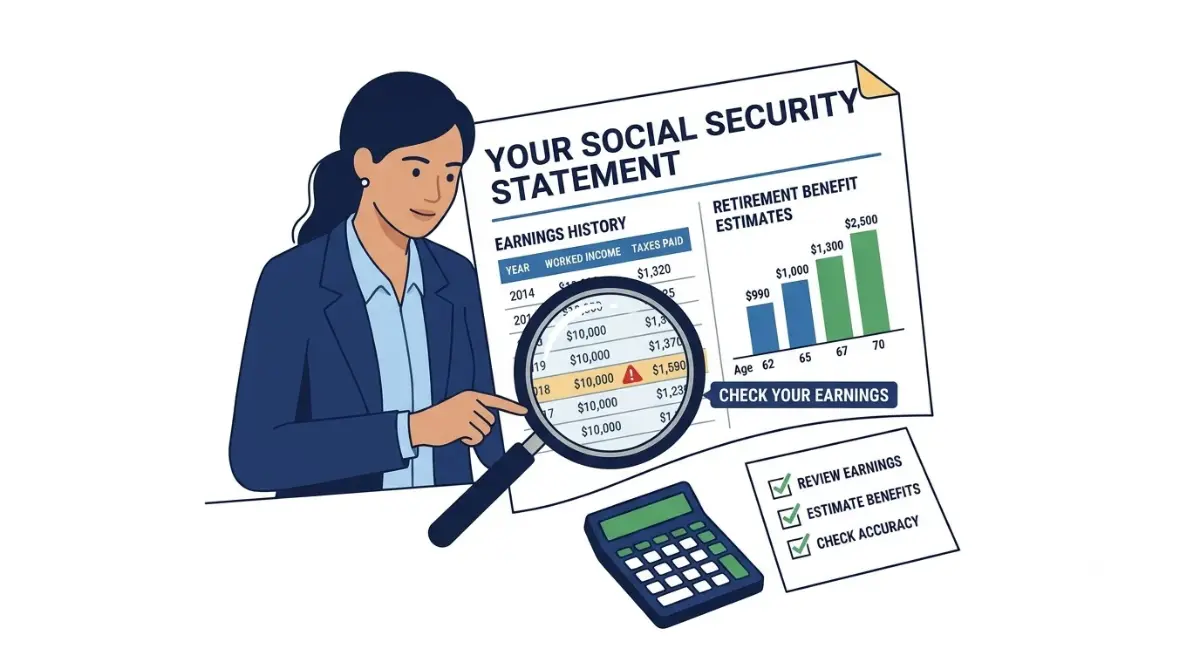
The estimate under your Social Security statement chart assumes your pay continues until you claim. SSA’s own sample assumes $54,489 a year.
In This Article
Rates and limits checked on October 23, 2026.
The benefit estimates on your Social Security statement assume you keep earning at your current pay until you claim, and the statement prints that assumed figure in one line under its chart. That line, the two earnings columns, and the date each year’s record becomes hard to change are the parts that decide whether the estimate rests on the right numbers.
Mailed at 60, online for everyone else
SSA mails a paper statement to workers age 60 and older who don’t have an online account, three months before their birthday. Everyone else reads it by signing in to a my Social Security account, which also shows your reported earnings and lets you estimate future benefits (SSA statement page).
The statement itself, mailed or downloaded, doesn’t list every year. SSA’s sample folds the early decades into three lines covering 1971 through 1980, 1981 through 1990 and 1991 through 2000, and directs you to the full earnings record online for the rest. A short or missing year inside one of those totals can’t be seen on the statement.
Readers who’d rather have it in Spanish can call 1-800-772-1213 and ask for the Spanish version.
The line printed under the estimate chart
$54,489 a year. That’s what SSA’s sample worker is assumed to keep earning until her benefits start, stated in a single sentence beneath the chart of estimates at ages 62 through 70 (SSA sample statement). It matches her last posted year, 2020, to the dollar.
Your statement prints your own figure in the same spot. Every bar on the chart counts the years between now and that claiming age at that pay. If you’ve stopped working or cut back, the bars at 67 and 70 include earnings that won’t arrive, and the later the age, the more of those years each bar carries.
Those estimates also rest on current law, which Congress has revised before.
To see how a different earnings path changes the picture, rerun the estimate with the future earnings you actually expect rather than the statement’s assumption.
Do your two earnings columns match?
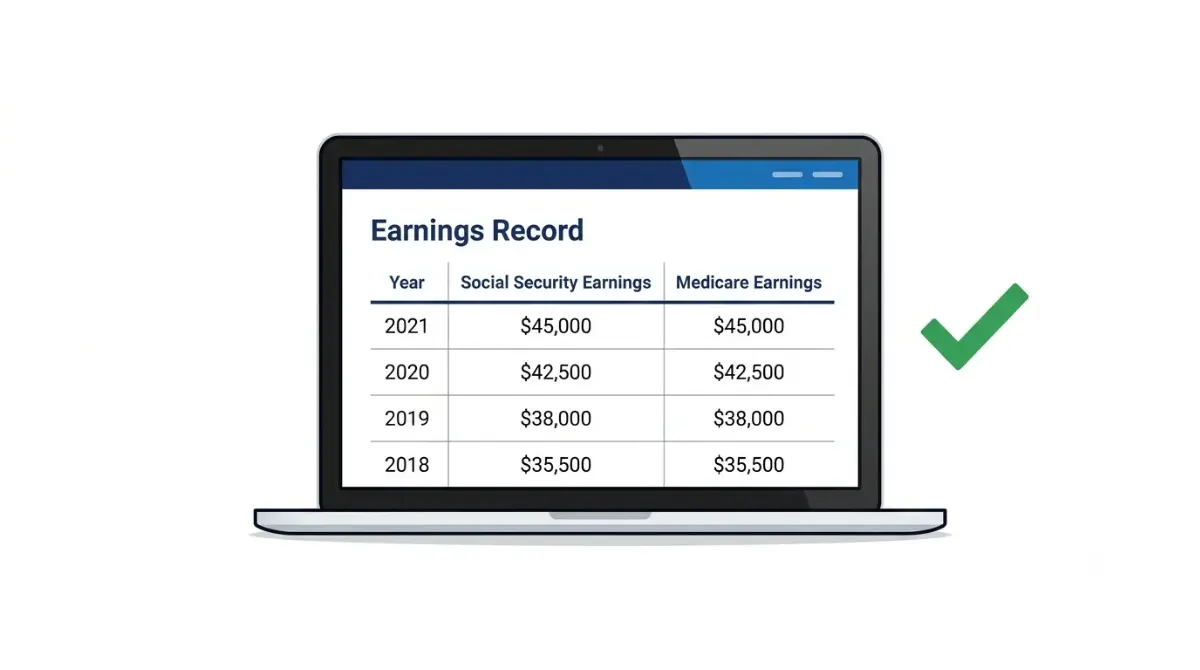
In SSA’s sample, the column of earnings taxed for Social Security and the column taxed for Medicare agree in every listed year except one. A gap between them has a short list of known causes, and a row that fits none of them is the one to raise with SSA.
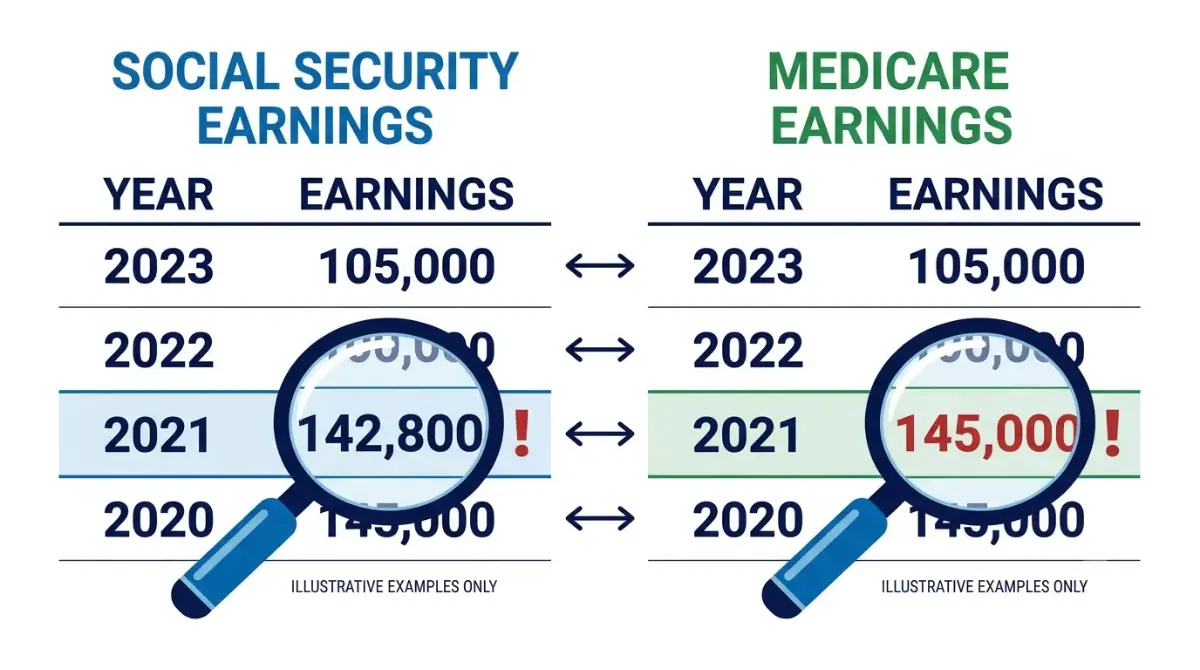
When a gap between the columns is expected
- Your pay went over the taxable maximum. Earnings above it don’t appear on your record, so the Social Security column stops at the cap while the Medicare column keeps going. The cap is $184,500 for 2026 and rises to $192,300 for 2027 (SSA contribution and benefit base).
- The year is 1991, 1992 or 1993. Medicare had its own higher caps of $125,000, $130,200 and $135,000 in those years, and it has had no cap at all since 1993.
- The year is before 1966. The Medicare column on the statement is headed “began 1966,” so earlier years have nothing in it.
A blank at the bottom of the table is expected too. The sample’s most recent year reads “Not yet recorded.”
The 2010 row in SSA’s sample
Example: the sample shows $45,666 taxed for Social Security and $45,847 taxed for Medicare in 2010, a gap of $181. The cap that year was $106,800, so those earnings sat at about 42.9% of it, nowhere near the limit. None of the causes above fits, and the sample gives no explanation for the gap.
| Year | Social Security earnings | Medicare earnings | Difference | Cap that year |
|---|---|---|---|---|
| 2009 | $44,603 | $44,603 | $0 | $106,800 |
| 2010 | $45,666 | $45,847 | $181 | $106,800 |
Source: SSA sample statement (form dated April 2025); caps from SSA’s taxable maximum table.
On your own statement, a row that behaves like 2010 is the row to ask about. A short year matters because SSA bases your benefit on your highest 35 years of earnings, and how your highest 35 years become a monthly benefit walks through the formula. For a year that shows nothing at all, what a zero year costs your benefit puts a figure on the gap.
Three more lines on page one
Three blocks sit beside the retirement chart: disability, survivors, and a note on pensions from work outside Social Security.
The disability estimate is what you’d get if you became disabled now and had enough recent work. In the sample it’s about $2,083 a month. The credits line above it confirms whether you qualify at all, and how work credits add up covers the count behind it.
Survivors figures show what each family member could receive if you died this year. The sample lists $1,562 for a minor child, $1,562 for a spouse caring for a child under 16 or a disabled child, and $2,083 for a spouse whose benefits start at full retirement age. It also caps total family benefits at $3,802 and notes a one-time death benefit of $255.
If you worked in a job outside Social Security, the pension note applies to you. It covers benefits that may have been reduced before January 2024 for people with a pension from uncovered work, and the Social Security Fairness Act, which ended the Windfall Elimination Provision and Government Pension Offset.
Wage years still inside the correction window
The oldest year you can still have corrected in the ordinary way is the place to begin. SSA’s rule is that, ordinarily, earnings can’t be corrected after 3 years, 3 months and 15 days from the end of the year the wages were paid (SSA, correcting your earnings record). When the last day lands on a weekend or federal holiday, the period runs to the end of the next workday (SSA Handbook §1423).
| Wage year | Social Security cap | Ordinary limit ends |
|---|---|---|
| 2022 | $147,000 | April 15, 2026 (passed) |
| 2023 | $160,200 | April 15, 2027 |
| 2024 | $168,600 | April 15, 2028 is a Saturday, so it rolls forward |
| 2025 | $176,100 | April 15, 2029 is a Sunday, so it rolls forward |
| 2026 | $184,500 | April 15, 2030 |
Sources: SSA taxable maximum table; SSA Handbook §1423 for the time limit and the weekend rule.
A year past its date isn’t automatically closed. SSA lists four exceptions, including matching the record to tax returns filed with the IRS and adding wages an employer reported that never reached your record. The rules that let an older year be reopened covers each exception and the proof SSA asks for.
With an account, you may be able to request a correction online. You can also call 1-800-772-1213 (TTY 1-800-325-0778), with your W-2s or pay stubs for that year in hand.
Deadline: wages paid in 2023 leave the ordinary correction period on April 15, 2027.
Open the full earnings record before you claim
Sign in and open the year-by-year earnings page instead of the statement PDF, since the PDF folds your earliest decades together. Go down both columns row by row and mark any year where they differ for none of the reasons above. Pull the W-2 or tax return for the oldest marked year before you contact SSA.
Statement updates and access from abroad
How often is the statement updated?
Once a year. The sample notes that the statement is updated annually and is available online, or by mail on request.
Can I see my statement if I live outside the US?
Yes, with an ID.me account. Online statements for people living overseas show domestic earnings only.
Informational disclaimer
The content on Finance Authority Hub is provided for general informational and educational purposes only and should not be considered personalized financial, investment, tax, legal, or professional advice. Financial decisions depend on your individual goals, income, risk tolerance, location, and regulatory situation. Before acting on any information, strategy, estimate, or calculator result, consult a qualified licensed professional who can evaluate your specific circumstances.