The hidden gold IRA cost that no fee schedule lists
Gold IRA fees look small until you price the dealer’s spread: FINRA reports some dealers charge under 20%, some frauds over 300%. Here is the math.
In This Article
A gold IRA salesperson will tell you what the account costs. This page covers the part that tends to come up last, if at all: the dealer’s markup, which is almost always the largest single cheque you write.
Where you are right now decides what you need:
- Being pitched, or about to call a dealer. Start with the five cost lines below, then the red flags near the end.
- You already opened one and want to know how you did. The day-one gap table shows you how to read your own custodian statement.
- You mainly want to know where gold goes next. That is a different question, and it belongs to our piece on where analysts think the price is going.
- You are still choosing an account type. Begin with which IRA type you’re actually holding.
We are not a metals dealer. We earn no commission on gold, carry no dealer advertising on this page, and name no company as a recommendation.
What follows is the full cost stack, the IRS rules that decide whether the account keeps its tax treatment, and the specific sales behaviour that federal regulators have documented in enforcement actions.
ℹ️ Financial Disclaimer: This article is general education, not personalized advice. It covers activity regulated across several areas — investing and securities, federal tax treatment of retirement accounts, and the sale of physical commodities — and nothing here accounts for your income, tax bracket, age, or the rest of your portfolio. Before moving retirement money into physical metals, consult a fee-only fiduciary financial advisor about suitability and a CPA or tax attorney about the tax consequences.
Who is actually on the other end of a gold IRA call
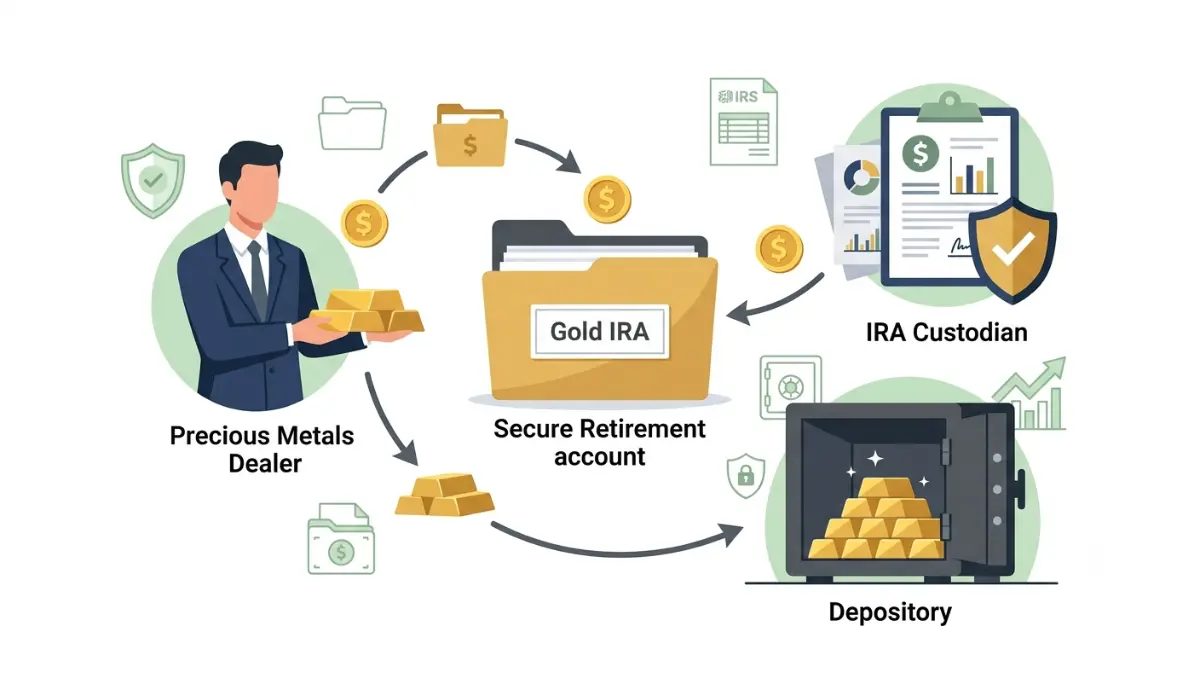
Three separate companies stand between you and a bar of gold, and each one charges you.
The three parties: dealer, custodian, depository
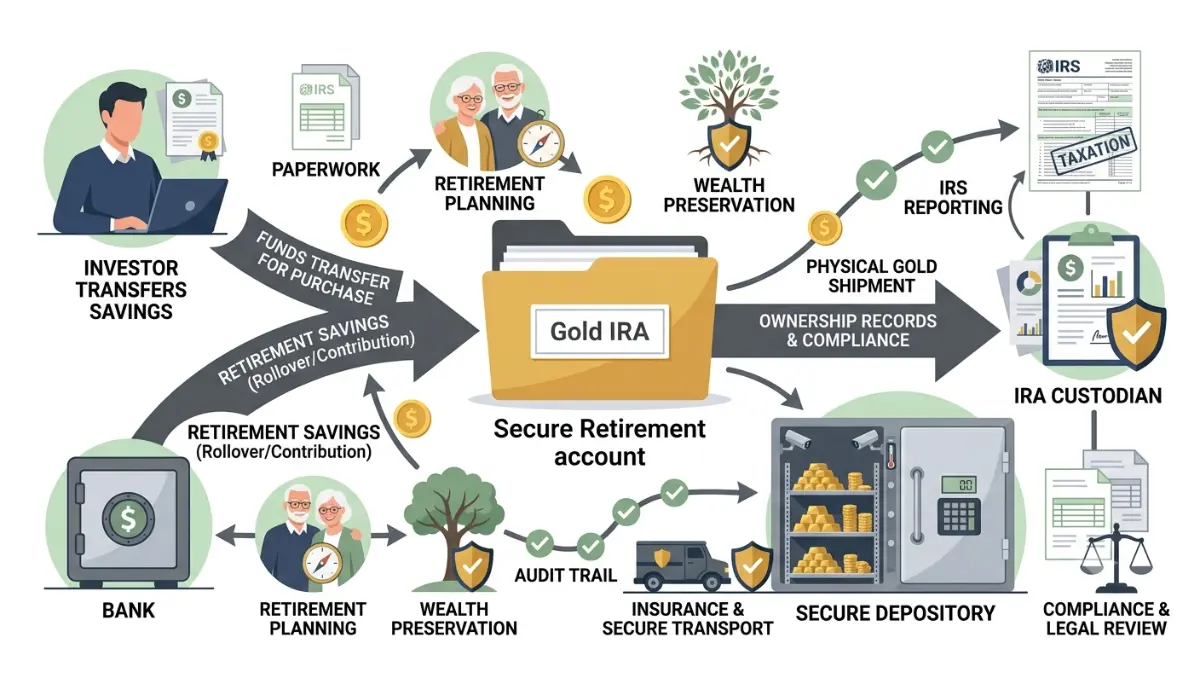
The precious metals dealer sells you the coins or bars and sets the price. The IRA custodian holds the account, files the paperwork with the IRS, and reports the account’s value. The depository physically stores the metal and insures it.
Only the custodian is a regulated financial institution in the way most savers assume. The other two are not.
What your custodian does not do
FINRA and the CFTC state plainly that retail metals dealers are not regulated at the federal level, and that in most cases the salesperson pitching a rollover holds no professional registration and is not qualified to give investment or tax advice.
The custodian will not fill that gap. The SEC, NASAA and FINRA warn jointly that self-directed IRA custodians generally do not evaluate the quality or legitimacy of an investment or the background of the person promoting it — see their guidance on what a self-directed IRA custodian does not do for you. The custodians say the same thing about themselves: STRATA Trust Company’s own disclosure describes it as a directed, passive custodian that performs no due diligence on investments, sponsors, dealers or service providers.
💡 Expert Note: A broker recommending a mutual fund for your IRA owes you a best-interest standard. A metals dealer recommending the same dollar amount of coins owes you nothing comparable, because physical metal is a commodity rather than a security. Same money, same account, different rulebook — and this is the single fact that reframes every number below.
Rolling a 401(k) or TSP in
Most gold IRAs are funded by a rollover, not a fresh contribution. A direct trustee-to-trustee transfer avoids the 60-day trap that turns a delayed rollover into a taxable distribution; the IRS rollover rules set out the difference, and how the rollover itself works covers the mechanics. The problems that come with self-direction generally, rather than with metals specifically, are covered in our piece on the risks that apply to every self-directed IRA.
What a gold IRA costs: the five lines on the bill
A gold IRA has five cost lines, and the largest one is not a fee.
The four fees you will see on a schedule
Four of the five appear on a published fee schedule you can read before you sign anything. They are small, disclosed, and roughly comparable between custodians.
| Cost line | What it pays for | Published fee | Key detail |
|---|---|---|---|
| Account setup | Opening the self-directed account | $50, waived for electronic applications | One-time; some dealers cover it as a promotion |
| Annual account fee | Custodial administration and IRS reporting | $125 per year | Flat here; some custodians tier it by balance instead |
| Storage and insurance | Depository vaulting | $100 commingled / $175 segregated per year | Segregated costs more and is not a security upgrade |
| Transaction and handling | Each metals purchase or sale | $40 per transaction, plus $35 depository handling | Charged again every time you trade |
Source: STRATA Trust Company’s published Precious Metals fee schedule, reviewed July 2026. One named flat-fee custodian, shown as a documented reference point — not an industry average, and not a recommendation. Percentage-of-value pricing exists elsewhere and scales badly on a large balance.
That is roughly $300 in year one and $225 a year after, on any account size. For comparison, what a mainstream IRA costs to hold and to leave is usually a fraction of that.
The fifth cost: the dealer’s spread
The fifth line appears on no custodian schedule, because the custodian does not charge it. The dealer does.
🔍 How It Works: The spot price is the wholesale price of metal, quoted per troy ounce. A dealer sells above spot and buys back below it, and the gap between those two prices is the spread. FINRA and the CFTC report that some dealers charge less than 20%, while some fraudulent dealers have charged spreads of more than 300% — which means the spread, not the annual fee, decides whether the account can ever make money.
Segregated versus commingled storage
Commingled means your metal sits with identical metal belonging to other accounts, and you own a specified weight rather than specific bars. Segregated means your exact coins are stored apart and labelled. The second costs more and changes nothing about your legal ownership.
✅ Action Step: Before you send any money, ask the dealer for the complete fee schedule and the current buy-back price in writing, in the same document. FINRA treats the absence of written fees before purchase as a warning sign in its own right.
What $50,000 looks like on your first statement
Your custodian will not value your metal at what you paid for it.

The day-one gap at four premium levels
FINRA and the CFTC explain that a custodian’s statement shows the melt value of the holding — total bullion weight multiplied by the spot price. The premium you paid the dealer is not part of that number. It is gone the moment the trade settles.
🔍 How It Works: If a dealer charges 20% over spot, then $50,000 buys $50,000 ÷ 1.20 of metal, or $41,667 at melt. The difference is not a fee anyone lists; it is the dealer’s margin, and it shows up as a gap between what you sent and what your first statement says you own.
| Premium over spot | Metal bought, at melt | Day-one gap | Key detail |
|---|---|---|---|
| 4% | $48,077 | $1,923 | Normal cost of buying physical bullion |
| 20% | $41,667 | $8,333 | The upper edge of what FINRA describes as ordinary dealer pricing |
| 33% | $37,594 | $12,406 | Typical of a “premium” or graded-coin upsell |
| 130% | $21,739 | $28,261 | The markup level the SEC alleged in one 2023 enforcement action |
Our own arithmetic on a $50,000 rollover, using the spread and melt-value definitions published by FINRA and the CFTC. Run it with your own number.
📊 Data Point: In one case cited by regulators, a customer rolled over a $300,000 IRA and the dealer allegedly took $150,000 in fees and commissions — Source: FINRA and CFTC Investor Bulletin, March 2024.
How far gold has to rise before you break even
Add the fees. At a 20% premium, with the published schedule above, five years of custodial and storage costs come to about $1,200. Gold’s spot price then has to rise roughly 23% before the account is back to the $50,000 you started with — before the dealer’s below-spot buy-back, and before the exit charges in the next section.
Run your own statement through it
You can work out your own break-even point with your actual purchase price and melt value, and model the drag over ten years if you plan to hold longer.
The IRS rules that decide whether it counts as an IRA
Two rules govern what your account may hold, and breaking either one ends the tax treatment.
Which metals qualify
Section 408(m) of the tax code bars IRAs from holding collectibles, then carves out two doors for metal. The first names specific U.S. Mint coins by statute, which is why the American Gold Eagle qualifies despite being struck as a 22-karat alloy rather than at investment-grade purity.
The second door is a fineness test, and the code does not set the number itself — it defers to whatever a commodity exchange requires for delivery against a futures contract. CME Group’s published delivery specification puts those minimums at 995 for gold, 999 for silver and 9995 for platinum and palladium. The IRS rule on collectibles in retirement accounts sets out both doors, plus the condition that matters more than either.
Why you cannot keep it at home
No. Eligible bullion must stay in the physical possession of a bank or an IRS-approved non-bank trustee, and taking personal custody is a distribution.
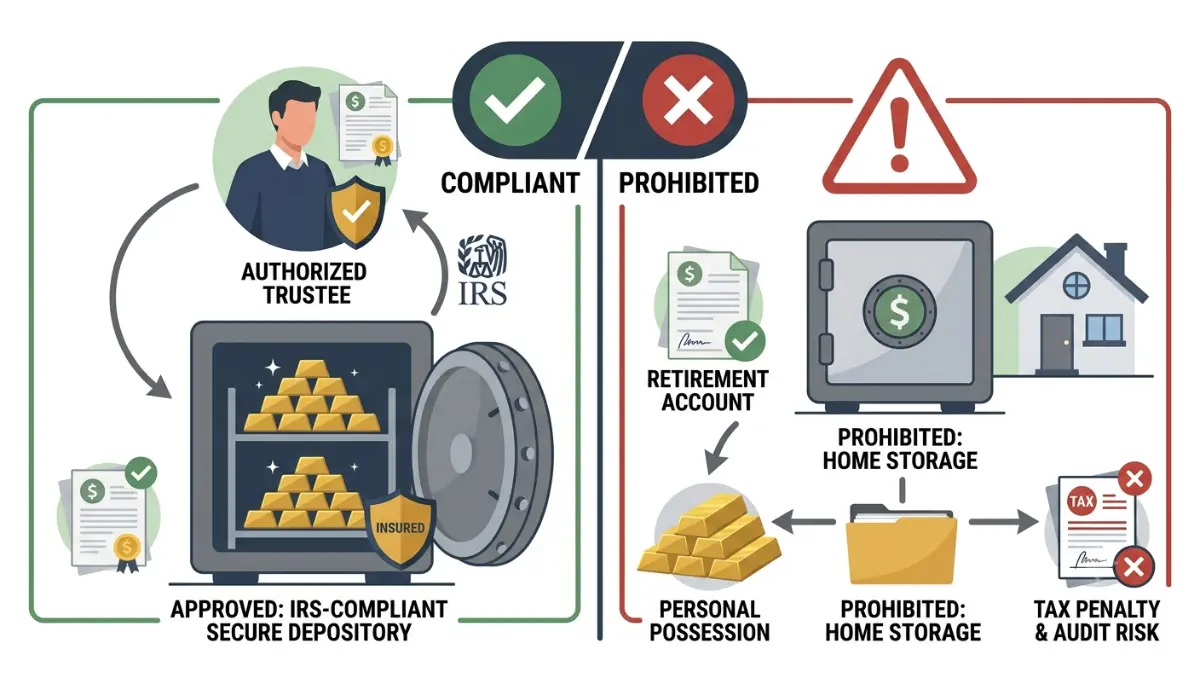
⚠️ Costly Mistake: In McNulty v. Commissioner (157 T.C. No. 10, November 2021), a couple bought American Eagle coins through an LLC owned by their self-directed IRAs and stored roughly $411,000 of them in a home safe. The Tax Court held the coins were taxable distributions equal to their cost. The coins themselves were eligible — the storage arrangement is what cost them the account, and under 59½ that is also treated as a distribution subject to the 10% additional tax.
What you can put in during 2026
A gold IRA does not come with its own contribution room. For 2026 the IRS limit is $7,500 across all your IRAs combined, or $8,600 from age 50, as set out in the 2026 contribution limits. Rollovers from a 401(k) or TSP sit outside that cap, which is why dealers pitch rollovers rather than contributions.
✅ Action Step: If metal bought with IRA money is already sitting in your house or a personal safe deposit box, ask a CPA or tax attorney this specific question: in which tax year did the distribution occur, and what is my exposure for that year and every year since?
Getting money back out, and the cheaper way to own gold
Selling is where savers discover the second half of the cost.
Selling: the spread works in reverse
The dealer who sold above spot buys back below it. On top of that sits the exit paperwork: on the published schedule above, a metals sale runs $40, a partial transfer out $100, an in-kind distribution $75 per asset, and closing the account $250. A round trip therefore needs a larger move in gold than most savers picture — and what has historically pushed gold down is worth reading before assuming the move goes one way.
RMDs when your account holds metal, not cash
Traditional IRAs require withdrawals from age 73. An account holding only bullion has no cash to pay one, so the custodian must either sell metal at the dealer’s buy-back price or ship you coins, which count as a distribution at their value on the date they leave the account.
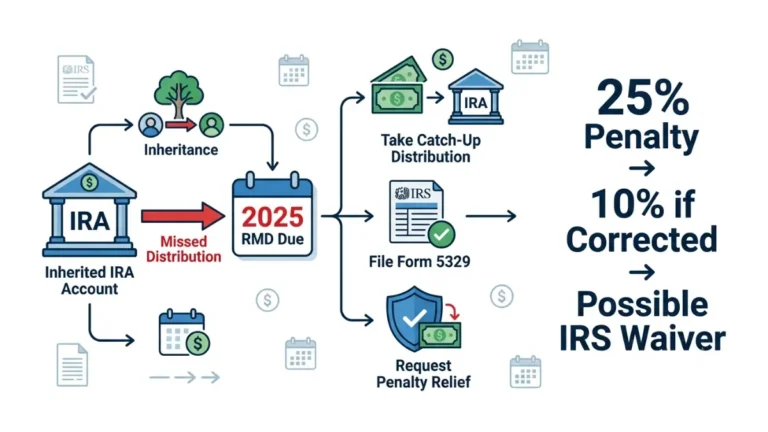
Missing the deadline carries a 25% excise tax on the shortfall, reduced to 10% if corrected within two years — the mechanics are in our guide to required minimum distributions.
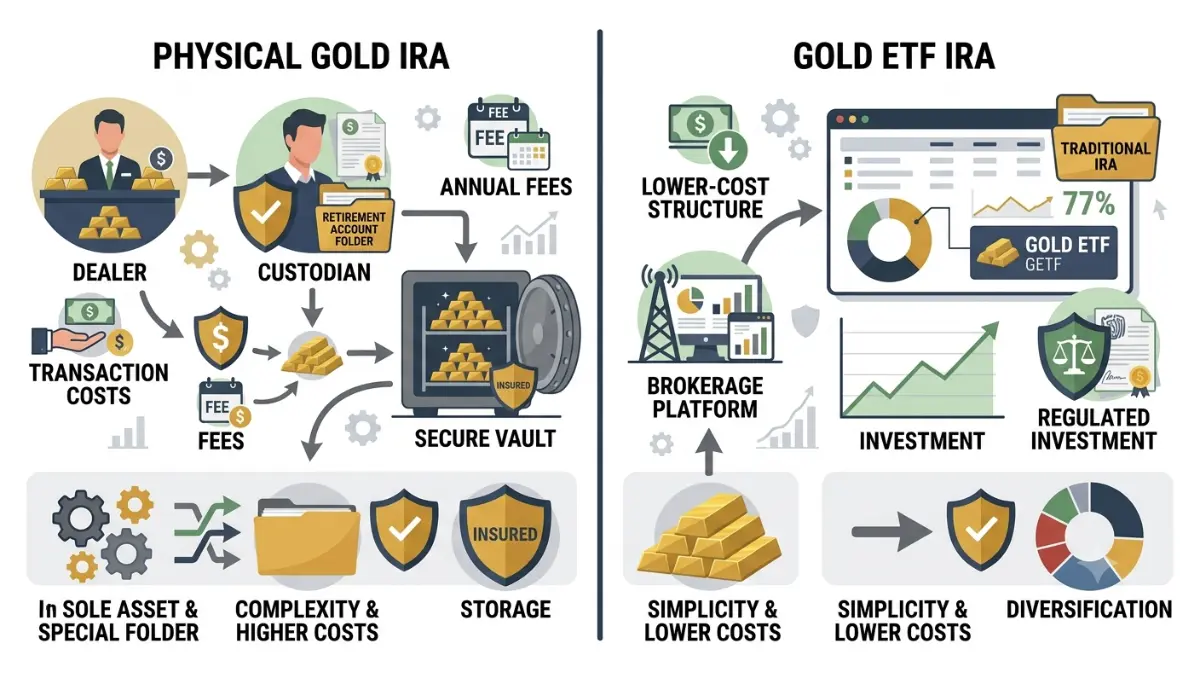
The alternative most people are not shown
FINRA and the CFTC point out that exchange-traded products and commodity pools offer exposure to metals prices, carry their own costs, are fully regulated, and can often be held inside the IRA you already have. That route involves no dealer spread, no depository and no separate custodian. Whether it suits you is a different question from whether it is cheaper.
✅ Action Step: Ask a fee-only fiduciary advisor one specific question: given my age, my required distributions and the rest of my portfolio, what does holding physical metal cost me in fees and liquidity compared with holding a regulated metals fund in my existing IRA?
Red flags that should end the call
Every warning sign below appears in a federal enforcement action or a regulator’s published guidance, not in our opinion.
Pressure, urgency and the free-silver offer
FINRA advises never responding to cold calls, unsolicited emails, late-night commercials or pop-up dealers at public events. Free metal, waived first-year fees and a closing deadline are sales costs, and they are recovered somewhere — usually in the spread.
📊 Data Point: The SEC charged a firm with selling coins at markups far above what it promised — Red Rock Secured told investors it charged 1% to 5%, and according to the complaint charged as much as 130%, in a scheme involving at least 700 investors — Source: SEC press release 2023-93, May 2023. In a separate matter, a federal court entered final judgment against Safeguard Metals in October 2025 ordering roughly $25.6 million in disgorgement and an equal civil penalty.
“Semi-numismatic” and other made-up words
FINRA is blunt about this one: “semi-numismatic” is an invented industry term with no special meaning, and such coins are typically neither rare nor more liquid than plain bullion. It exists to justify a wider spread.
No written fee schedule, no buy-back price
If either is unavailable in writing before you pay, stop. The regulators’ own list — the questions regulators tell you to ask a metals dealer — is worth reading in full before any call.
✅ Action Step: Ask your state securities regulator or state attorney general whether this dealer or salesperson has a complaint history. Savers can also call the FINRA Securities Helpline for Seniors on 844-574-3577.
Gold IRA questions people ask before they buy
1. How much does a gold IRA cost per year?
On one named custodian’s published schedule, a gold IRA costs about $225 a year — a $125 account fee plus $100 commingled storage — with $50 setup and $40 per metals transaction. Those are the disclosed costs. The dealer’s markup on your purchase is separate, larger, and appears on no schedule. Ask for both figures in writing before you fund the account.
2. What is the average markup on a gold IRA?
There is no reliable average, and any page quoting one is guessing. FINRA reports that some dealers charge spreads under 20% while some fraudulent dealers have charged over 300%. Price the metal yourself: weight multiplied by spot price, compared against the quote you were given. The gap between those two numbers is your real gold IRA markup.
3. Can I store gold IRA metals at home?
No. Gold IRA metal must stay in the physical possession of a bank or an IRS-approved non-bank trustee. In McNulty v. Commissioner, coins held in a home safe through an IRA-owned LLC were treated as taxable distributions equal to their cost. If metal is already at home, speak to a CPA about which tax year is affected.
4. Is a gold IRA a good idea?
That turns on two thresholds. If you can get a written premium near the low single digits over spot and you will not need the account liquid before 73, the cost case for a gold IRA is defensible. Above roughly 20%, the arithmetic works against you for years. A fee-only fiduciary advisor can price it against your own portfolio.
5. How much can I put in a gold IRA in 2026?
The 2026 limit is $7,500 across all your IRAs combined, or $8,600 if you are 50 or older. A gold IRA adds no extra room. Rollovers from a 401(k) or TSP are not capped by that limit, which is why sales pitches almost always target rollover money rather than annual contributions.
6. How do I get money out of a gold IRA?
Two routes: the custodian sells metal at the dealer’s buy-back price and distributes cash, or ships you the coins as an in-kind distribution taxed at their value on the distribution date. Both carry charges — $40 per sale, $75 per asset in kind, $250 to close the account on the schedule reviewed here.
7. Are gold IRA companies regulated?
Not in the way most savers assume. FINRA and the CFTC state that the retail metals dealers behind most gold IRA pitches are not regulated at the federal level, and that most salespeople hold no registration. Your custodian does not close that gap either, because it performs no due diligence on the dealer or the investment.
8. What are semi-numismatic coins?
FINRA describes “semi-numismatic” as a made-up industry term with no special meaning. The coins are sold as collectible but are usually neither rare nor valuable beyond their metal content, and they are often harder to sell than plain bullion. The label exists to justify a higher markup, so treat it as a warning.
9. What happens to my gold IRA at RMD age?
Withdrawals become mandatory at 73 for a traditional gold IRA. Because bullion is not cash, the custodian must sell metal or distribute coins in kind to satisfy the amount. Missing it triggers a 25% excise tax on the shortfall, cut to 10% if corrected within two years. Plan the liquidity with a CPA before you turn 73.
10. Can I roll my 401(k) into a gold IRA?
Yes, and rollovers are not limited by the annual contribution cap. Use a direct trustee-to-trustee transfer rather than taking receipt of the funds, because a missed 60-day deadline turns the rollover into a taxable distribution. Do not let a dealer coordinate the transfer without a CPA reviewing the paperwork first.
11. What is the cheapest way to own gold in an IRA?
FINRA notes that regulated exchange-traded products and commodity pools give exposure to metals prices and can often be held in an IRA you already own. That avoids the dealer spread, the depository fee and the second custodian entirely. Whether it suits your goals is a question for a fiduciary advisor, not a dealer.
Before you pick up the phone
Three things, and none of them take more than ten minutes.
Get the full fee schedule and the current buy-back price in writing, in one document, before any money moves. Multiply the weight of the metal you are being offered by today’s spot price and compare that figure to the quote — the difference is the spread, and it is the number that decides everything else.
Then ask what the same money would cost inside the IRA you already hold.
No honest dealer will object to you taking a week over any of that. We take no commission on this decision either way; this page was last reviewed in July 2026 and is updated when the underlying IRS figures change.

Informational disclaimer
The content on Finance Authority Hub is provided for general informational and educational purposes only and should not be considered personalized financial, investment, tax, legal, or professional advice. Financial decisions depend on your individual goals, income, risk tolerance, location, and regulatory situation. Before acting on any information, strategy, estimate, or calculator result, consult a qualified licensed professional who can evaluate your specific circumstances.