The key custodial Roth IRA rule is what your child earns
Custodial Roth IRA contributions stop at whatever your child earned — and the way they earned it decides what that money costs in tax.

In This Article
Your child got paid, and you would rather that money work for fifty years than fifty days. A custodial Roth IRA makes that possible, and a working minor can own one at any age. One rule governs the rest: the child must have earned income, and the contribution can never exceed it.
Where you start depends on your situation. If your child works for an outside employer, the earnings are already documented and the next section gives you the ceiling. If you own a business and are weighing whether to put your child on the payroll, sections three and four are yours.
If the money comes from babysitting or lawn care, section five covers a filing rule that catches most families out. If you are still choosing between accounts, the pillar guide to which IRA your income actually allows sets out the wider picture.
ℹ️ Financial Disclaimer: This article is educational, not personalized advice. It touches investment accounts, federal tax rules, payroll obligations and federal student aid — each regulated, each turning on your own facts. Take tax and payroll questions to a CPA or enrolled agent, investment questions to a fiduciary financial advisor, and any state employment or custodial question to a qualified attorney.
How much a child can put in a Roth IRA
For 2026, a child can contribute the lesser of $7,500 or their total earned income for the year. A teenager who earned $2,400 contributes $2,400, not $7,500.
The lesser of $7,500 or what they earned
The annual contribution limit rose to $7,500 for 2026, up from $7,000 (IRS, Notice 2025-67). For almost every minor the second half of the test binds, because the IRS caps the year’s contribution at the lesser of the annual limit or taxable compensation. The tax code sets no minimum age, and the Roth phase-out that limits high earners is not a threshold a child will meet. See the 2026 IRA contribution limits in full for the adult picture.
The money does not have to come from their paycheck
Nothing requires the child’s own wages to be the dollars that land in the account. A parent or grandparent can fund it while the child keeps their pay, because the cap is set by what the child earned, not by whose money it is. A child with no earnings at all is a different question, answered by the one account for a child with no earned income at all.
What one teenage year is worth
🔍 How It Works: Compounding rewards years more than dollars. Six contributions of $1,500 between ages 13 and 18 — $9,000 total, nothing added afterwards — reach roughly $171,500 by 65 at a hypothetical 6% annual return. The same $9,000 contributed at ages 25 to 30 reaches about $85,200. These are our calculations on stated assumptions, not forecasts, and they assume the money is invested rather than left in cash.
You can project the account with your child’s own numbers instead of ours.
What counts as earned income — and what each route costs
Four routes produce earned income for a child: an outside job, wages from a parent-owned business, self-employment, and the one that fails — chores and allowance. Each carries a different federal tax cost.
| Route | What proves it | Federal tax on $3,000 | Key detail |
|---|---|---|---|
| Outside employer | Form W-2 | $229.50 employee FICA | Nothing for you to file |
| Parent-owned sole proprietorship or parent-only partnership, child under 18 | Form W-2 from the business | $0 | No Social Security or Medicare under 18; no FUTA under 21 |
| Self-employment: babysitting, lawn care, tutoring | The child’s log, plus Schedule C and SE | $423.89 | Self-employment tax starts at $400 of net earnings |
| Chores, allowance, gifts | Nothing reportable | Not applicable | Not treated as compensation |
Sources: IRS Publication 590-A; the IRS rules for children employed by a parent’s business; IRS Topic no. 554. Tax amounts are our calculations from those rates.
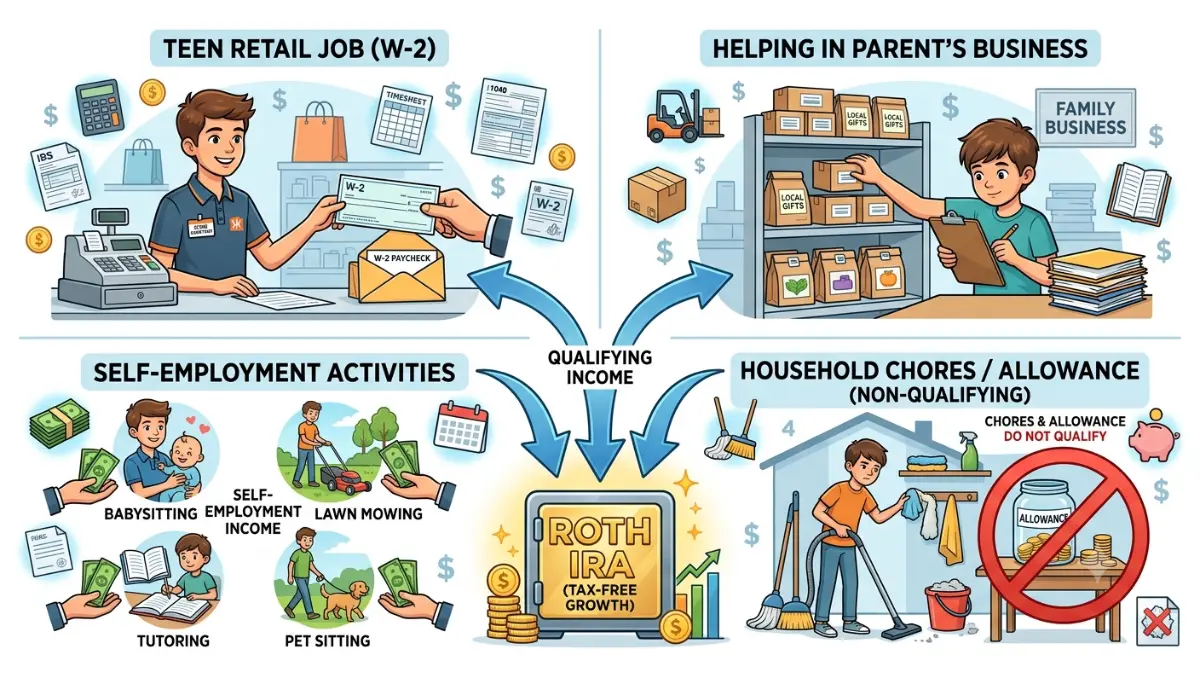
A job with an outside employer
The wage is already documented, and the W-2 box that shows the wages the IRS counts is the only record you need.
Wages from a business the parents own
Payments to a child under 18 in a parent’s sole proprietorship, or a partnership in which each partner is the child’s parent, are not subject to Social Security and Medicare taxes. Under 21 they escape federal unemployment tax too, though income tax withholding still applies at any age.
⚠️ Costly Mistake: That carve-out disappears if the business is a corporation, an estate, or a partnership with any non-parent partner. There the child’s wages carry full payroll taxes like anyone else’s, so the “hire your kid, skip the payroll tax” advice circulating online is wrong for S corporations and C corporations.
Self-employment: babysitting, lawn care, tutoring
🔍 How It Works: Self-employment tax runs at 15.3% — 12.4% Social Security plus 2.9% Medicare — on 92.35% of net earnings. On $3,000 that is $3,000 × 0.9235 × 0.153, or $423.89, owed even when no income tax is due.
What does not count
Interest, dividends and capital gains are not compensation, and neither is allowance or gift money. No IRS guidance treats chore payments between parent and child as compensation for IRA purposes, and Publication 15 handles domestic work in a parent’s home separately from work in a parent’s trade or business. The practical test is whether a record of payment for services actually performed exists.
✅ Action Step: Before putting a child on the payroll, ask a CPA: “Given my business entity type, what payroll filings do I owe, and what documentation would you want if this were examined?”
Paying your own child: what the rules require
Hiring your child is legitimate and common. It is also where families get into trouble, because the business deduction and the Roth contribution rest on the same evidence.

The work has to be real work
A business may deduct wages paid to a child only as ordinary and necessary compensation for services actually rendered (Internal Revenue Code §162). Federal child labor rules generally let children of any age work for a business owned entirely by their parents, with limits: no mining or manufacturing under 16, and no occupation the Secretary of Labor has declared hazardous under 18 (U.S. Department of Labor, Fact Sheet #43). State labor and school attendance rules still apply.
The pay has to be reasonable for that work
Reasonable means what the same task would cost from an unrelated worker of similar ability. No figure found online substitutes for a rate your CPA considers defensible.
✅ Action Step: Ask your CPA: “What hourly rate would you consider defensible for this work at this age, and what records do you want kept?”
The paperwork that makes it provable
One record set serves both the deduction and the contribution: dates, hours, the task, the rate, the amount paid and the payment method — plus the W-2 and whatever payroll filings your entity requires.
💡 Expert Note: The IRS treats a child working in a parent’s business as an employee for income tax withholding regardless of age. The family relationship changes which taxes apply, not whether payroll obligations exist.
Once the child’s account is handled, your own retirement options as a self-employed saver deserve the same attention.
Does your child now have to file a tax return?
Yes, if their net self-employment earnings reach $400 for the year — even when they owe no income tax at all.
The $400 self-employment trip wire
A child who mows lawns or babysits for cash is self-employed, and self-employment tax starts at $400 of net earnings. The IRS states that everyone, including minors, must file once net self-employment earnings reach that figure. Filing requirements do not bend for age.
The wage threshold is much higher
For a child claimed as a dependent, the 2026 standard deduction is the greater of $1,350 or earned income plus $450, capped at $16,100 (Revenue Procedure 2025-32). A child with $3,000 of wages gets a $3,450 deduction and owes no federal income tax, though filing can still recover tax withheld from their pay — see where a teenager’s wages actually land.
Why the kiddie tax does not touch this
📊 Data Point: The kiddie tax reaches only unearned income above $2,700 in 2026 — Source: IRS Topic no. 553 and Revenue Procedure 2025-32. Wages and self-employment pay are earned income and sit outside it.
✅ Action Step: Ask a CPA or the preparer who handles your return: “Does my child need to file this year, and does the self-employment income need a Schedule C and Schedule SE?”
Getting the money out — and who controls it at 18
Two objections stop most parents funding these accounts: that the money is locked until 59½, and that they lose all say over it. One is wrong. One is true.
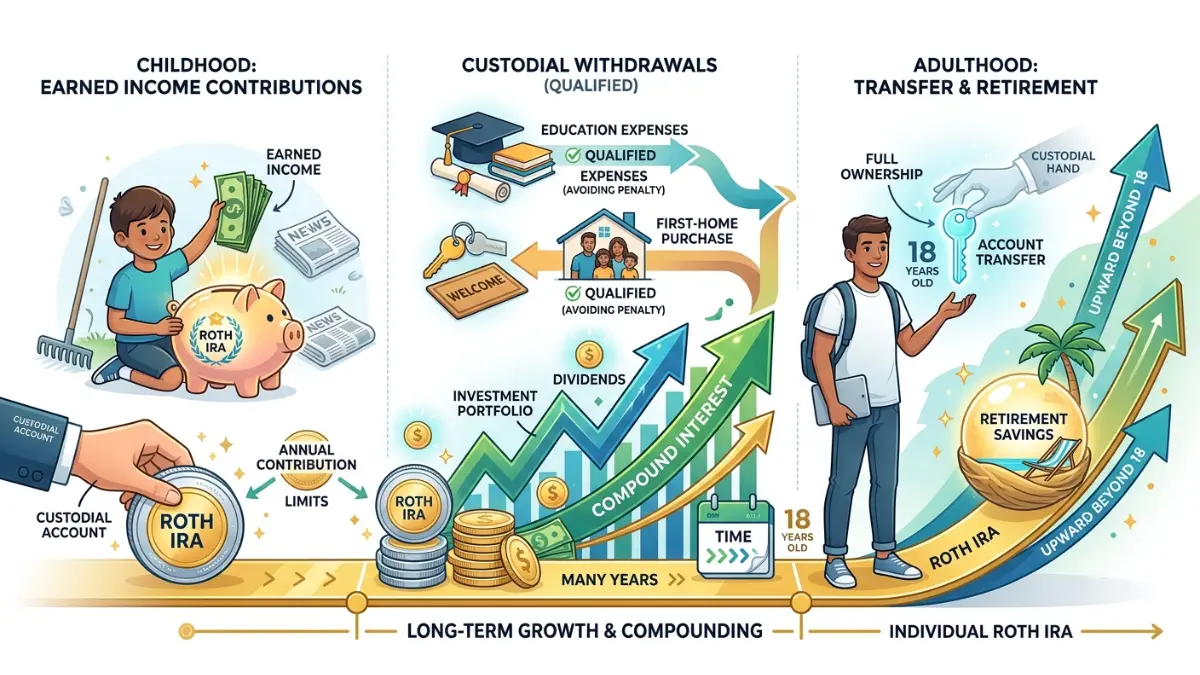
Contributions come out first, and they come out clean
Roth withdrawals follow an order. Regular contributions come out before anything else, and taking them back costs neither tax nor penalty — see how the IRS orders Roth withdrawals.
The earnings are the part with conditions
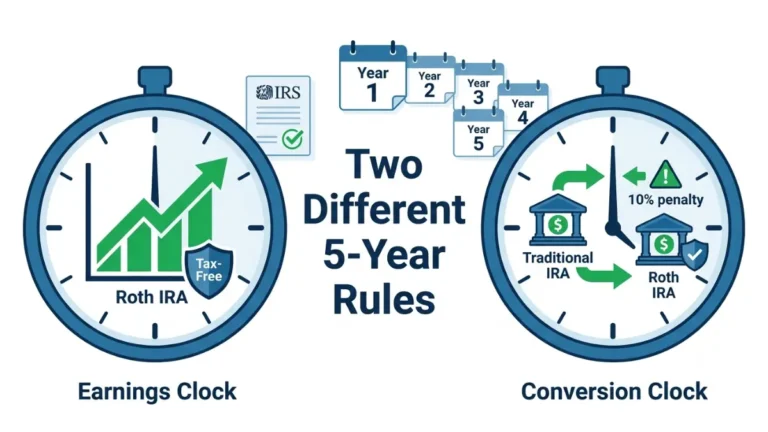
Earnings need a qualified distribution: the five-year clock that governs the earnings plus a qualifying event. Short of that, the IRS list of exceptions to the 10% additional tax covers qualified higher education expenses and up to $10,000 toward a first home. Those exceptions waive the 10% penalty, not the income tax on earnings — a distinction worth reading beside the exceptions that waive the 10% penalty.
Control transfers, and it is not conditional
At the age of majority set by your state and your provider’s custodial agreement — commonly 18 or 21 — the account becomes the child’s outright. Your approval is not part of it.
What financial aid sees
Retirement balances are not reported as FAFSA assets, while a student’s other savings face assessment of up to 20%. A withdrawal, though, counts as income two years later: how the FAFSA formula treats a student’s assets.
Five ways a custodial Roth IRA goes wrong
Common mistakes here are recoverable, and two are worth knowing before you fund anything.
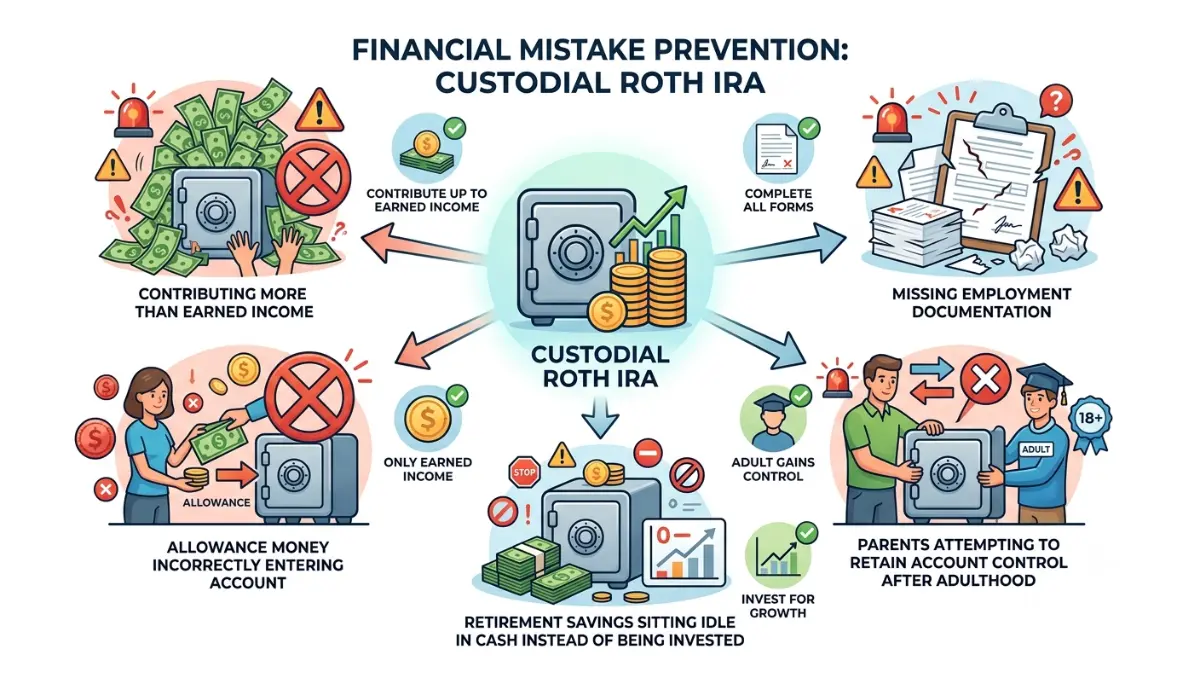
Funding more than the child earned
An excess contribution carries a 6% excise tax for each year it stays in the account (Internal Revenue Code §4973).
✅ Action Step: If you have already over-funded, ask a CPA: “What is the correction, and what is my deadline for this tax year?”
Keeping no record of the work
The contribution depends on earnings you can show, and a log written at the time is worth more than a reconstruction later.
Three more, briefly:
- Assuming chore money qualifies when no reportable wage sits behind it.
- Assuming you keep control past the age of majority.
- Funding the account and leaving it in cash, which removes the reason for opening it.
Still weighing accounts? See how the three kid accounts compare side by side.
Custodial Roth IRA: common questions
1. Can a child have a Roth IRA?
Yes. A custodial Roth IRA can be opened for a child of any age, provided the child has earned income for the year. The tax code sets no minimum age, and an adult custodian opens the account because minors generally cannot enter contracts. Contributions can never exceed the child’s earnings.
2. What counts as earned income for a child?
Wages, salaries, tips, commissions and net self-employment earnings count. Interest, dividends, allowance and gift money do not. A W-2 job, wages from a parent-owned business, and self-employment such as babysitting or tutoring all qualify where the work was performed and paid. Ask a CPA about anything unusual.
3. How much can a child contribute in 2026?
For 2026 the limit is the lesser of $7,500 or the child’s total earned income for the year. A teenager who earned $2,400 can contribute $2,400. That single limit is shared across every traditional and Roth IRA the child owns. A CPA can confirm the figure for an unusual income year.
4. Do chores or allowance count?
No IRS guidance treats allowance or household chore money as compensation for a custodial Roth IRA. Publication 15 handles domestic work in a parent’s home differently from work in a parent’s trade or business, and no reportable wage record exists behind the payment. Ask a CPA before contributing to the account on that basis.
5. Can I pay my child from my business?
Yes, where the child performs real work at a reasonable rate and the business runs proper payroll. Wages to a child under 18 in a parent’s sole proprietorship or parent-only partnership avoid Social Security and Medicare tax; corporations get no such treatment. Ask your CPA what your entity requires.
6. Is there a minimum age for a custodial Roth IRA?
No. The tax code sets no minimum age, so a custodial Roth IRA can hold a young child’s earnings. The practical limits are whether the child performed paid work, whether those earnings can be documented in writing, and whether the provider you choose accepts custodial retirement accounts at that age.
7. Does my child have to file a tax return?
Possibly. A child owes self-employment tax once net self-employment earnings reach $400, which requires a return even when no income tax is due. Wages alone are usually covered by the dependent standard deduction. Filing anyway can also recover tax withheld from their pay. A CPA can confirm your own child’s filing requirement.
8. Does a custodial Roth IRA hurt financial aid?
Retirement balances, including a custodial Roth IRA, are not reported as FAFSA assets, while a student’s other savings are assessed at up to 20%. The trade-off is that any withdrawal counts as income in the aid formula two years afterwards. Discuss the timing with a college financial aid office.
9. What happens when the child turns 18?
Control of a custodial Roth IRA transfers to the child at the age of majority set by state law and the provider’s custodial agreement, commonly 18 or 21. The transfer is automatic and does not depend on the parent’s approval. Read your provider’s custodial agreement carefully before opening the account.
10. Can the money come out for college or a first home?
Contributions can be withdrawn at any time, tax and penalty free. Earnings differ: the IRS waives the 10% additional tax for qualified higher education expenses and up to $10,000 toward a first home, but ordinary income tax on those earnings can still apply. Consult a CPA before withdrawing any earnings.
11. What if we contributed more than the child earned?
An excess contribution to a custodial Roth IRA carries a 6% excise tax for each year it remains in the account. The excess can be corrected, and the deadline for correcting it is tied to the tax return. Ask a CPA what the correction involves and when it falls due.
What to do this week
Three steps, in order.
- Confirm the earnings and write the number down, with the record that proves it.
- Open the account with a provider offering custodial Roth IRAs, using the child’s Social Security number.
- Fund it up to the lesser of the earnings or $7,500 — then invest it rather than leaving it in cash.
A contribution for a tax year can be made until the federal filing deadline for that year, not December 31: check the deadline for a 2026 contribution before assuming you have missed it.
Informational disclaimer
The content on Finance Authority Hub is provided for general informational and educational purposes only and should not be considered personalized financial, investment, tax, legal, or professional advice. Financial decisions depend on your individual goals, income, risk tolerance, location, and regulatory situation. Before acting on any information, strategy, estimate, or calculator result, consult a qualified licensed professional who can evaluate your specific circumstances.