
How the 2026 Roth IRA Income Limits Actually Work
Roth IRA income limits rose for 2026: singles phase out from $153,000, couples $242,000. See the exact amount the IRS worksheet allows at your income.
In This Article
For 2026, you can make a full Roth IRA contribution if your income is below the threshold for your filing status: $153,000 in modified adjusted gross income for single and head-of-household filers, or $242,000 for married couples filing jointly. Above those points your limit shrinks, and past $168,000 (single) or $252,000 (joint) direct contributions stop.
Where you go next depends on your situation. Single filers under $153,000 are clear — skip to the caps. If your income is climbing into the phase-out band, the calculation section gives your exact allowed amount. Married-filing-jointly readers use the $242,000 figure, not the headline $153,000. Married-separately filers face a much narrower rule. And if you already contributed and now worry you earn too much, the mistakes section covers the fix.
The most common error here isn’t math — it’s using the wrong income figure. Roth eligibility runs on modified adjusted gross income (MAGI), not the salary on your offer letter, and that changes the answer for a lot of people.
ℹ️ Financial Disclaimer: This article explains 2026 Roth IRA rules for general educational purposes and is not personalized investment, tax, or legal advice. Roth eligibility, MAGI, conversions, and excess-contribution corrections depend on your complete financial picture. Before acting — especially before a backdoor Roth conversion or fixing an over-contribution — consult a CPA or a fiduciary financial advisor. IRS figures shown are for tax year 2026 and are adjusted annually.
How Roth IRA income limits actually work
The Roth income limit is not an on/off switch. It’s a graduated phase-out with three zones, and knowing which one you’re in tells you what to do next.
Below the floor for your filing status, you contribute the full annual amount. Inside the range, your maximum is reduced on a sliding scale — you can still contribute, just less. At or above the top, your direct contribution is zero. A single filer at $153,001 loses a sliver, not everything.
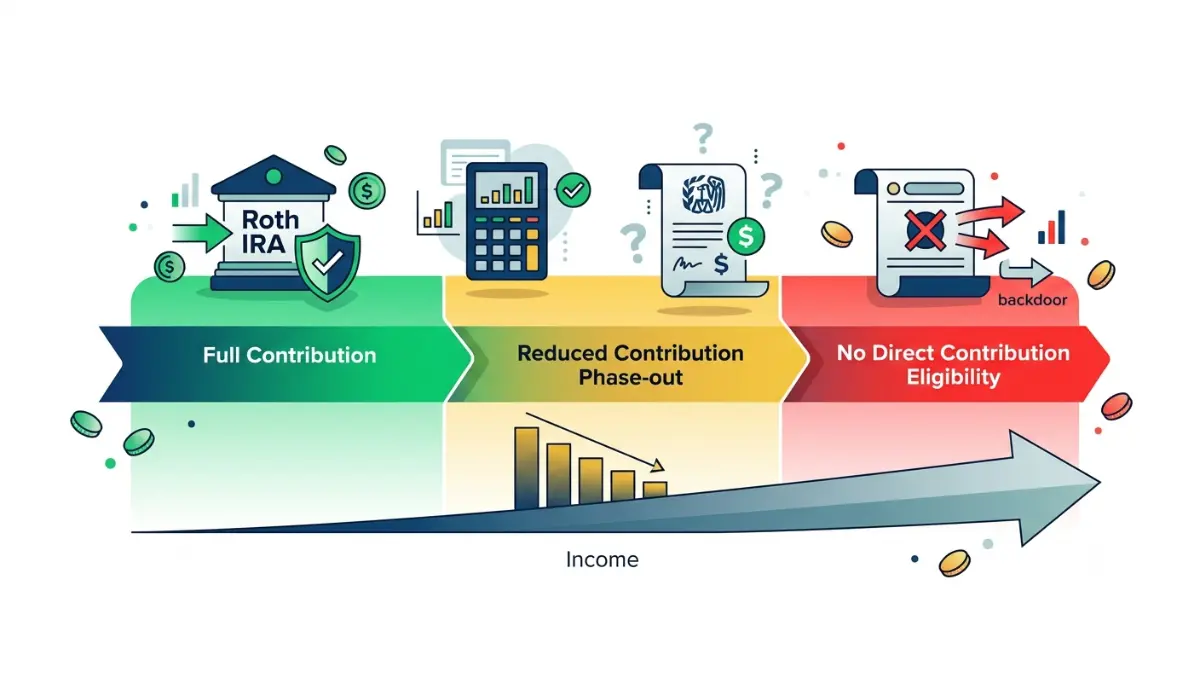
🔍 How It Works: The reduction spreads evenly across a fixed band — $15,000 wide for single filers, $10,000 for joint filers. As your MAGI moves from the bottom to the top of the band, your allowable contribution slides proportionally from the full amount down to $0. It’s a straight line, not a cliff.
Eligibility is measured by MAGI, not gross salary, so two people with identical paychecks can have different limits. If you’re new to these accounts, our guide to how a Roth IRA builds tax-free savings covers the basics, and the Roth is just one of the five main types of IRA accounts.
2026 Roth IRA income limits by filing status
For 2026, single and head-of-household filers can make a full Roth contribution below $153,000 MAGI; married couples filing jointly can do so below $242,000. Here are the complete phase-out ranges, with the 2025 figures for comparison.
| Filing status | 2026 phase-out range (MAGI) | 2025 range | Key detail |
|---|---|---|---|
| Single / head of household | $153,000 – $168,000 | $150,000 – $165,000 | Full below $153,000; $0 at $168,000+ |
| Married filing jointly | $242,000 – $252,000 | $236,000 – $246,000 | Full below $242,000; $0 at $252,000+ |
| Married filing separately* | $0 – $10,000 | $0 – $10,000 | Not inflation-adjusted; $0 at $10,000+ |
*Applies if you lived with your spouse at any time during the year. Source: IRS Notice 2025-67.
The contribution caps rose too. The 2026 maximum is $7,500, or $8,600 at 50 or older thanks to a $1,100 catch-up — a ceiling shared across all your IRAs combined. See the annual IRA contribution limits for how traditional and Roth accounts share one cap.
📊 Data Point: The 2026 IRA contribution limit is $7,500, up from $7,000 in 2025 — the first increase since 2023 — with the age-50+ catch-up rising to $1,100 from $1,000. Source: IRS, IR-2025-111 (2026 retirement-limit announcement).
Savers turning 50 should confirm they’re using the higher $8,600 figure; our overview of catch-up contributions for savers 50 and older explains how it applies across account types.
How to calculate your reduced Roth IRA contribution
If your MAGI lands inside the range, the IRS worksheet gives an exact number. The reduced contribution formula is your maximum limit times (the top of your range minus your MAGI), divided by your range width.
For a single filer under 50 with a MAGI of $160,500: subtract $153,000 to get $7,500, divide by the $15,000 band to get 0.5, and multiply the $7,500 cap by 0.5. The result is $3,750. (At 50 or older, the $8,600 cap gives $4,300.)
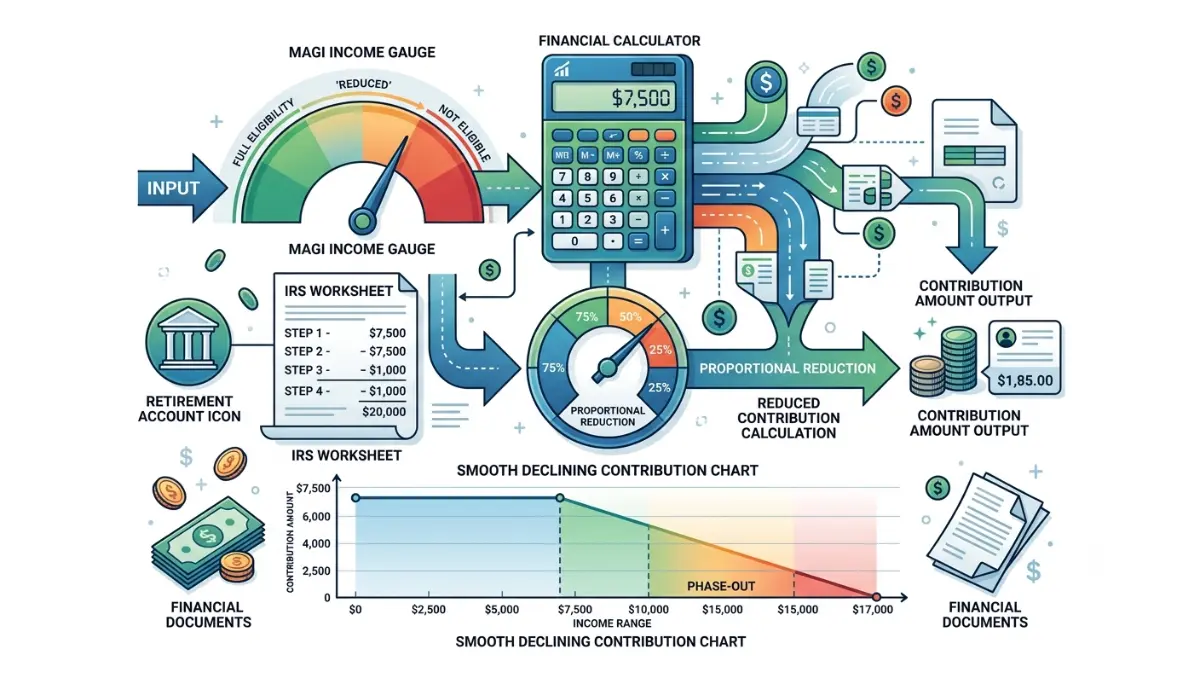
🔍 How It Works: The IRS rounds your reduced limit up to the nearest $10, and if the result is above $0 but under $200, you may still contribute $200. Once your MAGI reaches the top of the range, the formula produces $0. Source: IRS Publication 590-A, Worksheet 2-2.
Here is the full 2026 sliding scale for filers under 50 (the $7,500 cap), computed from the IRS worksheet:
| Single-filer MAGI | Max contribution | Joint-filer MAGI | Max contribution |
|---|---|---|---|
| $156,000 | $6,000 | $244,000 | $6,000 |
| $159,000 | $4,500 | $246,000 | $4,500 |
| $160,500 | $3,750 | $247,000 | $3,750 |
| $162,000 | $3,000 | $248,000 | $3,000 |
| $165,000 | $1,500 | $250,000 | $1,500 |
| $167,900 | $200 (floor) | $251,000 | $750 |
| $168,000+ | $0 | $252,000+ | $0 |
Figures computed by FinanceAuthorityHub using the IRS Publication 590-A reduced-contribution worksheet and the 2026 ranges from Notice 2025-67.
Once you know your amount, you can estimate your Roth IRA’s future value and see how tax-free compounding grows your contributions over the decades ahead.
Gross income or MAGI? Getting your income number right
Roth eligibility is based on modified adjusted gross income, not gross salary and not taxable income. This is where most people miscalculate, because the number that matters never appears as a single line on your return.
Start with your adjusted gross income (AGI) — line 11 of Form 1040. For Roth purposes, MAGI is that AGI with a few specific deductions added back.
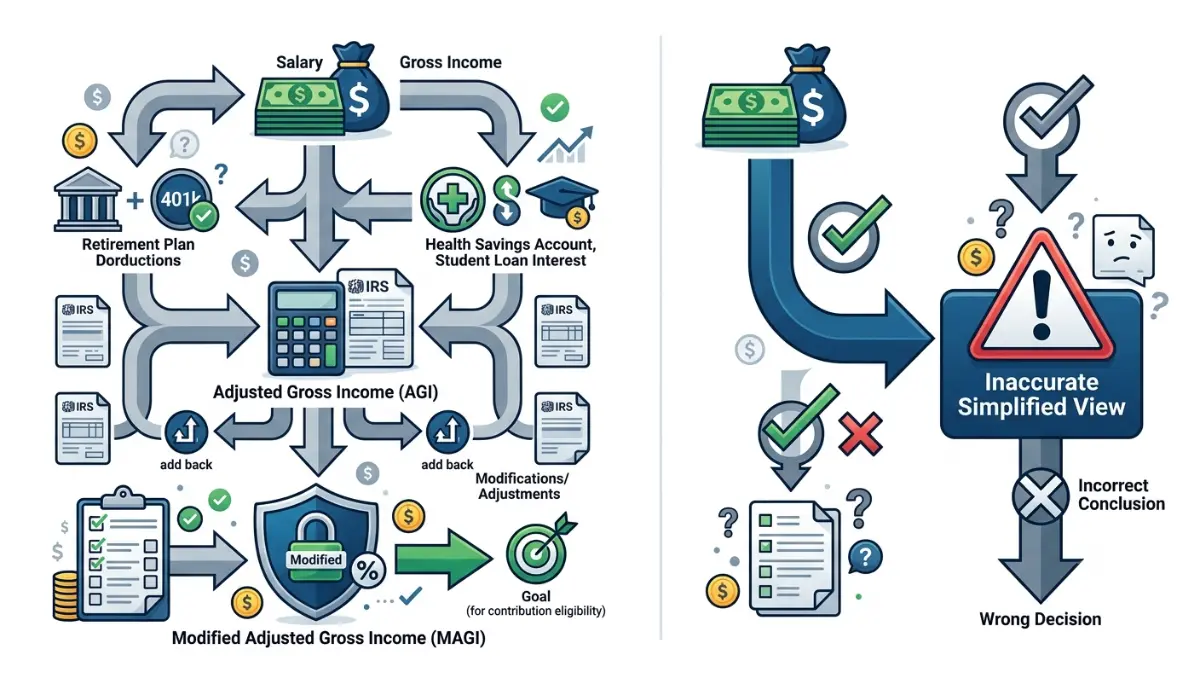
🔍 How It Works: Per IRS Publication 590-A, the add-backs include your student-loan interest deduction, foreign earned income and housing exclusions, excludable savings-bond interest, and excluded employer adoption benefits. For many salaried workers with none of these, MAGI and AGI are nearly identical.
Two consequences follow. Pre-tax 401(k) contributions lower your AGI, and therefore your MAGI, so maxing your workplace plan can pull you back under a threshold. And the self-employed, expats, and investors often have a MAGI well above their salary. Because MAGI builds on your AGI, our breakdown of your adjusted gross income on Form 1040 is a useful companion when you run the numbers.
What to do if you earn too much for a Roth IRA
Being over the limit doesn’t close the door — it changes the route. The most discussed path is the backdoor Roth IRA: contribute to a nondeductible traditional IRA (no income limit on contributions), then convert it to a Roth. Conversions carry no income cap.
The catch is the pro-rata rule, and it’s where people get an unexpected tax bill.
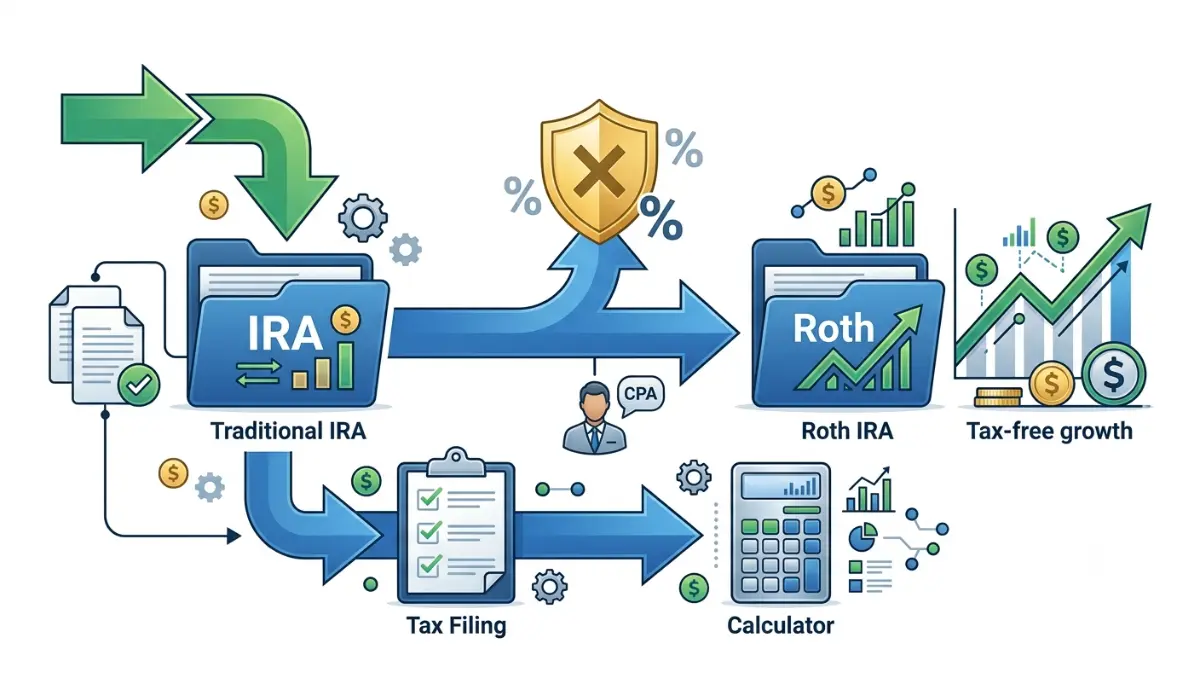
⚠️ Costly Mistake: If you hold any pre-tax money in a traditional, SEP, or SIMPLE IRA, the IRS treats a conversion as coming proportionally from all your IRA dollars — pre-tax and after-tax combined. You can’t convert only the after-tax portion, so part of the conversion becomes taxable even if your new contribution was nondeductible.
✅ Action Step: Before attempting a backdoor Roth, ask a CPA or a fiduciary financial advisor this specific question: “Given my existing pre-tax IRA balances, what would this conversion actually cost me under the pro-rata rule this year, and should I roll those balances into a 401(k) first?” Conversions are reported on IRS Form 8606.
There are simpler fallbacks. A nondeductible traditional IRA still gives tax-deferred growth. With a high-deductible health plan, an HSA is another tax-advantaged account worth funding. And if you haven’t maxed your workplace plan, deciding whether to prioritize a 401(k) or an IRA first may matter more than chasing a Roth contribution.
Common Roth IRA mistakes (and how to fix them)
Many readers reach this section because they contributed and then realized their income was higher than expected. The good news: an excess contribution is fixable if you act before your filing deadline.
⚠️ Costly Mistake: An excess Roth contribution is hit with a 6% excise tax for every year it stays in the account. To avoid it, withdraw the excess plus any earnings it generated before your tax-filing deadline, or recharacterize it as a traditional IRA contribution. Source: IRS retirement-topics guidance (excise tax under Internal Revenue Code §4973).
Three other traps recur. Using gross salary instead of MAGI produces a wrong eligibility call — recompute with the add-backs above. The married-filing-separately range is brutally narrow at $0 to $10,000 if you lived with your spouse. And the $7,500 cap is shared across every IRA you own, so you can’t fully fund both a traditional and a Roth in one year. The IRS retirement-topics page on IRA contribution limits details the excess-contribution correction rules.
Roth IRA income limits 2026: frequently asked questions
1. What are the Roth IRA income limits for 2026?
Full contributions are allowed below $153,000 MAGI for single and head-of-household filers, and below $242,000 for married filing jointly. Contributions phase out up to $168,000 and $252,000 respectively, then stop. Married-filing-separately filers who lived with a spouse phase out between $0 and $10,000.
2. What is the maximum Roth IRA contribution for 2026?
The 2026 maximum is $7,500, or $8,600 if you are 50 or older, which includes a $1,100 catch-up. This cap is shared across all of your IRAs combined, so a traditional and a Roth IRA together cannot exceed it. Your income may reduce this maximum if you fall inside the phase-out range.
3. Can married couples contribute to a Roth IRA in 2026?
Yes. Married couples filing jointly can each make a full contribution with MAGI below $242,000, a reduced amount from $242,000 to $252,000, and nothing at or above $252,000. Each spouse has a separate limit and account. Consider confirming your combined figures with a tax professional.
4. How much can I contribute if my income is in the phase-out range?
Use the IRS worksheet: your maximum limit times (the top of your range minus your MAGI), divided by your range width ($15,000 single, $10,000 joint). A single filer under 50 with a MAGI of $160,500 can contribute $3,750. Round up to the nearest $10; a result under $200 still allows $200.
5. Is the Roth IRA income limit based on gross income or MAGI?
It is based on modified adjusted gross income (MAGI), not gross salary or taxable income. MAGI starts with your adjusted gross income from Form 1040, line 11, then adds back certain items such as the student-loan interest deduction and foreign income exclusions. For many salaried filers, MAGI and AGI are close to identical.
6. What counts toward MAGI for a Roth IRA?
Begin with your AGI and add back the student-loan interest deduction, foreign earned income and housing exclusions, excludable savings-bond interest, and excluded adoption benefits, among a few others listed in IRS Publication 590-A. Pre-tax 401(k) contributions reduce AGI, and therefore MAGI, which can help you qualify.
7. What can I do if I earn too much for a Roth IRA in 2026?
Options include a backdoor Roth (a nondeductible traditional IRA contribution converted to a Roth), a plain nondeductible traditional IRA, or other tax-advantaged accounts like an HSA. The pro-rata rule can create a tax bill if you hold pre-tax IRA balances. Speak with a CPA before converting.
8. What is a backdoor Roth IRA?
It is a strategy for high earners: you contribute to a nondeductible traditional IRA, which has no income limit on contributions, then convert it to a Roth, which has no income limit on conversions. Existing pre-tax IRA balances trigger proportional taxation under the pro-rata rule. Consult a tax professional first.
9. What happens if I contribute too much to a Roth IRA?
An excess contribution faces a 6% excise tax each year until it is corrected. Fix it by withdrawing the excess plus any earnings before your tax-filing deadline, or by recharacterizing it as a traditional IRA contribution. If the deadline passes, a CPA can help you file the correction and limit further penalties.
10. What is the deadline to contribute to a Roth IRA for 2026?
The deadline is generally April 15, 2027 — the tax-filing deadline for the 2026 tax year. Contributions made between January 1 and April 15, 2027 must be clearly designated for the correct tax year in your brokerage, since that window overlaps two contribution years.
11. Can I contribute to both a 401(k) and a Roth IRA in 2026?
Yes. The limits are independent, so a workplace 401(k) does not reduce your Roth IRA limit. In fact, pre-tax 401(k) contributions lower your MAGI, which can help you qualify for a larger Roth contribution if your income sits inside the phase-out range.
Your 2026 Roth IRA next step
Your move comes down to one of three outcomes. If your MAGI is under $153,000 single or $242,000 joint, contribute the full $7,500 (or $8,600 at 50+) whenever you’re ready. If you’re inside the phase-out band, run the worksheet, confirm your figure, and fund that amount. If you’re over the top of the range, talk to a CPA about whether a backdoor Roth fits your existing IRA balances.
Whichever applies, these thresholds shift every year, so re-check them each January. To see how a Roth fits your bigger picture, model it against how much to save for retirement by age and use our retirement planning calculator to pressure-test the plan.
Related Articles
 IRA
IRAThe real limits on a 529 to Roth IRA rollover
July 27, 2026 IRA
IRAGet the Roth IRA 5-Year Rule Right the First Time
July 20, 2026 IRA
IRAYour SEP IRA Contribution Limits, Made Clear for Schedule C
July 25, 2026 IRA
IRAHolding a 401(k) and an IRA in the Same Year, Made Clear
July 27, 2026 IRA
IRAGetting Your 2026 RMD Right, From Your Age to the Deadline
July 21, 2026 IRA
IRAWhen a Penalty-Free IRA Withdrawal Is Possible Before 59½
July 21, 2026 IRA
IRAFacing a Missed RMD Penalty? Start Here to Lower It
July 22, 2026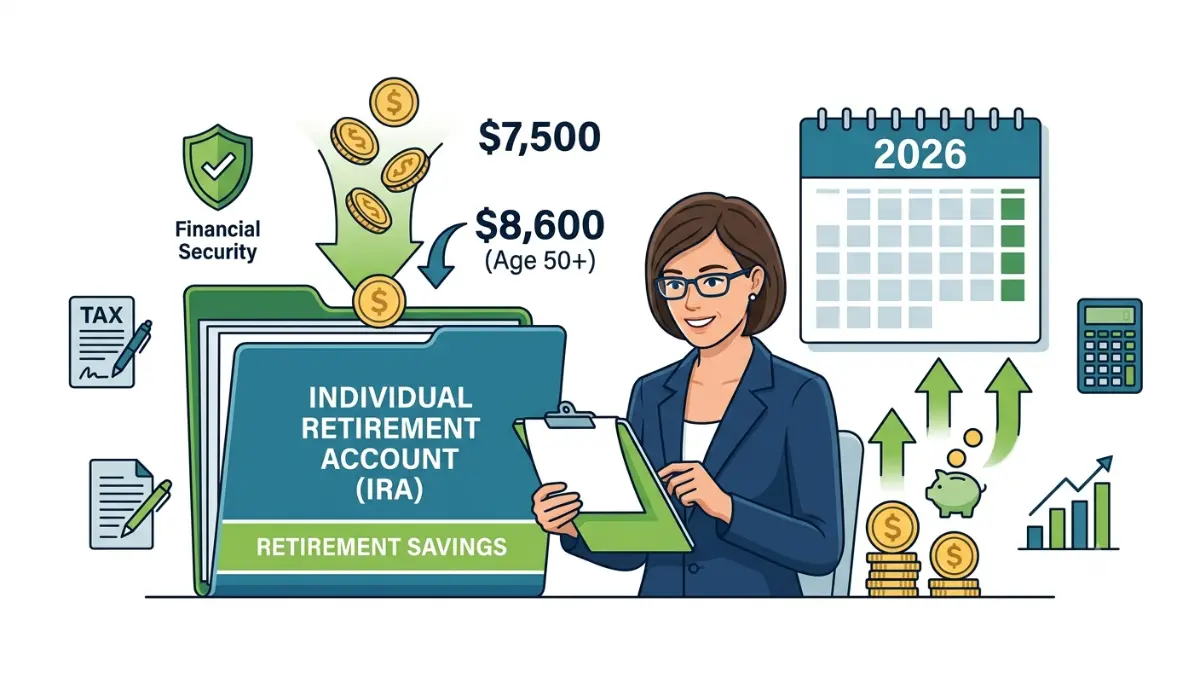 IRA
IRAIRA Contribution Limits and Who Can Use Them in 2026
July 15, 2026 IRA
IRAThe key numbers behind the average IRA balance by age
July 29, 2026
Informational disclaimer
The content on Finance Authority Hub is provided for general informational and educational purposes only and should not be considered personalized financial, investment, tax, legal, or professional advice. Financial decisions depend on your individual goals, income, risk tolerance, location, and regulatory situation. Before acting on any information, strategy, estimate, or calculator result, consult a qualified licensed professional who can evaluate your specific circumstances.