Behind on Retirement? How to Catch Up in Your 50s
Catching up on retirement after 50 isn’t hopeless—2026 hands you an extra $8,000 in 401(k) catch-up room, and a new Roth rule hits earners over $150,000.
In This Article
You opened your 401(k) statement, did some quick math, and felt your stomach drop. Being behind at 50 is far more common than being ahead of it — and turning 50 is exactly when the tax code starts handing you more room to save, not less.
Where you go next depends on where you are right now. If your balance feels too small and you want to know how you actually compare, start with the reality-check below. If you just want the exact 2026 numbers — the $32,500 you can put into a 401(k) at 50-plus — jump to the contribution limits. If you earn more than roughly $150,000, there’s a brand-new catch-up contribution rule for 2026 that changes how you save. And if you’re within a few years of 60, a bigger “super catch-up” is waiting for you. This guide walks through all of it — the benchmark, the levers, and what catching up can actually add.
ℹ️ Financial Disclaimer: This article is general educational information, not personalized investment, tax, or retirement advice. Contribution limits and rules are current for the 2026 tax year and can change; your plan’s terms and your tax situation may differ. Before acting on investment choices, tax strategy, or a withdrawal decision, consult a fiduciary financial advisor, a CPA, or a qualified tax attorney.
How far behind are you really?
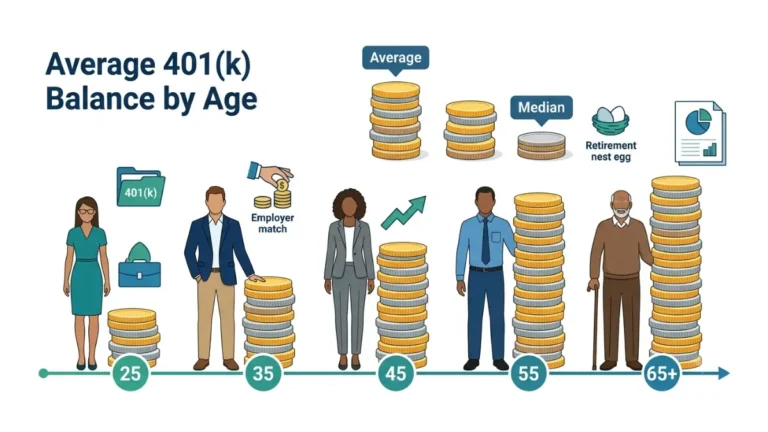
Most people measure themselves against the wrong number, and it makes them feel hopeless when they aren’t. Retirement savings anxiety usually comes from comparing your balance to an average that a handful of very large accounts have quietly inflated.
Average vs. median: why the average misleads
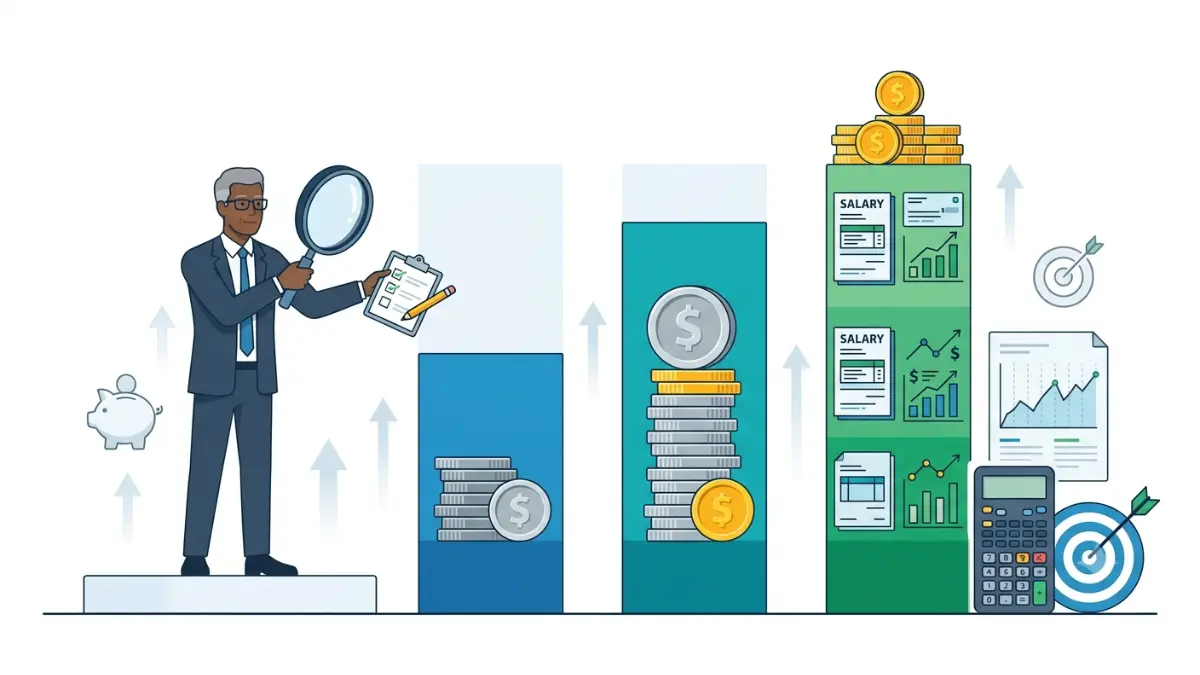
The average 401(k) balance is a poor yardstick for a typical saver. The median — the person standing exactly in the middle — tells you far more.
📊 Data Point: The average 401(k) balance hit a record $167,970 at year-end 2025, but the median was just $44,115 — a more than four-to-one gap. Source: Vanguard, How America Saves 2026 (data as of December 31, 2025).
💡 Expert Note: Vanguard’s own analysis notes that average balances skew toward older, longer-tenured, and higher-income participants. That is why a small group of large accounts pulls the average far above what most people actually hold — and why the median is the honest comparison for a typical worker.
The salary-multiple benchmark (and its limits)
A more useful gauge than any single dollar figure is a multiple of your income. Fidelity’s widely cited guideline suggests having roughly 6 times your salary saved by 50, 8 times by 60, and 10 times by 67 — assuming you retire at 67 and want to maintain your lifestyle.
Treat that as a goalpost, not a verdict. Your 401(k) is also only part of the picture: IRAs, a spouse’s accounts, home equity, and Social Security all count toward what you’ll actually live on. To see the full age-by-age breakdown, our guide on how your 401(k) stacks up by age puts the numbers in context.
How much you can contribute in your 50s
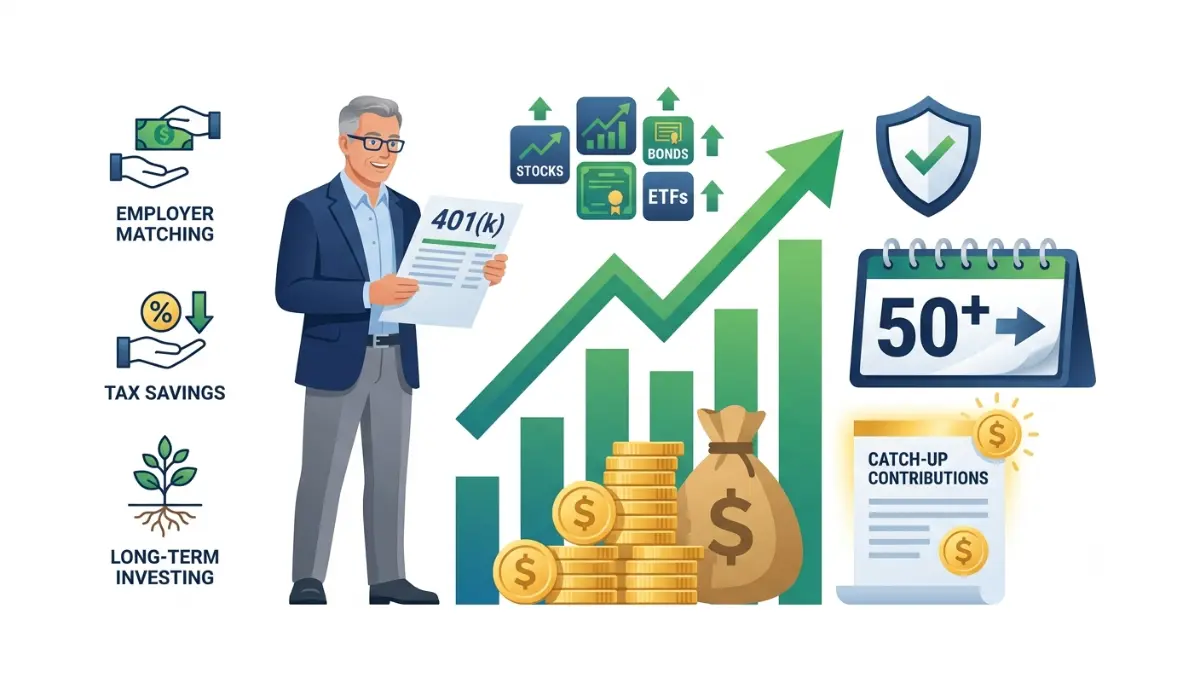
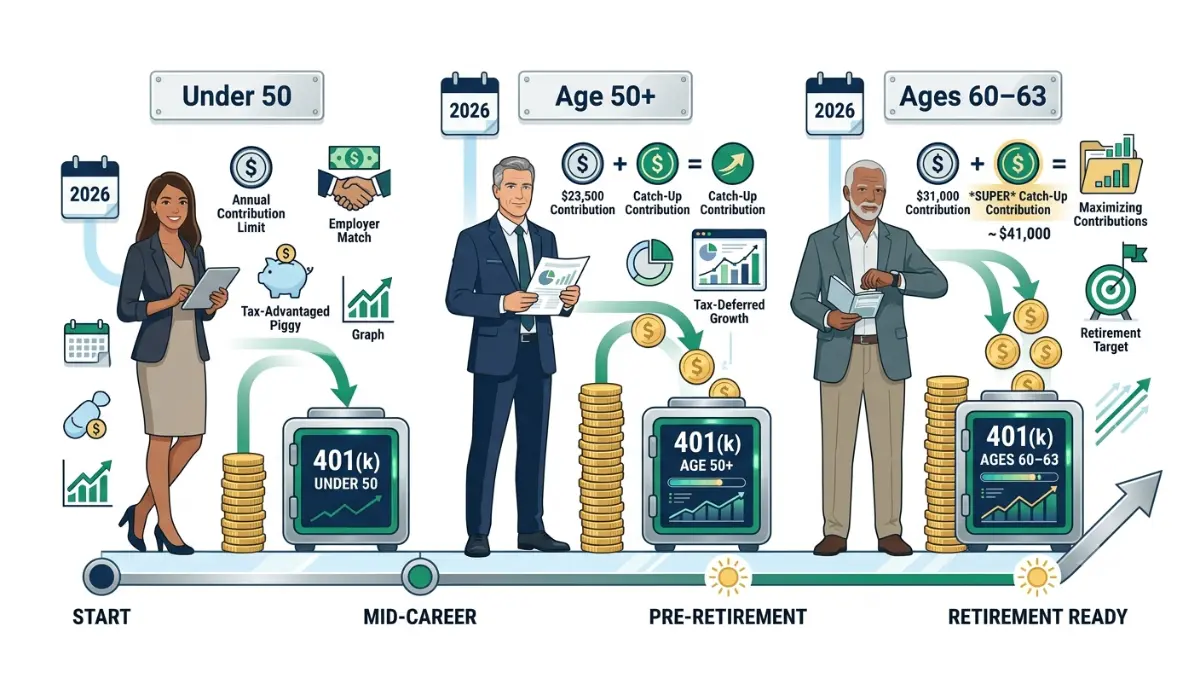
In 2026, savers 50 and older can put up to $32,500 into a 401(k): the $24,500 standard limit plus an $8,000 catch-up. If you’re between 60 and 63, that ceiling rises to $35,750. Here is the full 2026 picture.
| Account type (2026) | Under 50 | Age 50+ | Age 60–63 | Key detail |
|---|---|---|---|---|
| 401(k) / 403(b) / 457 / TSP | $24,500 | $32,500 | $35,750 | The $11,250 super catch-up replaces the $8,000 catch-up |
| IRA (traditional or Roth) | $7,500 | $8,600 | $8,600 | Separate from your 401(k); catch-up is $1,100 |
Source: IRS Notice 2025-67 (2026 cost-of-living adjustments).
The age-50 catch-up: an extra $8,000
The moment you turn 50, the IRS lets you contribute above the standard limit. For 2026, that catch-up is $8,000 on top of the $24,500 base.
🔍 How It Works: The catch-up stacks on the base limit — it doesn’t replace it. Your first $24,500 in elective deferrals fills the standard limit; only dollars beyond that count as catch-up. You can see the complete set of caps, including employer contributions, in the full 2026 401(k) contribution limits.
The 60–63 super catch-up: $11,250
Under the SECURE 2.0 Act, workers who are 60, 61, 62, or 63 by year-end get a larger catch-up. For 2026, that super catch-up is $11,250 — used instead of, not in addition to, the standard $8,000.
Don’t forget the IRA catch-up
Your IRA limit is separate from your 401(k). In 2026 you can contribute $7,500 to a traditional or Roth IRA, plus a $1,100 catch-up at 50 or older, for $8,600. For a deeper look at eligibility and timing, see how 401(k) catch-up contributions work.
✅ Action Step: Log into your plan portal this week and raise your deferral percentage toward the catch-up ceiling. Even moving from 6% to 10% starts capturing the extra room immediately. Confirm the 2026 figures against the IRS’s 2026 contribution limits.
The new 2026 rule: some catch-ups must be Roth
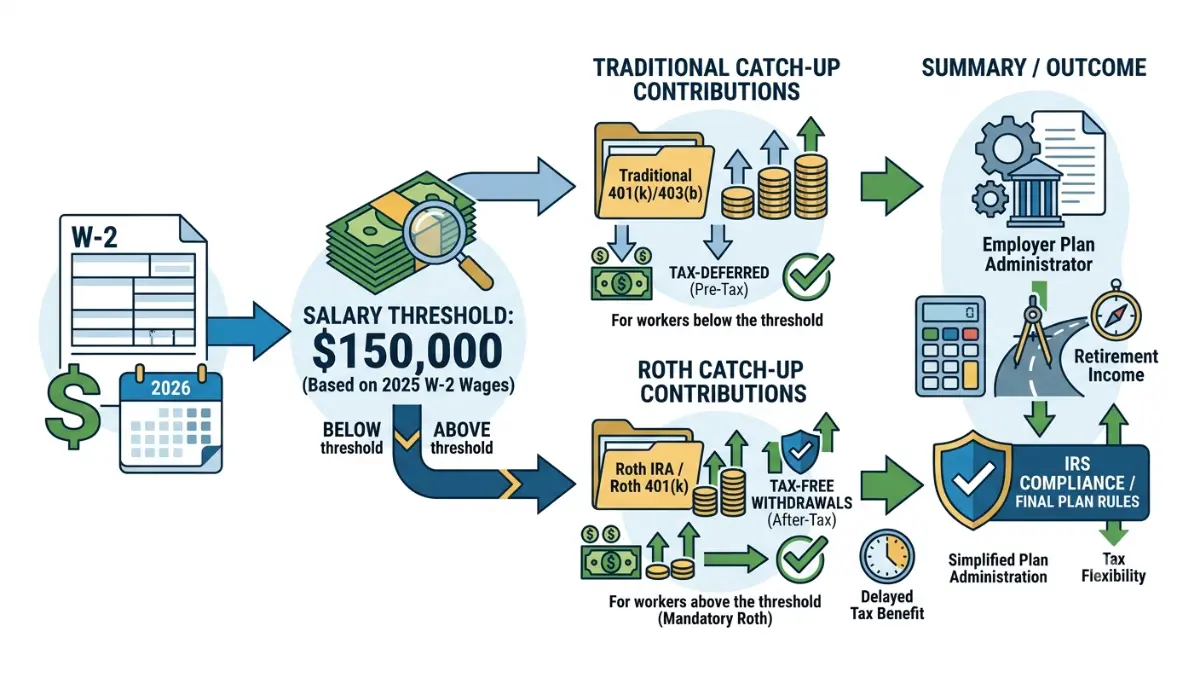
Starting in 2026, if your 2025 FICA wages topped $150,000, your 401(k) catch-up contributions must be made on a Roth (after-tax) basis. This is a first-year change under SECURE 2.0, and it catches many high earners off guard.
Who’s affected: the $150,000 wage line
The trigger is your prior-year Social Security wages, not your total income. Widely repeated coverage cited a $145,000 threshold, but the IRS indexed it upward — the confirmed 2026 figure is $150,000.
🔍 How It Works: Look at Box 3 (Social Security wages) on your 2025 W-2. If it exceeds $150,000, any catch-up you make in 2026 must go into the Roth side of your plan. The rule is permanent and rechecks against the prior year each year. The specifics are laid out in the IRS catch-up contribution rules.
The trap: no Roth option, no catch-up
Here’s the part that surprises people. If your employer’s plan doesn’t offer a Roth option, affected high earners can’t make catch-up contributions at all until the plan adds one.
⚠️ Costly Mistake: Assuming you can still make pre-tax catch-up contributions when you earn over $150,000. If your plan has no Roth feature, you lose the catch-up entirely — an $8,000 (or $11,250) hole in your 2026 savings until the plan is amended.
What Roth catch-up means for your taxes
Losing the upfront deduction stings, but Roth dollars grow and come out tax-free in retirement if you meet the holding rules. Whether that trade favors you depends on your bracket now versus later. Our comparison of how Roth and traditional contributions differ and the Roth catch-up rules for high earners go deeper.
✅ Action Step: Ask your plan administrator two questions — “Does our plan offer Roth 401(k) contributions?” and “How are my catch-up contributions being coded for 2026?” If you’re near the wage line, ask a CPA whether adjusting your other deferrals or withholding makes sense.
What catching up actually looks like
Limits are abstract until you see what they do. So here is a worked example, computed with one clearly labeled assumption.
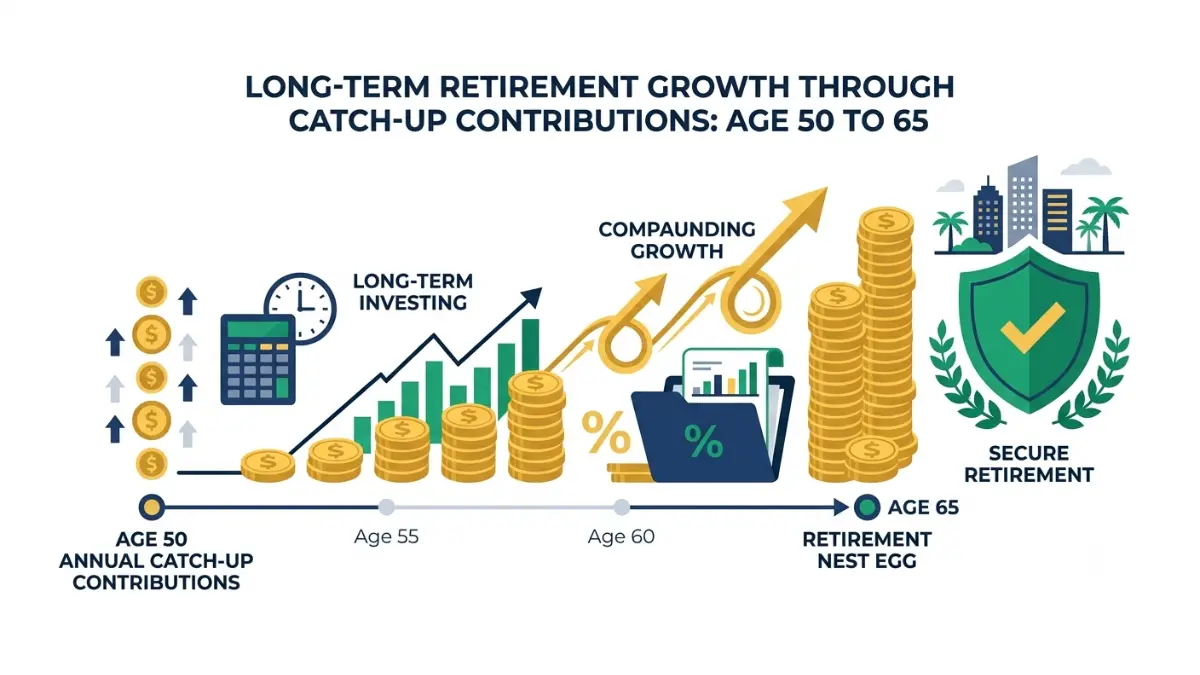
A worked example: maxing catch-up from 50 to 65
Picture a saver who commits to the full catch-up every year from age 50 to 65 — $8,000 a year, then $11,250 during ages 60 to 63, then $8,000 at 64. That’s about $133,000 in extra contributions over 15 years.
At a 6% illustrative average annual return, that $133,000 could grow to roughly $213,000 by age 65 — meaning about $80,000 comes from growth alone, not your own pocket.
🔍 How It Works: Compounding rewards the earliest dollars most, because they spend the longest invested. The $8,000 you add at 50 has 15 years to grow; the one you add at 64 has barely one. That front-loading is why starting the catch-up now, rather than “next year,” matters more than it feels like it should.
Why your real number will differ
That 6% is an illustration, not a promise. Markets don’t deliver a steady return, and the figures above ignore fees, taxes, and inflation, all of which would lower the real result. Your own number depends on your contributions, your time horizon, and returns no one can guarantee.
✅ Action Step: Model your own inputs — run your own catch-up numbers and see how contributions compound over time. For a plan built around your actual retirement date and risk tolerance, ask a fiduciary financial advisor to stress-test it.
Other catch-up levers beyond your 401(k)
Your 401(k) catch-up is the biggest lever, but it isn’t the only one. Stacking a few others can close the gap faster.
Capture the full employer match first
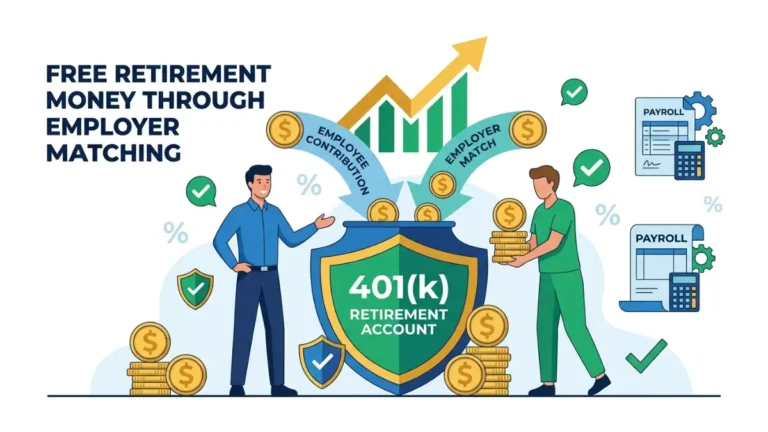
Before you chase the catch-up ceiling, make sure you’re getting every dollar of employer match — it’s the closest thing to free money in retirement saving. Leaving it on the table costs more than almost any other mistake here. Our guide to how employer 401(k) matching works breaks down the common formulas.
The HSA: an overlooked catch-up tool
If you have a qualifying high-deductible health plan, a health savings account offers a rare triple tax advantage. For 2026 you can contribute $4,400 for self-only coverage or $8,750 for family coverage, plus a $1,000 catch-up once you turn 55.
📊 Data Point: The 2026 HSA limits are $4,400 (self-only) and $8,750 (family), with a $1,000 catch-up at age 55 and older. Source: IRS Revenue Procedure 2025-19. See why an HSA can beat a 401(k) on taxes for the mechanics, and confirm the figures at the IRS’s 2026 HSA limits.
IRAs, Roth, and working longer
That separate $8,600 IRA limit is another bucket to fill, and estimating your IRA growth can help you size it. Working even two or three years longer is its own powerful lever: more contributions, more compounding, fewer drawdown years, and a larger Social Security benefit if you delay claiming — see how delaying Social Security changes your benefit.
✅ Action Step: Contribute at least enough to capture your full employer match before anything else. Then ask a CPA or fiduciary advisor how to sequence an HSA, an IRA, and extra 401(k) dollars given your tax bracket.
Catch-up mistakes that cost you
A strong catch-up push can still be undone by a few avoidable errors. These are the ones that quietly cost people the most.
Assuming your plan offers the super catch-up
The $11,250 super catch-up for ages 60 to 63 is optional for employers to offer. Some plans don’t, and some exclude certain groups — so confirm with your plan administrator before you count on it. If your plan doesn’t offer it, your catch-up stays at $8,000.
⚠️ Costly Mistake: Splitting contributions across two employers’ plans and over-contributing. Your elective deferrals across all plans share one annual limit; exceeding it creates excess deferrals that are taxed twice unless you request a corrective distribution by April 15.
Chasing risk to “make up time”
Feeling behind tempts people to pile into whatever’s hot to catch up quickly. Concentrating late in your career can backfire badly if a downturn hits just before you retire, when you have little time to recover.
✅ Action Step: Before making a big allocation change to “catch up,” ask a fiduciary financial advisor whether your mix matches your actual retirement date and risk tolerance.
Frequently asked questions
1. How much can I contribute to my 401(k) at age 50 in 2026?
In 2026, workers 50 and older can contribute up to $32,500 to a 401(k) — the $24,500 standard limit plus an $8,000 catch-up contribution. If you’re between 60 and 63, your ceiling rises to $35,750 thanks to the $11,250 super catch-up. Your plan must permit catch-up contributions for you to use them.
2. What is the super catch-up contribution for ages 60 to 63?
The super catch-up lets workers who are 60, 61, 62, or 63 by year-end contribute an extra $11,250 to a 401(k) in 2026 — used instead of the standard $8,000 catch-up — for a total of $35,750. It comes from the SECURE 2.0 Act, but offering it is optional for employers, so confirm your plan allows it.
3. Is it too late to start saving for retirement at 50?
No. Fifty is when catch-up contributions unlock, giving you thousands in extra tax-advantaged room each year, and even 15 years leaves meaningful time for compounding. The key levers are maxing your 401(k) catch-up, capturing your full employer match, and using an HSA or IRA. For a personalized plan, consult a fiduciary financial advisor.
4. Do I have to make catch-up contributions as Roth in 2026?
Only if your 2025 FICA (Social Security) wages exceeded $150,000. Above that line, SECURE 2.0 requires your 2026 401(k) catch-up contributions to be made on a Roth, after-tax basis. Below it, you can still make pre-tax catch-up contributions. If you’re near the threshold, ask a CPA how the change affects your taxes.
5. How much should I have saved for retirement by 50?
Fidelity’s guideline suggests roughly 6 times your annual salary saved by age 50, assuming you retire at 67. That’s a target, not a verdict — the median 401(k) balance across all ages is only $44,115, so being below benchmark is common. Your 401(k) is one piece; IRAs, home equity, and Social Security also count toward your total.
6. Can I contribute to both a 401(k) and an IRA in my 50s?
Yes. The two limits are separate. In 2026 you can contribute up to $32,500 to a 401(k) at 50 or older, plus up to $8,600 to a traditional or Roth IRA ($7,500 base plus a $1,100 catch-up). IRA deductibility and Roth eligibility phase out at higher incomes, so check the rules or ask a CPA.
7. What if my plan doesn’t offer the super catch-up?
Then your 2026 catch-up stays at the standard $8,000, even if you’re between 60 and 63. Offering the $11,250 super catch-up is optional for employers, and some exclude certain groups. Confirm with your plan administrator, and remember your separate IRA and HSA limits are still available to add more.
8. Should I use Roth or traditional for my catch-up?
It depends on whether you expect a higher tax rate now or in retirement. Roth catch-up costs you the upfront deduction but grows tax-free; traditional lowers today’s taxable income. High earners over the $150,000 wage line must use Roth for 401(k) catch-up in 2026. A CPA can model which favors your bracket.
9. How much can catch-up contributions actually add by retirement?
Meaningfully. As shown above, maxing the catch-up from 50 to 65 — about $133,000 in contributions — could grow to roughly $213,000 at a 6% illustrative return, with around $80,000 from growth. That figure is an illustration, not a guarantee; markets vary, and fees and taxes reduce real results. Run your own numbers with a retirement calculator.
10. Can I still get my employer match while making catch-up contributions?
Generally yes. Employer matching is calculated on your regular elective deferrals, and catch-up contributions typically don’t reduce your eligibility for the match. Plan formulas vary, though — some cap the match at a percentage of pay — so check your specific plan document to confirm how your match is applied.
11. What’s the fastest way to catch up on retirement in my 50s?
Capture your full employer match first, then max your 401(k) catch-up, then fill an HSA and IRA if you’re eligible. Working a few extra years and delaying Social Security adds more still. Avoid over-concentrating your investments to chase returns. For sequencing this around your taxes, ask a fiduciary advisor or CPA.
Your next move
Being behind at 50 is common, and it’s recoverable. The tax code gives you more room in your 50s than at any earlier point, and the levers — the $8,000 catch-up, the $11,250 super catch-up, the employer match, an HSA — are real and available right now.
Pick one action today. Raise your 401(k) deferral percentage toward the catch-up ceiling, or run your numbers to see the gap this can close. Momentum matters more than perfection, and the earliest dollar you add is the one that compounds the longest. For a plan shaped around your income, retirement date, and taxes, a fiduciary financial advisor or CPA can model it with you.

Informational disclaimer
The content on Finance Authority Hub is provided for general informational and educational purposes only and should not be considered personalized financial, investment, tax, legal, or professional advice. Financial decisions depend on your individual goals, income, risk tolerance, location, and regulatory situation. Before acting on any information, strategy, estimate, or calculator result, consult a qualified licensed professional who can evaluate your specific circumstances.