How the Rule of 55 Unlocks Your 401(k) Before 59½
The rule of 55 can waive the 10% early-withdrawal penalty on your 401(k) if you leave a job at 55+ — but one rollover mistake erases it for good.

In This Article
Leaving a job in your mid-to-late 50s raises one urgent question about your 401(k): can you reach that money before 59½ without losing a chunk to penalties? For many people, the answer is yes — through an IRS provision widely called the rule of 55.
Which situation is yours? If you were laid off or took a buyout at 55 or older, this rule may bridge your income until other retirement funds open up. If you’re voluntarily retiring early and plan to live partly on your 401(k), it can shape when and how you leave. And if you’re a public safety worker — police, firefighter, EMT — you may qualify even earlier, at 50.
This guide covers what the rule is, who qualifies, the taxes you’ll still owe, the mistakes that permanently void it, and how it stacks up against other early-access options. The goal is a clear yes or no on your eligibility, plus a real sense of what a withdrawal actually costs.
ℹ️ Financial Disclaimer: This article is educational and not personalized investment, tax, or retirement advice. Retirement withdrawals, tax planning, and investment choices carry consequences specific to your situation. Before acting on the rule of 55, consult a fiduciary financial advisor and a CPA; for questions about your own plan, contact your plan administrator.
What is the Rule of 55?
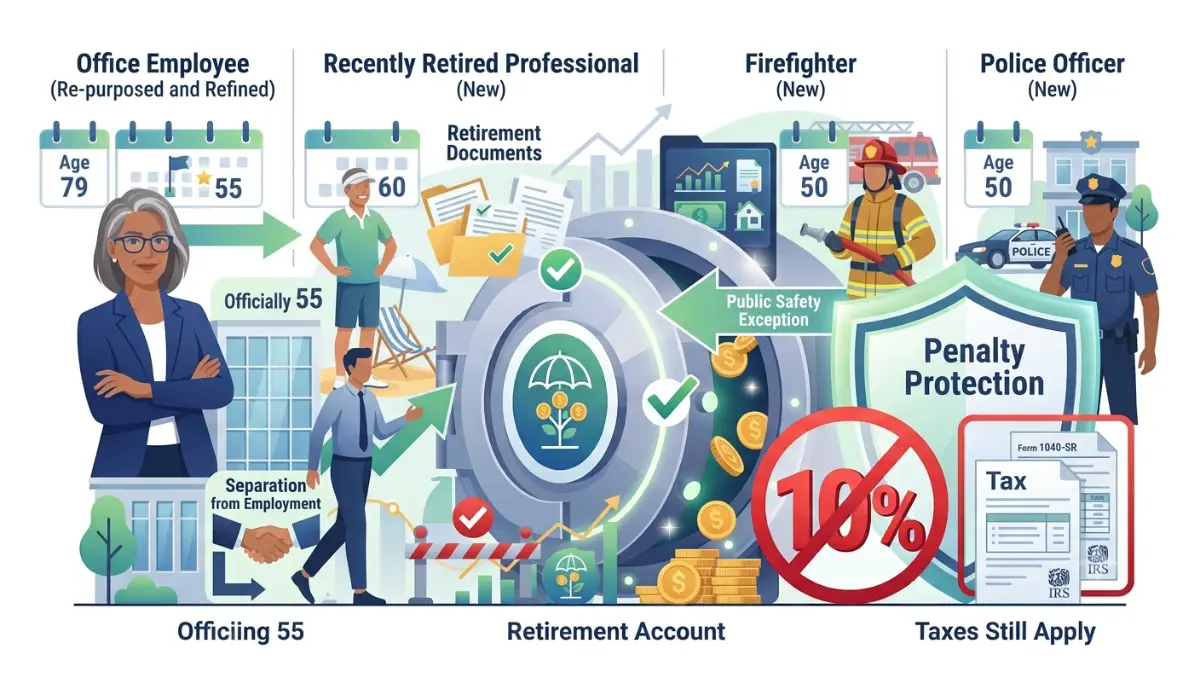
The rule of 55 is an IRS provision that waives the 10% early withdrawal penalty on 401(k) or 403(b) distributions if you leave your job in or after the calendar year you turn 55. It does not make the money tax-free — it removes only the extra 10% penalty that normally applies before age 59½.
The IRS never uses the phrase “rule of 55.” Its actual term is separation from service, and the exception lives in Internal Revenue Code section 72(t). The nickname stuck because 55 is the age that unlocks it for most workers. This exception is separate from the standard 10% early withdrawal penalty that hits most pre-59½ withdrawals.

What “separation from service” actually means
Separation from service means you’ve fully left the employer — you quit, retired, were laid off, or were let go. The reason doesn’t matter, but the employment relationship must genuinely end. Switching to part-time at the same company doesn’t count.
The year you turn 55, not the day
Here’s a detail people miss: you qualify if you separate during the calendar year you turn 55, even if your birthday hasn’t arrived yet. Leave in March when you’ll turn 55 in September, and you still qualify. The rule also covers a Roth 401(k), though earnings may be taxable if you’re under 59½ and haven’t met the account’s five-year rule.
🔍 How It Works: Normally, pulling money from a 401(k) before 59½ triggers a 10% additional tax on top of regular income tax. The rule of 55 switches off that 10% penalty for the plan at the job you just left — but the withdrawal still counts as ordinary income for the year, per the IRS exception for separating from service at 55.
Who qualifies for the Rule of 55?
You qualify for the rule of 55 if you meet all three conditions:
- Separation timing — You leave your employer in or after the calendar year you turn 55 (age 50 for qualified public safety workers, below).
- The right account — You withdraw from the 401(k) or 403(b) at the employer you just left — not an old employer’s plan, and not an IRA.
- The money stays put — You leave the balance in that employer’s plan. Roll it into an IRA and the exception disappears (more on that mistake shortly).
Public safety workers: the age-50 exception
Qualified public safety employees in a governmental plan — police, firefighters, EMTs, air traffic controllers — get earlier access. The penalty exception applies if they separate in or after the year they reach age 50, or complete 25 years of service under the plan, whichever comes first. This is one of several other IRS exceptions to the early withdrawal penalty worth knowing.
Confirm your plan allows it
The tax exception is federal law, but your plan controls how withdrawals work. Some plans restrict how often you can take money out after you leave. Those rules are spelled out in your plan’s Summary Plan Description, and they matter as much as the IRS distribution rules themselves.
💡 Expert Note: A common point of confusion is treating age 55 as a birthday requirement. What matters is the calendar year — separating in the year you turn 55 qualifies you, even months before you actually turn 55. IRS guidance ties the exception to the year of separation, not the exact date.
✅ Action Step: Before you count on this rule, request your Summary Plan Description from HR or your plan administrator and confirm the plan allows partial withdrawals after separation — not every plan does.
Do you still pay taxes on a Rule of 55 withdrawal?
Yes. The rule of 55 waives the 10% penalty, but the withdrawal is still taxed as ordinary income — and a large one can push you into a higher bracket for the year. You can estimate the tax on a withdrawal before you take it.
The mandatory 20% withholding
When you take a lump sum paid directly to you, the plan must send mandatory 20% federal withholding to the IRS. This isn’t an extra tax; it’s a prepayment against what you’ll owe at filing. Withhold too much and you get a refund; too little and you owe the difference.
A worked example: what $40,000 actually nets
Say you withdraw $40,000 under the rule of 55, and your other income puts you in the 22% federal bracket for 2026:
- 10% penalty: $0 — the rule waives it, saving you $4,000 versus a normal early withdrawal.
- 20% withholding: $8,000 sent to the IRS up front, so $32,000 lands in your account.
- Actual tax owed: roughly $8,800 at 22%, settled when you file — meaning the $8,000 already withheld nearly covers it.
The penalty savings are real. The income tax is not optional.
🔍 How It Works: Federal tax is marginal — only the portion of income above each threshold is taxed at the higher rate. A $40,000 withdrawal isn’t taxed entirely at your top rate; it stacks on top of your other income, and only the part that spills into a higher bracket is taxed there. A CPA can tell you whether a given withdrawal tips you into a higher bracket and how to spread it across tax years. You can also model how a withdrawal affects your retirement income first.
Mistakes that can void the Rule of 55
A few avoidable mistakes can erase your eligibility for the rule of 55 — some of them permanently. These are the ones that cost people the most.

Rolling your 401(k) into an IRA
This is the big one. If you’re rolling your 401(k) into an IRA, the rule of 55 no longer applies to those funds — permanently. IRAs follow the standard 59½ rule, with no separation-from-service exception. If you’ll need the money before 59½, leaving it in the employer plan is what preserves access.
Trying to use an old employer’s plan
The exception only covers the plan at the job you separated from at 55 or later. A 401(k) from a previous employer you left at 48 doesn’t qualify — even if you roll newer balances into it.
Getting locked into a lump sum
Some plans don’t allow partial withdrawals after you leave, which can force you to take the entire balance at once — a large, fully taxable event in a single year. Check this before you separate, not after.
Switching jobs, then withdrawing
You can take a new job and keep withdrawing from the old plan penalty-free — as long as you never roll that old plan over. Before pulling anything, it’s worth seeing what those same dollars could have grown to if left invested.
⚠️ Costly Mistake: Rolling your 401(k) into an IRA right after leaving feels like tidy housekeeping, but if you’re under 59½ and might need the money, it forfeits penalty-free access for good. There’s no undo. Confirm your withdrawal plan with a fiduciary advisor before moving a single dollar.
Rule of 55 vs. 72(t) vs. waiting until 59½
The rule of 55 isn’t the only way to reach retirement money early. Which path fits depends on your age and which accounts you’re drawing from. This is general education, not a personal recommendation — withdrawal sequencing is one of the highest-stakes retirement decisions, and it belongs with a professional.
| Option | Earliest access | Which accounts | Flexibility | Main risk |
|---|---|---|---|---|
| Rule of 55 | Year you turn 55 (50 for public safety) | The 401(k)/403(b) you just left | Any amount, anytime; no ongoing commitment | Lost if you roll to an IRA; old plans don’t count |
| 72(t) / SEPP | Any age | IRAs and employer plans | Locked into fixed annual payments | Irrevocable; breaking it triggers retroactive penalties |
| Wait to 59½ | Age 59½ | All 401(k)s and IRAs | Full penalty-free access, no restrictions | You need a bridge for the years before 59½ |

When each one fits
The rule of 55 tends to fit workers leaving a job at 55+ who want flexible access to that plan. A 72(t) — substantially equal periodic payments — is the main route before 55 or when the money sits in an IRA, but it commits you to fixed withdrawals for five years or until 59½, whichever is longer. Waiting to 59½ wins when you have other funds to live on and want the balance to keep growing.
⚠️ Costly Mistake: A 72(t) schedule is a commitment, not a trial. Change or stop the payments early and the IRS can retroactively apply the 10% penalty — plus interest — to everything you’ve withdrawn. Model it precisely with a professional before starting.
✅ Action Step: Before choosing a path, ask a fiduciary advisor and a CPA one specific question: “Given my other income and the years until 59½, does the rule of 55, a 72(t), or waiting leave me with the most after-tax income and the least locked-in risk?”
How the Rule of 55 fits your bigger retirement plan
The rule of 55 is a withdrawal tool, but it works best inside a plan that also builds the balance in the first place, anchored by the 2026 401(k) contribution limits and steady saving. The bigger the 401(k) when you leave, the more the rule can do.
Keep contributing right up to the exit
Until your last day, you can keep funding the plan. For 2026, workers can contribute up to $24,500 per the 2026 IRS contribution limits, and those 50 and older can add catch-up contributions of $8,000 for $32,500 total; the 60-to-63 catch-up is higher still at $11,250, for $35,750. Every dollar added before you leave is a dollar the rule of 55 can later reach.
Access now versus growth later
Early access carries a real cost: money withdrawn stops compounding. Weigh a withdrawal against what it would have grown to over the years before you’d otherwise touch it. You can project your 401(k) balance to see that trade-off, and lean on early access only when you genuinely need the bridge.
📊 Data Point: 2026 401(k) employee contribution limit — $24,500, rising to $32,500 with the age-50 catch-up and $35,750 for ages 60–63. Source: IRS, 2026.
The bottom line on the Rule of 55
The rule of 55 gives you a real, IRS-sanctioned way to reach your 401(k) before 59½ without the 10% penalty — if you separate from your employer in or after the year you turn 55 and leave the money in that plan. Remember the two truths that trip people up: penalty-free isn’t tax-free, and rolling the balance into an IRA erases the benefit for good.
Before you withdraw a dollar, confirm your plan’s rules, model the tax hit, and weigh the long-term cost against the growth you’d give up. A clear look at how much you should have saved for retirement helps you decide whether early access is a bridge or a leak.
Rule of 55 FAQ
1. What is the rule of 55?
The rule of 55 is an IRS provision that waives the 10% early withdrawal penalty on 401(k) or 403(b) distributions if you leave your job in or after the calendar year you turn 55. The withdrawal is still taxed as ordinary income; only the extra 10% penalty is removed.
2. Does the rule of 55 apply to IRAs?
No. The rule of 55 applies only to employer plans like 401(k)s and 403(b)s, never to IRAs. Roll a 401(k) into an IRA and you permanently lose the exception, with the IRA then following the standard 59½ rule. For early IRA access, a 72(t) arrangement is the usual route. Consult a CPA before moving retirement funds.
3. Do I still pay taxes on a rule of 55 withdrawal?
Yes. The rule waives the 10% penalty, but the money is taxed as ordinary income, and a lump sum paid to you carries a mandatory 20% federal withholding as a prepayment. A large withdrawal can push you into a higher bracket for the year. A CPA can help you model the tax and time withdrawals across years.
4. What age do I have to be for the rule of 55?
You qualify if you separate from your employer in or after the calendar year you turn 55 — even before your actual birthday that year. Qualified public safety workers qualify earlier, at 50. The money must come from the plan at the employer you just left.
5. Can I use the rule of 55 if I get another job?
Yes. Once you’ve separated at 55 or older, you can keep taking penalty-free withdrawals from that former employer’s plan even after starting a new job — as long as you don’t roll the old plan into an IRA or your new employer’s plan.
6. Does the rule of 55 apply to an old 401(k) from a previous employer?
No. The exception covers only the plan at the employer you separated from at 55 or later. A 401(k) from a job you left earlier — say, at 48 — doesn’t qualify, even if it still holds a balance.
7. What is the rule of 55 for public safety workers?
Qualified public safety employees in a governmental plan — including police, firefighters, EMTs, and air traffic controllers — can use the penalty exception if they separate in or after the year they reach age 50, or after 25 years of service under the plan, whichever comes first.
8. What happens if I roll my 401(k) into an IRA?
You permanently lose rule of 55 eligibility for those funds. IRAs offer no separation-from-service exception, so withdrawals before 59½ would face the 10% penalty unless another exception applies. If you may need the money before 59½, keep it in the employer plan. A fiduciary advisor can confirm the right move.
9. Rule of 55 vs. 72(t): which is better?
It depends on your age and accounts. If you’re under 55 or drawing from an IRA, 72(t) is usually the only option, but it locks you into fixed payments for five years or until 59½. If you left a job at 55+ and want flexible access to that plan, the rule of 55 is simpler. A CPA can compare both for your situation.
10. How much can I withdraw under the rule of 55?
There’s no IRS dollar limit on how much you can withdraw — the cap comes from your plan’s rules. Some plans allow flexible partial withdrawals; others force a single lump sum after you leave. Check your Summary Plan Description before assuming you can take small amounts over time.
11. Does the rule of 55 apply to Roth 401(k)s?
Yes. The rule waives the 10% penalty on Roth 401(k) withdrawals too. But if you’re under 59½ and haven’t held the account for five years, the earnings portion may still be taxable, even though the penalty is waived. A CPA can clarify what’s taxable in your case.
Informational disclaimer
The content on Finance Authority Hub is provided for general informational and educational purposes only and should not be considered personalized financial, investment, tax, legal, or professional advice. Financial decisions depend on your individual goals, income, risk tolerance, location, and regulatory situation. Before acting on any information, strategy, estimate, or calculator result, consult a qualified licensed professional who can evaluate your specific circumstances.